
"It feels like sticky glue keeps flowing down my throat" | Sinusitis in a 30s instructor suffering from constant dry coughing

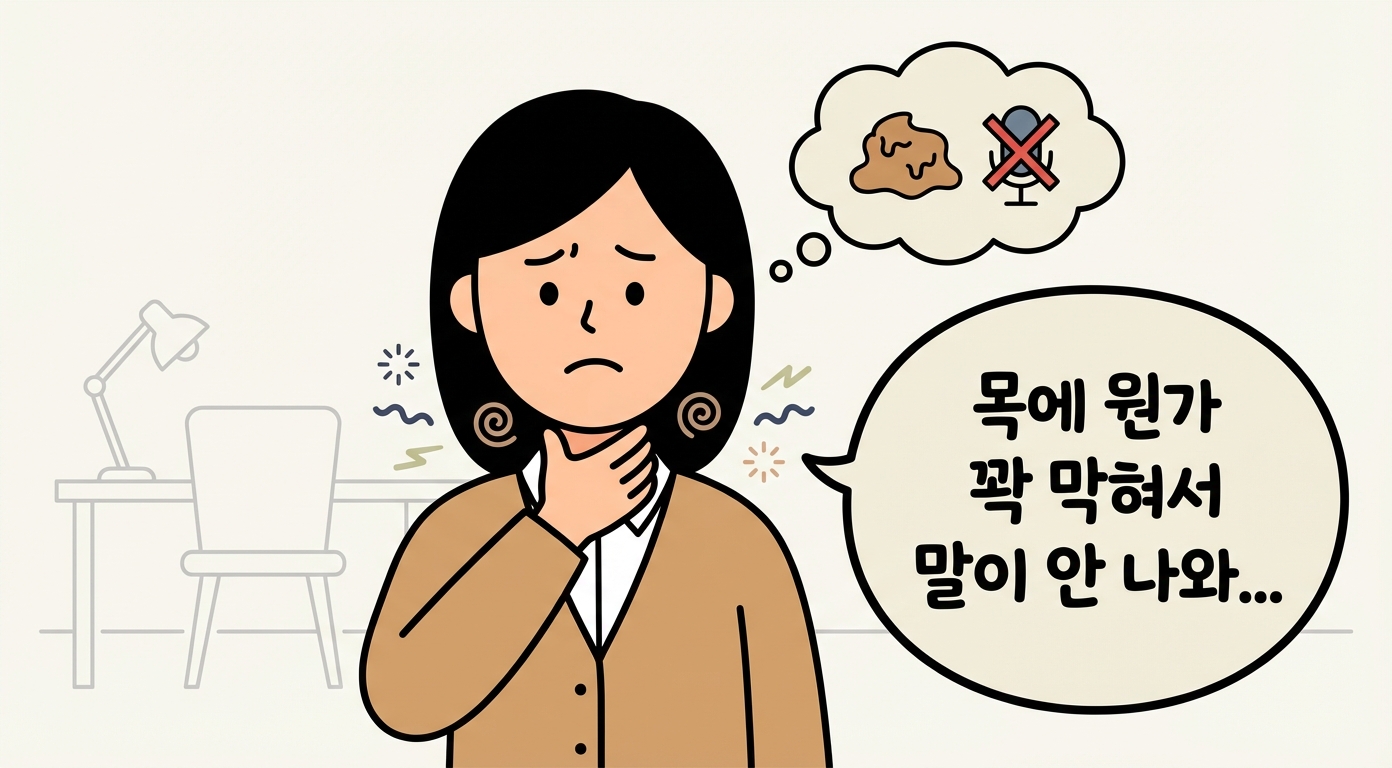
"It feels like thick, sticky paste keeps flowing down my throat that I can neither spit out nor swallow — it keeps interrupting the flow of my lectures."
These were the first words of Ji-yun (pseudonym), a 30s instructor, the moment she sat down in my clinic.
Even in our brief conversation, she cleared her throat with dry coughs many times, and behind it lay deep anxiety about her livelihood.
A mild foreign-body sensation that began one day grew worse with time, transforming into a stifling feeling as if clay had firmly stuck in her throat.
She had gone from ENT to internal medicine, undergoing various tests, but was only told there was nothing abnormal apart from mild rhinitis.
I frequently witness in my clinic how much the words "tests are normal" can make patients feel even more lonely and helpless.
The inexplicable frustration created stress, which in turn heightened throat tension, making the dry coughing more frequent — a vicious cycle.
I did not see Ji-yun's symptoms as only a localized problem of the nose and throat.
As a professional of similar age who earns a living by speaking, I deeply empathized with the anxiety of her livelihood being threatened by a cracking voice and dry cough interrupting her lectures.
So why does such a persistent foreign-body sensation not leave a throat that appears outwardly normal?
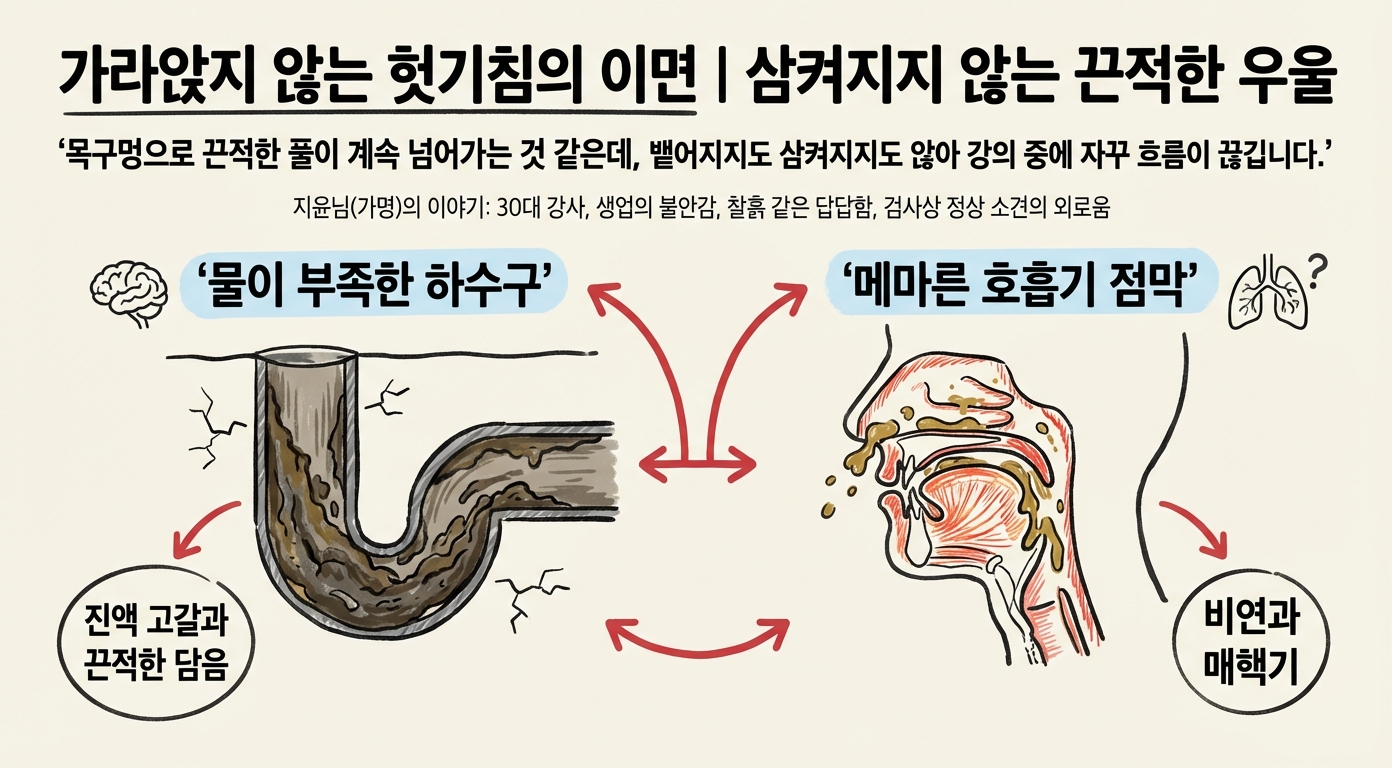 The Body's Pond Growing Stickier as It Dries: Bi-yeon and Maekhaegi
In Korean medicine, these symptoms — commonly diagnosed in Western medicine as postnasal drip syndrome — are understood as the combined result of 비연 (鼻淵) — inflammation in the nose causing mucus to pool and flow like a pond — and 매핵기 (梅核氣) — the stifling sensation as if a plum pit is lodged in the throat.
Here, 매핵기 (梅核氣) is not an actual physical lump. It is a nervous-origin foreign-body sensation felt as qi becomes knotted due to stress and tension.
Our respiratory tract must hold adequate moisture to filter dust and discharge mucus smoothly. But when persistent stress and overwork dry up the protective moisture — a state of fluid depletion (津液 고갈) — the situation changes. The once-clear secretions lose their moisture and congeal into sticky 담음 (痰飮) — like syrup thickened by prolonged boiling — blocking internal circulation.
담음 (痰飮) is the abnormal residue of bodily fluids that forms when fluid metabolism is impaired. Like filth sticking to a drainpipe with too little water that won't wash away no matter how much water is poured.
When mucus grows sticky, the autonomic nervous system of the mucous membranes becomes more sensitive, and the body produces endless dry coughs as a defense response. The more one dry-coughs, the more the membrane is damaged and dried by friction, making mucus thicker again — tightening the vicious cycle.
The Quiet Destroyers of Daily Life That Are Drying Out Your Respiratory Tract
To escape the chains of this stifling dry cough, what needs to change in daily life?
Given the nature of an instructor's profession — speaking non-stop while consuming moisture from the throat — it is hard to avoid.
Moreover, caffeinated drinks consumed habitually to fight fatigue further dry out mucous membranes through their diuretic action.
To restore respiratory humidity, instead of cold water or coffee, it is important to frequently moisten the throat with lukewarm water at about body temperature. Rather than drinking a lot at once, briefly holding water in the mouth and swallowing in small sips is far more effective at supplying moisture to mucous membranes. Setting a humidifier to maintain proper room humidity before sleep is also essential.
However, be especially careful: if blood-tinged phlegm appears during frequent dry coughing, or if the voice suddenly changes and doesn't return for a long time, this may signal a different condition — please undergo a detailed examination without delay.
 The Journey of Recovery: Bringing Gentle Rain to Parched Earth
True treatment means more than dissolving phlegm or temporarily suppressing coughing. It means correcting the whole body's fluid metabolism and building the power of the mucous membranes to maintain their own moisture.
Even if outwardly visible symptoms are the same as Ji-yun's, the constitutional weaknesses and life trajectories hidden within each person are different. This is why treatment starts from a detailed and warm gaze tailored to each patient's unique pace.
If unexplained discomfort continues, please listen to the signals your body is sending. Our bodies have a remarkable power to find balance and recover on their own. My role is to open the blocked pathways and search together for the key to that recovery.
No matter how stifling it may seem, you are not alone. I hope you will find healthcare providers who look beyond numerical test results — who look closely together at the weight of the daily pain you endure — and that you will regain your healthy daily life.
Reviewed by Director Jang-Hyuk Choi, Dongjedang Korean Medicine Clinic
Head & Face
"It feels like sticky glue keeps flowing down my throat" | Sinusitis in a 30s instructor suffering from constant dry coughing
View Program