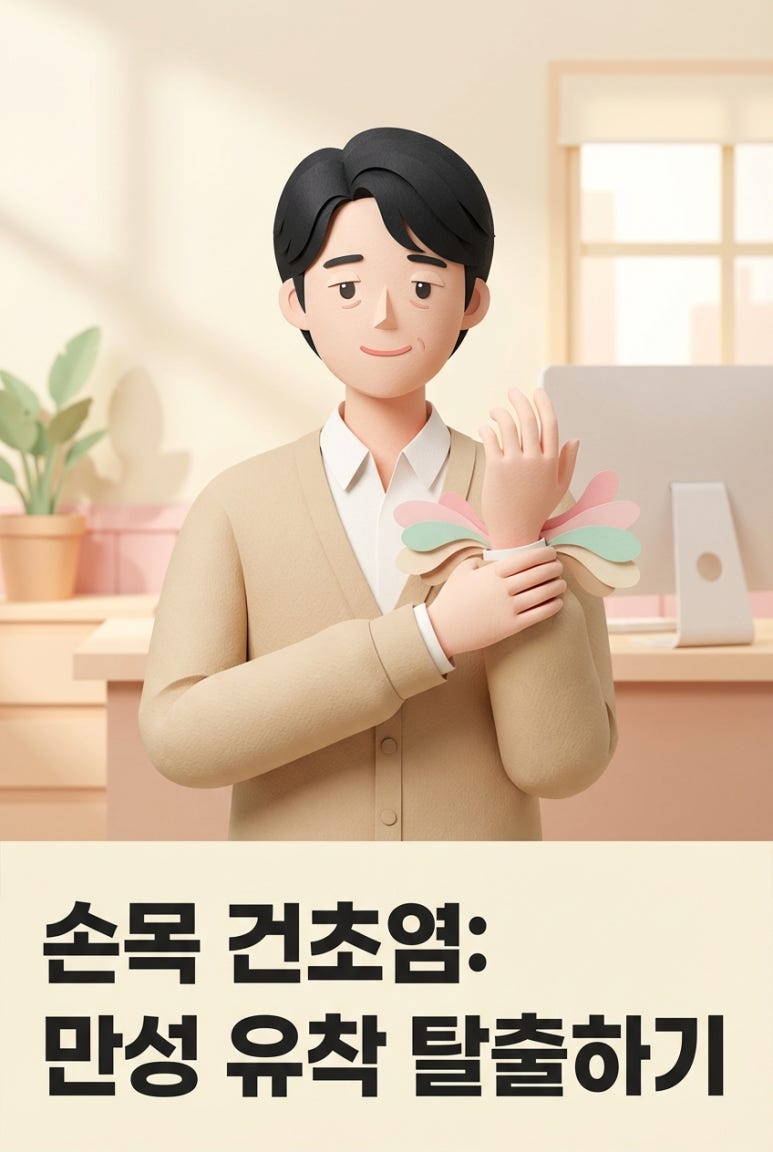
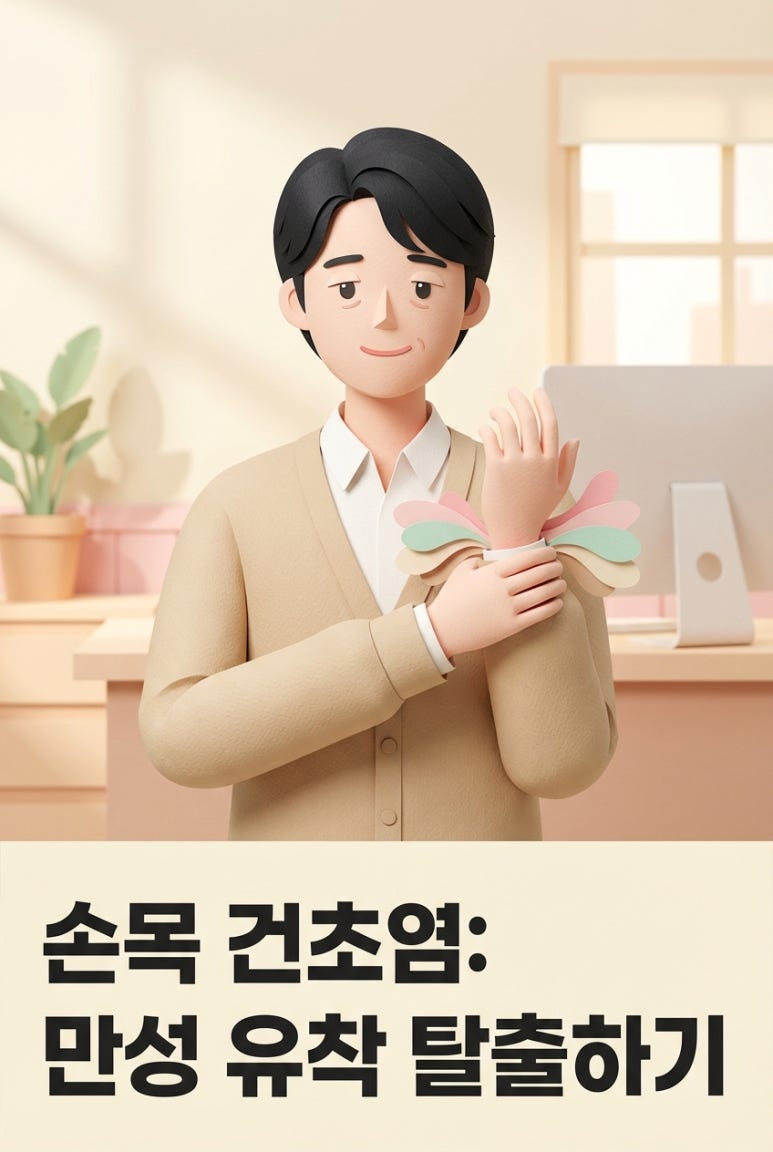
Wrist Tenosynovitis: Escaping Chronic Adhesions

 🧾 Answer First | Key Conclusion
"My wrist tingles and the pain gets worse every time I move my thumb side.
I thought it was just simple wrist pain, but it doesn't get better even with rest."
Many people suffer from similar experiences.
Tenosynovitis (tendon sheath inflammation) is a common condition for modern people who frequently use their wrists,
but if the pain does not disappear even with sufficient rest, the problem may be deeper than expected.
Neglected pain can develop into 'chronic adhesions' where tissues around the tendon become tightly stuck together,
making treatment even more difficult.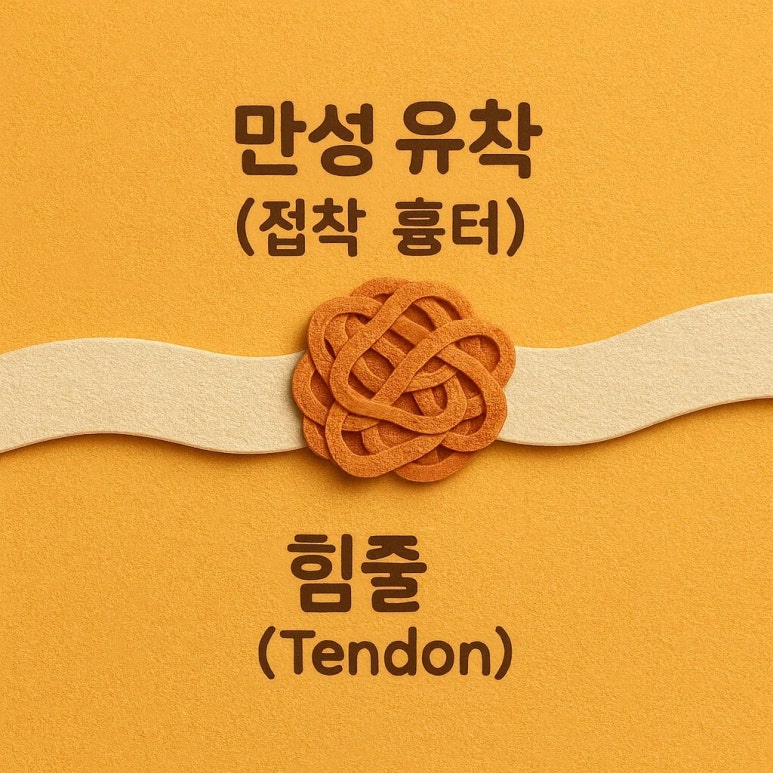 🧠 The Why
Chronic tenosynovitis that cannot be solved by rest alone.
The reason is that we are missing the real cause of the pain.
1️⃣ The real cause is 'adhesion,' not inflammation.
The real problem with chronic tenosynovitis is not the 'inflammation' in the tendon itself.
The real cause is the 'chronic adhesion' phenomenon where tissues around the tendon
become hard and stuck as inflammation repeats.
When inflammation becomes chronic, the tissues around the tendon in our body's recovery process
transform into something like an "adhesive scar."
When this scar tissue physically blocks the tendon's natural smooth gliding,
it causes friction and pain.
This is exactly why pain does not disappear even with sufficient rest,
and why it easily relapses with even slight movement.
2️⃣ The key to treatment is 'destruction' and 'regeneration.'
How can we resolve the stuck tissue?
The answer is surprisingly simple.
Physically break down and eliminate the adhesive tissue causing the problem,
and induce healthy tissue to regenerate in its place.
3️⃣ An unexpected habit that worsens pain: 'bent posture'
No matter how good the treatment is, if bad habits remain, pain will return.
The most unexpected culprit that worsens chronic tenosynovitis is 'posture' in daily life.
Especially while sleeping or using a computer,
maintaining a shortened wrist flexion posture unconsciously for long periods
not only narrows the space through which the tendon passes and applies continuous pressure,
but also impedes blood circulation and blocks waste elimination, slowing inflammation recovery.
This is how the cycle of pain begins.
No matter how good the treatment,
recognizing and correcting 'postures to avoid' in daily life that trigger pain is the start of fundamental resolution.
Small practices such as standing up and stretching your wrist every hour during computer work
can be the decisive key to breaking the cycle of pain.
🚨 Warning | Warning Signs You Must Check
In the following cases, do not rely only on self-care.
You must seek professional help immediately.
✔ Pain that disrupts sleep at night If pain is so severe that it is difficult to sleep at night,
it is a warning sign.
✔ Noticeable swelling and heat sensation If your wrist is noticeably swollen and feels hot,
it must be checked immediately.
✔ Numbness in fingers and arms In some cases, tingling symptoms spread to the fingers or entire arm.
This may indicate nerve compression, so please get a medical consultation.
Neglecting these symptoms can lead to chronic pain and adhesions.
🔚 Closing | Summary and Encouragement
The real cause of chronic wrist pain is not simple inflammation but 'chronic adhesion,'
and the key to solving it lies in the principle of 'destruction and regeneration' that breaks down the adhered tissue.
However, all these efforts can come to nothing if the aggravating factor of 'incorrect posture' of wrist flexion is not corrected.
Chronic tenosynovitis is easy to neglect because there is no visible wound,
but it is an honest warning signal our body sends saying not to strain anymore.
Understand the information presented today and listen to the signals your wrist is sending.
Through consistent management and correct posture, you can break the vicious cycle of persistent pain.
"Healthy habits are the most reliable treatment."
✍️ Reviewed by Director Choi Jang-hyuk of Dongjjedang Oriental Medicine Clinic
❓ FAQ
Q. Is the self-diagnosis method for wrist tenosynovitis really accurate?
Self-diagnosis methods are useful for identifying initial symptoms, but accurate diagnosis is difficult.
If you experience pain during Finkelstein's test, it is best to receive a medical examination at a healthcare facility[2].
This is because assessment of pain severity and differentiation from other conditions may be necessary.
Q. Is it okay to use anti-inflammatory drugs or patches for wrist tenosynovitis?
They can help with temporary pain relief.
However, anti-inflammatory drugs and patches are not fundamental treatments.
Over-reliance can leave the cause of inflammation untreated.
If pain persists, do not depend solely on medication; it is important to receive accurate diagnosis and treatment.
In particular, steroid injections should be decided carefully only after sufficient consultation with medical professionals.
Q. Can wrist tenosynovitis that has progressed to chronic adhesion be treated at an oriental medicine clinic?
Yes, oriental medicine clinics can treat wrist tenosynovitis caused by chronic adhesion.
Through acupuncture and pharmacopuncture treatments, inflammation is removed and the adhered tissues around the tendon are released.
Additionally, herbal medicine treatment is provided to reduce inflammation and promote regeneration of damaged tissue[4].
We carefully develop a treatment plan tailored to your individual constitution and symptoms.
📚 Reference Materials
[Western Medicine (WM)] [1] American Academy of Orthopaedic Surgeons (AAOS, 2021). "De Quervain's Tenosynovitis"
[2] Mayo Clinic (2022). "De Quervain's Tenosynovitis: Diagnosis & treatment"
[Oriental Medicine (KM)] [3] Korean Oriental Medical Association (2020). "Oriental Medical Treatment Guidelines for Carpal Tunnel Syndrome and Hand Tenosynovitis"
[4] Department of Rehabilitation Medicine, National Korean Medical University (2018). "Oriental Medicine Rehabilitation Medicine" (4th Edition), Content related to tenosynovitis