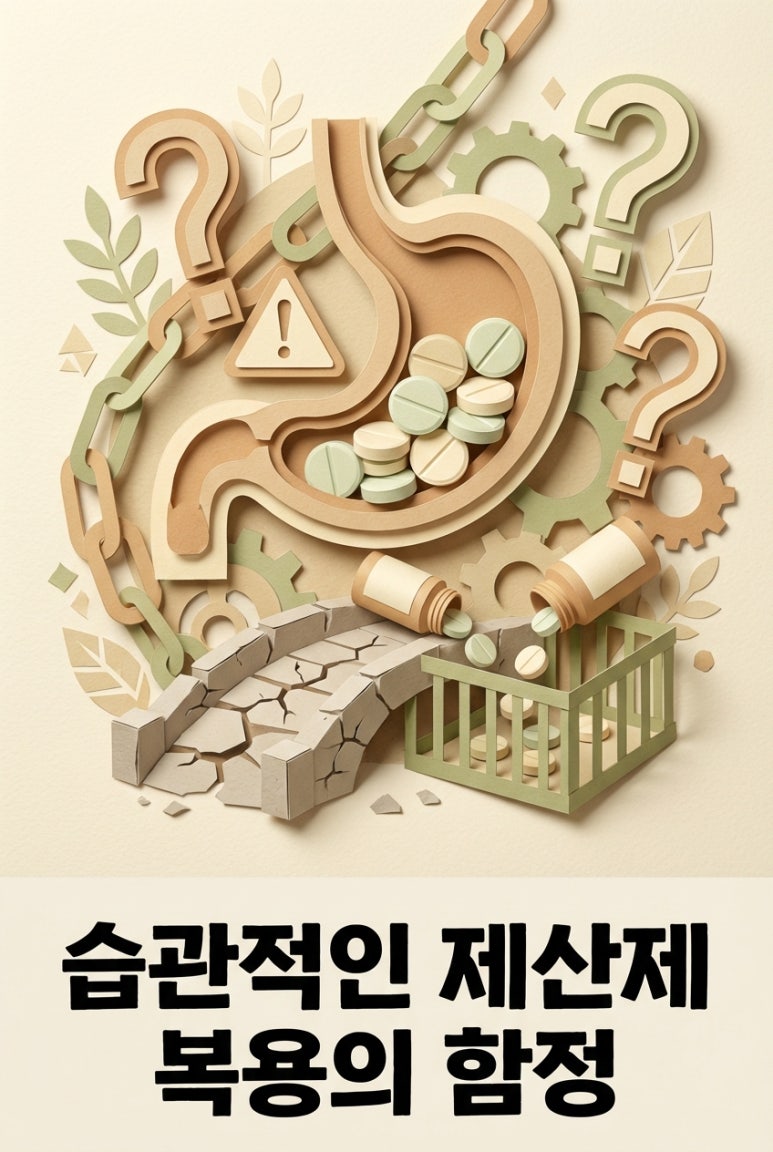
What Happens When You Take Squeeze Antacids Daily: The Trap of Habitual Antacid Use

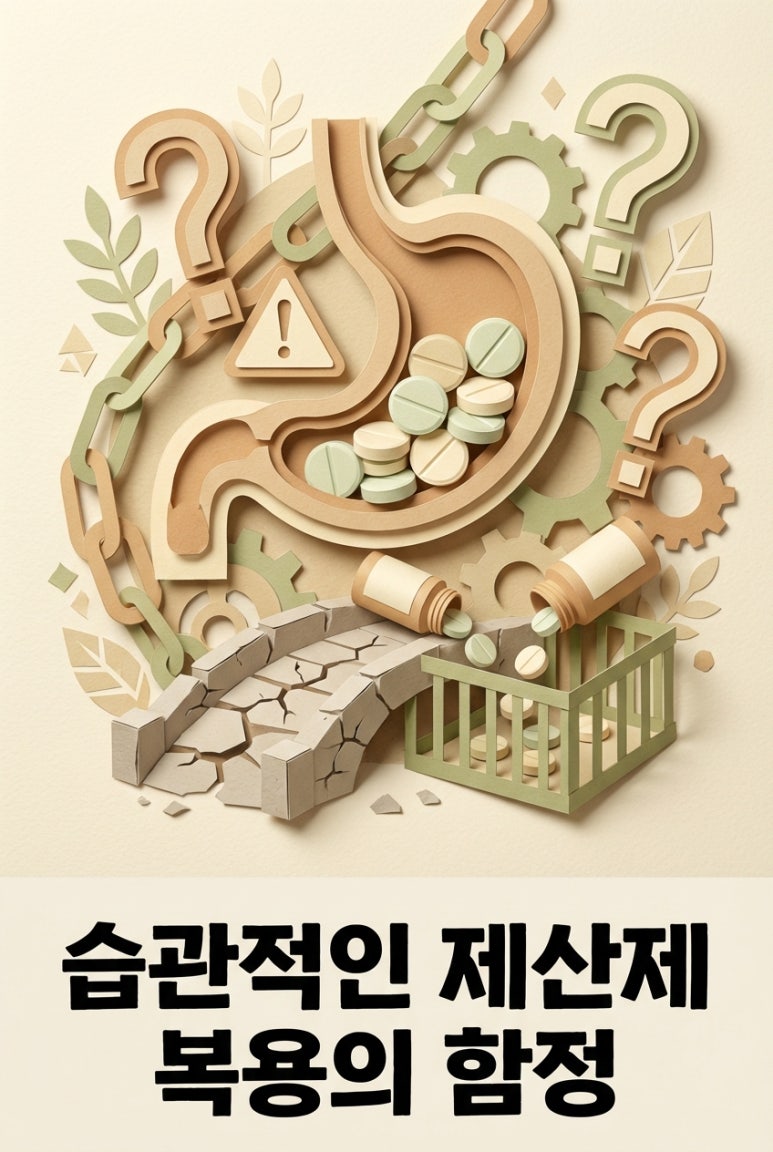 🧾 Answer First | Key Conclusion
Do you feel anxious when your drawer runs out of squeeze antacids?
Hello. I am Dr. Choi Jang-hyuk, director of Dongjjedang Oriental Medicine Clinic.
Many office workers I see in my clinic are dependent on digestive aids.
They habitually buy and take medications whenever they have heartburn or bloating.
All my patients complain that the medicine only works temporarily and their digestion gets worse over time.
Let me state the conclusion clearly:
Habitual antacid use is a self-destructive behavior that damages your stomach.
Temporarily suppressing stomach acid is not the right answer.
You need real treatment that restores the stopped movements of your stomach to normal.
From now on, I will share three things you must practice immediately to save your exhausted stomach.
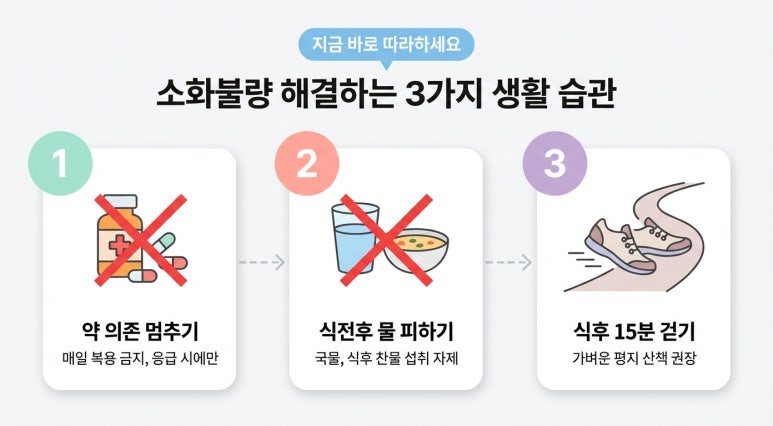 ✅ Action | Immediate Implementation
These are the lifestyle habits I first advise my indigestion patients about in my clinic.
Start with this before becoming dependent on medication.
1️⃣ Use antacids strictly for emergencies only
You must immediately stop taking antacid squeeze medications habitually after meals.
When you take medication daily, your stomach forgets how to work on its own.
Only take one dose when pain prevents you from sleeping at night or makes daily work impossible.
Gradually reduce from taking it three times daily to once daily.
The goal is to progressively reduce it to once every two days.
2️⃣ Avoid drinking water thirty minutes before and after meals
Avoid the habit of eating rice soaked in soup broth.
The habit of gulping down cold water or iced Americano right after meals is fatal.
Digestive juices that enter the stomach become diluted in water.
If you have poor digestion, avoid soup during meals.
It is best to drink water warm during fasting between meals.
3️⃣ Definitely take a light walk for fifteen minutes after eating
Sitting in a chair or lying on a sofa right after eating is a shortcut to indigestion.
The best way to help your stomach move on its own is a light walk.
Try walking slowly on flat ground for about fifteen minutes after eating.
When you move your arms and legs, the stiff stomach muscles also begin to move smoothly.
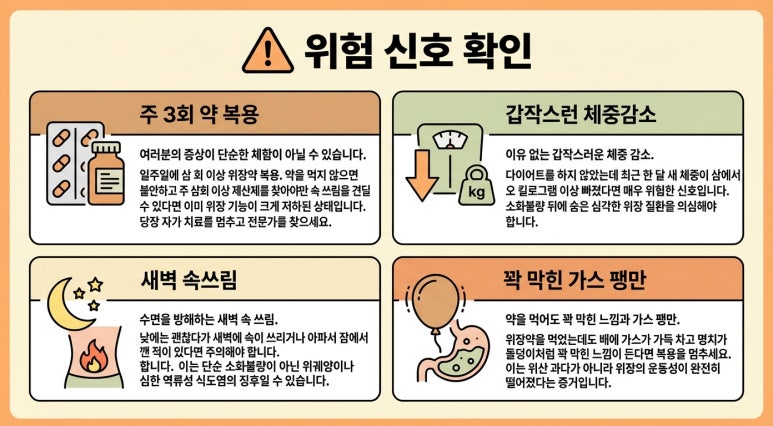 🚨 Warning | Warning Signs You Must Check
Your symptoms may not be simple indigestion.
If any of the following symptoms apply, you may have another condition.
Stop self-treatment immediately and see a specialist.
✔ Taking antacids three or more times per week
If you feel anxious without medication and need to take antacids three or more times per week to tolerate heartburn, your stomach function is already significantly impaired.
✔ Unexplained sudden weight loss
If you lost 3-5 kilograms or more in the past month without dieting, this is a very dangerous sign.
You should suspect serious stomach disease hidden behind indigestion.
✔ Early morning heartburn that disrupts sleep
If you've woken up from sleep due to heartburn or stomach pain in the early morning when you felt fine during the day, you should be careful.
This may be a sign of stomach ulcers or severe reflux esophagitis, not simple indigestion.
✔ Feeling of blockage and gas bloating even after taking medication
If you feel your abdomen is full of gas and your epigastrium feels completely blocked like a stone even after taking antacids, stop taking them.
This is evidence that your stomach's motility has completely decreased, not excess stomach acid.
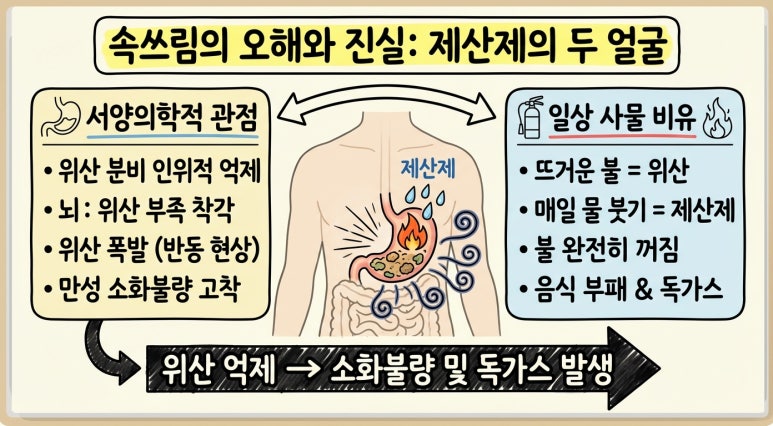 🧠 The Why | Root Cause Analysis
Many people mistakenly think that heartburn is caused by too much stomach acid.
Antacids and acid suppressants neutralize stomach acid and reduce immediate heartburn.
However, long-term use of acid suppressants causes bigger problems in your body.
Stomach acid is not bad at all.
It is like a hot fire that softens tough food we eat and kills harmful bacteria coming from outside.
But what happens if you pour water called antacid medication daily because of slight discomfort?
The fire in your stomach completely goes out.
Even when you eat meat, it doesn't dissolve in your stomach and goes down to your intestines as chunks.
Eventually, undigested food in your stomach rots and produces toxic gas.
This gas bloats your stomach, presses on your epigastrium, and causes worse indigestion.
This is the real reason why patients feel resistant to pharmacy digestive aids.
When stomach acid secretion is artificially strongly suppressed, your brain mistakenly judges that stomach acid is insufficient.
The moment the medication wears off, suppressed stomach acid is explosively secreted, causing a rebound acid reflux phenomenon.
This causes worse heartburn and the patient falls into a vicious cycle of seeking medication again.
Long-term, the stomach lining becomes thin and the stomach's motor nerves themselves become sluggish, leading to chronic indigestion.
📊 Proof | Case Studies and Evidence
I remember a patient in his late thirties, an office worker I saw in my clinic.
He was someone who had survived by stockpiling squeeze antacids in his drawer and taking them daily due to frequent overtime and extreme stress.
He was taking two to three pouches daily, but when he came to my clinic, he complained of pain even from drinking water.
My treatment goal was not to immediately suppress stomach acid.
I gently relieved the stomach muscles around his epigastrium that were tightly contracted due to stress through acupuncture treatment.
And I prescribed herbal medicine to strengthen stomach function so his stomach could mix and move food down on its own.
I focused on restoring stomach motility through acupuncture and herbal medicine treatment.
What were the results?
After one month, the patient no longer needed to keep antacids in his drawer.
He naturally recovered his suppressed digestive function on his own.
There is also research showing that long-term use of acid suppressants significantly increases the risk of worsening indigestion[2].
In contrast, Oriental medicine treatment has shown meaningful effects in recovering decreased stomach motility[3].
 🔚 Closing | Summary and Encouragement
Medications that quickly mask symptoms are excellent emergency treatment.
But if you must take that medication daily to maintain your daily life, it is never proper treatment.
Chronic indigestion Oriental medicine clinic treatment is not about forcefully suppressing symptoms but reviving the engine of your cold, stopped stomach to run powerfully again.
If your epigastrium feels stuffy every day and you depend on digestive aids, please do not suffer alone anymore and come see me.
I will sincerely help your exhausted stomach work on its own again.
✍️ Reviewed by Dr. Choi Jang-hyuk, Director of Dongjjedang Oriental Medicine Clinic
❓ FAQ
Q. Does taking squeeze antacids daily really cause tolerance?
A. Yes. Rather than what is commonly called drug tolerance, it is a phenomenon where your stomach function itself becomes sluggish.
When stomach acid is repeatedly suppressed by medication, your body loses its normal ability to produce digestive juices on its own.
Ultimately, you can fall into a vicious cycle where you cannot digest food at all without taking digestive aids.
It is best to reduce the frequency of use as much as possible.
Q. How should someone dependent on digestive aids quit them?
A. It is not recommended to quit medication overnight.
You should gradually reduce dosage along with lifestyle habit corrections.
Drink warm water on an empty stomach.
Practice fifteen-minute walks after meals daily.
While doing this, gradually reduce medication from three times daily to once daily.
If symptoms become too severe when reducing medication, it is safer to first strengthen the stomach's own power through Oriental medicine treatment.
Q. How does chronic indigestion Oriental medicine clinic treatment proceed?
A. It begins with basic acupuncture and moxibustion treatment to relieve tension in the hardened epigastrium area and abdomen.
In addition, herbal medicine to strengthen stomach function tailored to each patient's constitution and the cause of their indigestion is prescribed.
The key is not to paralyze the stomach but to create a warm and gentle environment where the stomach can move on its own again.
📚 References
[1] American College of Gastroenterology (ACG) Guidelines (2021). "Management of Dyspepsia."
[2] U.S. FDA Drug Safety Communication (2022). "Risks of long-term use of proton pump inhibitors (PPIs) and antacids."
[3] Korean Oriental Medicine Association CPG (2020). "Clinical Practice Guidelines for Functional Dyspepsia in Oriental Medicine"
[4] NIKOM (2021). "Research on the Efficacy and Safety of Herbal Medicine Treatment for Chronic Gastric Disorders"
Digestive
What Happens When You Take Squeeze Antacids Daily: The Trap of Habitual Antacid Use
View Program