"When the subway doors close on my commute, my stomach cramps in agony" | Irritable bowel syndrome diarrhea in a 30s office worker

A Shaking Commute, an Alarm Bell of Anxiety Ringing in the Stomach
"The moment the subway doors close on my way to work, my stomach starts cramping violently, I break into a cold sweat, and my vision goes yellow. The thought that I might not be able to get to a bathroom makes me feel like I can't breathe."
These were the words Kim Ji-hun (pseudonym), a man in his 30s, spoke in a heavy voice when he first came to see me.
The ordinary daily routine of leaving home at a set time each morning and squeezing onto a crowded subway was, for him, nothing less than a survival battle—carrying a time bomb that could go off at any moment.
At some point, bloating and gurgling sounds began in his stomach, and now every time he used public transportation, a compulsive dread and urgent diarrhea would strike together, making the act of going to work itself something to fear.
He had first visited an internal medicine clinic and received a prescription, but this only suppressed the symptoms temporarily and offered no fundamental solution.
The invisible terror of possibly not being able to reach a bathroom compounded his stress further, and that stress in turn stimulated his intestines and worsened the symptoms—creating a vicious cycle he couldn't escape.
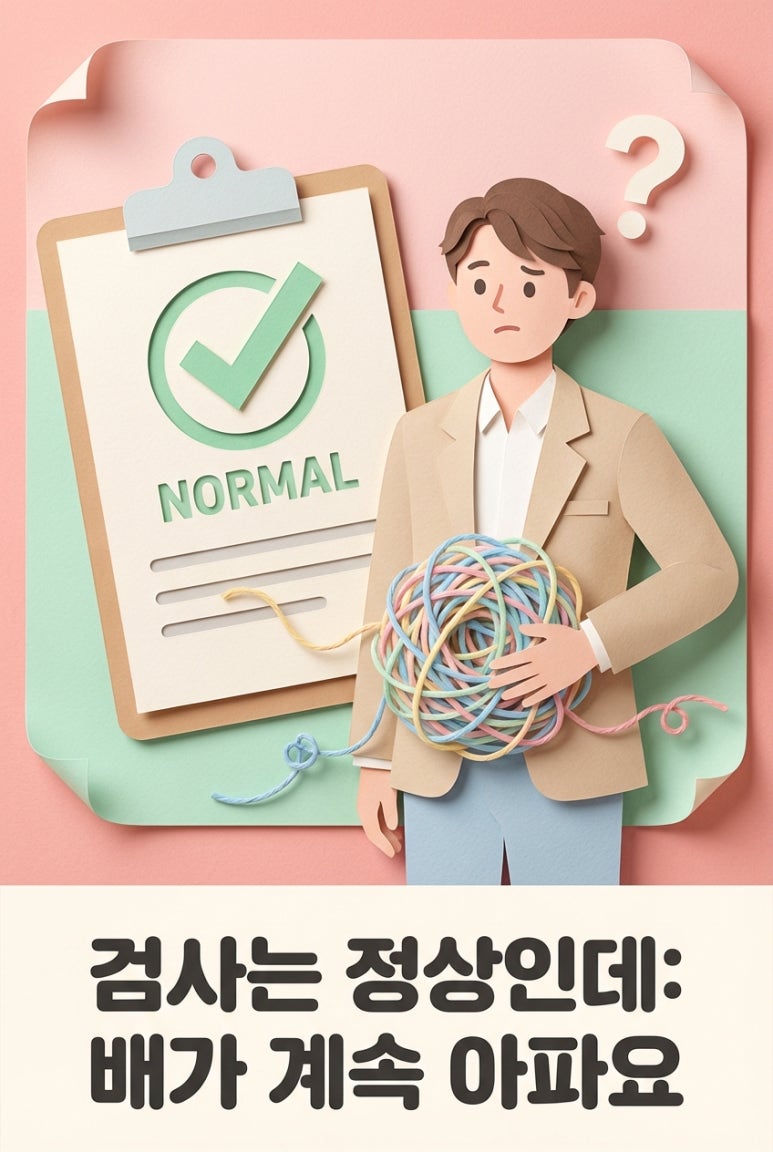
Multiple endoscopy examinations found no structural abnormality whatsoever, and the situation of not even being able to pin down a clear diagnosis left him with nothing but deep frustration.
Honestly, the invisible illness that doesn't show up on an endoscope screen can eat away at a patient even more deeply.
I did not view Ji-hun's symptoms as merely a problem of intestinal function.
Each time I faced the heart of someone who couldn't easily share their suffering with anyone, suffering silently, enduring the agonizing commute alone every morning—as a Korean medicine practitioner in my clinic, I felt profound sadness and empathy.
So why does the body cry out in such intense pain even when there is no visible abnormality?
The Misaligned Conversation Between Brain and Gut: The Swamp of 'Gan-bi Bul-hwa (肝脾不和)'
In Korean medicine, this state is examined carefully from the perspective of Gan-bi Bul-hwa (肝脾不和)—a state where digestive function has declined and balance is disrupted due to stress—and Chil-jeong-sang (七情傷)—where excessive emotional fluctuations lead to internal physical damage.
The brain and gut may appear physically distant, but in reality they are continuously in close communication through a channel called the vagus nerve, each influencing the other.
The Gut-Brain Axis theory in Western medicine—which states that the brain and gut are interconnected—aligns precisely with this Korean medicine interpretation.
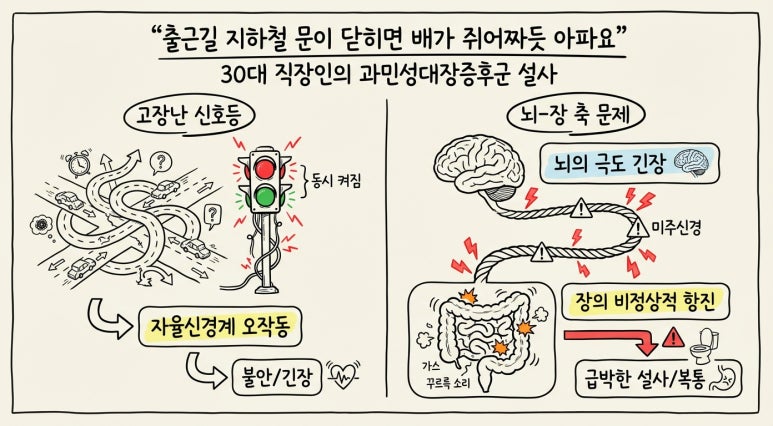
Extreme anxiety and excessive work stress originate in the brain, are transmitted to the gut, and turn the autonomic nervous system into something like a complex intersection with a broken traffic light—completely jammed and out of control.
As the flow of nerves that should assist normal digestion and absorption, and regulate bowel movements, becomes tangled, emotional tension causes the intestines' motility to become abnormally hyperactive.
Ultimately, emotional tension and stress induce a condition called Jang-wi Heo-han (腸胃虛寒)—where the intestines and stomach become cold and weak—creating an intestinal environment like a hypersensitive fire alarm that malfunctions noisily with even the slightest stimulus or passing thought, making the body tremble.
The process in which the brain's anxiety stimulates the gut, and the gut's pain in turn summons the brain's fear, exerts negative influence upon each other and tightens the grip of a vicious cycle that is difficult to escape.
How Can We Soothe a Stomach That Has Gone Cold and Stiff?
So is there any way to escape this suffocating grip that has swallowed up daily life, and soothe a stomach that has gone cold?
Cold food swallowed in a hurried rush, chronic sleep deprivation, and the work-related tension that begins tightening around the throat even before leaving for work—these harden our intestines into something cold and stiff, like frozen ground that has lost its vitality and become barren.
The first thing to do is breathe warm heat into this frozen ground, gradually releasing the tension in the muscles and nerves.
Instead of reaching for cold water or caffeine-heavy coffee the moment you open your eyes in the morning, it is better to slowly and savouringly drink warm water at a temperature close to your body temperature, gently waking the stomach that has stiffened overnight.
Also, before going to work or when anxiety surges, gently stroking around the navel in a clockwise circular motion to raise the abdominal temperature yourself is an excellent way to send positive calming signals to both the brain and the gut.
However, if during this daily care and effort, blood is found mixed in the stool, or if sudden, unexplained, significant weight loss is observed, this may not be a simple functional decline—immediate thorough medical examination is necessary.
Small daily practices don't create instant miracles, but they give a sense of reassurance that you are taking care of your own body, becoming a powerful first step in healing that soothes the brain's anxiety.

The Journey of Recovery: Finding the Path Back to Original Peace Beyond the Symptoms
The true treatment goal for irritable bowel syndrome goes beyond simply suppressing frequent bowel movements in the moment or hiding pain.
The essence of healing is to release the brain's tension and fundamentally change the temperature of the intestinal environment—so that the vast structure that is the body, like a delicately interlocking mechanical clock, can stop its off-rhythm and move harmoniously again.
Korean herbal medicine and acupuncture treatment tailored to each individual's constitution and condition serve as tools that open up the blocked flow of vital energy, drive out the cold energy of the intestines, and help the collapsed autonomic nervous system find its balance on its own.
Positive change begins only when we quietly listen to the signals our body sends and gently tend to the exhausted heart hidden beneath the symptoms.
Your body has a remarkable resilience—given the right direction, it can reclaim its original calm rhythm at any time.
My role is to be a warm ally who lifts the heavy fear you carry alone and helps find the key to that recovery together.
It does not have to be me—I hope you will find a medical practitioner who deeply empathizes with how exhausting and lonely your mornings are, and who knows how to approach the gut and brain in an integrated way, so you can reclaim a comfortable daily life as soon as possible.
Director Choi Jang-Hyuk, Dongjedang Korean Medicine Clinic
Digestive
"When the subway doors close on my commute, my stomach cramps in agony" | Irritable bowel syndrome diarrhea in a 30s office worker
View Program