
How Body Waste Accumulates in Your Body — How to Read Your InBody Results

 🧾 Answer First | Core Conclusion
Two people, both weighing 75kg and 165cm tall, visit the clinic with the same measurements.
When we take their InBody scans, the internal composition is completely different.
I am Choi Jang-hyuk, director of Dongjedang Korean Medicine Clinic.
Even with the same body weight, when you look inside, it divides into three different patterns.
Those with excess body water accumulated, those with high body fat accumulated, and those lacking muscle with only body fat accumulated.
The InBody results sheet shows this.
But most people only look at two lines—body weight and body fat percentage—then put the results away.
Let me make one thing clear here.
InBody is an indicator that shows what shape the waste accumulated in your body is currently taking.
It is not a diagnosis in itself.
In Korean medicine, we have called:
excess body water "water toxicity" (水毒) and "damp phlegm" (濕痰),
stagnant food debris "food stagnation" (食積),
and hardened circulation "blood stasis" (瘀血).
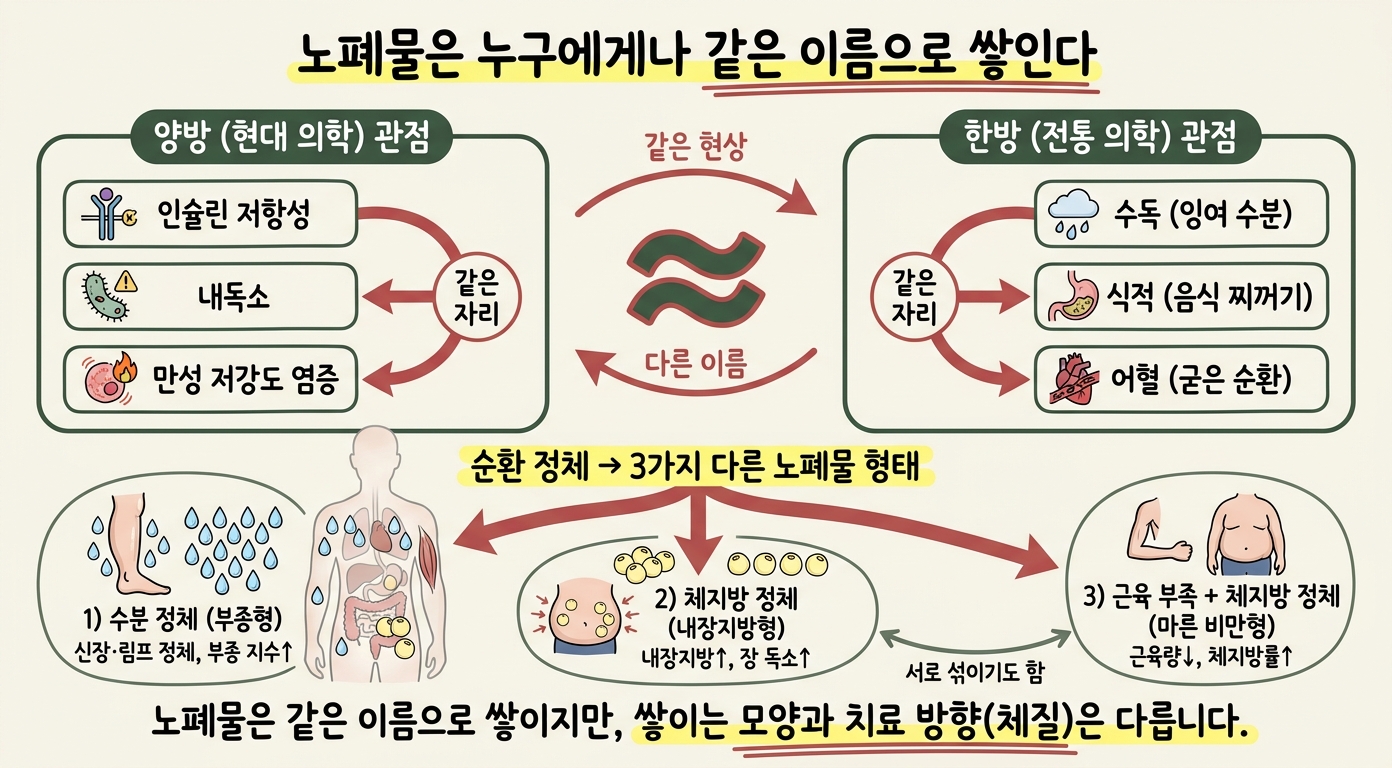
Regardless of a person's constitution — this waste itself accumulates under the same name.
However, what prescription is used to resolve it is determined by constitution.
Today, I will teach you how to identify your waste pattern from your InBody results sheet.
Once you see your own pattern, the direction of treatment tailored to your constitution is determined in the consultation room.
 ✅ Action | Immediate Practice
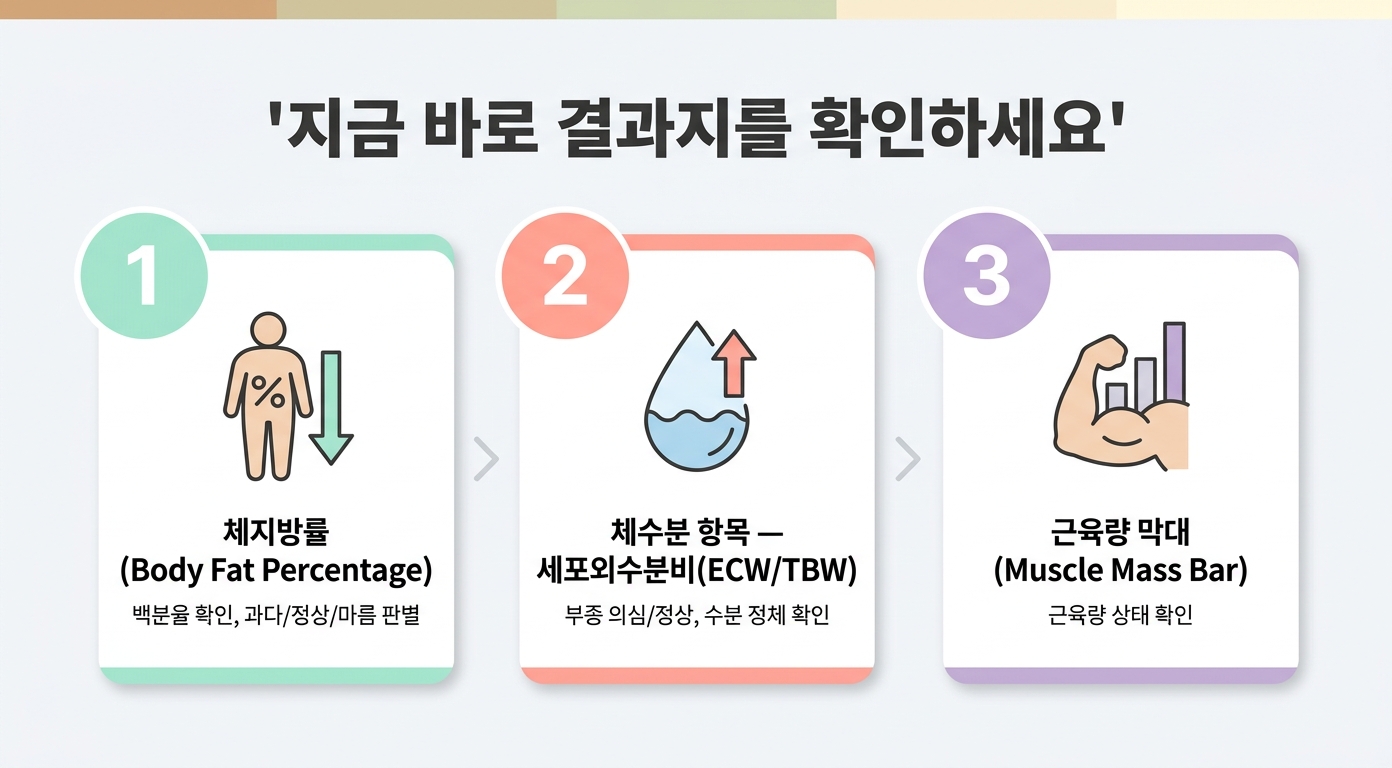
The next time you have an InBody measurement, check these three things first on the results sheet.
1️⃣ Body Fat Percentage
This is the percentage shown around the second line from the top.
- Women 30% or higher / Men 25% or higher → Excessive body fat
- Women 23~30% / Men 18~25% → Normal range
- Women under 23% / Men under 18% → Normal or lean
If body fat percentage is high, there is a high possibility that food stagnation and blood stasis are accumulated in the form of fat.
However, you need to look at the following two items together to see the accurate picture.
2️⃣ Body Water Section — Extracellular Water Ratio (ECW/TBW)
This is the "Body Water" or "Edema Index" section around the middle of the results sheet.
The name varies slightly depending on the InBody model.
- 0.360 or below → Normal
- 0.380 or higher → Suspected edema, possible water toxicity or damp phlegm stagnation
If body fat percentage is normal but this number is high, you are someone with excess body water stagnation rather than fat accumulation.
12 Weeks of Dieting Is Not the End covers the cleansing process for this pattern in detail.
3️⃣ Skeletal Muscle Mass Compared to Standard
A bar graph appears comparing your standard muscle mass relative to your height and weight.
- Longer than standard (110% or higher) → Muscular type
- Within standard range → Standard type
- Shorter than standard (90% or lower) + High body fat percentage → Skinny fat type
Even if body weight is light or average, if this combination appears, it means muscle is deficient with only body fat accumulated.
These are people who don't look overweight externally but are actually obese according to InBody.
Once you've identified which pattern your results fall into, you can view case examples of the same pattern in the Proof section below this article.
 🚨 Warning | Critical Warning Signs to Check
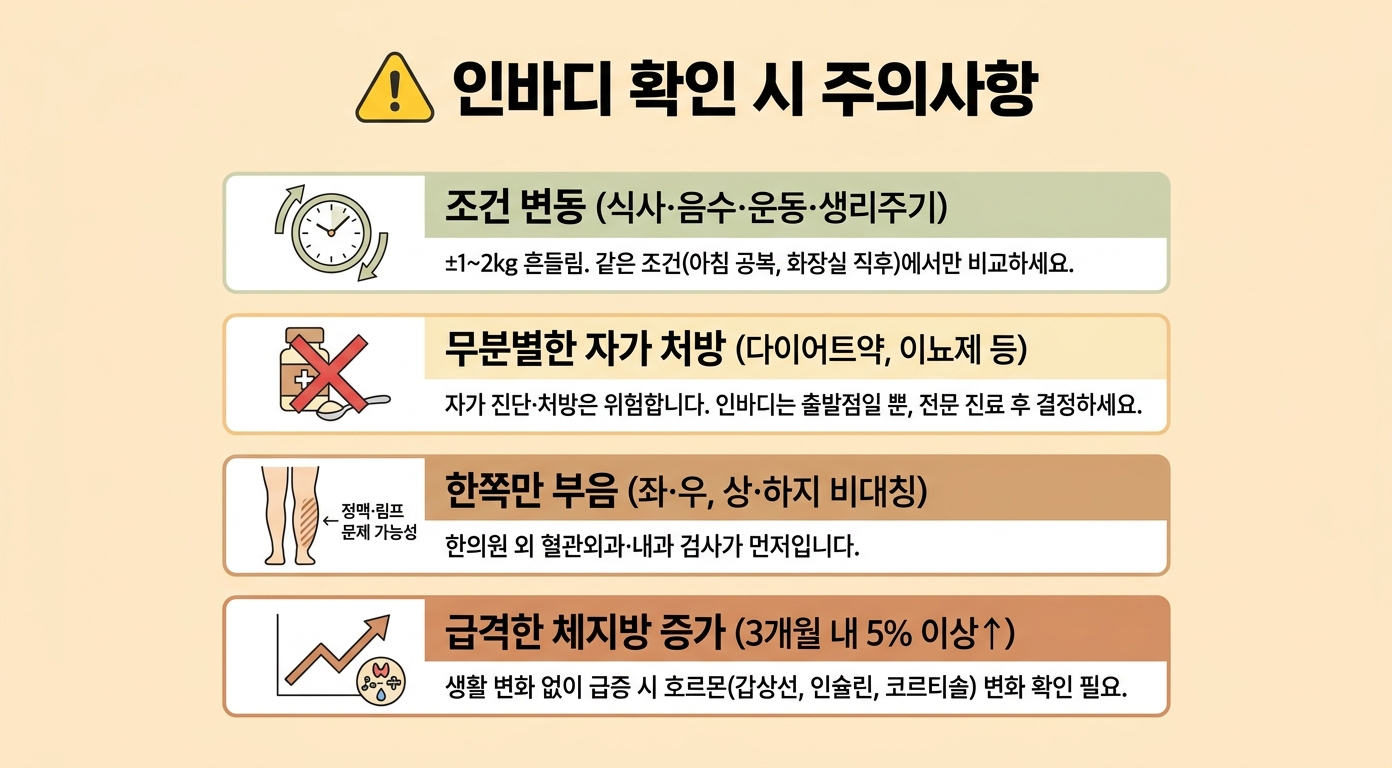
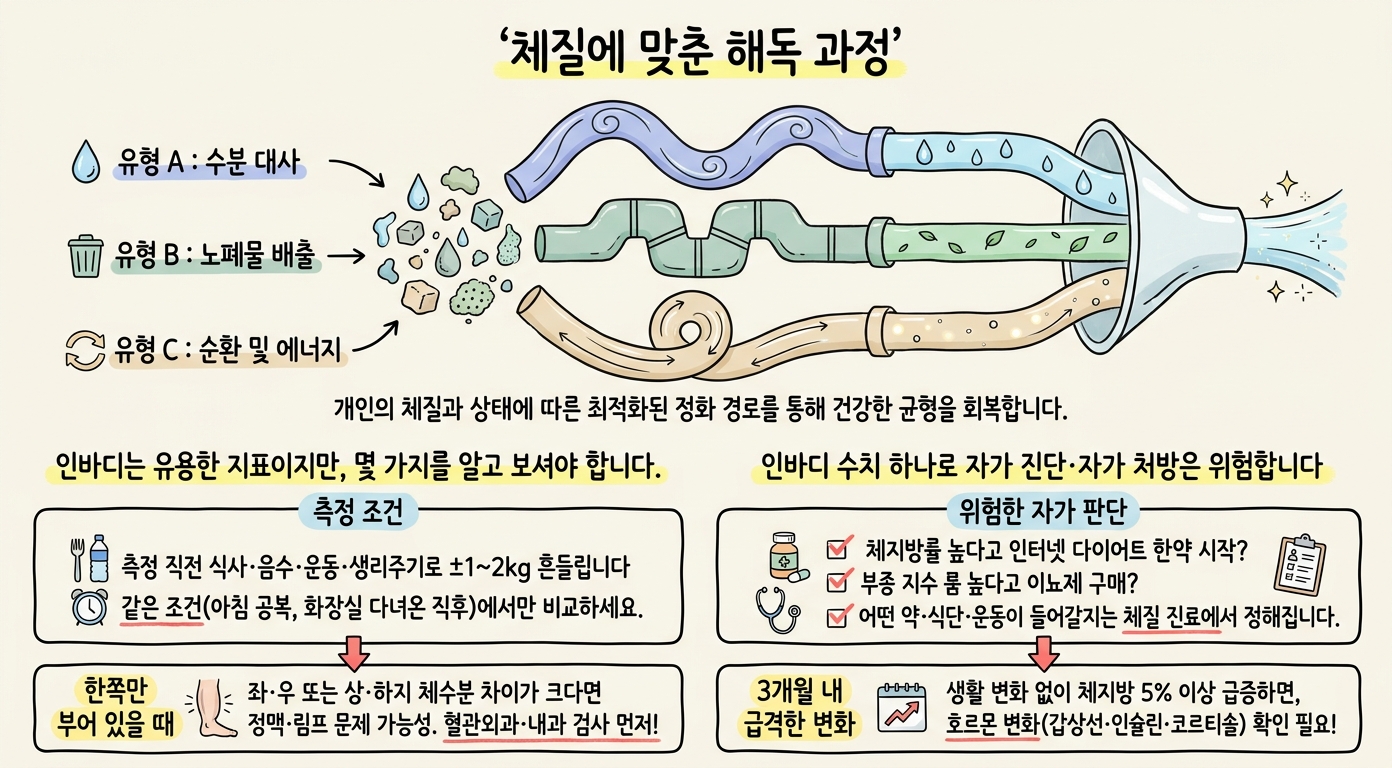
InBody is a useful indicator, but you need to understand a few things.
✔ Measurements fluctuate by ±1~2kg depending on eating, drinking, exercise, and menstrual cycle right before measurement
InBody measured after eating and InBody measured on an empty stomach can show different results even for the same person.
Only compare results measured under the same conditions (morning fasted state, after using the restroom).
✔ Self-diagnosis or self-prescription based on a single InBody number is dangerous
Some people start internet diet herbal medicine because their body fat percentage is high, or buy diuretics because their edema index is high.
InBody is a starting point for confirming the shape of your waste, not a tool for determining prescriptions.
What medicine, diet, and exercise should be included is determined in consultation after evaluating your constitution.
✔ When only one side is swollen
If InBody shows a significant difference in body water between left and right or upper and lower body on only one side, there may be venous or lymphatic issues.
A vascular surgery or internal medicine check is needed before visiting a Korean medicine clinic.
✔ When body fat increases suddenly by 5% or more within 3 months under the same conditions
If body fat percentage increases rapidly without lifestyle changes, it's necessary to first check for hormonal changes (thyroid, insulin, cortisol).
 🧠 The Why | Root Cause Analysis
Waste accumulates with the same name in everyone.
First, let me make one thing clear.
The waste created inside my body — excess body water (water toxicity, damp phlegm), stagnant food debris (food stagnation), hardened circulation (blood stasis) — this waste itself accumulates under the same name regardless of a person's constitution.
What Western medicine calls insulin resistance, endotoxin, and chronic low-grade inflammation is essentially the same location that Eastern medicine has called by different names.
Tae-eum types accumulate damp phlegm, So-yang types accumulate damp phlegm, and So-eum types accumulate damp phlegm.
Waste itself is a universal phenomenon.
However, even the same waste accumulates in different patterns and locations in different people.
InBody shows this different pattern quantitatively.
The three patterns shown by InBody
1) Pattern with excess body water accumulated
When kidney and lymphatic circulation becomes stagnant, water that should be eliminated remains in the body.
These are people showing high edema index (ECW/TBW).
This pattern doesn't drain well even with calorie restriction and exercise.
What drains is only body water, and it fills back up when you stop medication.
Western medicine frequently sees insulin resistance alongside edema-type obesity[1].
2) Pattern with excess body fat accumulated
This is a pattern where undigested food remains in the intestines becoming toxins, and excess calories accumulate as visceral fat.
Both body fat percentage and visceral fat level appear high.
This pattern cannot be resolved by just reducing calories.
You must first empty the waste stuck to the intestinal barrier.
Why Your Belly Sticks Out Even Without Constipation covers the diagnostic process,
Ganro Water and Detox Pills cover the methods of emptying.
3) Pattern with insufficient muscle and only body fat accumulated (Skinny Fat)
These are people with average body weight but low muscle mass and high body fat percentage.
Western medicine calls this sarcopenic obesity or myopenia-related obesity.
Basic metabolism is low so you gain weight even eating little, and when you reduce diet, muscle is lost first.
This pattern requires supplementing prescriptions before reducing prescriptions.
Without accompanying nourishing treatment and strength training, dieting actually damages your body.
Cases with all three patterns mixed together are also common.
Those with high body water content and high body fat, those with high body fat but insufficient muscle.
InBody shows shape, treatment direction is determined by constitution.
This is the most important point.
Even if the same "shape with accumulated body water" appears on InBody, the prescription varies completely depending on who that person is — what constitution they have.
If constitution differs, the pathway to release the same waste products also differs.
Each person reacts differently to herbal materials, can tolerate different intensities of prescriptions, and has different recovery sequences.
This is why Korean medicine uses different herbal formulas for each person.
Therefore, we cannot determine medication based solely on InBody results.
InBody is an indicator that shows "in what shape is the body currently collapsed," while "how we will restore this person" is revealed through constitutional diagnosis.
Constitution is the unchanging fundamental nature that remains constant throughout a patient's lifetime.
That is why we observe and determine it sufficiently in the consultation room.
It is not recorded in a single line like height and weight.
InBody is an area that patients can directly verify in their own result sheet, while constitution is the realm of clinical diagnosis.
The prescription is determined where these two domains meet.
 📊 Proof | Cases and Evidence
These are three different shape cases observed in our consultation room.
Case A — Shape with accumulated body water (Late 40s female, 75kg, body fat percentage 32%, ECW/TBW 0.395)
The edema index was very high.
Even with diet and exercise, this patient would swell again within a month of stopping diet herbal medicine.
However, another patient came with the same edema pattern.
A different female in her late 30s, same 75kg, ECW/TBW 0.391 — nearly identical figures.
The prescriptions given to both patients were different.
Although the InBody shape was the same, their constitutions were different.
The fundamental nature observed in consultation was different for both, and we determined different pathways to release the same excess body water.
After 12 weeks, both patients lost 5-6kg, and after discontinuing the herbal medicine, there was no recurrence of swelling.
→ InBody confirms shape, constitution determines prescription
Case B — Shape with accumulated body fat (Late 30s male, 82kg, body fat percentage 28%, visceral fat level 13)
Body water was normal, body fat percentage was high, and abdominal fat was thick.
A typical case where bowels move daily but only the belly protrudes.
For this patient, we incorporated a 5-day fasting period with Gamrosoo during a plateau phase, and recommended taking detox pills when bowel movements were not satisfactory.
The composition, ratio, and adjustments of supplementary herbs in the prescription were determined in consultation according to the patient's constitution.
In 12 weeks, 7.2kg of weight and 9cm of abdominal circumference were reduced.
→ InBody confirms shape, constitution determines how to operate fasting and detox pills
Case C — Shape with insufficient muscle and accumulated body fat only (Late 20s female, 54kg, body fat percentage 31%, muscle mass standard 85%)
Appeared lean on the surface, but InBody showed obesity.
Muscle had been lost from repeated restrictive dieting.
For this patient, we first recommended tonic herbal medicine and protein-rich diet, along with twice-weekly strength training, before a detoxification program.
Which tonic herbs would be included was determined in consultation based on the patient's constitution observed.
Only after muscle mass increased to standard 95% over 3 months did we begin full-scale detoxification.
→ Confirmed that InBody-guided prescription of supplementation comes first, constitution determines what to supplement
All three patients received consultation at the same clinic under the same director.
What InBody revealed was the shape at the starting point, and what consultation revealed was the path suited to that individual.
Standardized guidelines for the accuracy and clinical application of body composition analysis (BIA, Bioelectrical Impedance Analysis) are established in the field of obesity medicine[2].
The Korean Medicine Obesity Society also recommends integrating and utilizing InBody results in pattern differentiation classification.
 🔚 Closing | Summary and Encouragement
For those who looked only at weight and body fat percentage on the InBody result sheet and set it aside,
for those who repeated dieting without knowing what was accumulated in your body
— you must look at the other numbers on the result sheet together to see the picture of your body.
Whether body water is accumulated, body fat is accumulated, or body fat is accumulated due to insufficient muscle.
This is what InBody shows you.
However, InBody is a beginning, not an end.
Even with the same shape of results, different pathways must be taken for different people.
Which herbs, in what sequence, and with what supplements will be included is determined through consultation where your constitution is observed.
Constitution cannot be recorded in a single line, and therefore you must come in person to be evaluated.
First confirm the result from your body type, then follow the series and the flow will become clear.
- Shape with accumulated body water → Constitutional Herbal Medicine
- Shape with accumulated body fat → Why Your Belly Protrudes Without Constipation → Gamrosoo → Detox Pills
- Muscle deficiency + body fat shape → Supplementation and exercise come first, starting timing and supplementation content are determined in consultation
You can see the entire flow in our Dongjedang Detoxification and Diet Program Guide where body composition testing and constitutional diagnosis are conducted together. Consultation is possible even if you bring only the result sheet. Please feel free to inquire.
✍️ Reviewed by Director Choi Jang-hyuk, Dongjedang Korean Medicine Clinic
❓ FAQ
Q. How often should InBody be measured?
During a diet program, once every 2-3 weeks is appropriate.
Daily or weekly measurements are not recommended.
It is normal to fluctuate ±1-2kg due to meals, fluid intake, exercise, and menstrual cycle, but if you check daily, your mind becomes swayed by these fluctuations.
At our clinic, we measure under the same conditions (fasting, after using the bathroom) each visit for comparison.
Q. Can a prescription be determined based solely on InBody results?
No, it cannot.
InBody is merely an indicator showing in what shape waste products are accumulated, but it does not tell you what prescription is right for that person.
Even with the same edema index and the same body fat percentage, different herbs and diets are used for different people.
The direction of the prescription is determined in consultation by observing the patient's constitution.
Q. Can I receive consultation bringing only InBody results taken elsewhere?
Yes, it is possible.
If you bring a photo or printout of the result sheet, we can analyze the waste product shape together.
However, to begin prescription, face-to-face consultation is required by medical law, and we will re-measure using Dongjedang's InBody during the consultation.
Since measurement standards differ slightly between devices, tracking with the same device allows for accurate comparison.
📚 Reference Materials
[Western Medicine (WM)]
- Roumelioti ME et al. (2018). "Fluid balance concepts in medicine: Principles and practice." World Journal of Nephrology, 7(1):1-28. [1]
Diet
How Body Waste Accumulates in Your Body — How to Read Your InBody Results
View Program