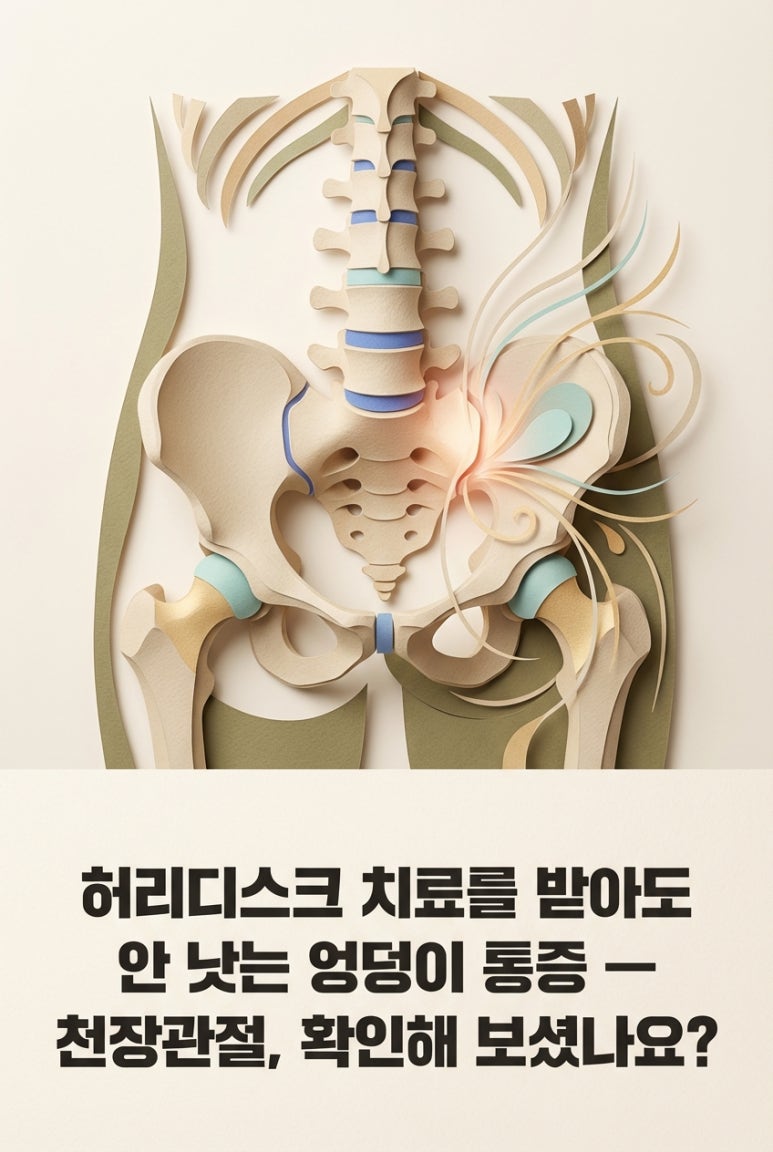

Guiding Needle Therapy, What Kind of Treatment Is It?

 🧾 Answer First | Key Conclusion
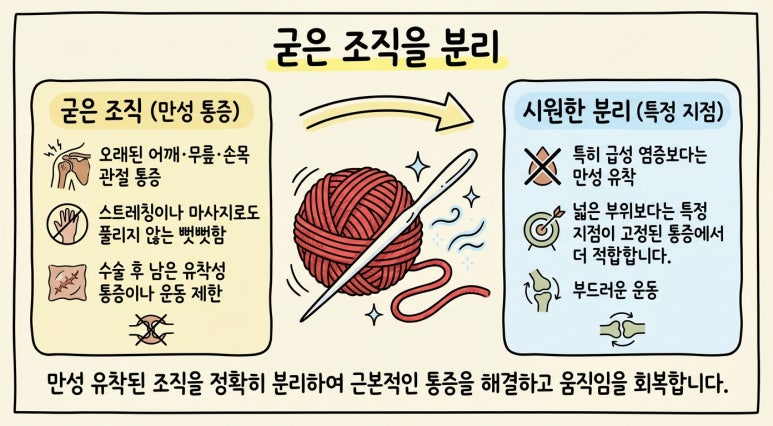
Guiding needle therapy is
a treatment using a special needle with a wider, flat blade-shaped tip compared to regular acupuncture needles,
precisely inserted into the adhered fasciae and ligament areas causing pain,
and directly releasing the hardened tissue.
Rather than injecting medication or applying heat,
you can understand it as a method that physically separates fused tissues.
 🧠 The Why
While it may seem similar to regular acupuncture at first glance, there are important differences.
Guiding needle therapy, like regular acupuncture, is a treatment involving inserting needles into the body.
However, there are differences in the shape of the needle tip and the treatment purpose.
Regular acupuncture uses a rounded needle tip to stimulate acupuncture points,
with focus on promoting qi and blood circulation and reducing pain.
In contrast, guiding needle therapy
uses a flat blade-shaped needle tip
to directly separate (dissociate) adhered fascia or ligaments,
allowing it to resolve even structural adhesions that are difficult to address with regular acupuncture.
In other words,
it is not a method of providing stimulation and waiting for a response,
but rather a treatment that directly separates hardened, fused areas.
 🧠 The Why
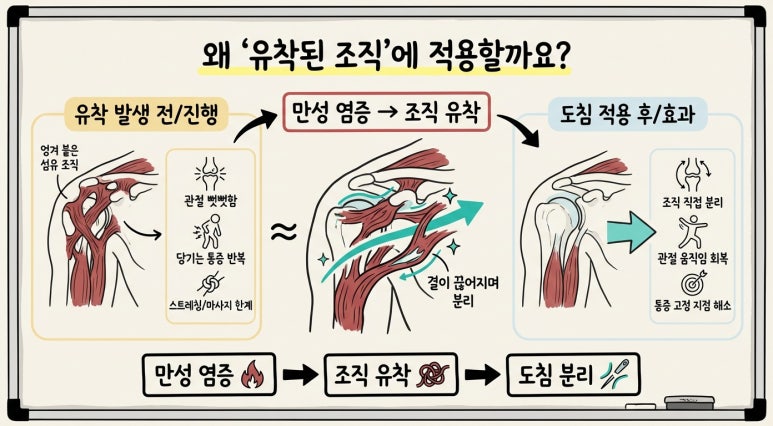
Why is it applied to 'adhered tissue'?
Fascia and ligaments
tend to develop adhesions by becoming fused with surrounding tissue
after repeated injury or chronic inflammation.
When adhesions develop,
joints become stiff,
pulling pain repeats with certain movements,
and a feeling of not being relieved by stretching or massage remains.
Guiding needle therapy
directly separates the spaces between these fused tissues,
aiming to restore joint mobility
and resolve the fixed point of pain.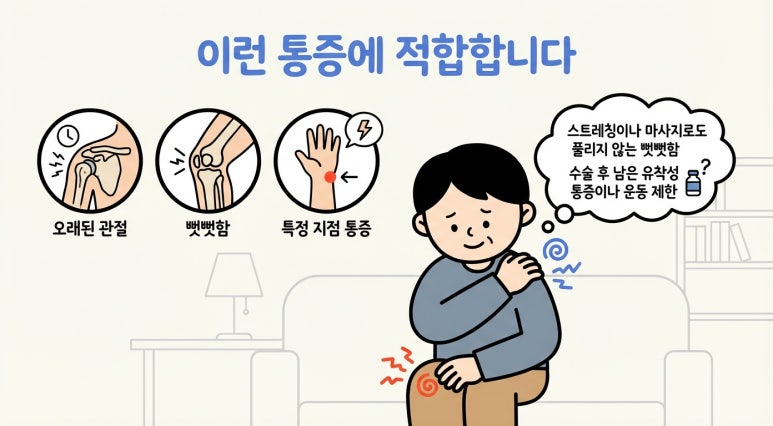 📌 Considered in These Cases
✔Chronic shoulder, knee, and wrist joint pain
✔Stiffness that cannot be relieved by stretching or massage
✔Adhesive pain or movement restriction remaining after surgery
✔Particularly with chronic adhesions rather than acute inflammation,
and fixed pain at specific points rather than in broad areas, it is more suitable.
 ⚠️ Cases Requiring Prior Confirmation
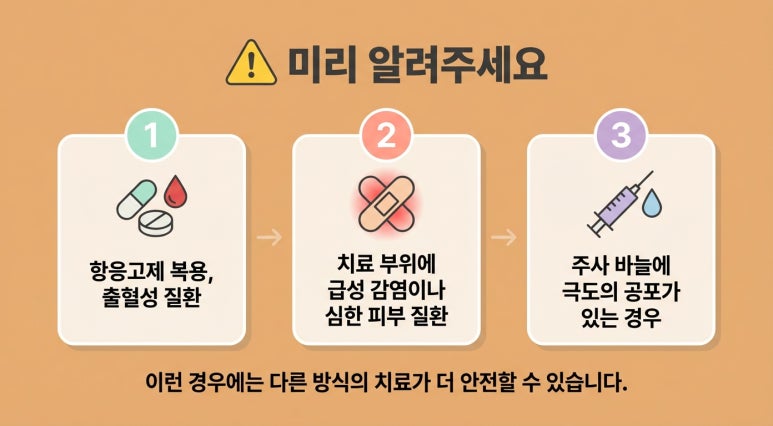
If any of the following apply, please inform us in advance.
✔Taking anticoagulants or bleeding disorders
✔Acute infection or severe skin disease in the treatment area
✔Severe osteoporosis
✔Extreme fear of injection needles
In these cases,
other forms of treatment may be safer.
 🔚 Closing | Summary
Guiding needle therapy is
not a treatment that "forcefully penetrates,"
but rather a treatment designed to precisely separate hardened, fused tissue.
While it has a similar form to regular acupuncture,
the difference is that it directly releases adhesions with the blade-shaped needle tip,
allowing improvement in joint movement and pain relief simultaneously.
It is not a treatment applied to all types of pain.
However, for pain that has been stiff for a long time, difficult to release,
and repeats in the same location,
it can be a meaningful option.
✍️ Reviewed by Director Choi Jang-hyuk of Dongjjedang Korean Medicine Clinic
❓ FAQ
Q. Is guiding needle therapy a very painful treatment?
Because the needle tip is wider than regular acupuncture, there may be a slightly more aching sensation at the moment of insertion.
However, the procedure itself is short, and the intensity of stimulation is adjusted according to the treatment area and condition.
It is not a procedure that involves large skin incisions or suturing.
Q. What does it feel like during guiding needle therapy?
Many people describe it this way.
"A feeling of the stiff area 'popping' and being released"
"The feeling was more refreshing than painful"
The procedure is completed within seconds to tens of seconds,
and many people feel the treated area becomes lighter after treatment.
Q. Can you see results from a single treatment?
It depends on the degree of adhesion and pain duration.
With mild adhesions, some people notice significant improvement with 1-2 treatments,
while chronic adhesions may require 3-5 or more repeated treatments.
Treatment intervals and frequency will be individually guided based on your condition.
Q. Is daily life possible immediately after treatment?
In most cases, daily activities are possible immediately after treatment.
However, depending on the treatment area, there may be slight soreness or light bruising for a day or two.
This is a normal response that appears during the tissue separation process and naturally fades with time.
Post-treatment precautions will be provided tailored to your individual condition.