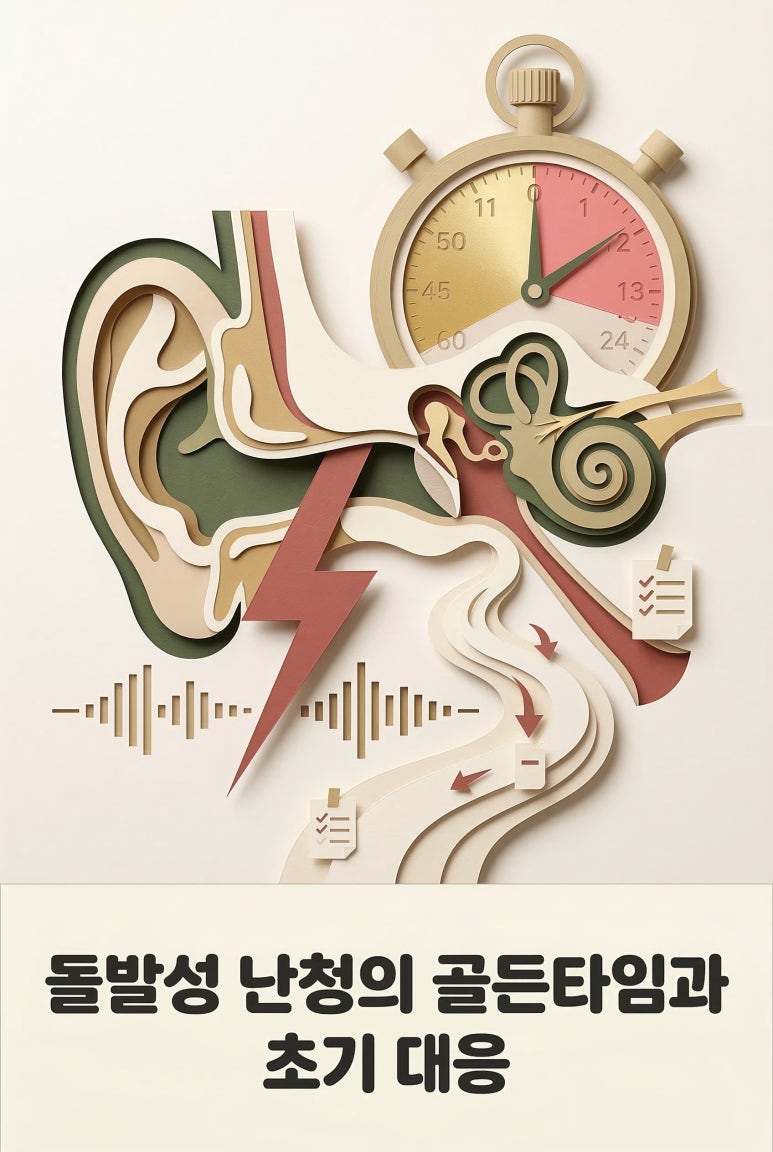
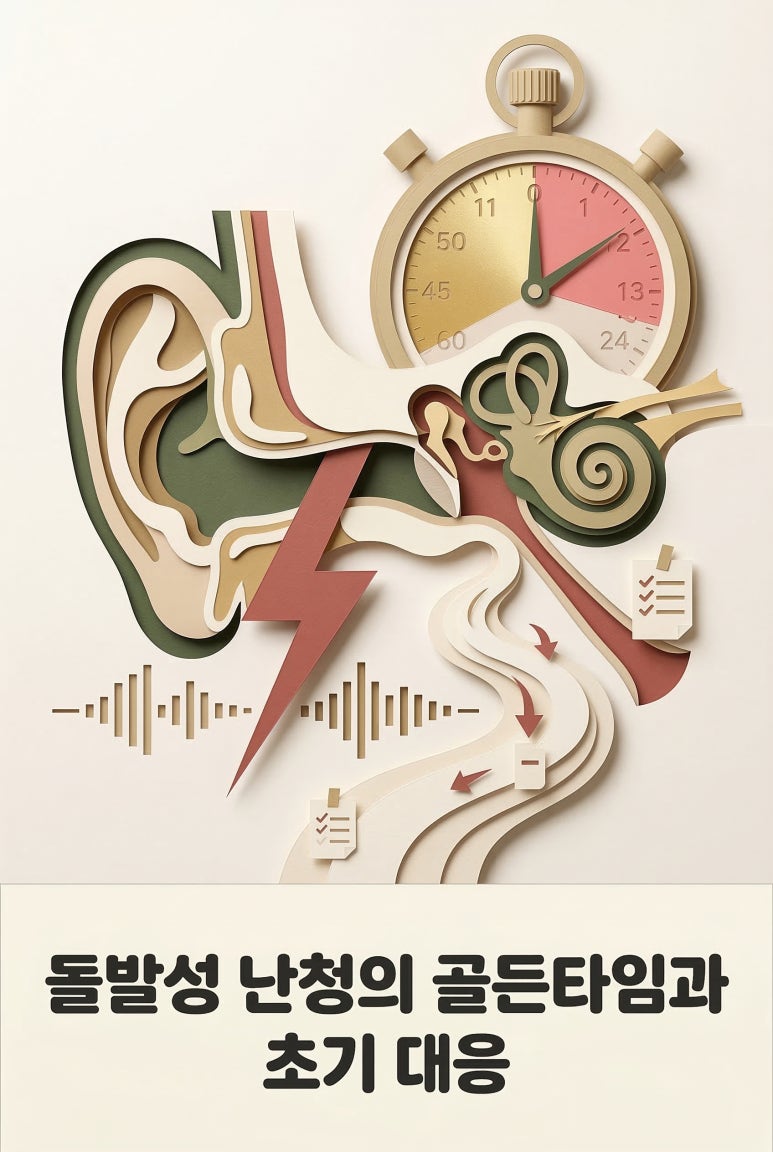
The Golden Time for Sudden Sensorineural Hearing Loss and Initial Response

 🧾 Answer First | Core Conclusion
Has the world suddenly started spinning and your ears felt blocked and stuffy?
Hello, I am Dr. Choi Jang-hyuk, director of Dongjejdang Korean Medicine Clinic.
The early response immediately after the onset of Ménière's disease and sudden sensorineural hearing loss determines lifelong hearing and daily life.
If you miss the golden time window, you may suffer from chronic dizziness and permanent hearing loss for a long time.
Don't worry, just follow the 3 initial response methods I will teach you from now on in order.
 ✅ Action | Immediate Implementation
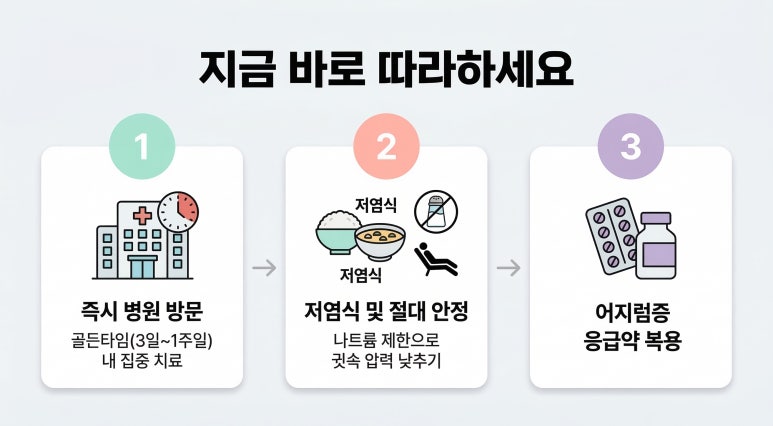
Take Action: The 3 Golden Time Principles for Initial Response
1️⃣ If your ears feel numb and you cannot hear, visit a hospital immediately.
The golden time for intensive treatment of sudden sensorineural hearing loss is within 3 days to at most 1 week after onset.
You must strictly follow this period and start intensive treatment such as steroids.
Only then can you prevent permanent hearing loss and expect complete restoration of daily life.
There is no time to delay.
2️⃣ Change your diet to be less salty and take absolute bed rest.
To lower the elevated pressure inside your ear, you must reduce sodium intake.
For now, avoid spicy and salty soup broths at lunch or delivery food.
Getting enough sleep is also very important.
This prevents body swelling and immediately reduces pressure inside the ear.
3️⃣ Take the prescribed emergency medication for dizziness.
When severe dizziness makes it difficult to even walk, you must address the immediate problem first.
Please take appropriate medication early in the symptom onset.
You must first calm extreme nausea.
Only then can you maintain minimal daily activities and sleep.
 🚨 Warning | Warning Signs You Must Check
Caution: The Vicious Cycle of Medication Dependence
When I see patients in my clinical practice, so many people rely only on medications to suppress immediate symptoms.
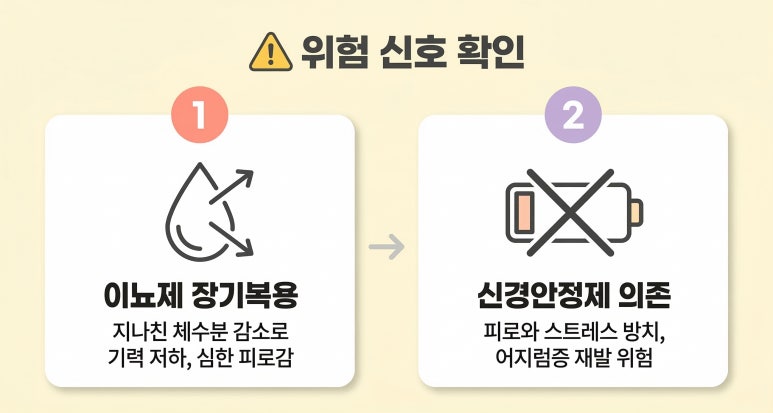
✔ Watch out for side effects of Ménière's diuretics
When taking medication for long periods, there is a high risk of exposure to side effects.
Excessive water loss from the body causes a sharp drop in energy and extreme fatigue.
Severe dry mouth and poor digestion symptoms may also occur.
✔ The limitations of nerve stabilizers for Ménière's disease
Nerve stabilizers only temporarily dull the nervous system's sensitive reactions.
They are not a method to treat the fundamental cause of dizziness that has begun.
If you leave depleted physical strength and accumulated stress untreated, it becomes a serious problem.
Whenever our body is tired and immunity drops, dizziness will always return.
 🧠 The Why | Root Cause Analysis
So why do these frightening symptoms commonly occur in office workers in their 20s to 50s?
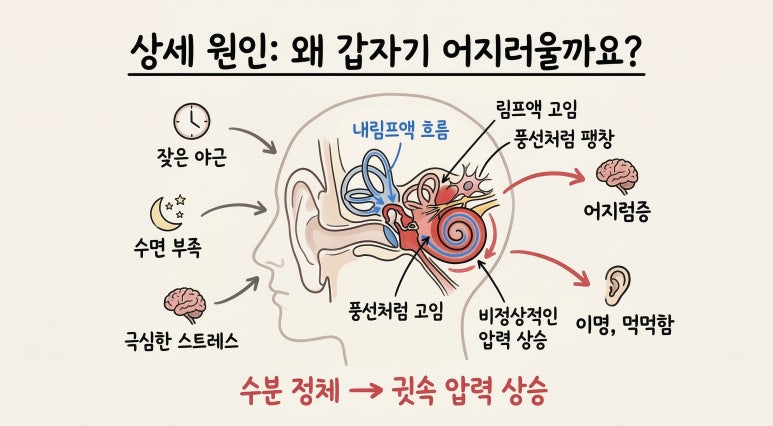
Deep inside your ear, there is a fine body fluid called 'endolymph' flowing.
When frequent overtime work, sleep deprivation, and severe stress continue for long periods, the body becomes strained.
Eventually, this fluid loses its normal flow and accumulates inside the ear.
It's like a sink with a clogged drain filled with debris with water continuing to run.
The improperly flowing lymphatic fluid fills up inside the ear.
This causes the internal pressure inside the ear to swell like a balloon.
The elevated pressure strongly compresses the inner ear nerves responsible for dizziness and hearing.
This is why the world suddenly starts spinning when extreme fatigue sets in.
The whistling sound in the ears and the muffled feeling are caused by this abnormal pressure increase.
📊 Proof | Case Studies and Evidence
Clinical cases and evidence: The importance of the golden time
In my experience, the outcomes differ greatly between those who observe the golden time window in early stages and those who do not.
Recently, I had a patient in their late 30s, an office worker, who came to my clinic.
This patient disregarded the initial dizziness as simple sleep deprivation and overwork and left it untreated for nearly a month.
Eventually serious hearing damage occurred before treatment began, and complete recovery took over 6 months.
In contrast, the prognosis was different for those who took emergency measures immediately upon onset and visited the clinic.
They actively underwent treatment from the early stages to lower the pressure around the ear.
As a result, return to daily life was much faster, and the recurrence rate of dizziness thereafter was significantly lower.
In fact, research results show that more than 80% of patient groups who received early bed rest combined with Korean medicine treatment showed a marked decrease in dizziness recurrence frequency[3].
 🔚 Closing | Summary and Encouragement
Ménière's disease and sudden dizziness are powerful SOS warning signals sent to the brain.
Your body is strongly protesting that it can no longer endure.
If you experience sudden dizziness, tinnitus, or hearing loss, never ignore it or delay treatment today.
First implement the accurate initial response within the golden time window I have emphasized.
After that, you must firmly restore your body's depleted immunity and the balance of the autonomic nervous system.
I always encourage patients who live comfortably and vibrantly without the fear of dizziness.
✍️ Reviewed by Dr. Choi Jang-hyuk, Director of Dongjejdang Korean Medicine Clinic
❓ FAQ
Q. How is sudden sensorineural hearing loss different from Ménière's disease?
Both conditions can feel similarly with muffled ears and dizziness.
However, the biggest characteristic of Ménière's disease is that severe paroxysmal dizziness appears repeatedly.
On the other hand, sudden sensorineural hearing loss is mainly characterized by sudden hearing loss in one ear.
For both conditions, rapid early treatment immediately after onset determines lifelong hearing.
Q. Can I continue taking prescribed Ménière's diuretics regularly?
During the acute phase when dizziness is severe and daily life is difficult, medication use is necessary.
However, special care must be taken when taking it for long periods.
When excessive water loss occurs from the body, nutritional balance may be disrupted, or side effects such as severe dry mouth and chronic fatigue may occur.
As symptoms improve, you should gradually reduce medication with the help of a specialist.
Q. How does Dongjejdang Korean Medicine Clinic treat Ménière's disease?
As the director of Dongjejdang Korean Medicine Clinic, I focus on relieving abnormal swelling inside the ear and restoring depleted physical strength.
Through customized herbal medicine and precise acupuncture treatment, I comfortably stabilize the tense autonomic nervous system.
I also provide treatment that aids fine blood circulation around the ear to lower internal pressure.
Through this, I prevent frequent dizziness recurrence and build a stronger body.
📚 References
Western Medicine WM
[1] BMJ Best Practice (2022). "Meniere's disease - Assessment and Management"
[2] AAO-HNS (2020). "Clinical Practice Guideline: Meniere's Disease"
Korean Medicine KM
[3] Korean Society of Oriental Medicine CPG (2021). "Clinical Practice Guidelines for Dizziness in Korean Medicine"
[4] Journal of Korean Oriental Medicine (2019). "Clinical Review of Herbal Medicine Treatment for Ménière's Syndrome"
Head & Face
The Golden Time for Sudden Sensorineural Hearing Loss and Initial Response
View Program