
Why Your Belly Sticks Out Even Without Constipation — For Those Stuck Despite Diet and Exercise


🧾 Answer First | Core Conclusion
"I have bowel movements every day.
I pay attention to my diet and exercise.
But my belly still sticks out."
I am Dr. Choi Jang-hyuk, director of Dongjedang Korean Medicine Clinic.
The most frustrated patients in my clinic are those like this.
A bloated belly that feels heavy, worsens after meals, and deflates in the morning only to puff up again by evening.
You can have a protruding belly even without constipation.
This is because having a bowel movement and completely emptying your intestines are two different things.
When gas builds up in the intestinal wall and inflammatory byproducts leak from the intestinal lining — even if you have daily bowel movements, your belly remains protruding.
The stagnation that doesn't improve no matter how much you manage diet and exercise usually starts here.
Even if you reduce calories, if your intestinal environment remains the same, your body won't empty.
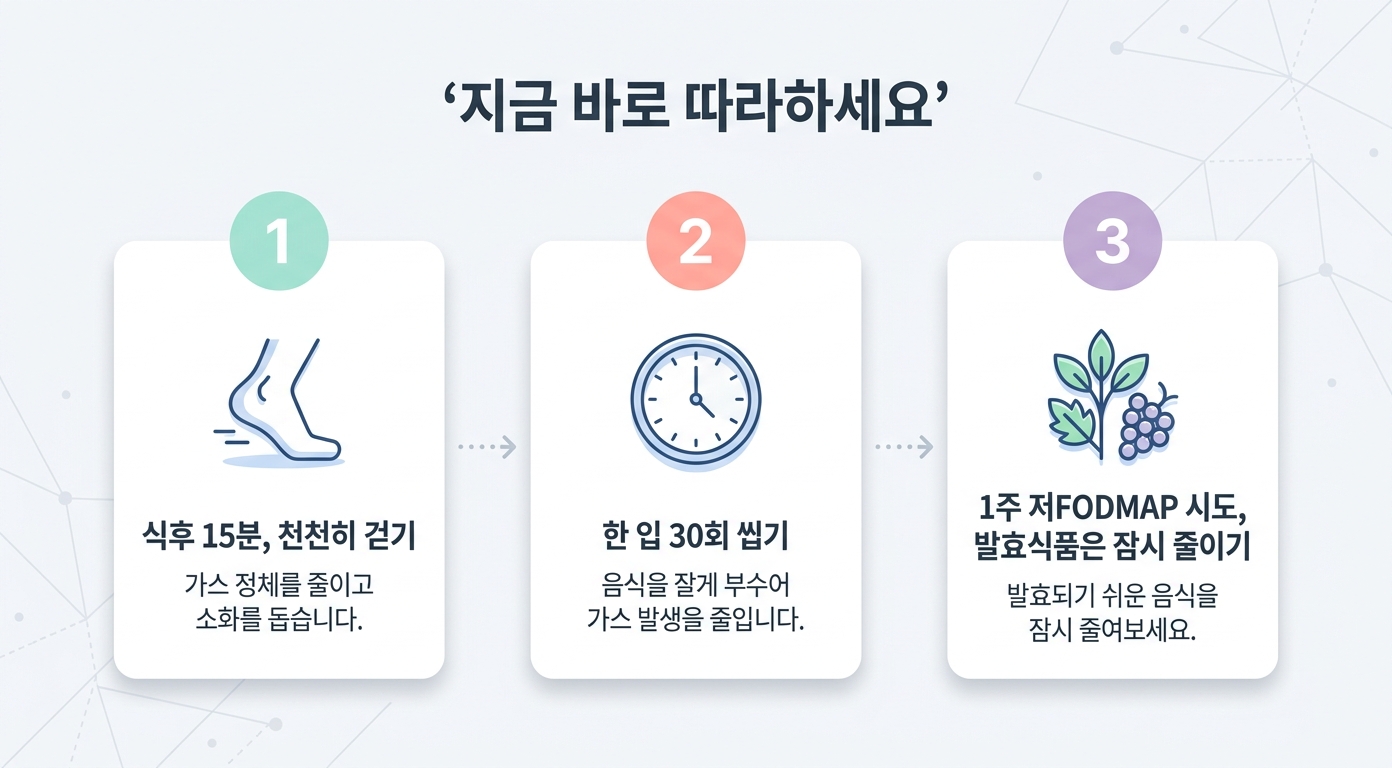
✅ Action | Immediate Implementation
Before visiting a Korean medicine clinic, let me share three things you can try for 1~2 weeks.
1️⃣ Slow walking for 15 minutes after eating
Many people sit in a chair or go straight into meetings right after meals.
This is the position where gas stagnates the most.
Even 15 minutes of walking after a meal speeds up the movement of food from the stomach to the intestines.
The time gas stays in one place decreases.
If you have a lunch meeting scheduled, simply taking a slow walk to the conference room makes a difference.
2️⃣ Chewing each bite 30 times
People who eat quickly have more gas in their intestines.
When food reaches the intestines in partially undigested form, intestinal bacteria break it down and produce gas.
Chewing 30 times per bite isn't difficult.
But when you actually try it, you realize how little you normally chew and swallow.
3️⃣ Try low FODMAP for one week, temporarily reduce fermented foods
Try reducing foods that ferment easily in your intestines — such as cabbage, onions, legumes, and milk — for just one week.
If you normally have a lot of gas, you'll feel your belly flatten in the first week.
Fermented foods like yogurt and kimchi are known to be beneficial, but for those whose intestinal environment is already compromised, they actually only produce more gas.
It's better to stop for one week, then slowly increase them again.
If there's no change after doing these three things for about two weeks, you'll need the stage of clearing what has already accumulated on your intestinal wall.
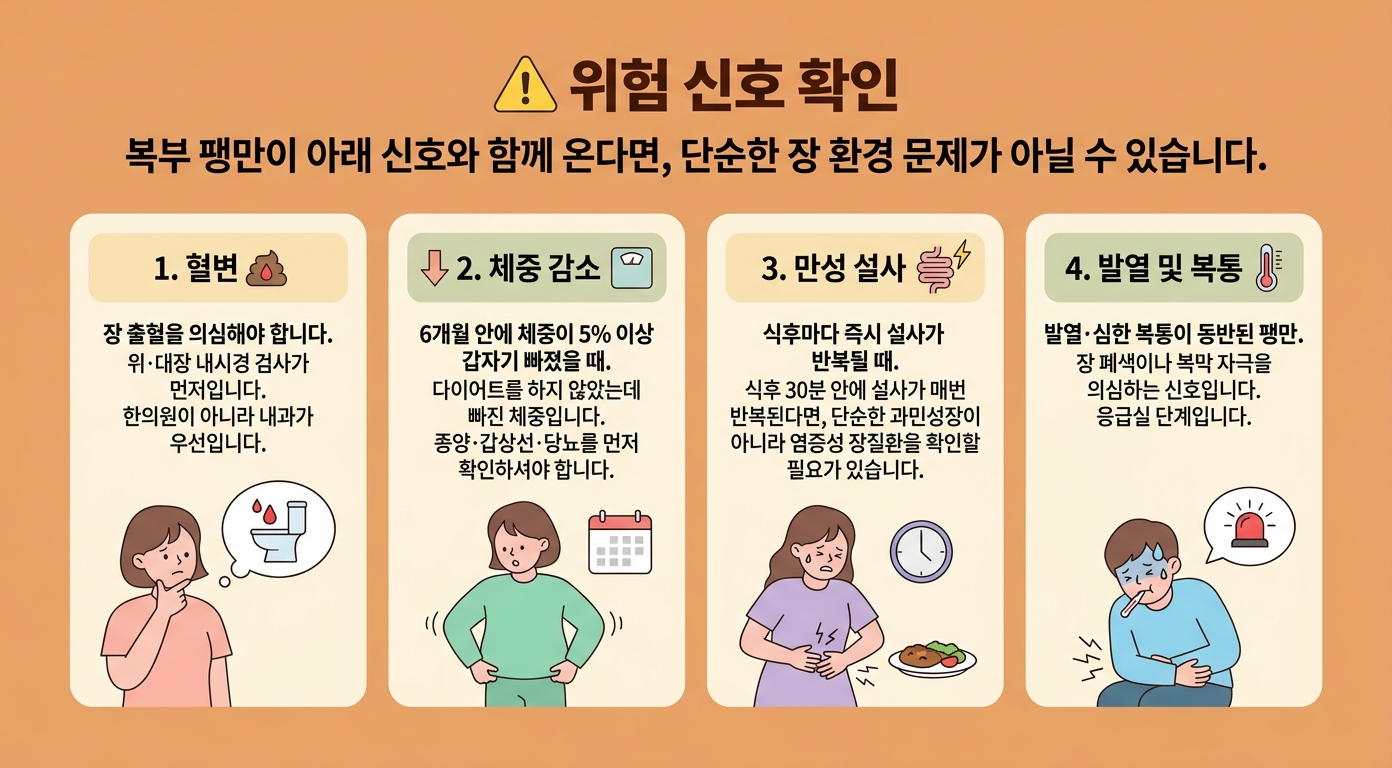 🚨 Warning | Warning Signs You Must Check
If abdominal bloating is accompanied by the following signs, it may not be a simple intestinal environment issue.
✔ When you see bloody stools or black stools
You should suspect intestinal bleeding.
Upper and lower endoscopy should come first.
Internal medicine takes priority over Korean medicine.
✔ When body weight drops by more than 5% within 6 months unexpectedly
This is weight loss without dieting.
You should first check for tumors, thyroid issues, and diabetes.
✔ When diarrhea repeats immediately after every meal
If diarrhea occurs consistently within 30 minutes after eating, rather than simple irritable bowel, you need to check for inflammatory bowel disease.
✔ When bloating is accompanied by fever and severe abdominal pain
This is a sign of suspected bowel obstruction or peritoneal irritation.
This requires emergency room treatment
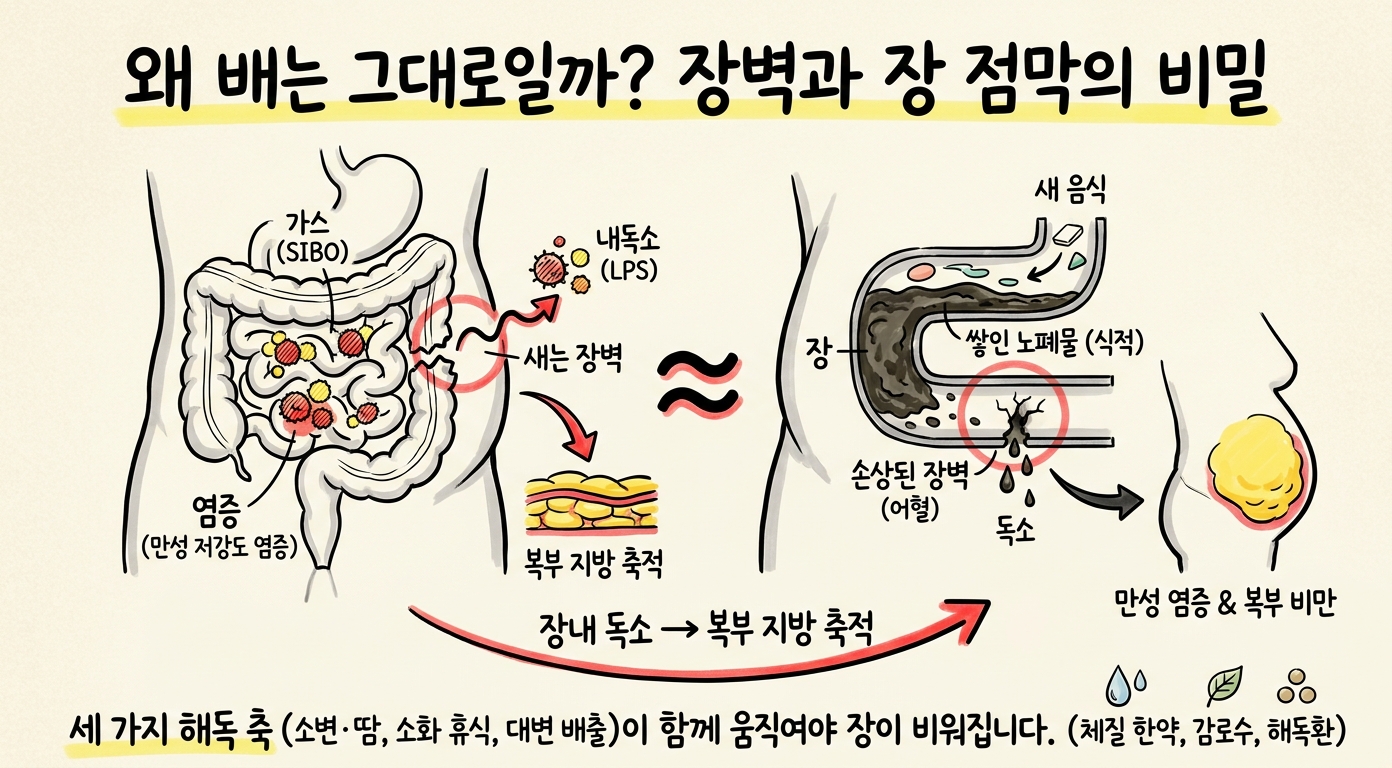
🧠 The Why | Understanding the Root Cause
Why do you have daily bowel movements but your belly stays the same.
The answer lies in the intestinal wall and intestinal lining.
The stool you passed today is what you ate yesterday.
However, what's stuck to the inside of your intestinal wall is not just from yesterday.
Waste that has accumulated from months and years ago remains exactly there.
New food coming in simply slides over the top and passes through.
In this accumulated state, your intestines create two problems.
The first is gas.
When bacteria grow excessively in the small intestine (SIBO, small intestinal bacterial overgrowth), they ferment the carbohydrates we eat before normal digestion occurs.
That byproduct is gas.
This is the most common reason for a protruding belly even without constipation[1].
The second is a leaky intestinal barrier.
When the intestinal lining is damaged, endotoxin (LPS) flows into the bloodstream.
Your body recognizes this as a threat and enters a state of chronic low-grade inflammation.
This inflammatory signal encourages your body to store more fat in the abdomen[2].
This is why abdominal fat doesn't decrease even when you reduce food intake.
In Korean medicine, we have understood this same state as food stagnation (食積) and blood stasis (瘀血).
Food that cannot be digested becomes toxic and remains — this is food stagnation, and circulation blocked and hardened — this is blood stasis.
It is simply viewing the same situation from different angles as SIBO and leaky gut in Western medicine.
There's an important point here.
This intestinal problem cannot be solved with just one method.
Removing excess body fluids through urine and sweat, resting the digestive system to clear toxins, and pushing what's stuck on the intestinal wall out through bowel movements — all three methods must work together for the intestines to empty.
This is why our clinic uses three pillars together: constitution-based herbal medicine, Gamrasu (sacred water), and detox pills.
📊 Proof | Case Studies and Evidence
A common patient type I see in my clinic looks like this.
A professional in his late 30s.
Daily bowel movements, dietary management, and gym 3 times a week.
Yet for 4 months his weight hasn't decreased and his belly keeps protruding.
My first question wasn't about diet or exercise.
"How do you eat lunch at the office?"
The answer was this.
"I finish in 10 minutes and go straight into meetings."
Eating quickly, sitting immediately after eating, no time for gas to escape.
Even if diet and exercise are managed perfectly, if that situation remains unchanged, the intestines won't empty.
For this patient, I first had them change to a 5-minute walk after meals and increase chewing frequency.
We also conducted a 12-week constitution-based detox program together.
Using constitution herbal medicine to remove excess body fluids, inserting Gamrasu fasting during stagnation periods, and taking detox pills when bowel movements weren't satisfactory.
From weeks 2~3, completely different stools appeared.
Stools mixed with mucus, dark reddish-colored stools, and larger amounts.
This was the process of things stuck on the intestinal wall being expelled.
By week 6, abdominal circumference decreased by 4cm, and by week 12, body weight decreased by 2.8kg.
However, the most common thing the patient said wasn't about the numbers.
"My body feels lighter."
It was a lightness not felt for 4 months.
This was the result of recovering the intestines' potential.
It wasn't stopping diet and exercise, but rather adding another layer of organizing the intestinal environment on top of those.
How Gamrasu and detox pills each work is covered in detail in separate articles.
The principle of how Gamrasu allows the digestive system to rest and the principle of how detox pills push out blood stasis, if you refer to them,
you'll see the complete picture.

🔚 Closing | Summary and Encouragement
For those who see bowel movements daily but only their belly protrudes, or those whose diet and exercise have plateaued — most are blocked by intestinal environment issues.
Simply reducing calories will not reach this goal.
It is because you are leaving what is stuck to the intestinal wall and only reducing intake.
That is why we use three approaches together.
A way to reduce body water, a way to rest the digestive system, and a way to push it out through bowel movements.
Once the intestines are emptied, the subsequent diet and exercise work differently.
If you are curious about detoxification methods tailored to your constitution and current condition,
you can view the entire process at Dongjjedang Detox & Diet Program Guide.
Feel free to contact us.
✍️ Reviewed by Director Choi Jang-hyuk, Dongjjedang Korean Medicine Clinic
❓ FAQ
Q.
I take probiotics regularly, but I feel more gas instead.
Why is that?
For those whose intestines are already in a SIBO state, probiotics can create more gas.
This is because new bacteria enter and increase fermentation.
In this case, the correct order is to first empty what has accumulated in the intestines, and then introduce bacteria after the intestinal environment is normalized.
Q.
Does gas relief medication (simethicone) from the pharmacy help?
Simethicone is a temporary medication that combines already-formed gas bubbles for elimination.
It does not address the root cause of gas formation itself.
It helps reduce discomfort for that day, but it does not address the fundamental problem of a protruding belly.
Q.
Do I have to visit the clinic in person for the first detox consultation?
For the first visit, in-person consultation is required by medical law.
It is safer to assess the current condition through body composition analysis and blood tests, and determine constitution and program accordingly.
For those who have received treatment before, non-face-to-face consultation can continue with herbal medicine prescriptions.
📚 Reference Materials
[Western Medicine (WM)]
- Pimentel M et al. (2020). "ACG Clinical Guideline: Small Intestinal Bacterial Overgrowth." American Journal of Gastroenterology, 115(2):165-178. [1]
- Cani PD et al. (2022). "Gut microbiota, the role of the metabolic endotoxemia." Gut, 71(5):1020-1032. [2]
- Camilleri M. (2019). "Leaky gut: mechanisms, measurement and clinical implications in humans." Gut, 68(8):1516-1526.
[Korean Medicine (KM)]
- Korean Society of Oriental Internal Medicine (2021). "Clinical Practice Guidelines for Functional Dyspepsia in Korean Medicine."
- NIKOM (2023). "Standard Clinical Pathway for Obesity in Korean Medicine — Pattern Differentiation Classification for Intestinal-Type Obesity."
- Oh Dal-seok et al. (2015). "Preliminary Research for Development of Fasting Supplement Beverage Ganrosu (甘露水)." Journal of Korean Medicine Obesity, 15(1).
Diet
Why Your Belly Sticks Out Even Without Constipation — For Those Stuck Despite Diet and Exercise
View Program