

"My stomach always feels slimy and my head is heavy like fog" | Chronic gastritis and dizziness in a 50s office worker with chronic fatigue

Every Day Like Walking Through a Foggy Swamp, a Heavy Stone Settled in the Pit of the Stomach

"Every morning my stomach feels slippery and completely blocked—I just can't get up. My head is heavy and foggy, like it's wrapped in thick mist, and I can barely focus at work."
These were the first words, exhaled with a deep sigh, by Mr. Kim Min-cheol (pseudonym) in his 50s when he first opened the door to my clinic.
Having devoted more than 20 years to his company amid frequent overtime and heavy responsibilities, he had long endured an irregular lifestyle in which he couldn't even keep regular meal times.
At some point, the indigestion that had quietly begun surpassed mere bloating, and a dizzying sensation—as if the ground were suddenly dropping away—accompanied it, making even daily life a struggle.
At first he visited an internal medicine clinic and underwent endoscopy, only to be told there was nothing remarkable beyond mild chronic gastritis, and had to turn away with a heavy step.
Even after faithfully taking the prescribed stomach medication, relief came only temporarily, and the lingering discomfort escalated into intense stress, drawing him back into a vicious cycle that further strangled his digestive system.
The numbers and imaging results looked perfectly normal, yet the pain he endured every morning upon waking was anything but trivial.
Honestly, treating patients whose test results read "normal" sometimes requires the most careful attention, and whenever I hear such stories, I feel the weight settling on my own shoulders as well.
I did not view Mr. Kim's symptoms as merely a mild inflammation of the gastric mucosa.
As a practitioner and observer seated across from him, I could not help but feel profound empathy and sadness for the invisible, heavy burden of his suffering.
It seemed as though every morning he was walking alone, precariously, through a fog-filled swamp with no end in sight.
So where exactly does this relentless tightness and dizziness—with no clear cause on any test—originate?
A Clogged Kitchen Sink and a Moss-Covered Pond: The Pathway Between the Stomach and Brain Becomes Blocked
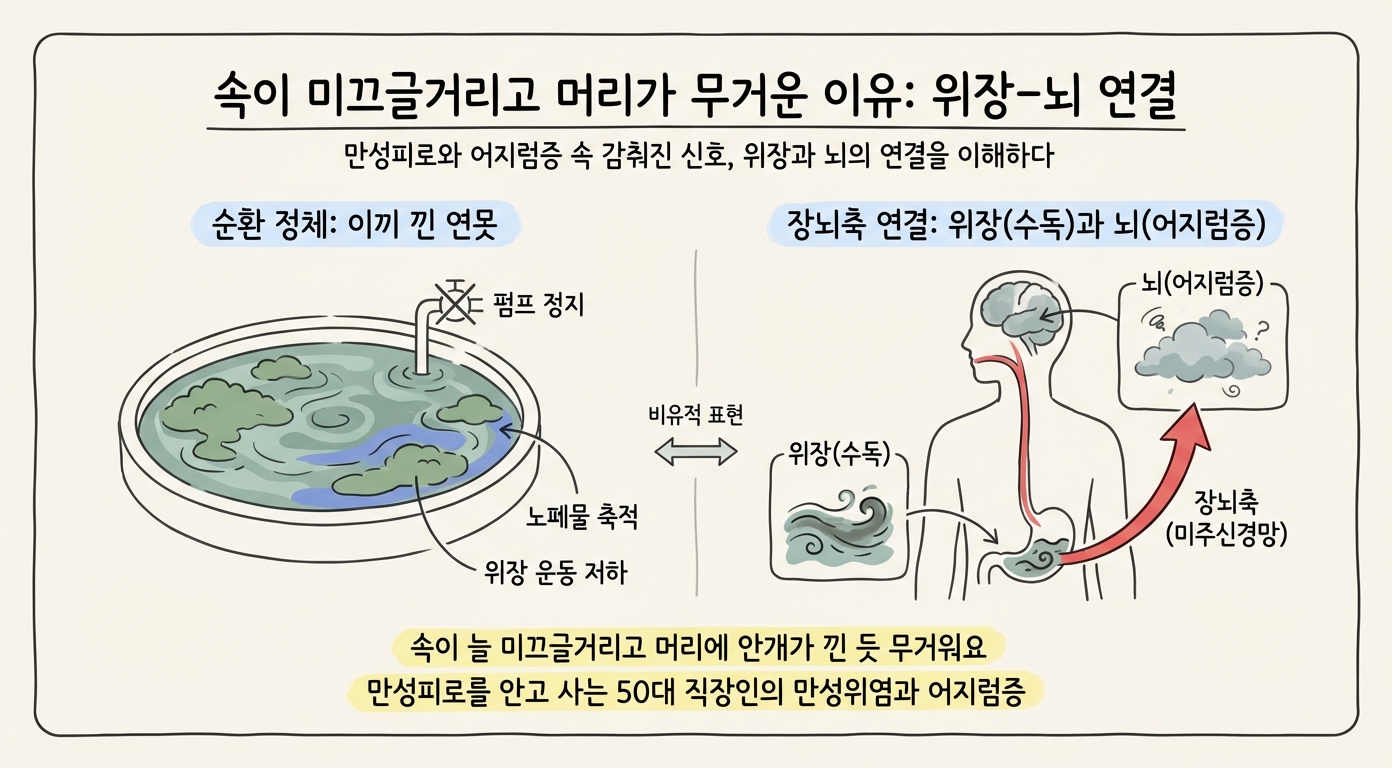
In Korean medicine, the state in which the stomach's vital energy has dropped so drastically that the digestive system can no longer function at all is called Bi-wi Gi-heo (脾胃氣虛)—deficiency of spleen and stomach qi.
When the peristaltic movement of the stomach becomes weak, ingested food cannot be properly digested and remains in the gastrointestinal tract for too long. The residue and toxins produced through fermentation then accumulate densely around the mucosa—a phenomenon explained as Dam-jeok (痰飮), the accumulation of phlegm and fluid stagnation.
This is like a kitchen sink with a completely clogged filter, constantly overflowing—waste that should flow out smoothly instead rots and stagnates inside, obstinately blocking the flow throughout the entire body.
Modern Western medicine also explains this phenomenon through the Gut-Brain Axis theory, which recognizes that the brain and gut are connected by the vast neural network of the vagus nerve, continuously exchanging chemical signals with each other.
The waste accumulated in the stomach seriously stagnates the body's fluid metabolism, generating a pathological, turbid, and viscous form of fluid called Su-dok (水毒)—water toxin.
This is akin to the process of the body's ecosystem—the brain and entire body, which should be kept clean—transforming into an ecological pond where the circulation pump has stopped and moss is spreading.
Just as fish in a murky pond can no longer breathe properly and gradually sicken, the Su-dok generated by the stomach's stagnation disrupts the balance of the autonomic nervous system throughout the body and obstructs the flow of clean oxygen and blood to the brain.
Ultimately, the toxins in the stomach stimulate the cranial nerves to trigger dizziness, while the stress the brain experiences in turn paralyzes the stomach's movement—each inflicting devastating harm upon the other.
The sensation of a heavy stone blocking the pit of the stomach and the spinning dizziness the patient described are not separate conditions at all, but inevitable outcomes branching from the single root of the body's stalled metabolism.
How Can We Drain the Murky Water Pooled in Our Body in Daily Life?

So what careful daily efforts are needed to escape this relentless morning tightness and to clear away the murky water pooled in our body?
Frequent overtime, intense work stress, and the irregular habit of rushing through meals without proper meal times dry out the digestive enzymes in our body.
This is the primary cause that tenses the stomach wall to the extreme—like an overheated engine running without rest, glowing red—accelerating the chronic accumulation of waste.
To gently improve this hardened stomach in daily life, it is beneficial to develop the habit of slowly drinking a warm glass of water at a temperature close to your own body temperature immediately upon waking each morning.
This serves as an excellent first step—like gently and warmly rousing the stomach, which has been cold and stiff throughout the night.
Also, after meals, rather than immediately leaning back in a chair or lying down just because digestion feels difficult, it is very important to take a leisurely stroll around for about twenty minutes, helping the intestines create their own peristaltic rhythm from the outside.
It is wise to keep ice water, which chills the digestive system, and flour-based foods, which irritate the stomach lining, as far from your table as possible.
However, if during these consistent daily efforts and dietary management, unusual and dangerous warning signs appear—such as sudden, unexplained rapid weight loss in a short period, or the appearance of black stools—do not hesitate and immediately visit a nearby medical institution for a thorough examination.
Toward a Body Through Which Clear Water Flows: An Integrative Journey of Healing for Yourself
True healing must not stop at merely suppressing momentary nausea or transiently blocking dizziness with medication.
It must be an integrative process of gently releasing the stiffened stomach, reconnecting the blocked circulation throughout the body, and restoring the vast ecosystem that is our body to its original clear and transparent state.
This is akin to the principle that—like an analog clock in which countless gears mesh and turn in perfect precision—when the stomach, brain, and autonomic nervous system harmonize and balance from their respective positions, a beautiful rhythm of daily life is finally created.
Each patient who visits the clinic has a different life trajectory and a different innate constitution, so the Korean medicine approach must also be a meticulous and personalized design tailored to each individual's unique physical environment—unblocking what is congested and replenishing what is deficient.
After consistent treatment and effort, Mr. Kim has now cleared the long-standing fog and is greeting mornings that are considerably lighter and clearer.
Please listen with kindness to the foggy and dizzy signals your body sends, and never consider time spent caring for yourself a waste.
Your body, when given the right direction, harbors a remarkable power of recovery—a deep-rooted drive to return to its original state of health on its own.
My role is to be a steadfast ally in the clinic who helps find the key to that recovery together and encourages weary steps forward.
It does not have to be me—I sincerely hope that you will meet a warm medical practitioner who deeply empathizes with and understands the invisible weight of suffering you carry in silence, who examines the overall imbalance of the body one by one with care, and helps you reclaim a peaceful and clear daily life.
Director Choi Jang-Hyuk, Dongjedang Korean Medicine Clinic
Digestive
"My stomach always feels slimy and my head is heavy like fog" | Chronic gastritis and dizziness in a 50s office worker with chronic fatigue
View Program