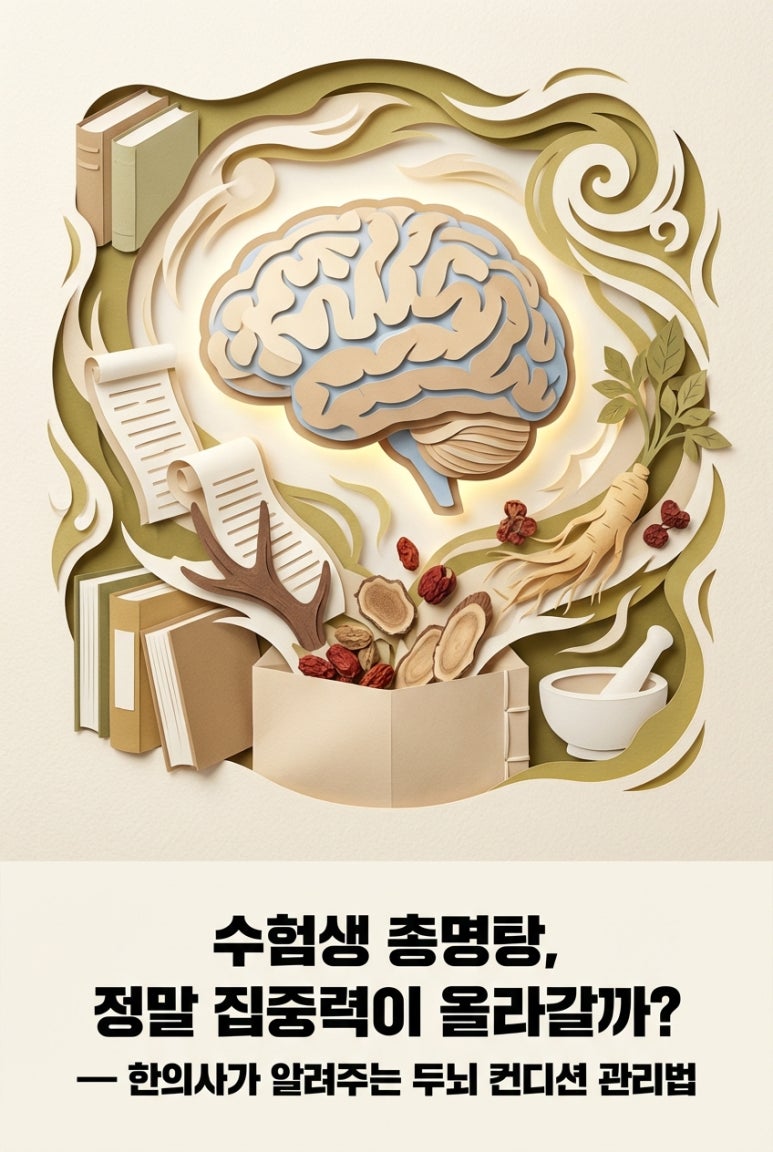
Does Chongmyeong-tang (Clarity Decoction) Really Improve Concentration for Test Takers? — Brain Conditioning Methods Explained by a Korean Medicine Practitioner
 🧾 Answer First | Key Conclusion
When you sit at your desk, within less than 10 minutes your mind becomes cloudy and blurry, and you can't remember what you just read.
If you're a test taker, you've likely experienced this at least once.
Chongmyeong-tang is not a 'drug for studying well.'
It is a herbal prescription that creates the proper physical condition for the brain to function correctly.
The Donguibogam (Principles and Practice of Eastern Medicine) records that if one takes Chongmyeong-tang for a long time, they can memorize a thousand words a day. This is not an exaggeration but rather means that 'when brain fatigue is relieved, one's original memory capacity returns.'
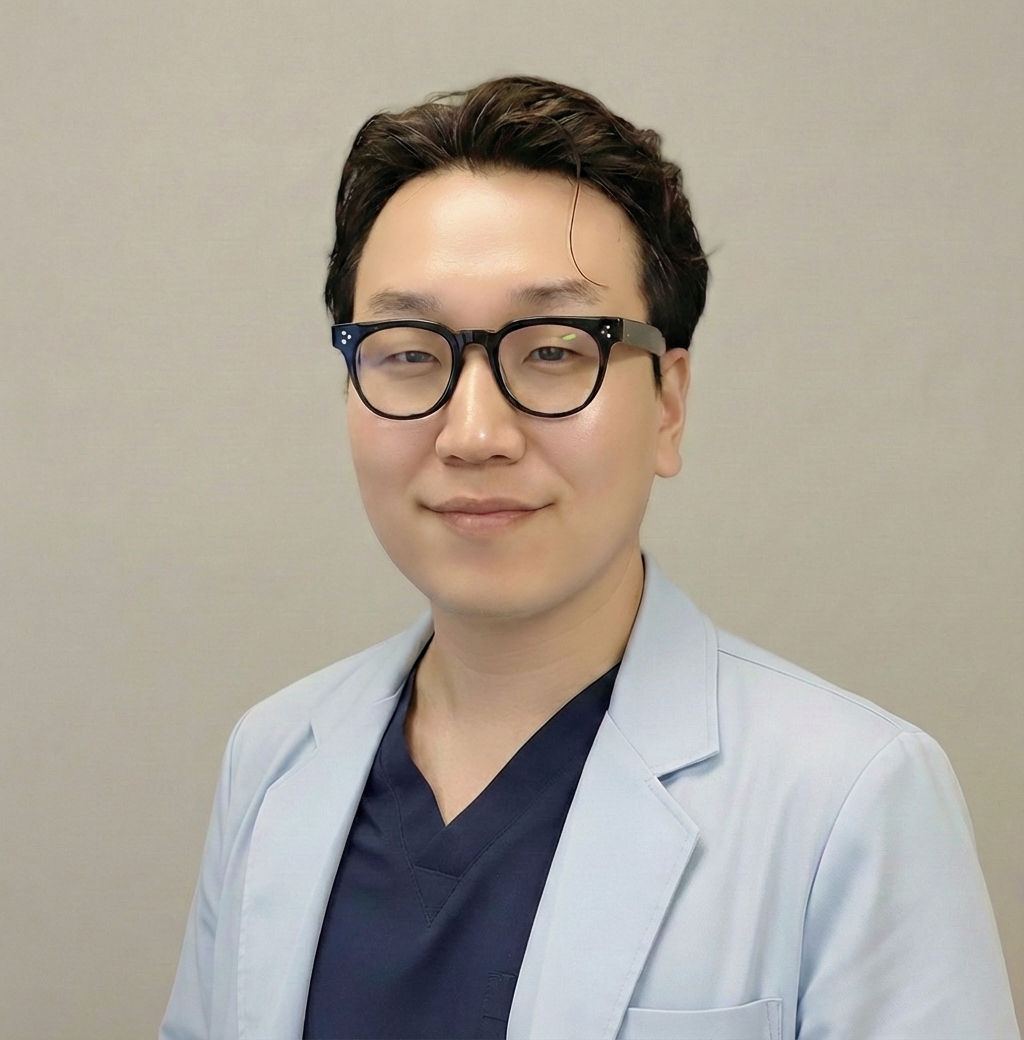
I am Choi Jang-hyuk, director of Dongjjedang Korean Medicine Clinic.
Today, I will share the actual efficacy of Chongmyeong-tang along with three body management habits that test takers must change right now.
 ✅ Action | Immediate Implementation
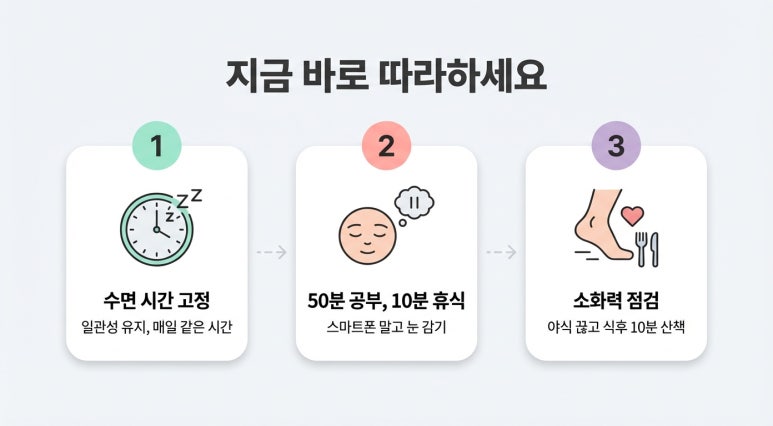
1️⃣ Fix your sleep time to the same time every day
An MIT research team tracked the sleep habits of 100 college students and found that the 'consistency' of sleep time had a greater impact on academic performance than the 'quantity' of sleep[1].
Try maintaining a pattern of sleeping at midnight and waking up at 6:30 AM for just two weeks.
The hippocampus, which is the brain's memory storage function, is most active during sleep.
When your sleep pattern is irregular, even the best medicine loses half its effectiveness.
2️⃣ Practice 'eye closing' for 10 minutes after 50 minutes of studying
Concentration is like a muscle.
If you use it without rest, it becomes fatigued.
Just by studying for 50 minutes and then resting for 10 minutes with your eyes closed and no thoughts, the fatigue in your brain's prefrontal cortex recovers.
Looking at your smartphone is not resting.
Monitor light re-awakens your brain, making you feel like you've rested but actually leaving you more exhausted.
During your 10-minute rest, looking out the window or taking a walk down the hallway is best.
3️⃣ Check your digestive capacity first
Many students with weak stomachs don't feel the effects even when taking Chongmyeong-tang.
If digestion is poor, nutrients cannot reach the brain.
If you feel bloated after meals, have no appetite in the morning, or frequently eat late-night snacks, you should first examine your digestive function.
Try quitting late-night snacks and making a 10-minute post-meal walk a habit.
If you try changing these lifestyle habits on your own and see no improvement after more than two weeks, examining your constitution and physical condition together is the fastest approach.
 🚨 Warning | Warning Signs You Must Check
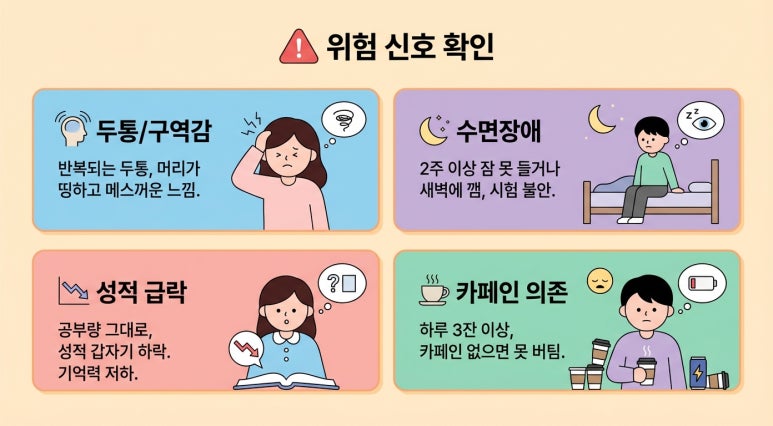
✔ Headaches accompanied by repeated nausea
Feeling your head is heavy and nauseous when sitting at your desk for long periods may not be simple fatigue.
It's a signal of insufficient blood flow to the brain, so if it repeats not just once or twice but for more than a week, medical consultation is necessary.
✔ Unable to sleep for more than 2 weeks or frequently waking up in the early morning
When exam anxiety becomes severe, the brain enters a state of overarousal.
If this continues for more than two weeks, it is not simple nervousness but an early stage of sleep disorder.
Baekboksin (White Poria), a component herb in Chongmyeong-tang, helps reduce such anxiety, but if symptoms are severe, prescription adjustment is needed.
✔ Academic performance suddenly drops despite study time not decreasing
If your grades suddenly fall while your study time remains the same, your brain may be receiving input but unable to store it.
Accumulated sleep deprivation prevents conversion to long-term memory.
In such cases, sleeping more is more effective than solving another set of practice problems.
✔ Cannot get through the day without caffeine
If you're drinking energy drinks or coffee three or more times a day, you're already dependent on caffeine.
Caffeine doesn't eliminate fatigue; it just masks the feeling.
Caffeine after 3 PM reduces sleep quality and creates a vicious cycle.
 🧠 The Why | Root Cause Analysis
Most concentration problems in test takers are not due to the brain itself.
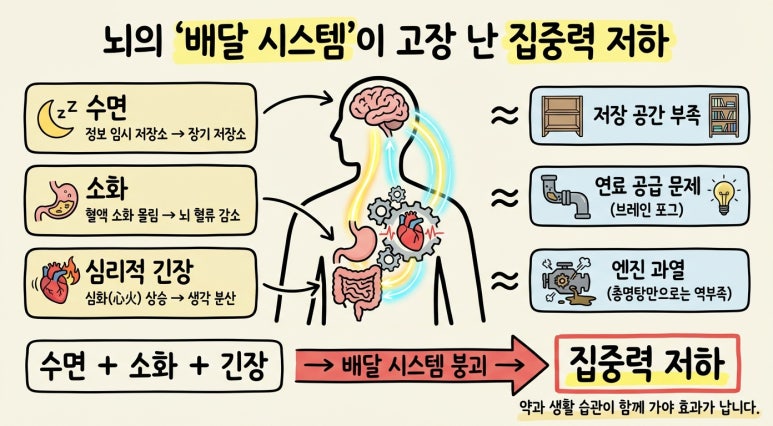
Rather, the delivery system that sends fuel to the brain is malfunctioning.
There are three main delivery systems.
First, sleep.
During sleep, the brain transfers information received during the day from 'temporary storage' to 'long-term storage.'
If sleep is insufficient, this process stops, and when new information enters the next day, there is no space to store it.
Ultimately, no matter how much you read, you can't remember anything.
Second, digestion.
When the stomach is burdened, blood rushes to the digestive system.
When blood flow to the brain decreases, you enter a state of 'brain fog' where your mind becomes unclear.
This is why you feel particularly sleepy and foggy after eating late-night snacks or overeating.
Third, psychological tension.
In Korean medicine, this is expressed as 'heart fire rising upward.'
When exam stress intensifies, your heart rate quickens and your thoughts cannot focus on one place.
Yuanji (Polygala), a key herb in Chongmyeong-tang, calms this heart fire, while Shicangpu (Acorus gramineus) opens the brain's pathways.
Baekboksin (White Poria) stabilizes an anxious mind and promotes restful sleep.
Taking only Chongmyeong-tang when these three systems are broken down is like putting premium gasoline in a car with no oil.
Medicine and lifestyle habits must go together to be effective.
📊 Proof | Case Studies and Evidence
The Department of Korean Medicine Neuropsychiatry at Kyung Hee University conducted a double-blind clinical trial for 12 weeks with 118 adults complaining of memory decline.
The experimental group given a Chongmyeong-tang-derived complex prescription (HT008-1) showed significantly higher scores in working memory and delayed recall compared to the control group, with improvements in physical fatigue relief and mental concentration also reported[2].
This research was published in the international journal Pharmacology, Biochemistry and Behavior[3].
Among the test takers I've seen in my clinical practice, there was a similar case.
It was a high school senior girl whose mock exam scores had been declining for three months.
Her study time hadn't decreased, and even she felt frustrated.
Upon examination, her digestive function was significantly impaired, and her average sleep time was 4.5 hours.
I prescribed Chongmyeong-tang adjusted to her constitution while increasing her sleep to 6 hours and stopping late-night snacks.
After 4 weeks, the student herself said, "My head feels clearer in the morning," and her performance began to recover on the next mock exam.
As confirmed in the MIT study, students who fall asleep after 2 AM showed lower academic performance even when sleeping 7 hours[1].
This means the timing of sleep is as important as the amount of sleep.
 🔚 Closing | Summary and Encouragement
A test taker's lack of concentration is not a matter of willpower.
First, you must read the signals your body sends and take care of three things: sleep, digestion, and mind.
Chongmyeong-tang is a prescription that returns the brain, damaged by these three factors, to a state where it can function properly.
Since the composition of herbs must be adjusted according to individual constitution, the same Chongmyeong-tang may work well for some people but be less effective for others.
If your child's condition continues to decline, seek a consultation that examines both constitution and physical state.
Creating an environment where the brain can rest is far more helpful than buying one more practice book.
✍️ Reviewed by Choi Jang-hyuk, Director of Dongjjedang Korean Medicine Clinic
❓ FAQ
Q. When should I start taking Chongmyeong-tang to see effects?
Chongmyeong-tang must be taken consistently for at least 4 weeks for noticeable effects to appear.
If you have more than 3 months until the exam, now is the best time to start.
Taking it for 1-2 weeks and stopping because you see no effect means you haven't given the herbs enough time to work.
If you want faster results, the key is to manage sleep and digestion alongside taking the medicine.
Q. What's the difference between Chongmyeong-tang and Gongjin-dan?
Chongmyeong-tang is a prescription focused on the brain's memory and concentration.
Gongjin-dan is aimed at boosting overall body vitality.
To put it simply, if your mind is working but your body is exhausted and about to collapse, Gongjin-dan is the priority. If your physical stamina is fine but your mind is foggy, Chongmyeong-tang is more suitable.
Both can be used together, but since priorities differ based on constitution, expert consultation is needed.
Q. Will taking Chongmyeong-tang make me drowsy?
Because Baekboksin, one of the herbs in Chongmyeong-tang, has a calming effect, students who are anxious and have poor sleep actually experience better sleep.
This is not drowsiness but rather a sign that the brain is finally resting properly.
As sleep quality improves, daytime concentration naturally follows.
If you feel excessively drowsy during the day, adjusting the prescription dosage will resolve it.
Q. Can I take Chongmyeong-tang instead of energy drinks?
The caffeine in energy drinks 'masks' fatigue, while Chongmyeong-tang 'eliminates' the cause of fatigue.
They work in completely opposite directions.
If you've been dependent on energy drinks, I recommend gradually reducing them while starting Chongmyeong-tang rather than quitting abruptly.
However, completely stopping caffeine can cause headaches, so it's safer to reduce over 2 weeks.
📚 References
[Western Medicine (WM)]
- [1] Grossman et al. (2019). MIT Study: Sleep quality, duration, and consistency are associated with better academic performance in college students. Science of Learning, 4(16).
- [2] Pharmacology, Biochemistry and Behavior (2008). HT008-1 Clinical Trial: Double-blind randomized controlled study with 118 adults complaining of memory decline.
[Korean Medicine (KM)]
- [3] Department of Korean Medicine Neuropsychiatry, Kyung Hee Medical Center & Department of Herbology, College of Korean Medicine, Kyung Hee University. Clinical Research on Cognitive Function Improvement of Chongmyeong-tang Derived Complex Prescription (HT008-1).
- [4] Huh Jun, 『Donguibogam』 Internal Classic Section — "Chongmyeong-tang treats forgetfulness; if taken for a long time, one can memorize a thousand words a day (治多忘 久服能日誦千言)."
- [5] Gong Jeong-hyun, 『Jonghang Seonbang (Fragrant Apricot Immortal Formulas)』 (1581) — Original formula of Chongmyeong-tang recorded.
Pediatric
Does Chongmyeong-tang (Clarity Decoction) Really Improve Concentration for Test Takers? — Brain Conditioning Methods Explained by a Korean Medicine Practitioner
View Program