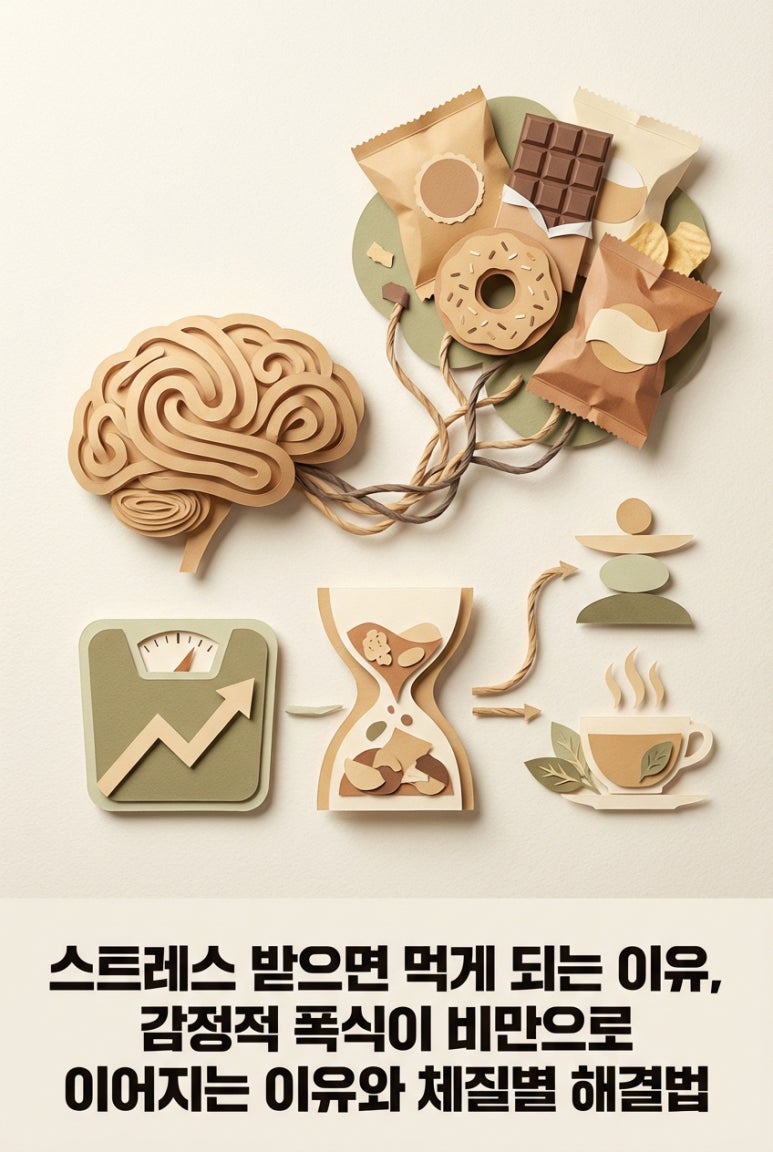
Why You Eat When Stressed: Understanding Emotional Overeating, How It Leads to Obesity, and Constitution-Specific Solutions


🧾 Answer First | Core Conclusion
Unable to resist late-night snacking every night, self-blaming and fasting the next day, then binge eating again—this cycle.
This is not due to weak willpower.
It is because stress directly disrupts the appetite control circuits in the brain.
Hello.
I am Choi Jang-hyuk, Director of Dong Je Dang Korean Medicine Clinic.
Research shows that 45% of obese individuals exhibit emotional eating—eating in response to emotions rather than hunger[1].
Learning to manage emotions before reducing calories is the key to escaping obesity.
With the 3 practical strategies I'm about to share, you can see changes starting tonight.
✅ Action | Immediate Practice
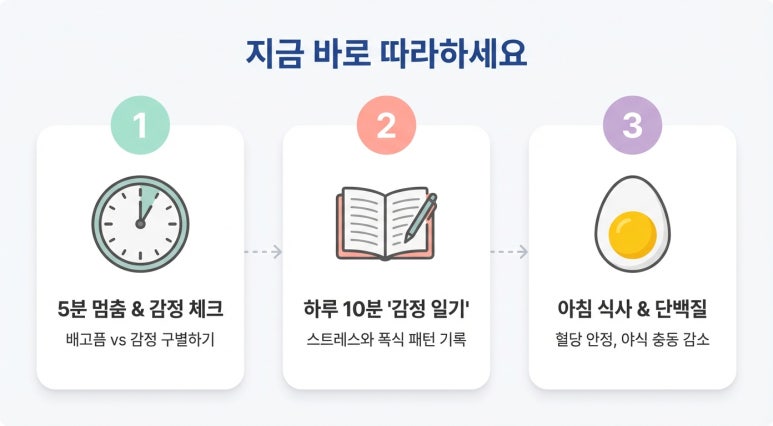
1️⃣ When the urge to eat late-night snacks comes, pause for 5 minutes and check your emotions
Before opening the refrigerator, pause for just 5 minutes.
Ask yourself one simple question: "Am I physically hungry, or is my heart feeling empty?"
If it's true hunger, your last meal would have been 4 hours ago.
If not, then emotion has disguised itself as appetite.
This 5-minute pause alone can reduce binge eating by half.
2️⃣ Write a "feelings diary" for 10 minutes daily
Before bed, write down one moment from your day when you felt the most stressed.
Record what emotion you felt at that moment, and what you ate afterward (or wanted to eat).
After just 2 weeks, you'll begin to see your own "emotion-binge eating pattern" clearly.
Once you see the pattern, you can break it.
3️⃣ Do not skip meals—especially breakfast
Skipping meals raises cortisol (stress hormone) levels, increasing the likelihood of evening binge eating.
Eating a meal with protein at breakfast stabilizes blood sugar throughout the day and significantly reduces nighttime eating urges.
Two boiled eggs and one banana are sufficient.
If self-directed attempts show no improvement, working with a professional to identify the root cause is the fastest path forward.

🚨 Warning | Critical Signs to Monitor
✔ Binge eating-fasting cycles repeat for more than 2 weeks
One or two instances of overeating happen to everyone.
But if eating and fasting patterns repeat for over 2 weeks, emotional eating has become a established habit.
Professional intervention is needed.
✔ Severe guilt or depression follows after eating
If self-reproach like "Why am I like this?" repeats every time, you've already entered a psychological vicious cycle.
This is not a matter of willpower but a signal that the brain's reward circuits have been disrupted.
✔ Body weight fluctuates more than 5kg within 3 months
Rapid weight fluctuations are warning signs of hormonal disruption and visceral fat accumulation.
Especially if fat concentrates in the abdominal area, cortisol-related issues should be suspected.
✔ When stressed, no mood-boosting method besides food comes to mind
When food becomes your sole comfort method, it indicates emotional isolation.
We strongly recommend consulting with a professional healthcare provider.

🧠 The Why | Root Cause Analysis
When stressed, our brain switches to survival mode.
With the hypothalamic-pituitary-adrenal (HPA) axis activated, the hormone cortisol floods the system.
Cortisol is originally a hormone that commands the body to secure energy during crisis situations.
The problem is that modern stress is not a momentary crisis like being chased by a tiger,
but rather chronic stress that repeats daily.
Chronically elevated cortisol does three things[2]:
First, it amplifies cravings for high-calorie, salty-sweet foods.
Second, it redirects fat storage toward the abdominal visceral area.
Third, it prevents proper satiation even after eating.
Added to this is a dysfunction in the brain's reward circuits.
When eating high-calorie foods, dopamine is released, creating temporary pleasure.
But when this pattern repeats, the brain becomes desensitized to the same amount of dopamine,
requiring increasingly larger amounts to achieve the same satisfaction[3].
This is identical to the tolerance mechanism of substance addiction.
In Sasang Constitution Medicine, this process is explained as an imbalance of Seong-Jeong (emotional nature).
Yi Je-Ma taught, "When emotional nature becomes greatly disturbed, it is no different from cutting an organ with a blade."
Particularly for the Tae-Eumins (greater yin constitution), when emotional nature reaches extremes, it is described as 'endless indulgence in pleasure (侈樂無厭)',
which directly parallels the endless binge-eating state caused by dopamine tolerance.
For the So-Eumins (lesser yin constitution), when emotional nature is shaken, it is said that 'preferences become indefinite (喜好不定)'.
This is the state of trying various foods but never feeling satisfied, where dietary habits themselves become unstable.
Because the direction in which the mind deteriorates differs by constitution, even in the same obesity, uniform dieting approaches fail.
📊 Proof | Cases and Evidence
A 2025 systematic review (21,237 subjects) reported the prevalence of emotional eating in overweight and obese populations at 44.9%[1].
Another meta-analysis confirmed a bidirectional relationship: obesity increases depression risk by 55%, while depression increases obesity risk by 58%[4].
In a study of 3,348 Koreans, the obesity risk for Tae-Eumins (TE) was 20.2 times higher in males and 14.3 times higher in females compared to So-Eumins, and this difference was maintained even after adjusting for dietary habits[5].
This evidence shows that obesity is not simply due to "eating too much," but is deeply connected to constitutional psychological structures.
Among patients I've met in clinical practice, some achieved average weight loss of 4-5kg over 3 months with only changes in emotional pattern recognition and constitution-specific lifestyle adjustments—without dietary modification.
The common factor among these patients was that they first changed "the emotional state in which they eat" rather than "what they eat."

🔚 Closing | Summary and Encouragement
Diet failure is not a matter of willpower.
Stress disrupts cortisol and dopamine, creating a vicious cycle of binge eating.
To break this cycle, you must address emotions before diet.
Your body is already prepared to recover.
You simply need emotional balance to come first so your body can follow.
You need not carry this discomfort alone.
If you would like to schedule a consultation where we can examine your constitution and lifestyle habits together, please feel free to contact us.
✍️ Reviewed by Choi Jang-hyuk, Director of Dong Je Dang Korean Medicine Clinic
❓ FAQ
Q. How do I distinguish between emotional overeating and regular overeating?
The key is: "Did I eat because I was hungry, or did I eat because of emotion?"
Emotional overeating starts suddenly, craves specific foods (salty-sweet), and is followed by guilt.
Regular overeating develops gradually, stops as you become full, and while you feel satiated after eating, guilt is minimal.
Q. Isn't constitution-based dieting just about matching foods?
The constitution-specific food lists commonly known are only a small fragment of Sasang Constitution Medicine.
The original texts of Sasang Medicine view the cause of disease as 'imbalance of emotional nature (性情)',
placing much greater importance on emotional balance than on food.
While eating foods suited to your constitution helps, understanding your own pattern of responding to stress comes first.
Q. Do I need to directly test my cortisol levels?
For typical stress-related obesity, cortisol testing is not absolutely necessary.
However, if severe abdominal obesity is accompanied by facial puffiness or thin skin with easy bruising, Cushing's syndrome is possible and consultation with an endocrinologist is recommended.
📚 References
[Western Medicine (WM)]
[1] Chew et al. (2025). "The global prevalence of emotional eating in overweight and obese populations: A systematic review and meta-analysis." British Journal of Psychology.
[2] Hewagalamulage et al. (2016). "Stress, cortisol, and obesity: a role for cortisol responsiveness in identifying individuals prone to obesity." Domestic Animal Endocrinology.
[3] Yu et al. (2022). "A literature review of dopamine in binge eating." Journal of Eating Disorders.
[4] Luppino et al. (2010). "Overweight, obesity, and depression: a systematic review and meta-analysis." Archives of General Psychiatry.
[Korean Medicine (KM)]
[5] Baek et al. (2014). "The prevalence of general and abdominal obesity according to sasang constitution in Korea." BMC Complementary and Alternative Medicine.
[6] Yi Je-Ma. 『Donguisusebowon (東醫壽世保元)』 Sadan Theory. 1894.
[7] Sasang Psychology Research Institute. 『Sasang Psychology—Reading Vibrant Donguisusebowon 2.0』