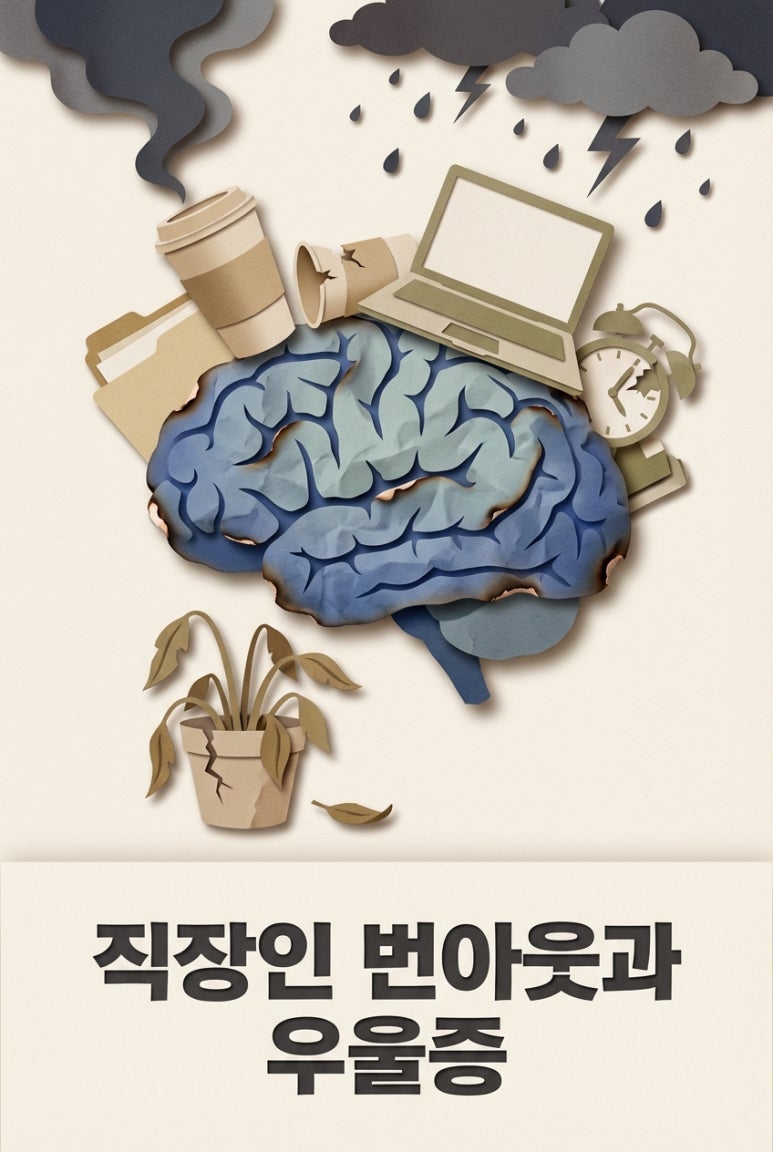

I'm Not Even Sad, But I Don't Want to Do Anything — Depression Is Not Deep Sadness, but Eyes That Were Looking Outward Now Turned Inward

 🧾 Answer First | Core Conclusion
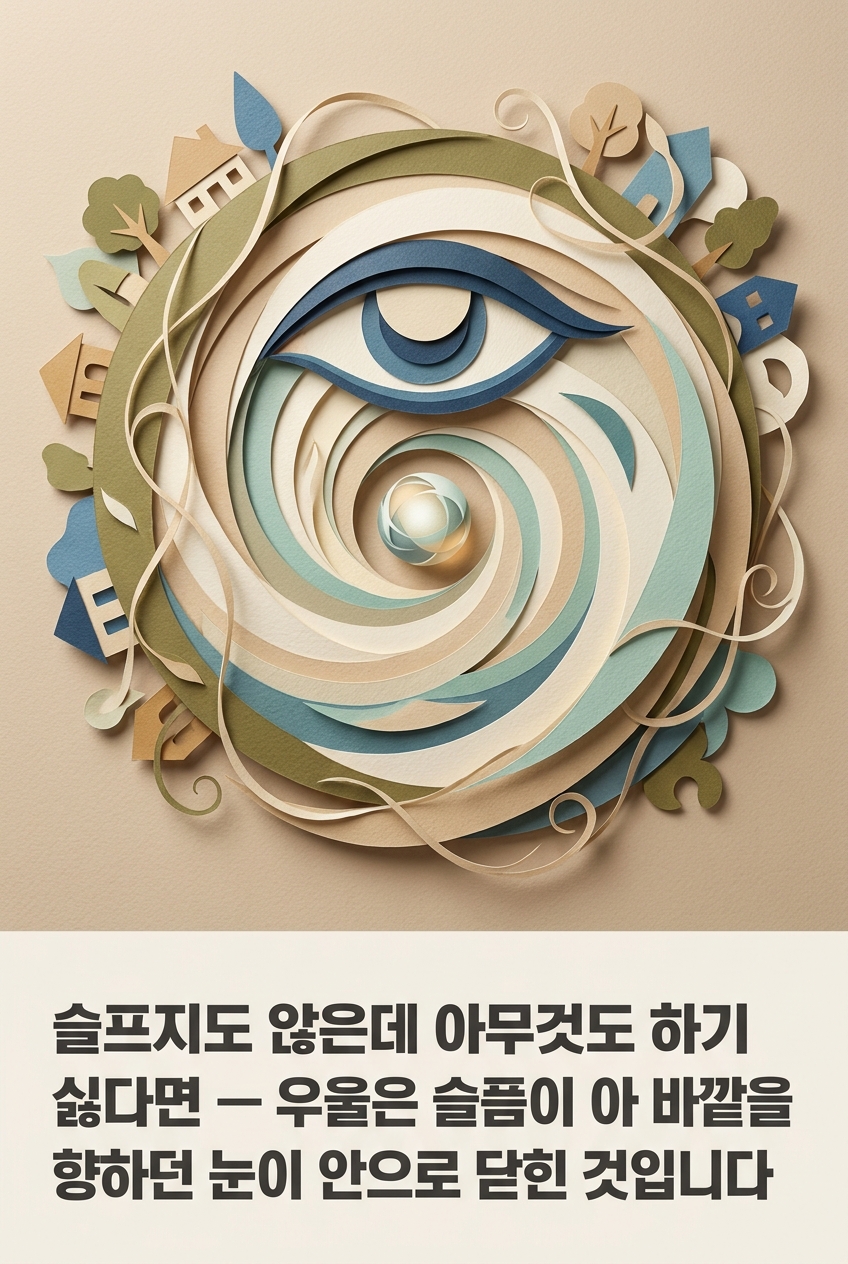
I don't want to cry, but I simply don't want to do anything.
Even the things I used to enjoy have withered, and my heart doesn't stir even when someone brings good news.
I am Dr. Choi Jang-hyuk, director of Dongjjedang Korean Medicine Clinic.
Let me say this first.
Depression is not sadness deepened.
Sadness is crying in reaction to something—the mind is still turned outward.
Depression is when that gaze stops looking outward and closes inward instead.
That's why good things don't feel good, and gradually you lock yourself away inside.
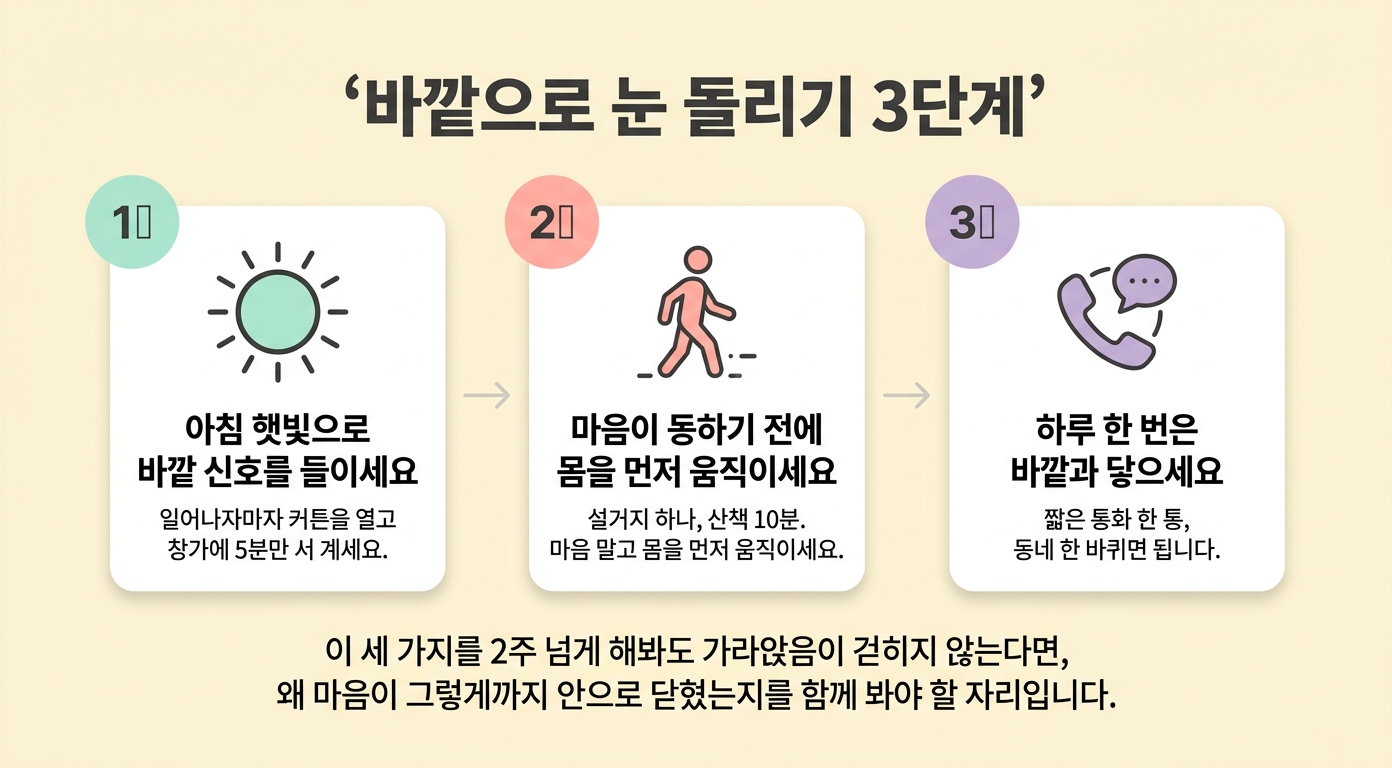
Let me start with three ways to turn those closed eyes back outward.
 ✅ Action | Immediate Practice
1️⃣ Let in the external signal with morning sunlight
A body closed inward doesn't turn itself on.
The moment you wake up, open the curtains and stand by the window for just 5 minutes.
When outside light enters, the daily rhythm that had stopped begins to move again.
2️⃣ Move your body before your heart feels like moving
If you wait for "the desire to do something" to come, it never will.
Because depression extinguishes that very desire first.
Wash one dish, take a 10-minute walk.
Move your body first, not your heart.
3️⃣ Touch the outside world at least once a day
The longer you stay in your room, the more your mind turns inward.
One brief call, one walk around the neighborhood is enough.
It's not about pretending to be well, but about touching the outside world once.
If this heaviness doesn't lift even after doing these three things for more than 2 weeks, it's time to look together at why your mind has closed inward to this extent.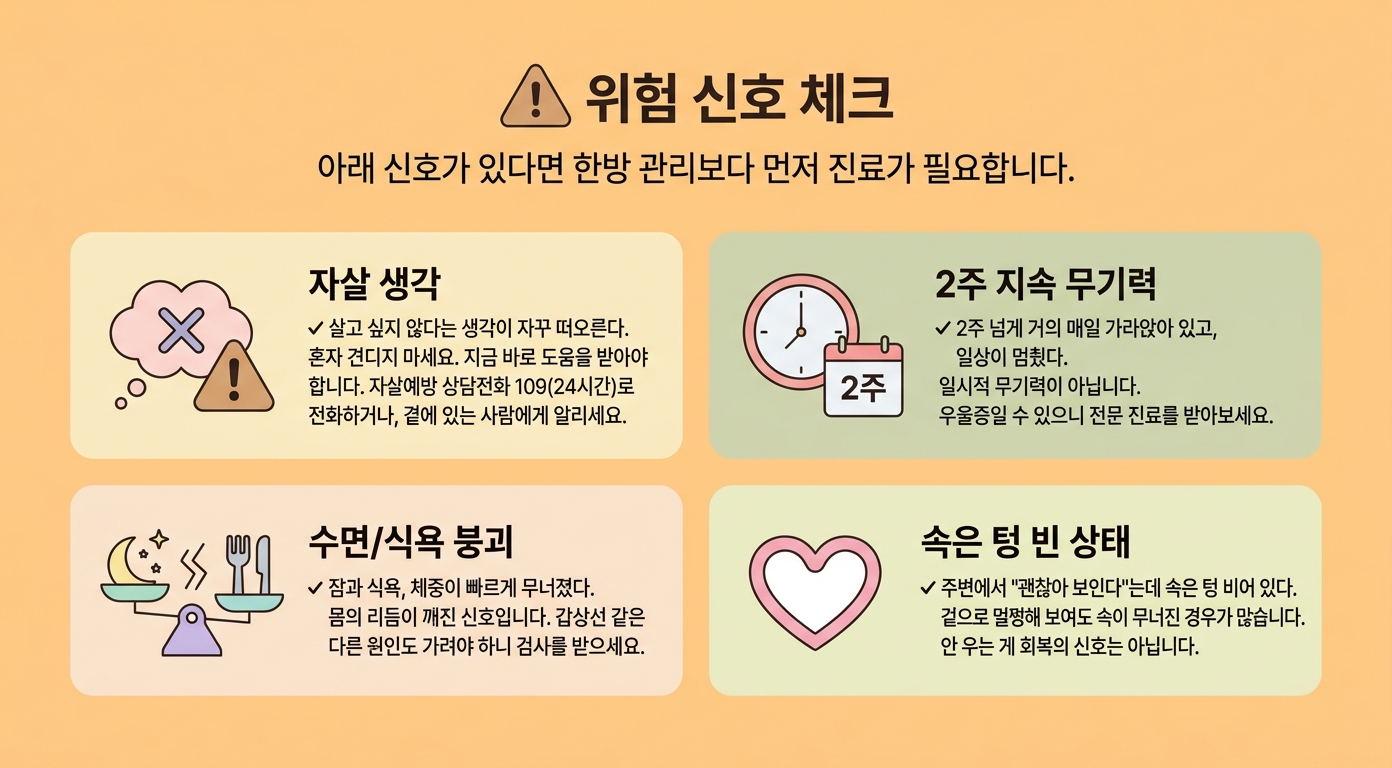 🚨 Warning | Warning Signs You Must Check
If you have any of the following signs, you need medical attention before any treatment.
✔ Thoughts that you don't want to live keep coming to mind
Don't endure this alone.
You need help right now.
Call the Suicide Prevention Hotline 109 (24 hours) or tell someone close to you.
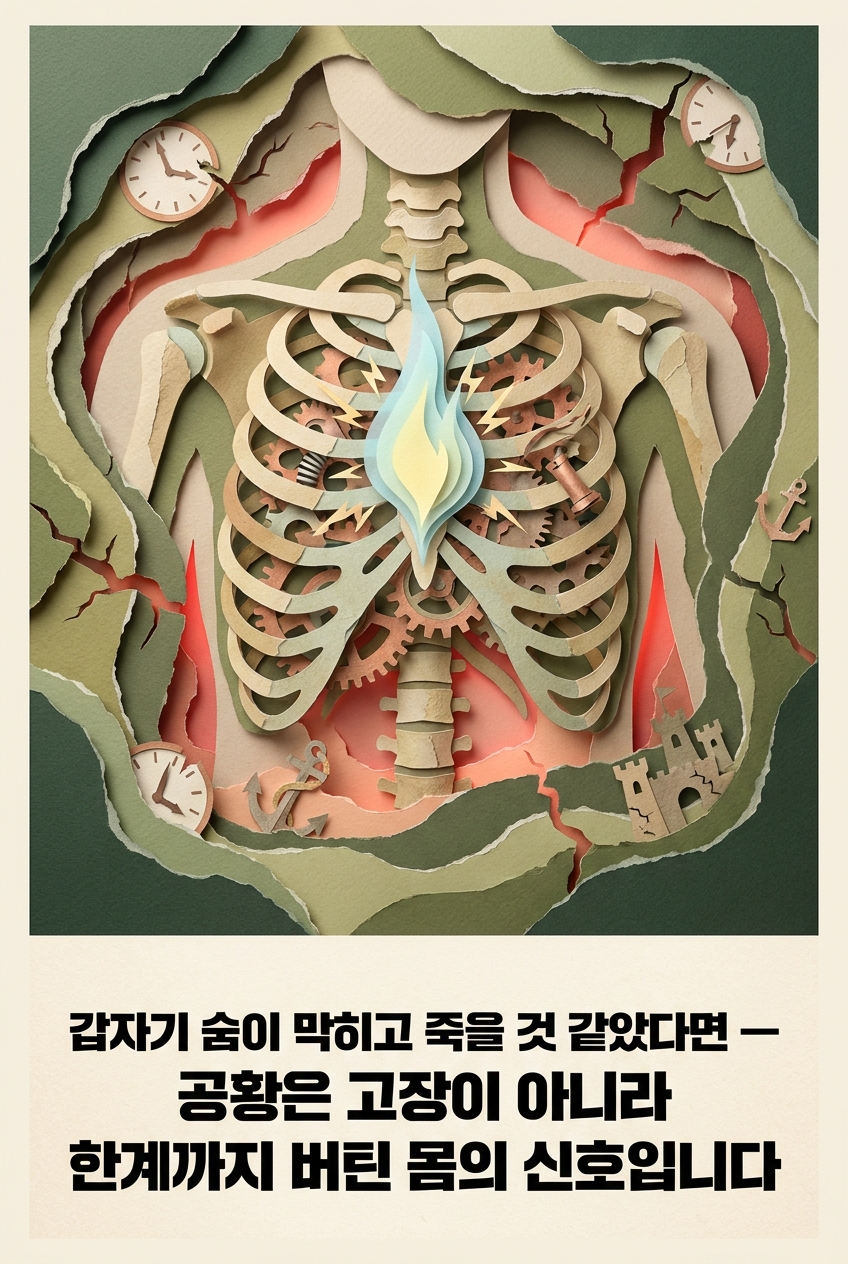
✔ You've been feeling down almost every day for more than 2 weeks, and your daily life has stopped
This is not temporary helplessness.
You may have depression, so seek professional medical evaluation.
✔ Your sleep, appetite, and weight have rapidly deteriorated
This is a sign that your body's rhythm has broken down.
Get tested to rule out other causes like thyroid problems.
✔ People around you say you "look fine," but you feel empty inside
Often people look fine on the surface even when they're falling apart inside.
Not crying is not a sign of recovery.
 🧠 The Why | Anatomy of Cause
Explanation | From a Western Medicine Perspective
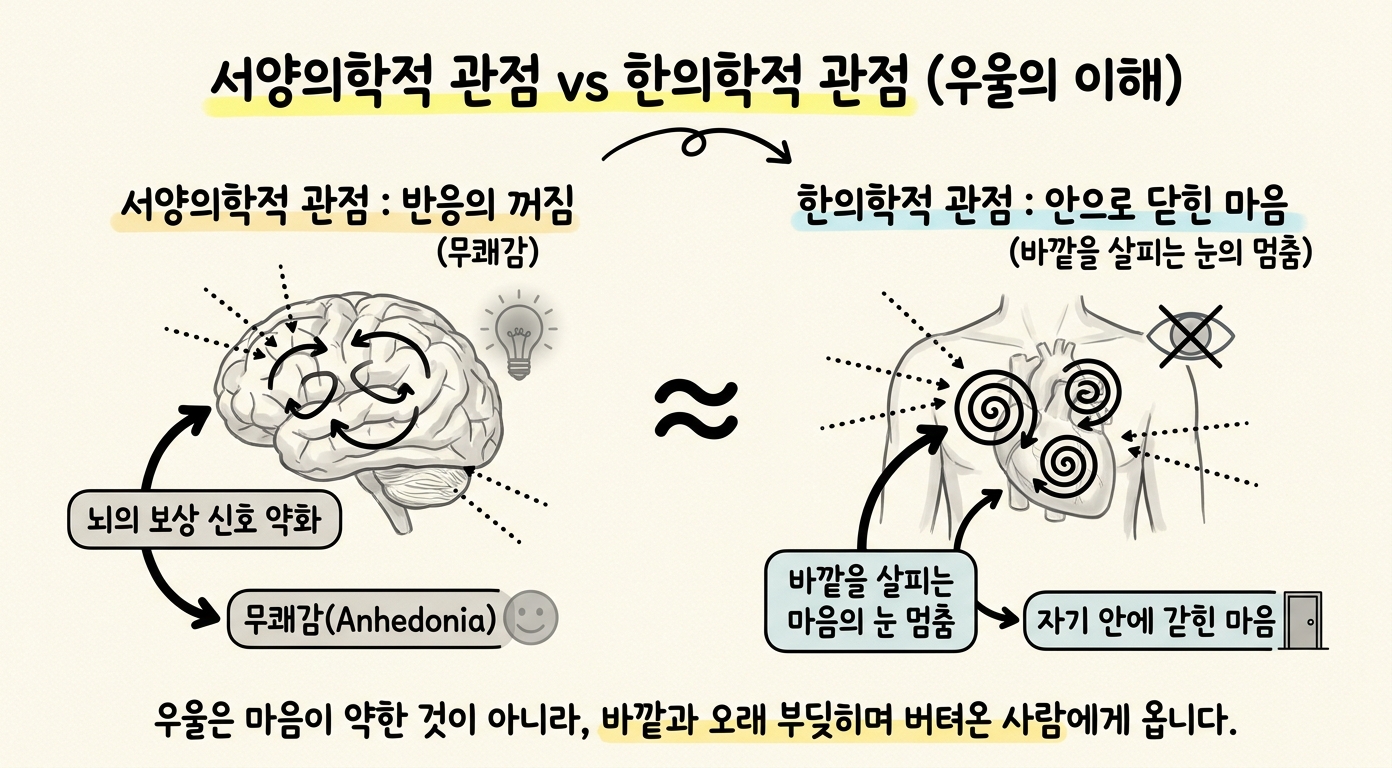
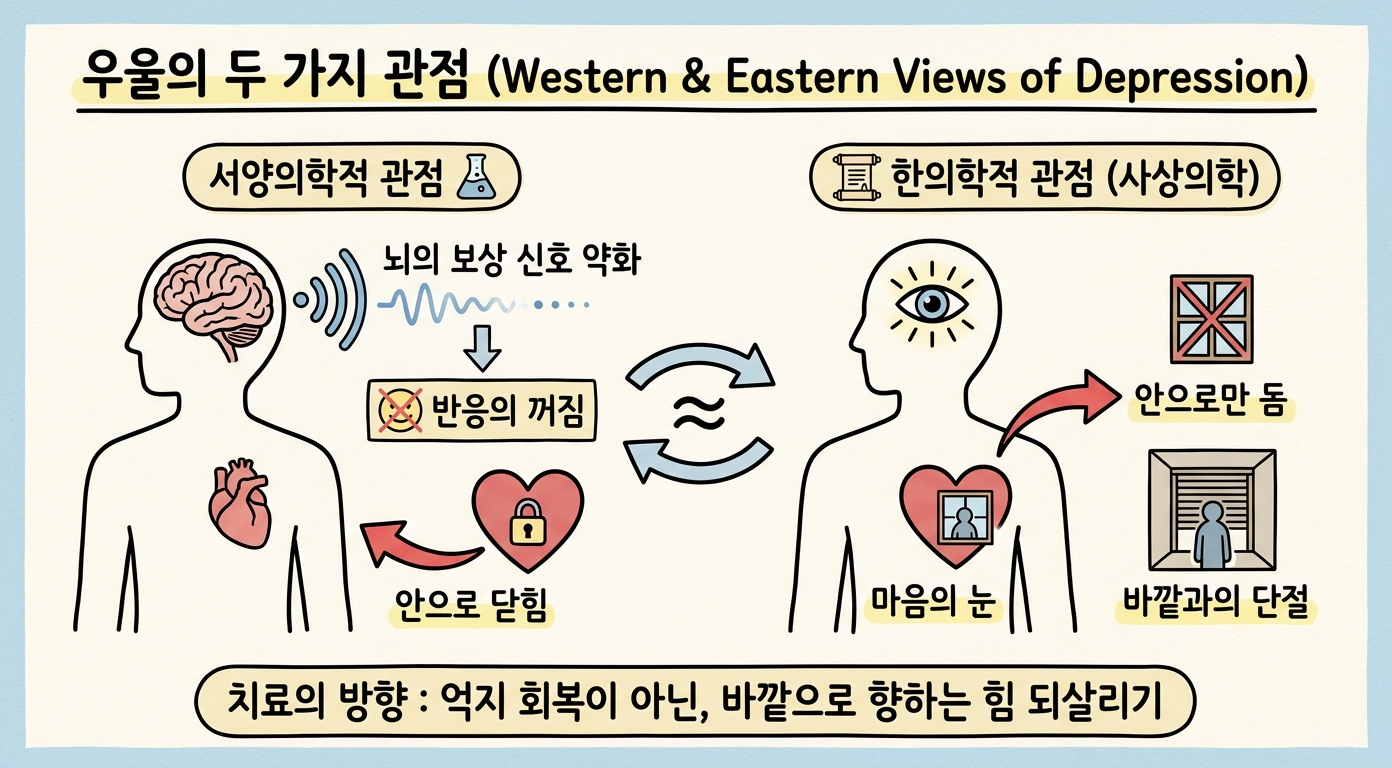
Western medicine views depression not as sadness but as a "loss of responsiveness."
The brain's reward signals that make you feel joy at good things have weakened.
That's why you don't feel pleasure, and both motivation and appetite drop.
This is called anhedonia.
Medication lifts those dulled signals again.
However, it doesn't ask why this particular person has closed up this way.
Explanation | From a Korean Medicine Perspective
Sasang medicine looks at what comes before.
Lee Je-ma considered the mind's eye that observes the external world to be important.
When this eye remains alive looking outward, the mind flows while exchanging with the world.
But when pressed for a long time, this eye stops looking outward and only turns inward.
The strength to respond to the external world fades, and the mind becomes trapped within itself.
Think of a room with all its windows closed.
When outside light and sound are cut off, the person inside gradually locks themselves away.
It's not that they turned away from the world of their own will, but they've spent all their strength enduring and are now closed off.
That's why depression comes not to those with weak hearts, but to those who have endured long struggles with the outside world.
When the same blockage bursts outward, it becomes panic, and when it closes inward, it becomes depression.
I covered in greater depth how this mind's eye is revealed in the body in where emotions fall in the body.
What's interesting is the solution Lee Je-ma offered.
He did not say to forcibly lift the closed mind.
"Observe the external world (察於外)"—turning the eyes back outward is the first step, he said.
The three practices above are exactly that.
The direction varies slightly by constitution, but for closed-in depression, touching the outside world again is where it begins.
That's why constitutional treatment doesn't forcibly lift mood either.
Instead, it helps revive the strength so that eyes that only turned inward look outward again.
 📊 Proof | Cases and Evidence
There was a man in his 40s who worked in an office.
He said nothing felt fun even though he wasn't sad, and even things he used to enjoy had withered away.
Tests were normal, and people around him only told him he was "hanging in there well."
I didn't ask "since when" but rather "what happened to you before that?"
He had been shouldering outside responsibilities alone for over a year, never once expressing his true feelings.
He had spent all his strength observing the external world, and his mind had closed inward.
Instead of grand resolutions, we started with morning sunlight and short walks.
As he began touching the outside world again, the withered activities gradually came into view.
He didn't suddenly become stronger.
His closed eyes simply turned outward again. 🔚 Closing | Summary and Encouragement
Depression is not sadness.
It is a state where the mind's eye that was looking outward has turned inward.
Rather than forcibly lifting mood, turning that eye back outward comes first.
Not all at once, but starting today with just one touch to the outside world.
If you would like to look together at a sunken heart, please check out our mental health program and feel free to contact us.
✍️ Reviewed by Dr. Choi Jang-hyuk, Director of Dongjjedang Korean Medicine Clinic
❓ FAQ
Q. How is a depressed mood different from depression?
Everyone has days when they feel down.
If you recover within a few days, it's temporary mood.
But if for more than 2 weeks you've felt almost no joy in almost everything daily and your daily life has stopped, it could be depression.
At this point, professional medical attention is needed.
Q. Can someone have depression even without feeling sad?
Yes.
The core of depression is not sadness but a loss of responsiveness.
Good things don't feel good, and bad things become numb.
Not even feeling sadness can actually be a deeper warning sign.
Q. Can depression be overcome by willpower?
It's not a matter of willpower.
The desire to do something itself is extinguished, so "steel yourself" doesn't solve it.
Rather than waiting for your heart, moving your body first and touching the outside world comes first.
Q. Do I need to take medication?
Medication fills the brain signals that lift mood.
It can be very helpful when symptoms are severe.
However, medication doesn't change why it closed.
Sudden cessation carries risks of withdrawal symptoms or relapse, so decisions about reducing or combining treatments should be made with a professional.
Q. Why do you recommend constitutional treatment for depression?
Constitutional treatment observes in which direction that person's mind has closed and opens that place.
As closed eyes begin looking outward again, the extinguished mind gradually turns back on.
📚 References
[Western Medicine (WM)]
[1] Anhedonia as a core symptom of depression—reduced reward value and blunted dopamine reward circuits (Goldstein Ferber et al., Int J Mol Sci 2021)
[2] Cipriani et al. Comparative efficacy and acceptability of 21 antidepressants—network meta-analysis of 522 RCTs involving 116,477 participants, all antidepressants effective compared to placebo (Lancet 2018)
[3] Diagnostic criteria for major depressive disorder—depressed mood or loss of interest/pleasure lasting more than 2 weeks (DSM-5)
[4] Effect of behavioral activation and morning light exposure on depression improvement
[Korean Medicine (KM)]
[5] Korean Society of Oriental Neuropsychiatry. 『Standard Clinical Practice Guidelines for Depressive Disorder in Korean Medicine』
[6] Lee Je-ma. 『Dongeuisusebowon』Gwangjeset—余足之曰 太陰人察於外而恒寧靜慟心 (Observing the outside makes sorrow peaceful and tranquil)
[7] Choi Jang-hyuk. 「Where does the mind's closure fall—Lee Je-ma's theory of distortion and Nummenmaa's emotional body map」 Sowonjae 2026