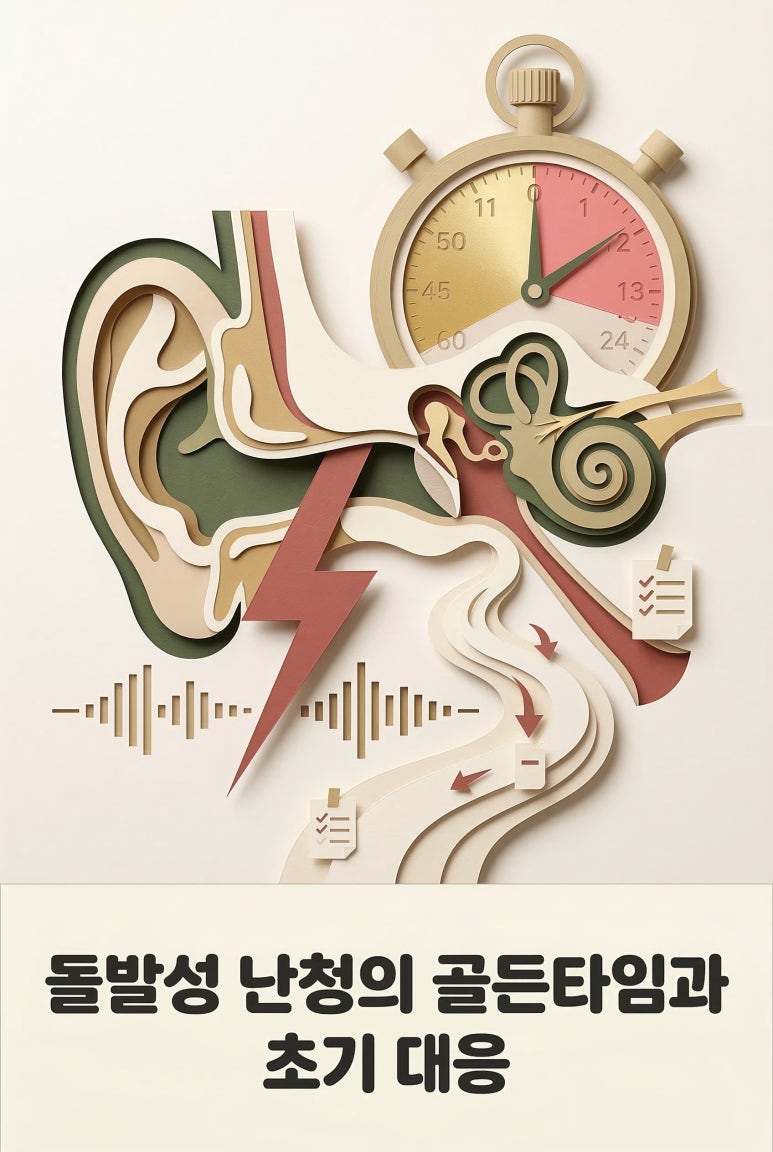

My nose is blocked and my head feels foggy, and I can't concentrate on work. What should I do?: Solutions for rhinitis that causes nasal congestion, brain fog, and reduced concentration

 🧾 Answer First | Key Conclusion
Hello.
I am Dr. Choi Jang-hyuk, Director of Dongjedad Korean Medicine Clinic.
"My nose is completely blocked, and my head feels foggy. I simply cannot concentrate on work."
This is a complaint I hear very frequently from office workers in their 30s and 40s in my clinic these days.
When your nose is blocked, the oxygen supply to the brain decreases, making your head feel heavy and causing extreme fatigue.
I can only imagine how frustrating it must be to be unable to concentrate on work when you can barely breathe.
However, you must stop blindly spraying pharmacy nasal sprays or taking mucus medications out of urgency.
Instead, it can actually reduce brain alertness and worsen work efficiency.
What is needed is fundamental management that reduces nasal mucosa swelling and opens the oxygen pathway to the brain.
Please follow these 3 steps that I'm about to share with you right now.
 ✅ Action | Immediate Implementation
If your nose is severely blocked to the point where your head feels foggy, implement these 3 things right now.
1️⃣ Apply a warm towel compress around your nose.
Soak a towel in warm water and place it around your nose and eyes for about 5 minutes.
As the warmth is transmitted, blood circulation is promoted and the swelling of the nasal mucosa temporarily subsides.
You can immediately feel the previously blocked airways open up and your head become much lighter.
2️⃣ Raise indoor humidity to 50-60%.
The dry office air makes the nasal mucosa more swollen and sensitive.
Turn on a personal humidifier or drink warm water frequently to keep the mucosa constantly moisturized.
Simply drinking more than 1.5 liters of lukewarm water throughout the day in small portions can thin out sticky nasal mucus and make drainage much smoother.
3️⃣ Gently stretch your neck and shoulders.
When muscles around the neck become tight and stiff, blood circulation to the head worsens.
While seated, slowly rotate your head in large circles and move your shoulders up and down to loosen stiff muscles for 5 minutes.
As blood flow to the brain increases, you can reduce headaches and the foggy feeling caused by nasal congestion.
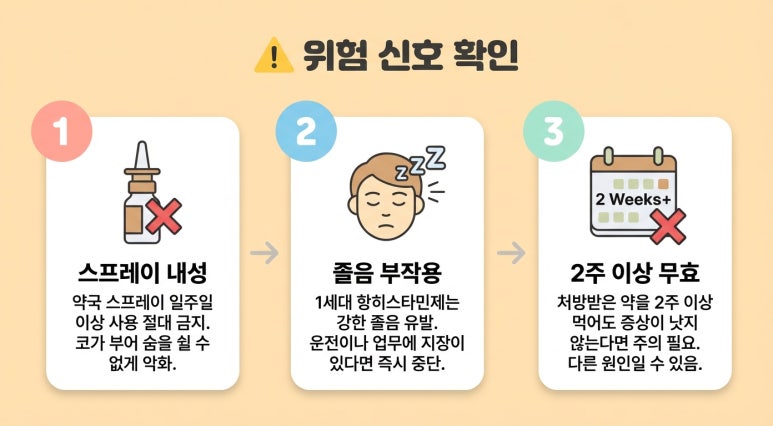 🚨 Warning | Critical Warning Signs to Check
What I most strongly warn my patients about is 'improper medication use.'
The critical warning signs of worsening the condition while trying to get immediate relief are as follows.
✔ When tolerance to rhinitis spray develops
You absolutely must not continuously use over-the-counter nasal sprays like Otrivin for more than a week.
Initially, your nose feels clear and refreshed, but gradually the blood vessels in your nasal mucosa become paralyzed.
Eventually, no matter how much you spray, your nose swells like a rock and you cannot breathe, progressing to 'medication-induced rhinitis.'
✔ When antihistamine drowsiness side effects are severe
Have you ever had meetings or work ruined by overwhelming daytime drowsiness after taking cold medications?
First-generation antihistamines penetrate the brain and cause severe drowsiness and reduced concentration.
If it interferes with daily life or driving, you must immediately stop taking the medication and find alternative solutions.
✔ When prescribed rhinitis medication shows no effect
If nasal congestion and headaches do not improve even after taking medication prescribed by an ENT clinic for more than 2 weeks, you should be cautious.
This goes beyond simple allergic reaction and indicates that the nasal mucosa's own immunity is depleted and is chronically swollen.
Do not blindly increase strong medications; you must fundamentally change your treatment approach.
 🧠 The Why | Root Cause Analysis
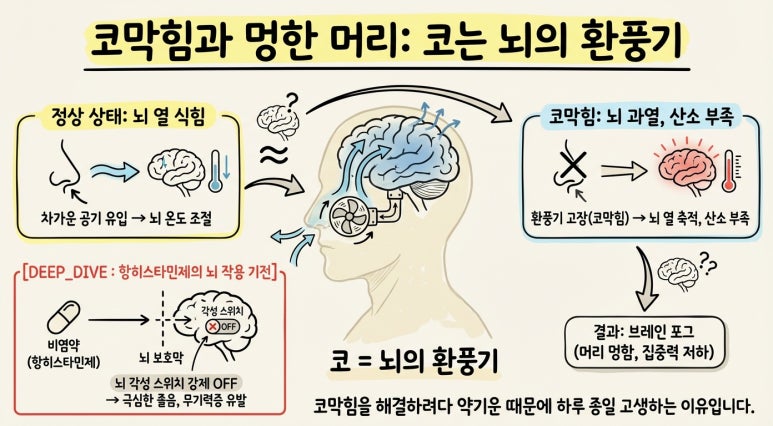
So why does your head feel foggy when your nose is blocked?
Our nose is not merely an organ for smelling.
The nose plays a very important 'ventilation fan' role in cooling the brain's heat.
When we breathe through our nose, cold air passes through the nasal cavity and cools the heated brain.
However, when your nose is blocked, it's like a computer with a broken cooling fan—the brain accumulates heat and lacks oxygen.
This results in the 'brain fog' phenomenon where mental processing slows down, concentration drops, and your head feels foggy.
Commonly taken rhinitis medications easily penetrate the brain's thin protective barrier.
They don't just dry up nasal mucus; they forcibly shut off the brain's 'alertness switch' itself.
Ultimately, this is the structural reason why while trying to solve nasal congestion, you end up suffering from extreme drowsiness and lethargy all day due to medication effects[1].
📊 Proof | Cases and Evidence
Let me share the case of a patient in his late 30s whom I treated.
This patient had to attend important presentations and meetings daily, but whenever he took cold medication, he became so drowsy that he made frequent work mistakes.
To avoid drowsiness, he relied on nasal congestion-clearing sprays, but eventually developed tolerance and came to see me in the worst state where he couldn't breathe at night.
Based on my clinical experience, in such cases, rather than forcibly constricting the mucosa, the priority is to enhance the mucosa's inherent immunity.
I prescribed 'mind-clearing herbal medicine' tailored to his constitution that reduces chronic inflammation of the nasal mucosa and improves blood circulation to the brain.
After 4 weeks of combined acupuncture treatment twice a week, the patient could breathe comfortably through his nose without the effects of strong medication.
The patient smiled broadly saying, 'Doctor, now I can work with a clear head without being intoxicated by medication.'
According to actual domestic research, Korean medicine treatment has been proven to significantly improve quality of life in rhinitis patients and suppress inflammatory responses[3]. 🔚 Closing | Summary and Encouragement
Brain fog caused by nasal congestion is enormous stress and business loss for office workers who work against time every day.
Don't become dependent for life on temporary pharmacy sprays or rhinitis medications that cause drowsiness just because you find breathing uncomfortable right now.
You must identify the real cause of why your nasal mucosa is swollen and help your body recover its own immunity.
With proper treatment applied carefully, you can once again work with a clear and refreshed mind.
Do not suffer alone in silence; please seek help from professionals at any time.
✍️ Reviewed by Dr. Choi Jang-hyuk, Director of Dongjedad Korean Medicine Clinic
❓ FAQ
Q. Can I keep using nasal congestion-clearing medications from the pharmacy?
No, you absolutely must not use them continuously for more than a week.
These medications forcibly constrict blood vessels in the nasal mucosa.
With prolonged use, rebound action causes your nose to swell even more and become hard and stiff.
Q. What should I do when prescribed rhinitis medication shows no effect?
You must go beyond simply suppressing inflammation and enhance the nasal mucosa's regenerative and immune capacity.
Medication that merely dries nasal mucus and stops sneezing temporarily makes it very difficult to reduce structurally swollen mucosa.
You can only see improvement by changing your treatment approach to fundamental therapy tailored to your current body condition and constitution.
Q. Is there really herbal medicine that doesn't cause drowsiness and clears the mind?
Yes, it is possible to achieve a clear mind without the severe drowsiness side effects of antihistamines.
Herbal medicine does not work by suppressing the central nervous system and putting the brain to sleep.
Because it gently alleviates chronic inflammatory areas around the nose and actively improves blood circulation to the brain, it is remarkably effective in maintaining a clear and alert mind without side effects.
📚 References
[Western Medicine (WM)]
[1] ARIA (Allergic Rhinitis and its Impact on Asthma) Guidelines (2020).
"Management of allergic rhinitis and its impact on work productivity."
[2] Bousquet, J., et al.
(2019).
"Allergic Rhinitis and its Impact on Asthma (ARIA) Phase 4 (2018): Change management in allergic rhinitis and asthma."
Allergy.
[Korean Medicine (KM)]
[3] Korean Medicine Association CPG (2021).
"Korean Medicine Clinical Practice Guidelines for Allergic Rhinitis"
[4] NIKOM Korea Institute of Oriental Medicine (2020).
"Korean Medicine Treatment of Respiratory Diseases and Anti-inflammatory Mechanisms of Herbal Medicine"
Head & Face
My nose is blocked and my head feels foggy, and I can't concentrate on work. What should I do?: Solutions for rhinitis that causes nasal congestion, brain fog, and reduced concentration
View Program