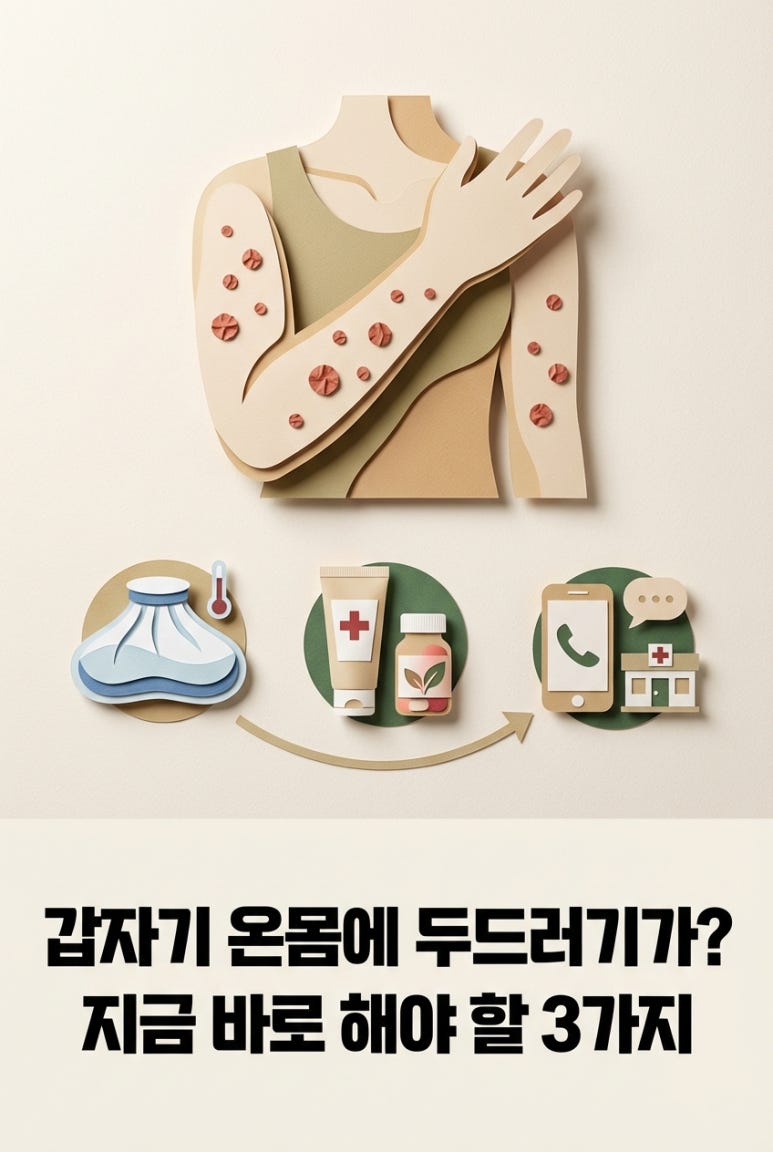
Sudden hives all over your body? 3 things you must do right now

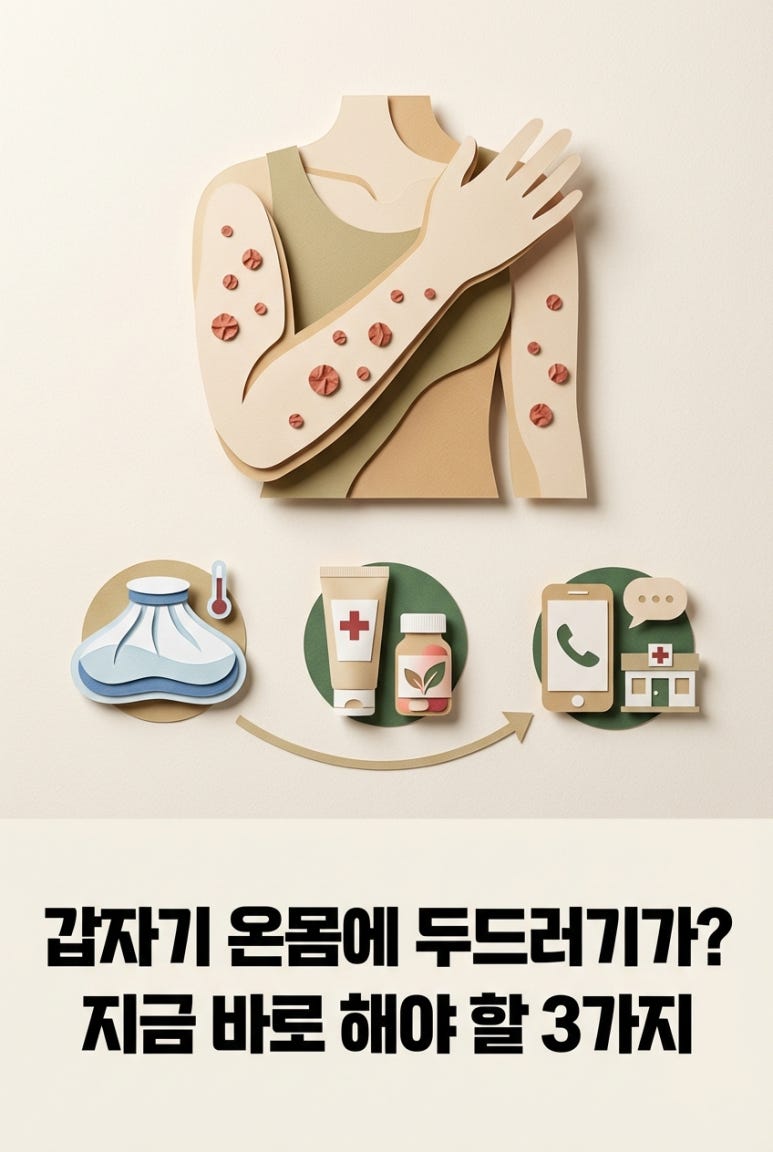 🧾 Answer First | Key Conclusion
"After leaving work and taking a shower, my forearms turned red and swollen.
When I scratched them, they spread further, and the itching is so bad I can't sleep.
I have to go to work tomorrow—should I go to the emergency room right now?"
Hello.
I'm Choi Jang-hyuk, director of Dongjjedang Korean Medicine Clinic.
Hives that suddenly appear at night don't require an emergency room visit.
Most acute hives subside within 24 hours.
However, if you handle them incorrectly at the initial stage, scratching can spread them and they may persist for more than a day.
Try just these 3 things I'm about to tell you.
Most people will feel the itching decrease within 1-2 hours.
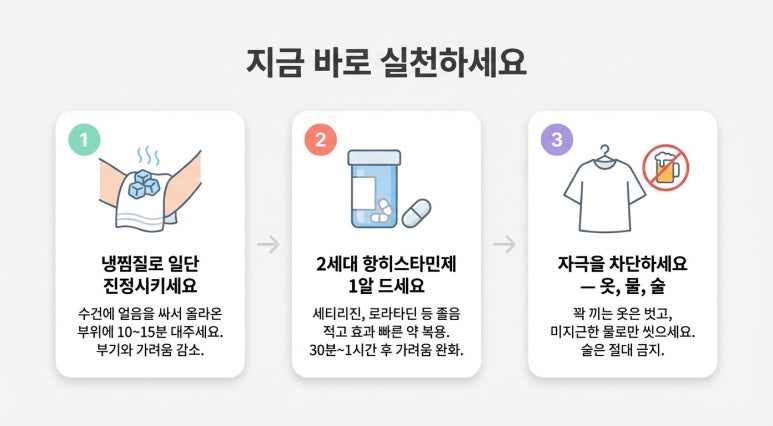 ✅ Action | Immediate Steps
1️⃣ Calm it down with cold compress
Wrap ice in a towel and apply it to the affected area for 10-15 minutes.
The cold temperature slows histamine release and reduces both swelling and itching.
Be sure to wrap the ice in a towel—applying ice directly to skin carries the risk of frostbite.
2️⃣ Take one second-generation antihistamine tablet
Cetirizine or loratadine, available at pharmacies without a prescription, will work.
They cause minimal drowsiness and work quickly.
Avoid first-generation antihistamines (such as chlorpheniramine) as they cause severe drowsiness—skip them if you're driving or working.
The itching will noticeably decrease within 30 minutes to 1 hour after taking it.
3️⃣ Block stimulation — clothing, water, alcohol
Remove tight clothing and change into loose cotton garments.
Hot water dilates blood vessels and worsens hives.
Wash only with lukewarm water today.
Alcohol interferes with histamine breakdown, so it's best not to have even a single drink on days you have symptoms.
If these three measures don't help and symptoms continue for more than a day, it's time to identify the underlying cause of the immune reaction.
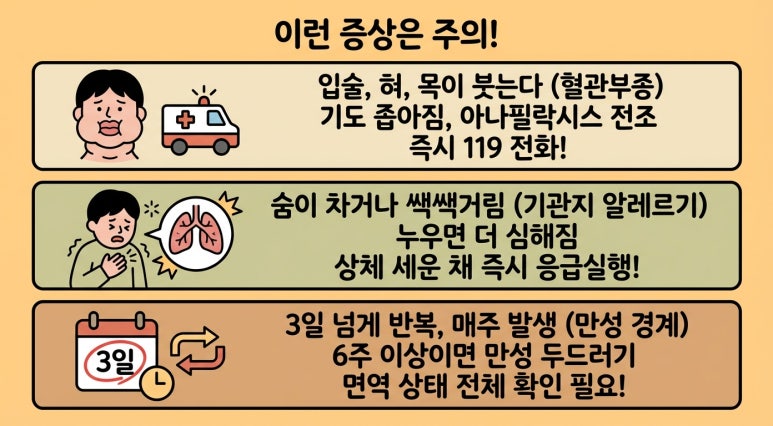 🚨 Warning | Critical Warning Signs to Watch
Most hives are uncomfortable but not dangerous.
However, if the following signs appear, you must act immediately.
✔ Swelling of the lips, tongue, or throat
Deep tissue beneath the skin is swollen (angioedema).
The airway can narrow, and this is a precursor to anaphylaxis.
If you see this symptom, call 119 immediately.
✔ Shortness of breath or wheezing sounds
The allergic reaction has spread to the bronchial tubes.
Lying down will make it worse, so you must sit upright and go to the emergency room immediately.
✔ Symptoms repeat for more than 3 days or return every week
You're at the boundary between acute and chronic hives.
If it repeats for 6 weeks or longer, it's classified as chronic urticaria[3].
At this point, antihistamines alone are insufficient, and you need to examine your overall immune status.
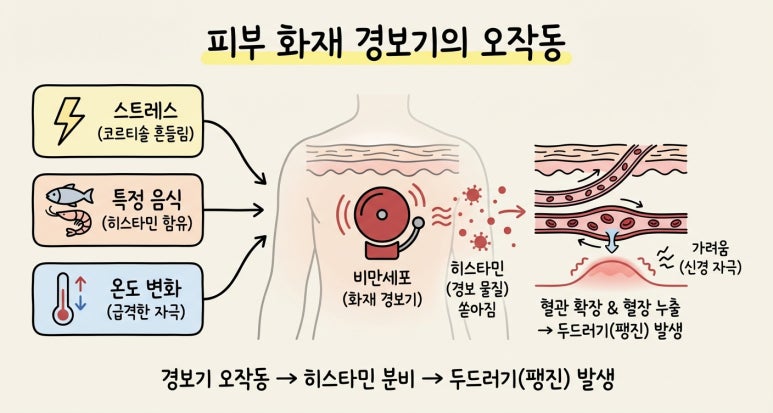 🧠 The Why | Understanding the Cause
Right beneath the skin are immune cells called 'mast cells.'
They're a kind of fire alarm.
Normally, they should only sound when real danger (bacteria, viruses) enters.
But if you're tired, stressed, eat certain foods, or experience sudden temperature changes—this alarm malfunctions.
When the alarm sounds, mast cells release 'histamine' all at once.
Histamine dilates blood vessels and allows plasma to seep under the skin, creating red, raised hives (wheals).
The itching occurs because histamine irritates nerves.
Stress and fatigue: When cortisol levels fluctuate, mast cells become more sensitive.
This is why people who work frequent late nights often develop hives after leaving work.
Food: Foods high in histamine like mackerel, shrimp, and tuna introduce more histamine from outside.
Temperature changes: Right after a hot shower or when entering a warm room from cold outside air, blood vessels react suddenly.
In Korean medicine, this is viewed as 'wind (風)' entering the skin.
If there is accompanying heat, it's classified as wind-heat (風熱); if cold is the cause, it's classified as wind-cold (風寒), and treatment direction is determined accordingly[4].
📊 Proof | Cases and Evidence
According to international guidelines (EAACI 2022), approximately 70% of acute hives patients have their symptoms controlled with second-generation antihistamines alone[1].
The remaining 30% require increased dosage or alternative treatment.
The prevalence in Korea is also significant.
15-20% of the general population experience hives at some point in their lives, and about 30% of them progress to chronic cases[3].
Here's a story of a patient in their 30s who works in an office that I saw in my clinic.
Every Friday evening, hives appeared on their arms and legs.
When they took Western medicine, they felt better the next day, but the hives returned the following week.
When I asked, they were working 60 hours per week and sleeping less than 5 hours.
After examining their constitution and combining immune-stabilizing herbal medicine with adjustments to sleep and diet, the frequency dropped dramatically by week 4, and by two months later, they were fine without medication.
 🔚 Closing | Summary and Encouragement
To summarize — when hives suddenly appear, use cold compress, take antihistamines, and block stimulation.
Do these three things right away.
Most cases subside within a day.
But if hives keep recurring, don't just suppress them with medication—investigate why the alarm is malfunctioning.
✍️ Reviewed by Choi Jang-hyuk, Director of Dongjjedang Korean Medicine Clinic
❓ FAQ
Q. Why do hives get worse at night?
Cortisol levels drop at night, activating immune responses.
Histamine release increases and body temperature rises, making itching and hives worse.
Taking antihistamines before bed can help.
Q. Can I shower if I have hives?
It's fine to wash with lukewarm water (35-37℃) briefly.
Hot water can dilate blood vessels and worsen hives.
Avoid scrubbing or rubbing hard, as this damages the skin barrier—just lightly wash with some foam.
Q. Why do hives appear when I drink alcohol?
Alcohol reduces the activity of enzymes that break down histamine.
Histamine stays in your body longer, making hives more likely to form.
In particular, fermented alcohol like wine or beer contains histamine itself, so they're more likely to trigger hives.
📚 References
[Western Medicine (WM)]
- [1] Zuberbier T, et al. (2022). "The International EAACI/GA²LEN/EuroGuiDerm/APAAACI Guideline for the Definition, Classification, Diagnosis, and Management of Urticaria." Allergy.
- [2] NICE CKS (2023). "Urticaria — Scenario: Acute urticaria."
- [3] Korean Dermatological Association (2021). "Guidelines for Urticaria Management."
[Korean Medicine (KM)]
- [4] Korean Association of Oriental Medicine (2020). "Korean Medicine Clinical Practice Guidelines for Urticaria (Damma-jin)."
- [5] NIKOM (2019). "Korean Medicine Treatment of Urticaria — Evidence Analysis of Herbal Complex Formulas."