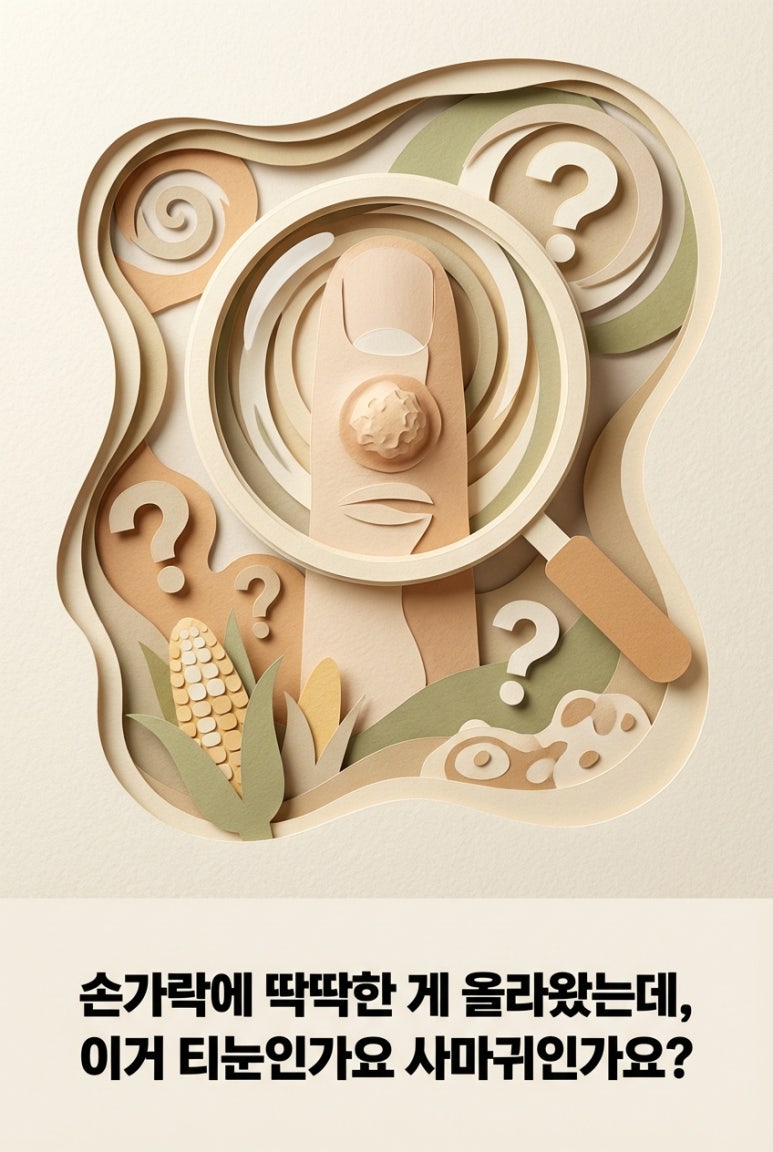
Hard bumps appeared on my fingers - is this a callus or a wart?

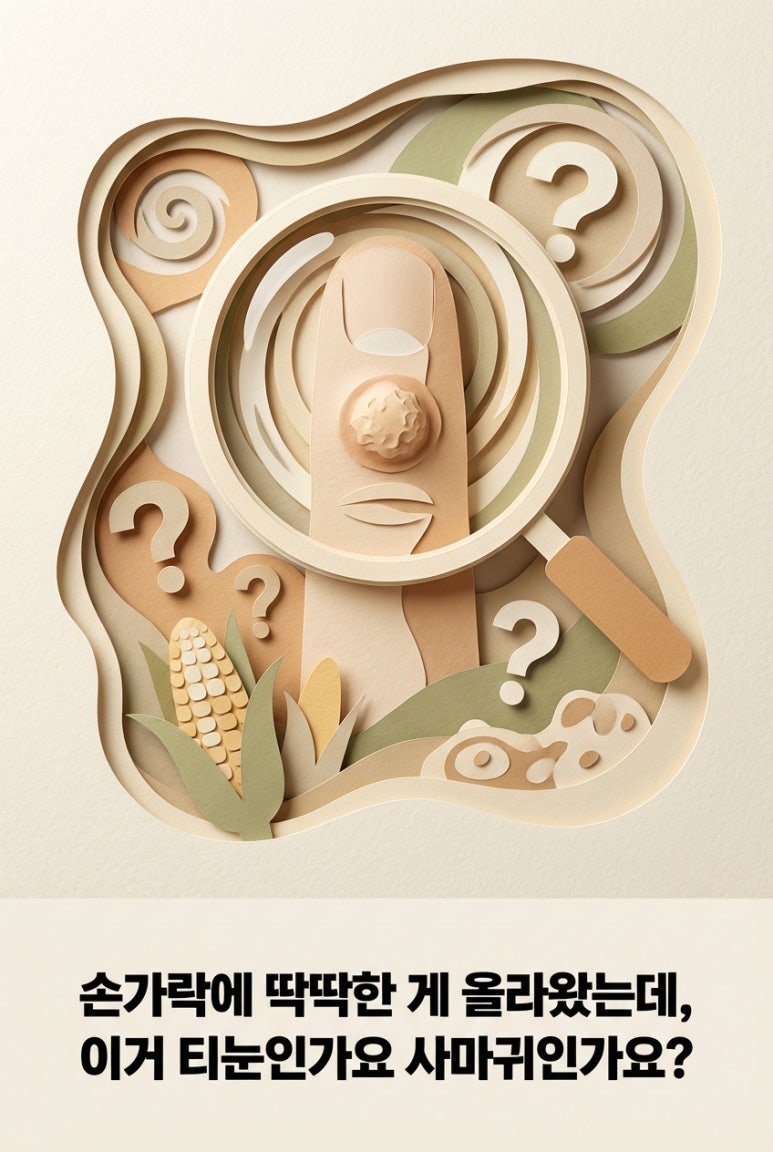 🧾 Answer First | Key Conclusion
You've probably noticed rough, hard bumps appearing on your fingers or the back of your hands,
thinking they were calluses and leaving them alone.
If you see black dots inside, it's not a callus.
It's likely a viral wart.
Hello.
I'm Dr. Choi Jang-hyuk, director of Dongjejdang Korean Medicine Clinic.
Common warts are caused by human papillomavirus (HPV) infection on the skin.
If left untreated, they can spread to surrounding areas and transmit to others.
However, with appropriate treatment, most warts heal completely.
Check out the 3 management methods I'm about to share and the warning signs you must know about.
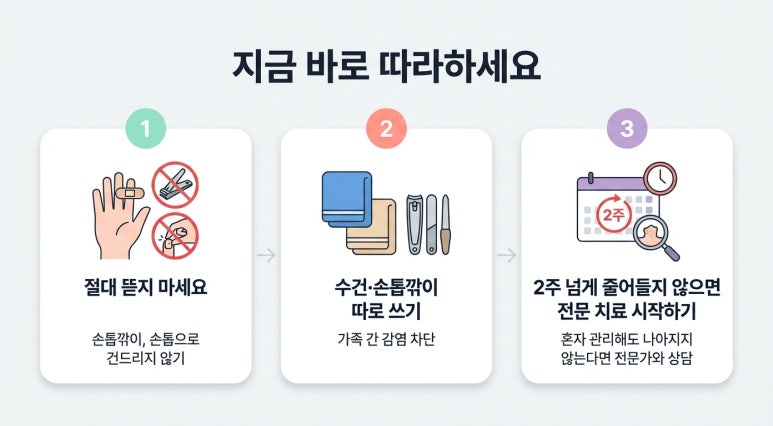 ✅ Action | Immediate Steps
1️⃣ Never pick at it — Don't touch with fingernails or nail clippers
When you pick or trim a wart, virus-contaminated debris transfers to surrounding skin.
There are actual cases where a wart that started on one finger spread to both hands and even the lips.
If you discover a wart, don't touch it and cover it with a bandage for now.
2️⃣ Use separate towels and nail clippers — Block family transmission
Wart virus spreads through towels and nail clippers.
Special caution is needed in households with children.
If you have a wart, you must use separate personal towels and tools.
3️⃣ If it doesn't shrink after 2 weeks, start professional treatment
Warts sometimes disappear naturally depending on immunity,
but if there's no size change after 2 weeks or it's actually growing,
professional treatment is needed rather than waiting for natural healing.
Especially for frequently-used areas like hands and feet, starting treatment earlier shortens the duration.
If self-management doesn't improve it, identifying the root cause with an expert is the fastest path.
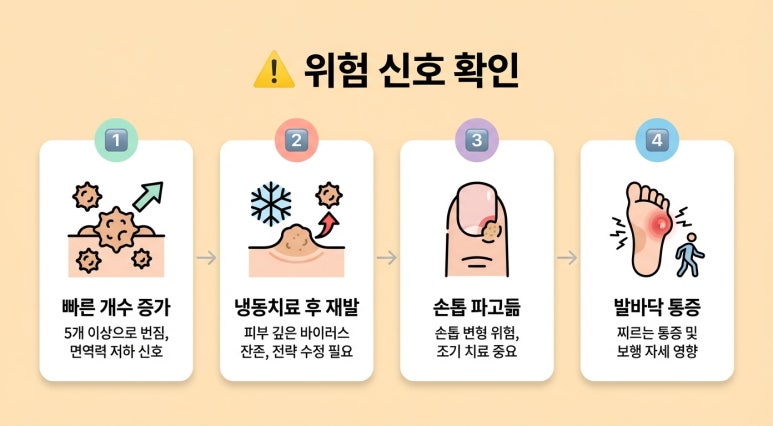 🚨 Warning | Must-Check Warning Signs
✔ When the number of warts increases rapidly
If warts that started as 1-2 spread to 5 or more in several weeks,
it signals that immunity isn't suppressing the virus.
In this case, immune status must be evaluated together.
✔ When recurrence occurs after 3 or more cryotherapy treatments
Cryotherapy is a method that freezes and removes only the visible part of the wart.
If the same spot regrows despite 3 or more repeated treatments,
it means the virus remains deep in the skin, requiring a change in treatment strategy.
✔ Warts burrowing around the nail
Warts growing under or beside the nail are difficult to treat,
and if left untreated, can cause nail deformation.
In such cases, early treatment initiation is important.
✔ Warts on the sole of the foot that hurt when walking
Plantar warts grow inward due to weight pressure, causing stabbing pain with each step.
Altered gait can lead to knee and lower back pain.
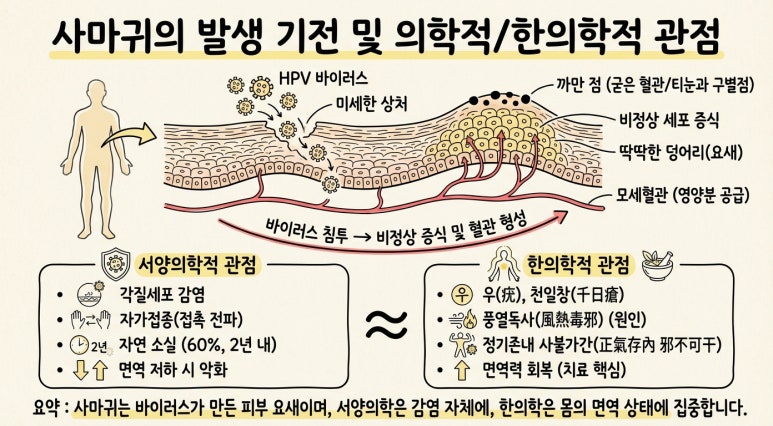 🧠 The Why | Understanding the Cause
Warts form because of viruses embedded in the skin.
The cause is human papillomavirus (HPV), and among over 200 types,
HPV-2 and HPV-4 are the types that commonly affect hands and feet.
If there are microscopic wounds on the skin invisible to the eye, the virus penetrates and establishes itself within epidermal cells.
Virus-infected cells multiply abnormally fast, creating hard lumps.
It's similar to building a small fortress on the skin surface.
The black dots visible inside are coagulated blood capillaries,
the traces of warts pulling blood vessels to attract nutrients.
This dot is the most reliable clue to distinguish warts from calluses.
Wart virus only infects skin keratinocytes and doesn't spread through bloodstream.
Therefore, autoinoculation from contact rather than transmission is the problem.
About 60% of warts disappear naturally within 2 years, but may worsen in immunocompromised patients[1].
In Korean medicine, warts have long been called '우(疣)' or '천일창(千日瘡)'.
The cause is attributed to wind-heat-toxic pathogens, focusing on the body's weakened state that allowed virus invasion.
Following the principle '정기존내 사불가간(正氣存內 邪不可干)' — when the body's vital qi is sufficient, pathogenic factors cannot invade — immune recovery is considered the core of treatment.
📊 Proof | Cases and Evidence
Reports indicate that about 30% of wart patients experience natural resolution within 6 months, and 60% within 2 years[1].
However, the remaining 40% persist beyond 2 years or spread further.
The effectiveness of Korean medicine treatment is also confirmed through research.
The Korean Medicine Dermatology Clinic at Gangdong Kyung Hee University Hospital published a case in an SCI journal showing complete resolution of 16 multiple plantar warts after 8 weekly bee venom acupuncture treatments, with no recurrence 4 weeks later[2].
In my clinical practice, I see many patients who underwent 5-6 cryotherapy sessions at dermatology clinics only to experience recurrence in the same location.
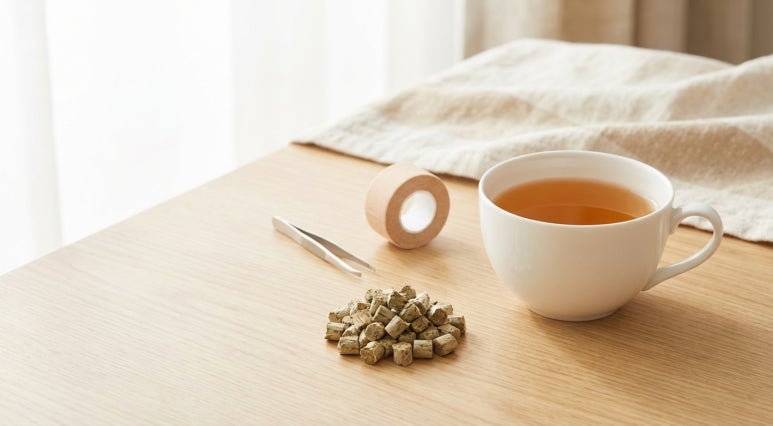
In such cases, when combining bee venom acupuncture and moxibustion with immune-boosting herbal medicine, I observe increased body resistance to the virus and reduced recurrence.
 🔚 Closing | Summary and Encouragement
Warts are neither frightening nor dangerous.
However, without proper treatment, they can spread, recur, and persist long-term.
Not touching it, separating personal hygiene tools, and starting treatment after 2 weeks.
Just remembering these three points makes dealing with warts much easier.
Especially if you've had multiple cryotherapy treatments but keep getting recurrence,
or if you're worried about treatment because it's a child,
you might consider Korean medicine treatment that boosts immunity.
If you're uncomfortable now, feel free to contact us.
We'll examine your constitution and immune status and find the right approach for you.
✍️ Reviewed by Dr. Choi Jang-hyuk, Director of Dongjejdang Korean Medicine Clinic
❓ FAQ
Q. How do you distinguish between warts and calluses?
The easiest way is the presence or absence of black dots.
Looking closely at the wart surface, you can see black dots, which are traces of blood vessels being pulled to the wart.
Calluses have a white core in the center and hurt when pressed from above.
Warts have the characteristic of hurting when pinched from the side.
If distinction is difficult, visiting a hospital is most accurate.
Q. Are warts contagious?
Yes, they are contagious.
If you touch other skin with hands that touched the wart area, it can spread,
and it can also transmit through objects like towels or nail clippers.
Children with low immunity are particularly susceptible, so household hygiene management is important.
Q. What methods are used in Korean medicine treatment for warts?
Representative methods include bee venom acupuncture, moxibustion, and herbal medicine treatment in combination.
Bee venom acupuncture induces immune response in the wart area,
causing virus-infected tissue to shed, while moxibustion reduces hyperkeratinized skin.
Herbal medicine uses ingredients like Job's tears (yulmu) to boost immunity from within the body.
With minimal pain and no scarring, it's suitable for children and those sensitive to pain.
Q. What happens if warts are left untreated?
About 60% of wart patients naturally lose them within 2 years.
However, the rest gradually spread or grow larger, and in severe cases can increase to dozens.
Warts around nails or on soles particularly warrant early treatment due to risk of deformation or pain.
📚 References
[Western Medicine (WM)]
- Al Aboud AM, Nigam PK. "Wart." StatPearls Publishing, 2023.
- Clinical guideline for the diagnosis and treatment of cutaneous warts.
J Dermatol. 2022.
[Korean Medicine (KM)]
- Kim Min-hee. Complete cure case of plantar warts using bee venom therapy. Explore, 2024.
- Analytical case study of Korean medicine treatment for warts. Journal of Korean Medicine Otorhinolaryngology, Ophthalmology and Dermatology, 2019.