

Menopausal Insomnia: All Symptoms Worsen When You Cannot Sleep

 🧾 Answer First | Key Conclusion
3 AM, you've woken up again because of your sweat-soaked pajamas.
No matter how hard you try to close your eyes, your mind remains clear and you cannot fall back asleep.
Menopausal insomnia is not a matter of willpower.
As hormone levels drop, the brain's sleep switch becomes unstable.
40-60% of women around menopause are experiencing the same difficulty[1].
I'll share 3 routines you can start implementing tonight.
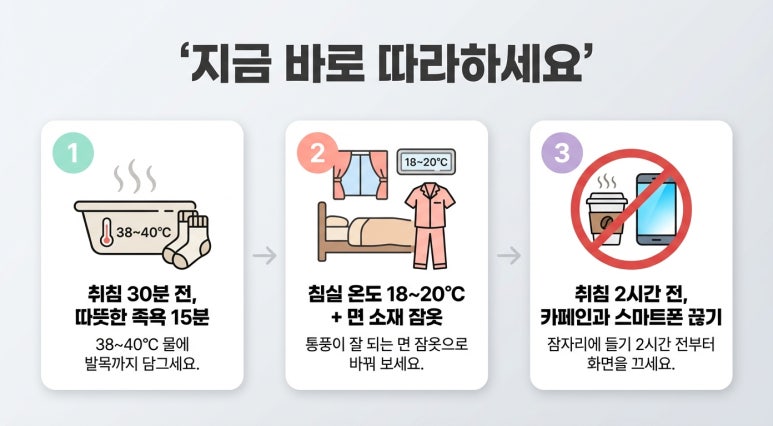 ✅ Action | Immediate Steps
1️⃣ Warm foot bath for 15 minutes, 30 minutes before bedtime
Soak your feet up to the ankles in water at 38-40℃.
As blood pools toward your feet, your core body temperature naturally decreases.
This drop in body temperature signals your brain that "it's time to sleep now."
Putting on cotton socks after the foot bath extends the effect further.
2️⃣ Bedroom temperature 18-20℃ + Cotton sleep wear
Menopausal hot flushes occur because temperature regulation becomes more sensitive.
A warm bedroom or synthetic fiber pajamas trigger night sweats more frequently.
Try lowering your room temperature to 18-20℃ and switching to breathable cotton pajamas.
Many people report a significant reduction in hot flushes with this change alone.
3️⃣ Stop caffeine and smartphones 2 hours before bedtime
Caffeine remains in your body for over 6 hours.
Avoid coffee, green tea, and chocolate after 2 PM.
Blue light from smartphones delays melatonin secretion, your sleep hormone.
Simply turning off screens 2 hours before bed shortens the time it takes to fall asleep.
If trying on your own doesn't help, working with a specialist to identify the root cause is the fastest path forward.
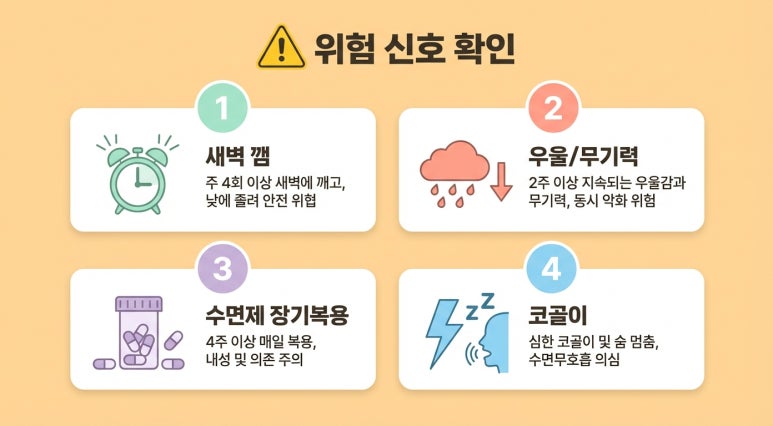 🚨 Warning | Red Flags You Must Check
✔ Waking up in the early morning 4 or more times per week, and feeling so drowsy during the day that driving or work becomes dangerous
Sleep deprivation has progressed beyond simple fatigue to threaten your daily safety.
Professional medical consultation is necessary.
✔ Insomnia accompanied by depression and lethargy lasting more than 2 weeks
Menopausal insomnia and depression worsen each other.
When both appear simultaneously, it's better to seek help quickly rather than struggling alone.
✔ Taking sleeping pills daily for more than 4 weeks
Even prescription sleep medications can develop tolerance and dependence with continuous use beyond 4 weeks.
If you want to reduce them but cannot, consult your healthcare provider.
✔ Severe snoring or feeling like your breathing stops during sleep
The incidence of sleep apnea increases after menopause.
In this case, insomnia treatment alone won't solve the problem, and a polysomnography test is needed.
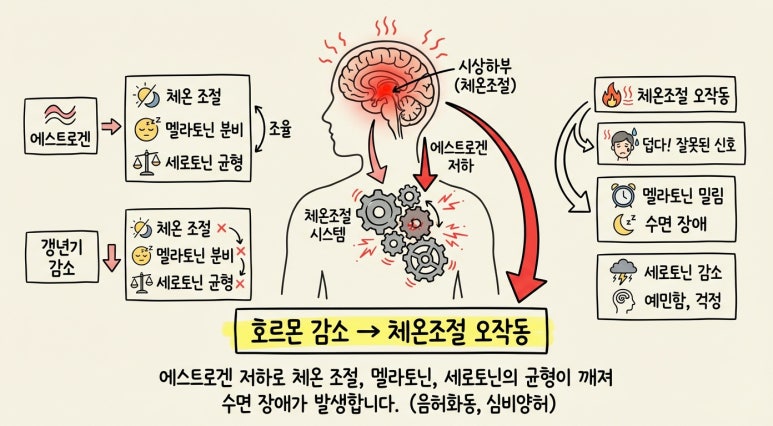 🧠 The Why | Root Cause Analysis
Estrogen simultaneously regulates three functions that create sleep:
Body temperature control, melatonin secretion, serotonin balance — deep sleep comes when these three work together harmoniously.
When estrogen decreases during menopause, all three begin to destabilize.
Body temperature regulation breaks down first.
The hypothalamus in the brain sends incorrect signals of "I'm hot" regardless of actual body temperature[2].
When you suddenly flush and sweat in the middle of the night, of course you wake up.
The timing of melatonin secretion also becomes disrupted.
Since the sleep hormone doesn't appear on time when you need to sleep, you toss and turn.
When serotonin also decreases, emotions become sensitive.
Minor worries circle through your mind, pushing sleep further away in a vicious cycle.
In Korean medicine, this is called yin deficiency with fire blazing (陰虛火動).
When yin blood that cools the body becomes insufficient, the heart palpitates,
and heat rises to the head, leaving the mind unsettled.
When heart-spleen dual deficiency (心脾兩虛) overlaps with this, sleep becomes shallow and dreams multiply.
📊 Proof | Cases and Evidence
40-60% of women around menopause experience sleep disorders[1].
Research shows that women with night hot flushes wake up 2-3 times more frequently during sleep[2].
Sleep hygiene education alone improved insomnia symptoms by approximately 30%[5].
This means changing daily routines before medication is effective.
Here's the story of a 52-year-old female patient I met in clinical practice.
She woke up every early morning at 2 AM with hot flushes, with daily sleep barely exceeding 4 hours.
After combining constitutional Korean herbal medicine and sleep hygiene education, her sleep time increased to 6.5 hours after 4 weeks.
She said, "I can't remember the last time I woke up refreshed in the morning."
 🔚 Closing | Summary and Encouragement
Lower your body temperature with foot baths, keep your bedroom cool, and cut off caffeine and screens early.
If you consistently practice these three things for 2 weeks, your sleep quality will begin to change.
You don't have to carry this discomfort alone.
If you'd like a consultation where we can examine your constitution and lifestyle habits together, feel free to contact us anytime.
✍️ Reviewed by Director Choi Jang-hyuk, Dongjedang Korean Medicine Clinic
❓ FAQ
Q. Is it okay to take sleeping pills for menopausal insomnia?
Short-term (2-4 weeks) prescription sleeping pills help put out the immediate fire.
However, daily use beyond 4 weeks often leads to tolerance where doses must be increased.
Correcting the root cause of hormonal changes and sleep environment together is safer long-term.
Q. Is Suan Zao Ren Tang effective for menopausal insomnia?
Suan Zao Ren Tang is one of the most widely used formulas in Korean medicine for insomnia.
It works well for types with heart palpitations, shallow sleep, and frequent dreams[4].
However, depending on constitution and symptoms, modified formulas or other prescriptions may be more suitable,
so consultation with a specialist is recommended before use.
Q. Does exercise help menopausal sleep?
Aerobic exercise 3-4 times per week for 30 minutes or more improves sleep quality.
However, intense exercise within 3 hours of bedtime actually stimulates the sympathetic nervous system and interferes with sleep.
Walking, swimming, and cycling in the morning or early afternoon are recommended.
📚 References
[Western Medicine (WM)]
- [1] NAMS (2023). "Management of Sleep Disturbances in Menopause"
- [2] Kravitz HM et al. (2023). "Sleep disturbance during the menopausal transition." Sleep Med Clin 18(4)
- [5] Baker FC et al. (2022). "Sleep and menopause." Climacteric 25(6)
[Korean Medicine (KM)]
- [3] Korean Society of Oriental Obstetrics and Gynecology CPG (2022). "Korean Medicine Clinical Practice Guideline for Menopausal Syndrome"
- [4] NIKOM (2021). "Korean Medicine Treatment Guideline for Insomnia"
Women's Health
Menopausal Insomnia: All Symptoms Worsen When You Cannot Sleep
View Program