

When You Can't Get Pregnant, Check Your Body Before You Worry
 🧾 Answer First | Key Conclusion
"All the test results are normal.
But there's been no news for six months."
This is what I hear most often in my clinic.
Both spouses have fine numbers, but every month when menstruation begins, hearts sink.
However, infertility is not that your body is broken.
It's more that you're not yet fully prepared for pregnancy.
If you first check your constitution and uterine environment, you'll often see a path forward faster than you think.
Start with these 3 things.
 ✅ Action | Immediate Implementation
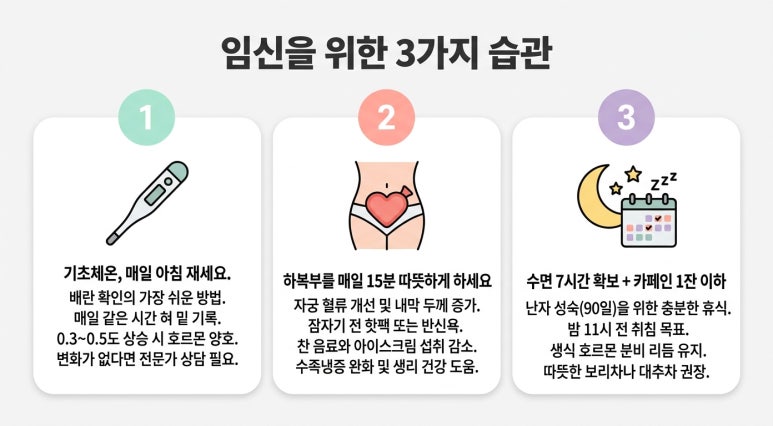
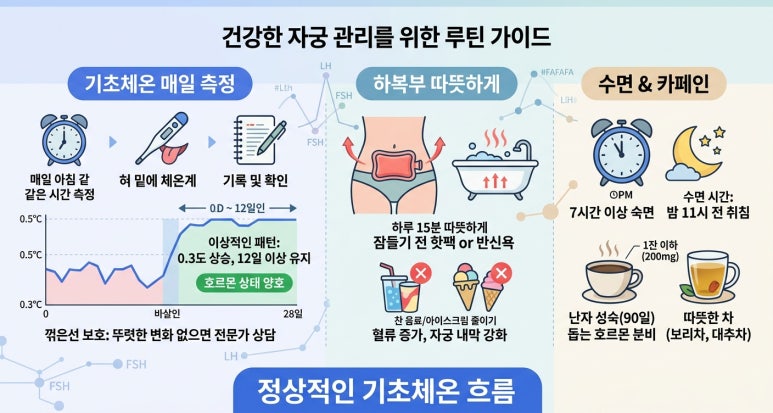
1️⃣ Measure your basal body temperature every morning
This is the easiest way to check if ovulation is occurring properly.
Insert a thermometer under your tongue at the same time every day and record it.
If your temperature rises 0.3-0.5 degrees after ovulation and is maintained for 12 or more days, it means your hormone levels are in good condition.
If the temperature change is not clear, there may be an issue with ovulation or luteal function.
In this case, professional consultation is needed.
2️⃣ Warm your lower abdomen for 15 minutes every day
The uterus needs warmth for good blood circulation and for the endometrium to thicken.
Before bed, apply a heat pack to your lower abdomen or take a half-body bath for about 15 minutes.
You should reduce cold drinks and ice cream.
Especially if your lower body is cold and your hands and feet are chilly, you can feel this one habit change your menstrual pain and menstrual patterns.
3️⃣ Ensure 7 hours of sleep + limit caffeine to 1 cup or less
It takes approximately 90 days for an egg to mature.
If sleep is insufficient during this period, the secretion rhythm of reproductive hormones (FSH, LH) becomes disrupted.
Aim to go to bed before 11 PM.
Limit caffeine to 1 cup (200mg) or less per day.
Warm barley tea or jujube tea is better than coffee.
If there is no change even after maintaining this routine alone for more than 3 months, getting precision consultation tailored to your constitution is the fastest path forward.
 🚨 Warning | Warning Signs You Must Check
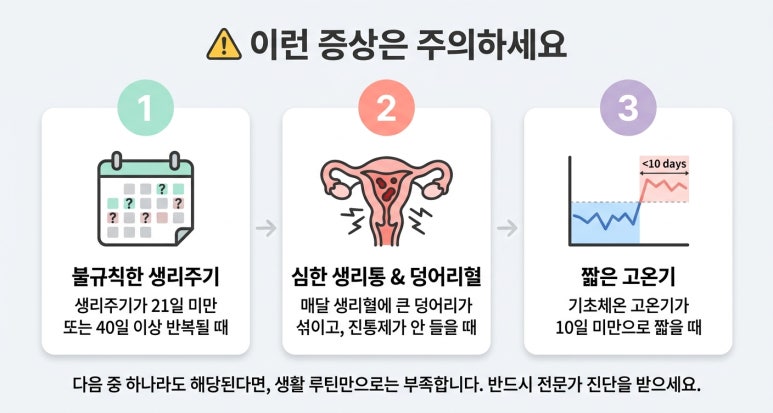
If any of the following apply to you, lifestyle changes alone are not enough.
You must receive a professional diagnosis.
✔ When your menstrual cycle is less than 21 days or repeats for 40 days or more
There is a high possibility that ovulation is irregular or not happening at all.
You should check for hormone issues such as polycystic ovary syndrome (PCOS).
✔ When there are large clots in your monthly menstrual blood and you experience menstrual pain that doesn't respond to painkillers
There may be issues with uterine structure such as endometriosis or uterine fibroids.
This directly affects the implantation environment.
✔ When your basal body temperature high phase is less than 10 days
This is a sign of luteal phase defect.
If progesterone secretion is insufficient, even if a fertilized egg implants, it is difficult to maintain.
✔ When you have tried regularly for 1 year or more without becoming pregnant
If you are 35 or older, 6 months is the standard.
Both spouses should undergo detailed testing, and check lifestyle habits and constitution together.
 🧠 The Why | Understanding the Cause
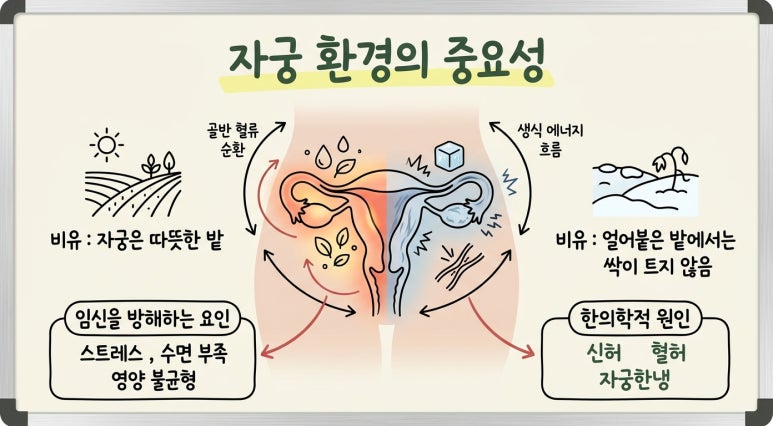
The uterus is similar to a field.
No matter how good the seed is, if the field is frozen or lacks water, it won't sprout.
Pregnancy is the same.
From a Western medical perspective, pregnancy requires a precise balance of the hormone flow from the hypothalamus→pituitary gland→ovaries.
When this flow is disrupted by stress, sleep deprivation, or nutritional imbalance, ovulation timing is delayed or the endometrium fails to grow sufficiently.
Much of unexplained infertility results from the accumulation of these small imbalances.
From a Korean medicine perspective, the core causes of infertility are largely three-fold:
Kidney Deficiency (腎虛) — a state where reproductive energy itself is insufficient.
Blood Deficiency (血虛) — a state where there is insufficient blood to nourish the uterus.
Uterine Cold (子宮寒冷) — a state where the uterus is cold due to reduced pelvic blood flow.
Because which area is weaker differs depending on constitution, the same 'infertility' may require different treatments.
When stress is added on top of this, it becomes worse.
When cortisol, a stress hormone, rises, the ovulation signal weakens.
An anxious mind actually pushes pregnancy further away.
 📊 Proof | Cases and Evidence
According to NICE guidelines, approximately 25-30% of infertile couples have no clear cause identified[1].
Normal test values don't mean there is no problem.
Small environmental differences that tests don't catch are preventing pregnancy.
According to clinical practice guidelines from the Korean Society of Oriental Obstetrics and Gynecology, pregnancy rates increased in infertile patient groups receiving combined herbal medicine and acupuncture treatment[3].
Effects were particularly clear in improving endometrial thickness and stabilizing ovulation.
Let me share one case I've seen in clinical practice.
A 34-year-old woman, 2 years into marriage, with both spouses' tests being completely normal.
When checking basal body temperature, the high phase was short at 9 days, with cold hands and feet and a cold lower abdomen.
After constitution diagnosis, I prescribed herbal medicine tailored to kidney and blood deficiency, and combined this with lower abdomen warming management and sleep correction.
After 3 months, the high phase stabilized at 13 days, and by the 4th month, natural pregnancy was achieved.
 🔚 Closing | Summary and Encouragement
When you can't get pregnant, check your body before you worry.
Record your basal body temperature, manage lower abdomen warmth, and regulate sleep and caffeine.
These three things are the basic foundation of pregnancy preparation.
Add herbal medicine and acupuncture treatment tailored to your constitution, and your uterine environment can change noticeably.
Don't blame yourself for not getting pregnant.
When your body is ready, it naturally follows.
You don't have to carry this anxiety alone.
If you'd like consultation where we can examine your constitution and lifestyle habits together, please feel free to contact us.
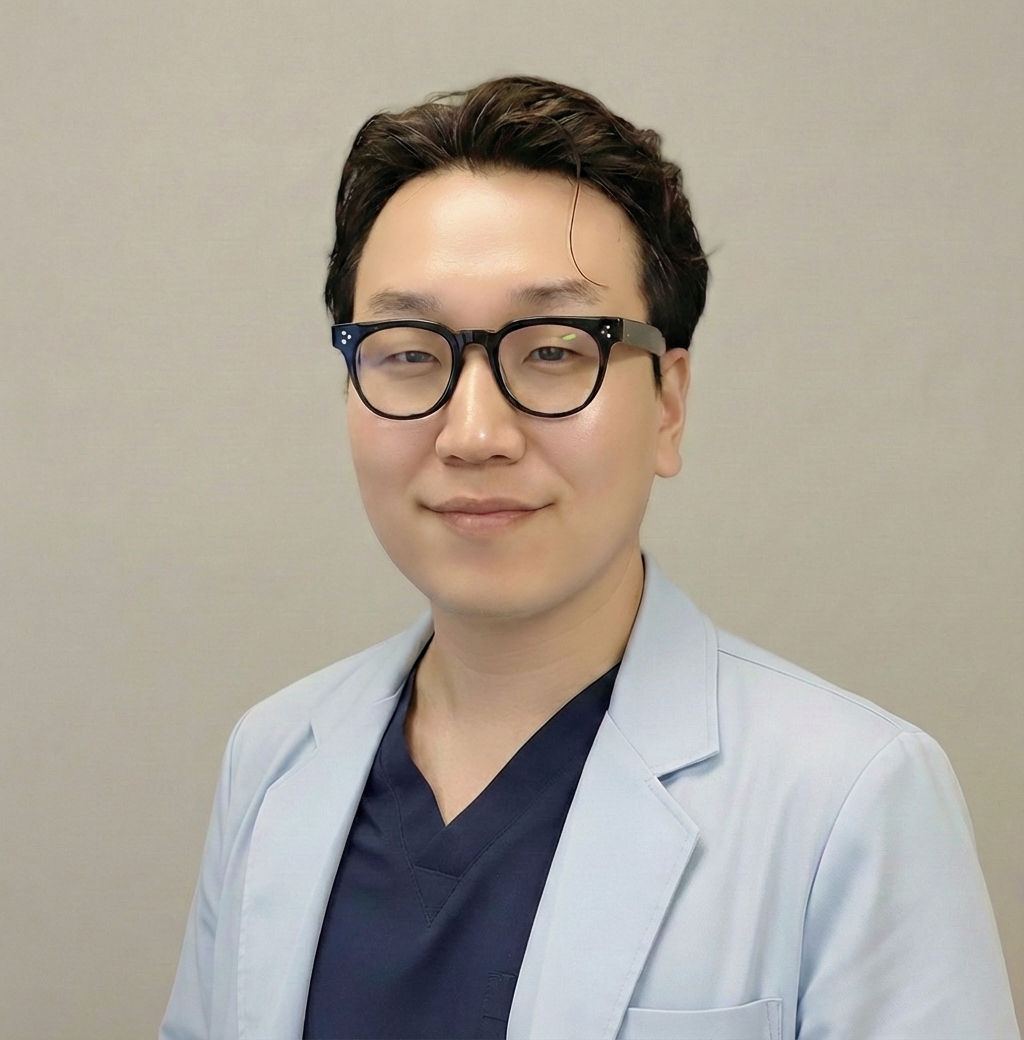
✍️ Reviewed by Director Choi Jang-hyuk, Dongjedo Korean Medicine Clinic
❓ FAQ
Q. When should I start taking herbal medicine for infertility?
It's best to start at least 3 months in advance.
Since it takes about 90 days for an egg to mature, it's effective to prepare the uterine environment with herbal medicine tailored to your constitution during this period.
If you're planning IVF treatment, I recommend starting 2-3 months before the procedure.
Q. Can I take ovulation-inducing medication and herbal medicine together?
Yes, they can be taken together.
However, you must inform both medical teams and adjust the timing of administration.
Herbal medicine works to supplement the uterine environment and physical strength, while ovulation-inducing medication directly promotes ovulation, so they have different mechanisms. If you space the intake 1-2 hours apart, it's safe.
Q. Should my husband also take herbal medicine?
About 40% of infertility involves male factors.
If sperm motility or count is borderline, herbal medicine tailored to the male constitution can help.
When both spouses correct lifestyle habits and take herbal medicine together, the success rate of pregnancy increases.
Q. I'm in my late thirties—is natural pregnancy possible?
Absolutely possible.
While it's true that ovarian function declines after age 35, improving ovarian environment through constitution management and lifestyle correction increases the likelihood.
However, time is important, so if you haven't succeeded after 6 months or more of trying, I recommend seeking active consultation.
📚 References
[Western Medicine (WM)]
[1] NICE (2024). "Fertility problems: assessment and treatment" CG156
[2] ESHRE (2023). "Unexplained Infertility Guideline"
[5] Fertility and Sterility (2022). "Lifestyle factors and reproductive health: a review"
[Korean Medicine (KM)]
[3] Korean Society of Oriental Obstetrics and Gynecology (2022). "Clinical Practice Guidelines for Korean Medicine Treatment of Infertility"
[4] NIKOM (2021). "Korean Medicine Clinical Practice Guidelines for Female Infertility"
[6] J Korean Med (2023). "Effects of concurrent herbal medicine on IVF outcomes: a systematic review and meta-analysis"
Women's Health
When You Can't Get Pregnant, Check Your Body Before You Worry
View Program