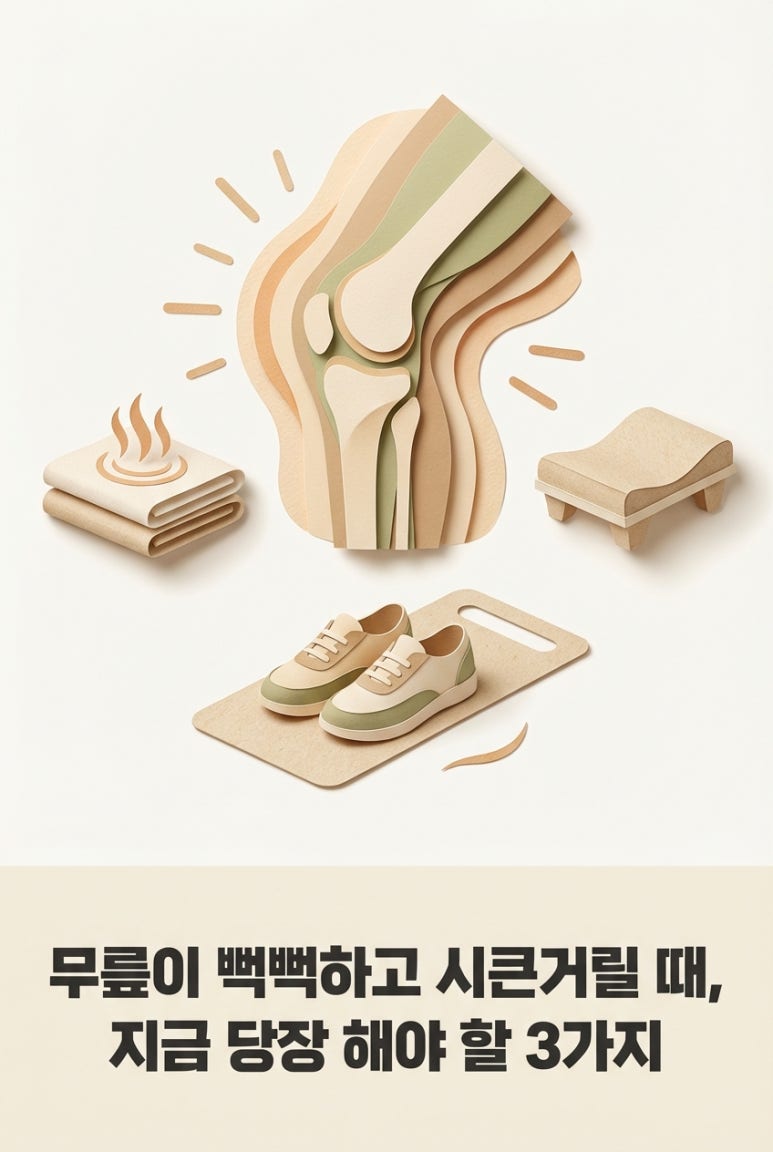
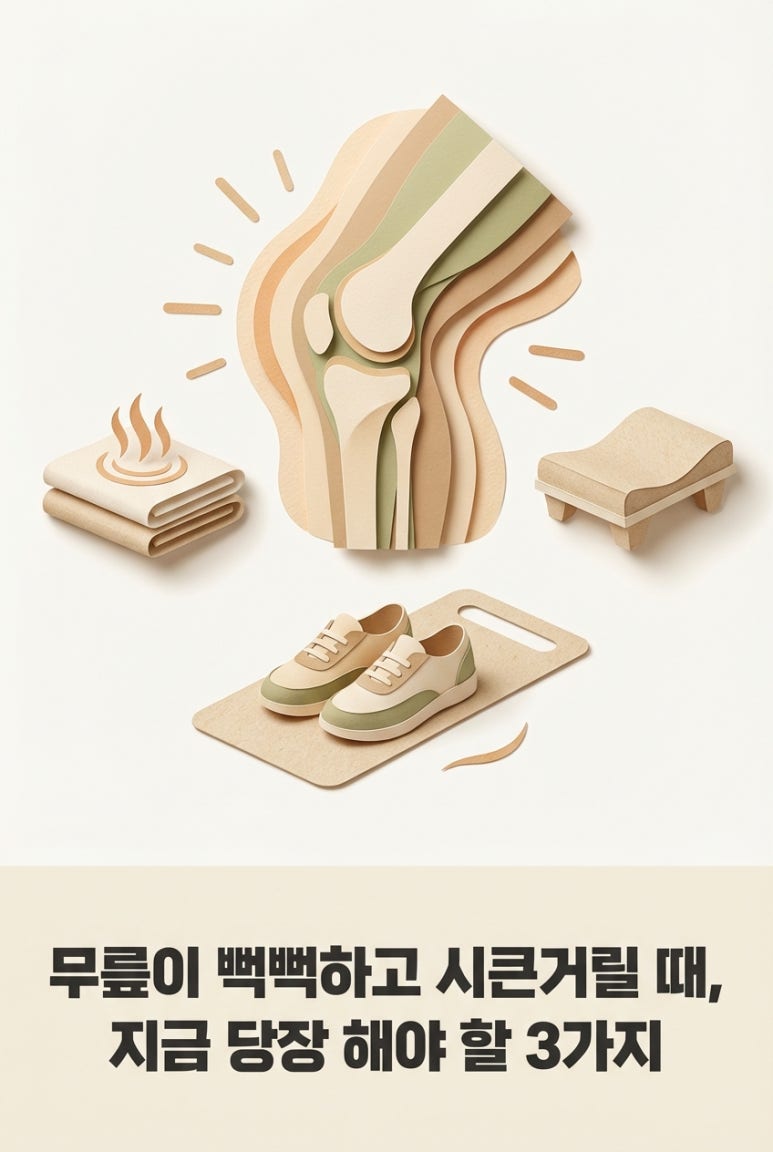
When Your Knees Feel Stiff and Achy, 3 Things You Must Do Right Now

 🧾 Answer First | Key Conclusion
You sit for a long time, then stand up and your knee makes a cracking sound while feeling stiff.
If sharp pain shoots up with each step more than once or twice, you're probably starting to worry.
To put it simply, the core issue of knee pain is not cartilage, but weakened muscles around the knee.
When muscles don't provide support, impact is transmitted directly to bone and cartilage.
If you consistently follow the 3 routines I'm about to share, most knee pain improves significantly within 4-6 weeks.
 ✅ Action | Immediate Implementation
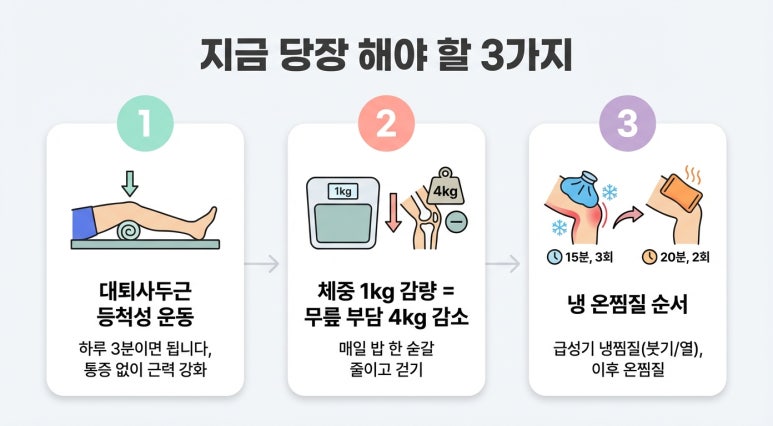
1️⃣ Quadriceps Isometric Exercise — Just 3 minutes a day is enough
Sit with your legs stretched out on the floor.
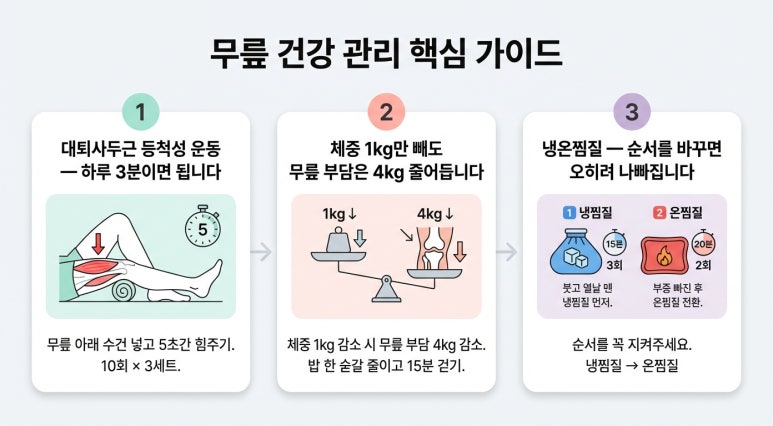
Roll up a towel and place it under your knee, then apply firm pressure to the front of your thigh for 5 seconds as if pushing the towel down to the floor.
10 repetitions × 3 sets, twice a day is sufficient.
Since this exercise doesn't bend your knee, you can build strength without pain.
The American College of Rheumatology (ACR) recommends this as the first exercise for patients with knee osteoarthritis[1].
2️⃣ Losing just 1kg of body weight reduces knee strain by 4kg
When walking, your knee bears 3-4 times your body weight.
If you weigh 70kg, your knee endures 210-280kg of pressure with each step.
Losing just 1kg reduces the burden your knee feels by approximately 4kg.
This isn't about drastic dieting.
Simply reducing one spoonful of rice daily and taking a 15-minute walk after dinner can result in 1-2kg of weight loss per month.
3️⃣ Hot and cold therapy — the order matters; reversing it makes things worse
If your knee is swollen and hot, apply cold therapy first for 15 minutes, 3 times daily.
After the swelling and heat subside (usually after 48-72 hours), switch to heat therapy.
Apply for 20 minutes, 2 times daily.
Using heat therapy first in the acute phase widens blood vessels, making swelling worse.
Please follow the order carefully.
If self-management doesn't improve your condition, consulting with a professional to identify the root cause is the fastest path forward.
 🚨 Warning | Critical Warning Signs to Check
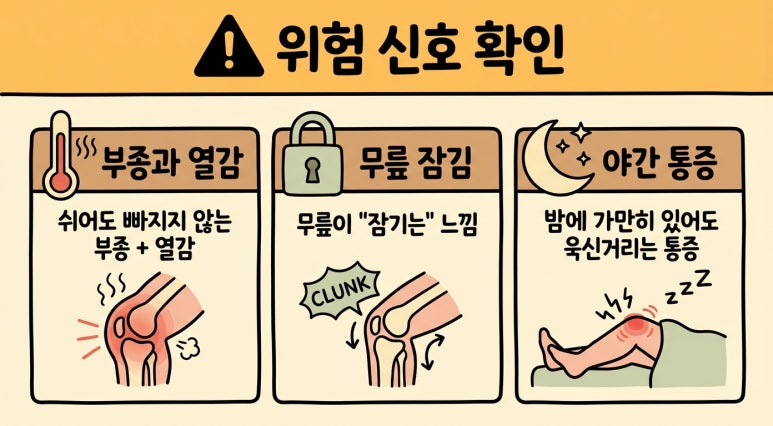
If any of the following symptoms apply, do not rely on self-care and seek professional medical attention immediately.
✔ Persistent swelling and heat that doesn't subside with rest
If your knee remains puffy with a hot sensation for more than two days, you should check for infectious arthritis or rheumatoid arthritis.
✔ Feeling of knee "locking"
If your knee suddenly stops or buckles while walking, or won't straighten after bending, suspect meniscus injury.
Leaving it untreated can rapidly progress cartilage damage.
✔ Throbbing pain even at rest, especially at night
Pain at rest that worsens at night, independent of activity, may not be simple degenerative changes.
Though rare, detailed examination is necessary to rule out malignant conditions.
 🧠 The Why | Understanding the Cause
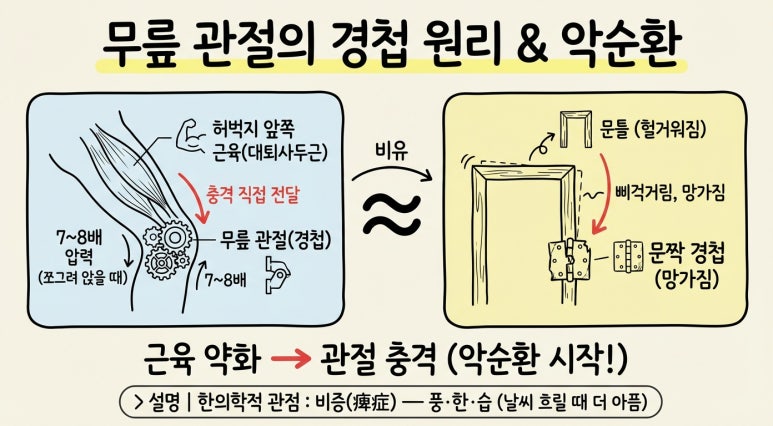
Think of your knee joint as a door hinge.
Even if the hinge itself is sturdy, if the door frame is loose, the door creaks and eventually the hinge breaks.
The "door frame" role in the knee is played by the front thigh muscle (quadriceps).
When this muscle weakens, impact is transmitted directly to the cartilage without filtration with each step.
Pain makes you reluctant to move, and not moving weakens muscles further, starting a vicious cycle.
Add posture problems to this.
Squatting increases pressure on the knee joint surface to about 7-8 times that of standing[2].
This is why many people with sedentary lifestyles, cross-legged sitting habits, and jobs requiring squatting experience knee pain early.
In Korean medicine, knee pain is viewed as 'Bi Syndrome (痺症)'.
Wind, cold, and dampness — when these three pathogenic factors enter the joint and obstruct qi and blood circulation, stiffness and pain develop.
Those whose knees hurt more on cloudy days or before rain often fall into the category of 'Damp Bi (濕痺)'[4].
📊 Proof | Cases and Evidence
According to research published in JAMA, when 240 knee osteoarthritis patients combined diet control and exercise for 18 months, those who reduced body weight by more than 5% experienced approximately 50% reduction in knee pain[3].
Similar results appear in my clinical experience.
A woman in her early 50s came in unable to descend stairs due to bilateral knee pain.
While X-rays showed only mild degenerative changes, her quadriceps strength was only 60% of the average for her age group.
She received acupuncture and herbal acupuncture twice weekly while performing isometric exercises daily, and within 6 weeks could descend stairs with alternating feet.
 🔚 Closing | Summary and Encouragement
To summarize:
Isometric strength exercise, weight management, and following proper hot and cold therapy order — these three are the cornerstone of knee pain management.
When knee pain starts, worry often takes over: "Is it too late?"
But most knee pain improves sufficiently through muscle strengthening and lifestyle habit correction alone.
You don't have to carry this discomfort alone.
If you'd like a consultation that considers your constitution and lifestyle habits together, please feel free to contact us anytime.
✍️ Reviewed by Director Choi Jang-hyuk, Dongjjedang Korean Medicine Clinic
❓ FAQ
Q. Is glucosamine effective for knee pain?
Glucosamine's effectiveness varies across studies.
The American College of Rheumatology (ACR) Guidelines do not strongly recommend glucosamine[1].
Since muscle strengthening exercise and weight management have more solid evidence than cartilage protection effects, it's best to consider glucosamine only as a supplement.
Q. Is it okay to wear a knee brace continuously?
Wearing it during activity is helpful.
However, wearing it all day can actually weaken muscles as they become dependent on the brace.
Wear it only during painful activities, and remove it when you're sitting still.
Q. Is it okay to walk if my knee hurts?
Walking on flat surfaces is fine.
It actually helps joint fluid circulation and nutritional supply.
Just don't walk at an intensity that significantly worsens pain.
Stop at a level of mild soreness.
Hiking or climbing stairs can wait until pain decreases.
📚 References
[Western Medicine (WM)]
- [1] Kolasinski SL et al. (2020). "2019 ACR/AF Guideline for Management of Osteoarthritis of the Hand, Hip, and Knee." Arthritis Care & Research, 72(2):149-162
- [2] NICE (2022). "Osteoarthritis: care and management" CG177 Updated
- [3] Messier SP et al. (2018). "Effects of Intensive Diet and Exercise on Knee Joint Loads in OA." JAMA, 320(12):1263-1270
[Korean Medicine (KM)]
- [4] Korean Acupuncture and Moxibustion Medicine Society (2020). "Clinical Practice Guideline for Knee Osteoarthritis in Korean Medicine"
- [5] Korea Institute of Oriental Medicine NIKOM (2021). "Korean Medicine Treatment Recommendations for Musculoskeletal Disorders"
Pain
When Your Knees Feel Stiff and Achy, 3 Things You Must Do Right Now
View Program