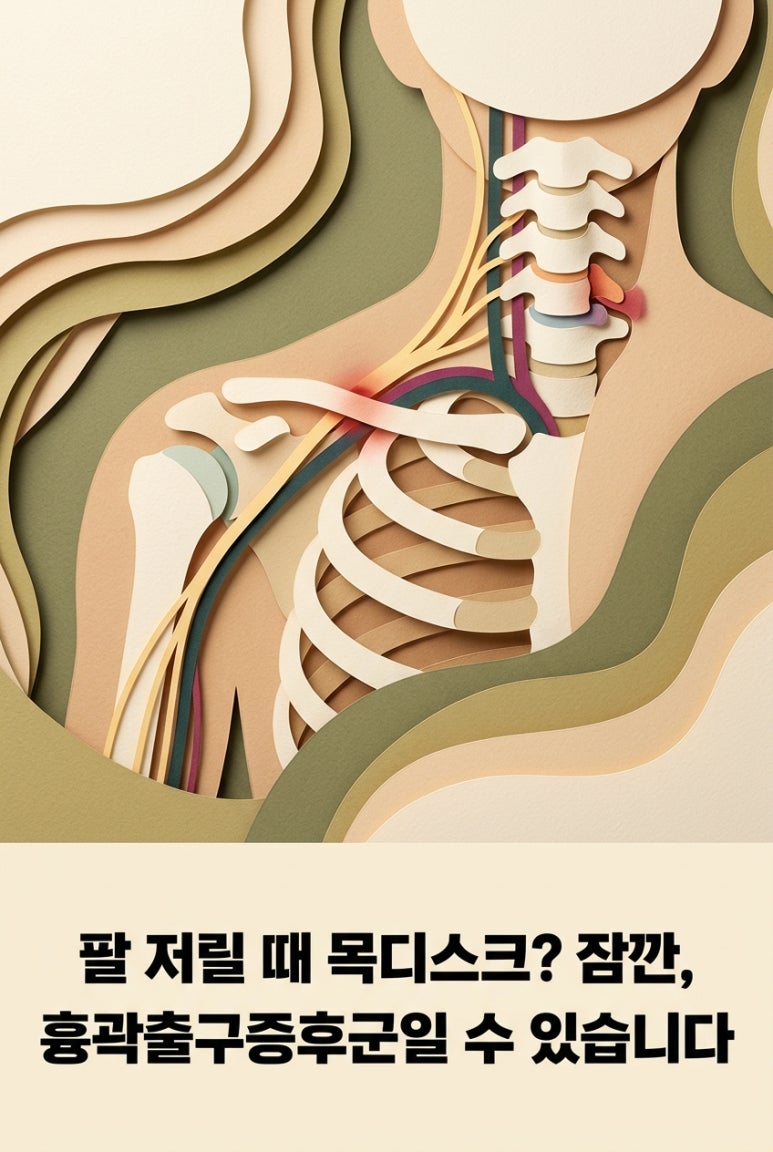
Arm Numbness from Cervical Disc Herniation? Wait, It Could Be Thoracic Outlet Syndrome

 🧾 Answer First | Core Conclusion
"My arm was numb, so I got an MRI and was told I have cervical disc herniation."
Hello.
I am Dr. Choi Jang-hyuk, director of Dongjejae Korean Medicine Clinic.
I hear this at least once or twice a week in my clinic.
However, there are quite a few patients whose numbness doesn't improve even with diligent treatment.
It's because arm numbness is often caused not by cervical disc herniation but by thoracic outlet syndrome.
While the two conditions have similar symptoms, the location of nerve compression differs.
Remember just one way to distinguish them.
If numbness worsens when you raise your arm above your head, you should suspect thoracic outlet syndrome.
With just a simple self-test and posture check, you can identify the true cause of your arm numbness.
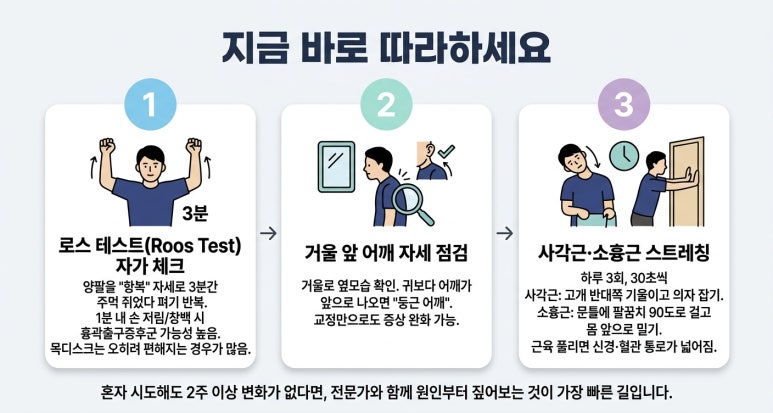 ✅ Action | Immediate Steps
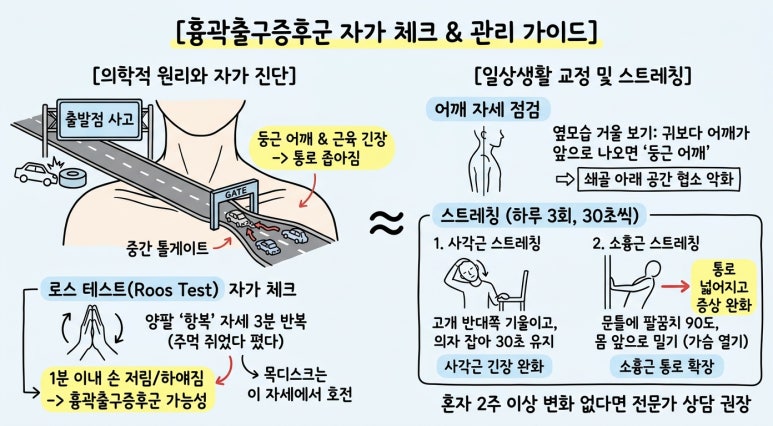
1️⃣ Self-check with Roos Test
Raise both arms in a "surrender" position, then repeatedly clench and open your fists for 3 minutes.
If your hands become numb or turn pale in less than a minute, thoracic outlet syndrome is likely.
Cervical disc herniation often actually improves in this position.
2️⃣ Check your shoulder posture in front of a mirror
Look at your side profile in a mirror.
If your shoulders are positioned forward of your ears, you have "rounded shoulders."
Rounded shoulders narrow the space below the clavicle, worsening thoracic outlet syndrome.
Many patients find their symptoms reduce just by correcting this posture alone.
3️⃣ Scalene and Pectoralis Minor Stretching (3 times daily, 30 seconds each)
Scalene stretch: Tilt your head to the opposite side and hold a chair with the same-side hand for 30 seconds.
Pectoralis minor stretch: Hook your elbow at 90 degrees on a doorframe and push your body forward to open your chest.
When these two muscles loosen, the pathway through which nerves and blood vessels pass widens.
If you see no change after trying on your own for more than 2 weeks, consulting with a professional to identify the root cause is the fastest approach.
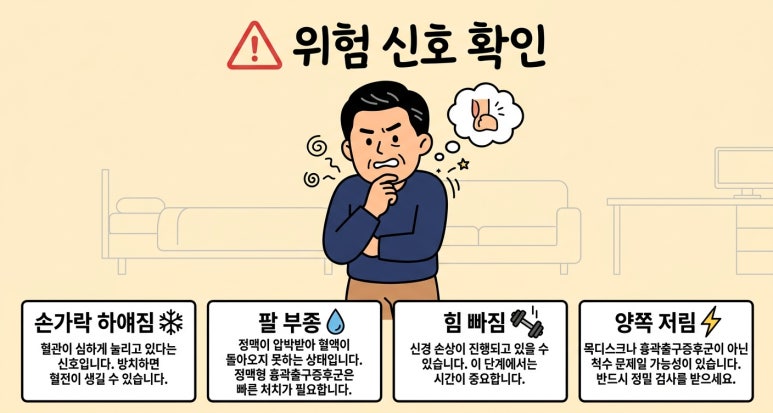 🚨 Warning | Critical Warning Signs to Check
If you have any of the following symptoms, you need immediate medical attention, not self-management.
✔ When your fingers turn white or blue
This is a sign that blood vessels are severely compressed.
If left untreated, blood clots can form.
✔ When your entire arm is swollen and the swelling doesn't resolve
Your veins are being compressed and blood cannot return.
Venous-type thoracic outlet syndrome requires prompt treatment.
✔ When you keep dropping objects or your arm strength suddenly weakens
Nerve damage may be progressing.
At this stage, time is critical.
✔ When both arms are numb simultaneously and your legs are also numb
This may indicate a spinal cord problem rather than cervical disc herniation or thoracic outlet syndrome.
You must undergo detailed testing.
 🧠 The Why | Root Cause Analysis
Arm numbness essentially means "a nerve is being compressed somewhere."
However, the location of compression differs.
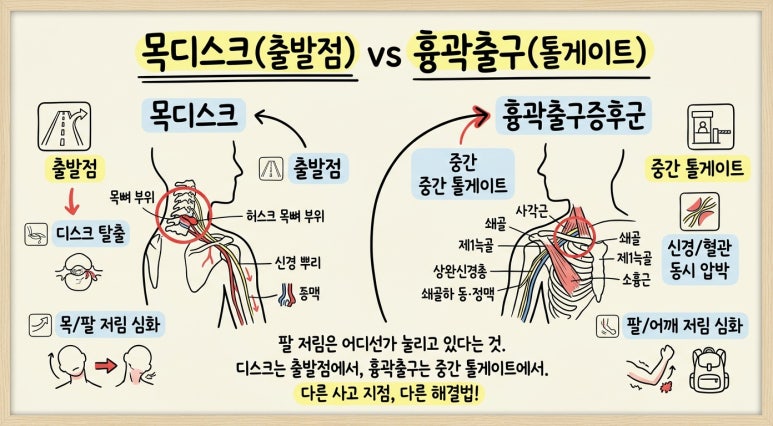
Cervical disc herniation occurs when the disc between neck vertebrae protrudes and directly compresses the nerve root descending from the neck to the arm.
The characteristic feature is that numbness worsens when tilting your head backward or to the side.
Thoracic outlet syndrome occurs when nerves and blood vessels are compressed together in the narrow passage between the clavicle and first rib, and between the scalene and pectoralis minor muscles.
Numbness worsens when raising your arm or carrying a heavy bag.
Think of the pathway through which nerves descend to your arm as a highway.
Cervical disc herniation is like an accident at the starting point (neck vertebrae), while thoracic outlet syndrome is like a narrow toll gate (below the clavicle).
Since the accident sites differ, naturally the solutions must also differ.
Thoracic outlet syndrome is a condition where the brachial plexus and subclavian arteries and veins are compressed in three locations: between the anterior and middle scalene muscles (scalene triangle), between the clavicle and first rib (costoclavicular space), and below the pectoralis minor muscle (pectoralis minor space)[1].
The neurogenic form (approximately 95%) is most common, while venous and arterial forms are rare but emergencies[2].
In Korean medicine, we approach this from the perspective of "bi-syndrome (痺證)" where qi and blood circulation is blocked.
Wind-cold-dampness (風寒濕) blocking meridians or qi stagnation and blood stasis (氣滯血瘀) from prolonged static postures are the causes.
We restore meridian circulation through acupuncture and pharmacopuncture while releasing muscle tension[4][6].
 📊 Proof | Case Examples and Evidence
This happened in my clinic.
A 40-year-old male office worker came in saying "I received cervical disc herniation treatment for 6 months but my arm numbness hasn't improved."
Upon examination, he had severe rounded shoulders, and in the Roos Test, his hands turned pale in just 30 seconds.
After combining acupuncture treatment and posture correction focused on the scalene and pectoralis minor muscles, his numbness reduced by over 70% in just 4 weeks.
Thoracic outlet syndrome has a high improvement rate with non-surgical treatment.
There are reports that approximately 50-90% of patients experience improvement with conservative treatment alone such as physical therapy and posture correction[3].
Yet many patients fail to receive accurate diagnosis and repeatedly undergo only cervical disc herniation treatment.
If your arm has been numb for a long time, it's worth checking once whether there might be other underlying causes.
 🔚 Closing | Summary and Encouragement
When your arm is numb, it's easy to first think of cervical disc herniation.
However, similar numbness can have multiple different causes.
Does your numbness worsen when you raise your arm? Are your shoulders rolled forward?
Check just once today.
Finding the accurate cause is the beginning of treatment.
If it's difficult for you to judge alone, feel free to get a consultation that examines both your constitution and posture.
✍️ Reviewed by Dr. Choi Jang-hyuk, Director of Dongjejae Korean Medicine Clinic
❓ FAQ
Q. Can thoracic outlet syndrome be confirmed with MRI?
MRI is useful for diagnosing cervical disc herniation, but diagnosing thoracic outlet syndrome with MRI alone is difficult.
Accurate differentiation requires combining physical examination tests (Roos Test, Adson Test, etc.) with symptom patterns.
When needed, nerve conduction studies or vascular ultrasound may be added.
Q. Can cervical disc herniation and thoracic outlet syndrome occur simultaneously?
Yes, it's not uncommon.
This is called "double crush syndrome," where when a nerve is compressed at two or more locations, symptoms become more severe.
If improvement is not seen with treatment of just one condition, check whether other causes are present together.
Q. Can thoracic outlet syndrome be treated at a Korean medicine clinic?
Yes, it can.
We approach it through acupuncture treatment around the scalene and pectoralis minor muscles, muscle tension relief through pharmacopuncture, and improving qi and blood circulation with constitution-appropriate herbal medicine.
Since this condition centers on non-surgical conservative treatment, Korean medicine approaches work well for it.
📚 References
[Western Medicine (WM)]
[1] Jones MR et al. (2019). "Thoracic Outlet Syndrome." Anesthesiology Clinics, 37(2), 235-245.
[2] Illig KA et al. (2021). "Reporting Standards of the Society for Vascular Surgery for Thoracic Outlet Syndrome." J Vasc Surg, 64(3), e23-e35.
[3] Levine NA, Rigby BR (2018). "Thoracic Outlet Syndrome: Biomechanical and Exercise Considerations." Healthcare, 6(2), 68.
[Korean Medicine (KM)]
[4] Korean Acupuncture and Moxibustion Medicine Society (2020). "Clinical Practice Guideline for Neck and Shoulder Pain Acupuncture and Moxibustion"
[5] Korean Medicine Association Journal (2022). "Korean Medicine Clinical Practice Guideline for Cervical Intervertebral Disc Disorder"
[6] Korean Medicine Association Journal (2021). "Case Report on Korean Medicine Treatment of Thoracic Outlet Syndrome"
Pain
Arm Numbness from Cervical Disc Herniation? Wait, It Could Be Thoracic Outlet Syndrome
View Program