

Tests Show Normal, But Your Intestines Are Always Sensitive — Constitutional Detox for Both Gut and Mind

 🧾 Answer First | Key Conclusion
Your stomach hurts as if it's being squeezed before a presentation,
You suddenly need to find a bathroom during meetings,
But when you get tested, all you hear is "nothing's wrong."
I'm Dr. Choi Jang-hyuk, director of Dongjedang Oriental Medicine Clinic.
I want to tell you first:
It's not because your intestines are weak.
Your mind's imbalance is leaking out through your intestines first.
This is why simply suppressing the intestines with medication doesn't work.
You must look at both gut and mind together.
Today I'll address three key points.
 ✅ Action | Immediate Practice
1️⃣ Write down "that moment" when your stomach hurts
Not what you ate, but what situation you were in. Write about commute times, just before meetings, in front of your boss. You'll see it's not the intestines but the mind that was tense.
That situation is your starting point for treatment.
2️⃣ Remove intestinal irritants first
Try reducing cold foods, greasy foods, caffeine, and alcohol.
These directly inflame a sensitive intestine.
If certain foods keep bothering you, stop them for just 2 weeks.
3️⃣ Release tension after eating
If you rush back to work right after meals, your intestines never rest.
Take 10 minutes after eating to walk slowly or exhale long breaths to relax your abdomen.
Your intestines move when tension releases.
If after 2 weeks of these three practices nothing changes, it's not just an intestinal problem—it's time to address the emotional knots alongside it.
🚨 Warning | Critical Warning Signs to Check
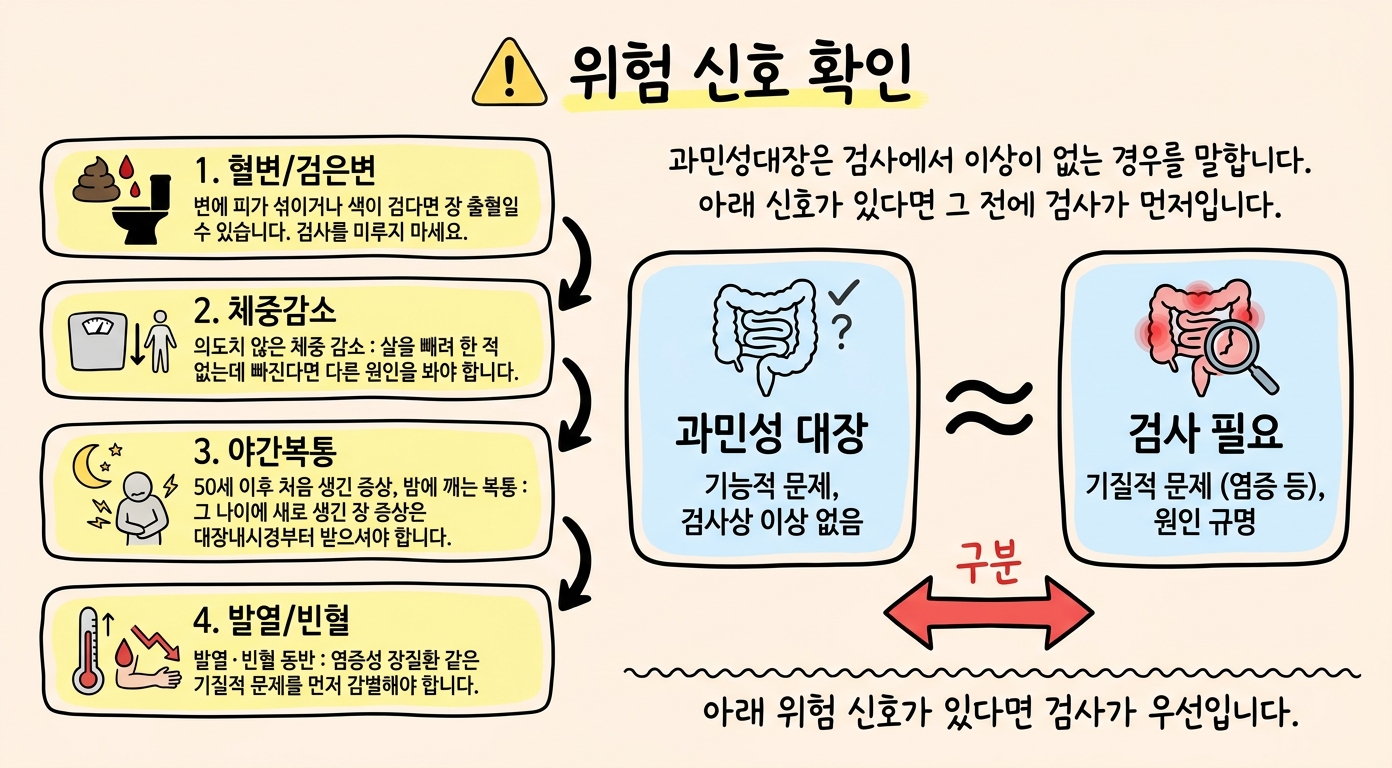
Irritable bowel syndrome refers to cases where tests show no abnormalities.
If you have the following signs, testing comes first.
✔ Bloody stools or dark stools
If blood is mixed in your stool or the color is dark, it could be intestinal bleeding. Don't delay testing.
✔ Unintended weight loss
If you're losing weight without trying to diet, another cause needs to be investigated.
✔ First-time symptoms after age 50, abdominal pain that wakes you at night
New intestinal symptoms at that age require colonoscopy first.
✔ Fever or anemia
Structural problems like inflammatory bowel disease must be ruled out first.
 🧠 The Why | Understanding the Cause
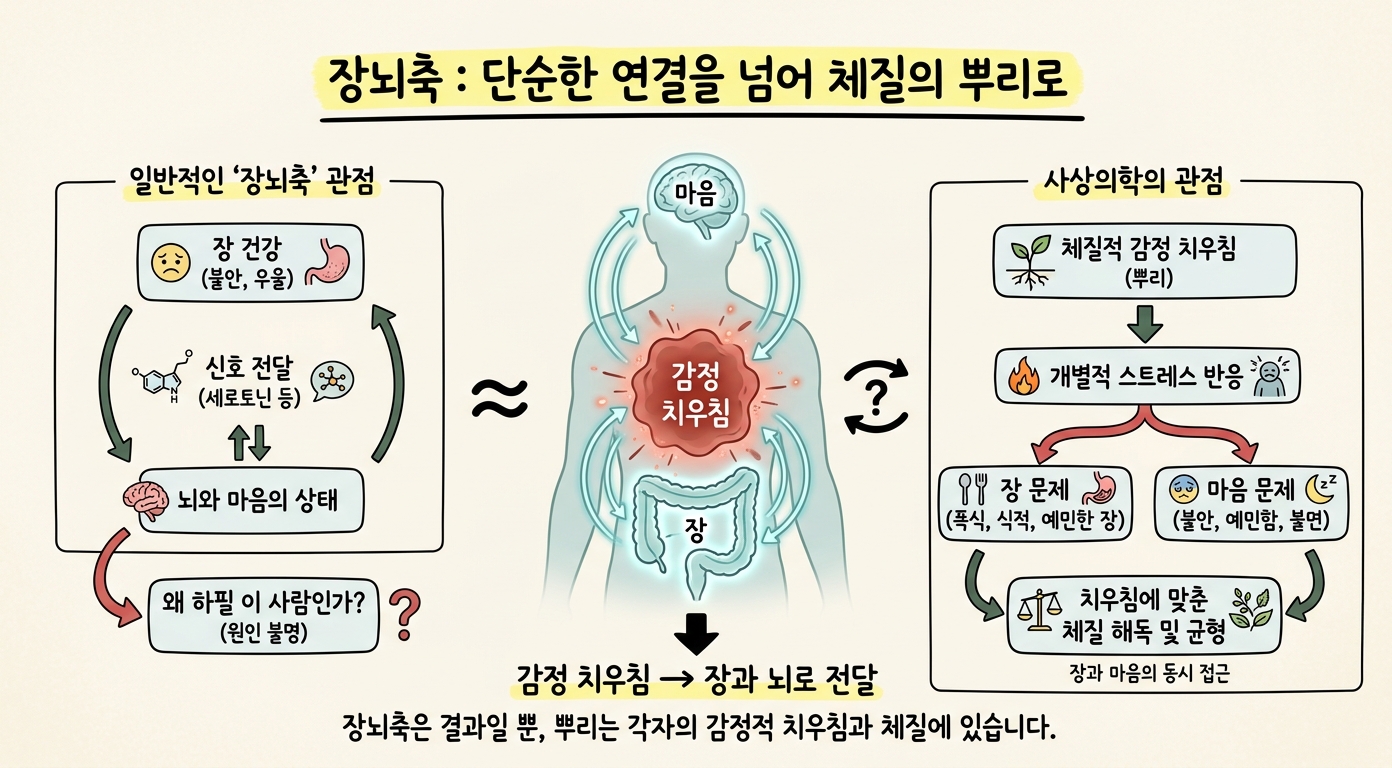
You've probably heard a lot about the "gut-brain axis" these days.
It means when the gut is bad, the mind shakes; when anxious, the stomach hurts. That's true.
In fact, about 40% of IBS patients also experience anxiety, and 30% experience depression[2].
Research shows bacteria living in the intestines produce signaling molecules like serotonin that communicate between gut and brain[3].
But the gut-brain axis stops there—at "the gut and brain are connected."
It doesn't ask why this particular person becomes this way.
Even with the same stress, one person gets stomach troubles while another can't sleep.
The gut-brain axis alone can't explain that difference.
Sasang Constitutional Medicine looks deeper.
Both gut and brain are results; the root is that person's constitutional emotional imbalance.
For example, in So-Yang constitution, when anger cannot be controlled, sadness boils underneath (怒極不勝則 悲哀動中).
This imbalance leaks out simultaneously as binge eating and food stagnation on one side, and anxiety and sensitivity on the other.
This is why people with sensitive intestines and people with sensitive minds are often the same person.
| Category | Gut-Brain Axis (Mainstream View) | Dongjedang Perspective |
|---|---|---|
| Root Cause | The gut environment (bacteria, inflammation) shakes the brain | That person's emotional imbalance leaks simultaneously to gut and brain |
| Question Asked | How are gut and brain connected | Why does this person become this way |
| Treatment | Fix the gut through probiotics and diet to help the brain | Address the imbalance first to release both gut and mind together |
So constitutional detox is not just about emptying the intestines.
 📊 Proof | Cases and Evidence
There was a man in his late 30s working at a company.
His tests were always normal, but whenever an important meeting was scheduled, his stomach would rumble and he'd run to the bathroom repeatedly.
He always carried antidiarrheal medication in his bag, but it only helped temporarily.
He also slept poorly and was sensitive to minor things.
Instead of asking "when did this start," I first asked "when does your stomach act this way?"
His symptoms erupted in situations where he was being evaluated, where he had to smile while suppressing anger.
That imbalance was leaking through both his intestines and his mind.
When we addressed food stagnation and the imbalance according to his constitution, his abdominal pain before meetings decreased.
Along with it, his sensitivity and poor sleep also settled down.
It wasn't just fixing the gut—the gut and mind released together from the same root.
A diarrheal case of IBS triggered by stomach pain on the subway commute is covered separately in our IBS article.
Research shows that low-FODMAP diets and similar dietary modifications improve both intestinal symptoms and psychological indicators like anxiety and depression[4].
This supports our approach.
 🔚 Closing | Summary and Encouragement
A sensitive gut and a sensitive mind are not two separate diseases.
They are two faces of one person's imbalance.
So when you regulate the gut, the mind becomes lighter too.
The same imbalance next manifests as sleep disturbance and anxiety—we'll continue that story in the next article.
If you want to see both gut and mind together in one place, check out our constitutional detox program,
and if your intestinal symptoms are more urgent, look at our digestive care consultation and feel free to contact us.
✍️ Reviewed by Dr. Choi Jang-hyuk, Director of Dongjedang Oriental Medicine Clinic
❓ FAQ
Q. My tests are normal, so why are my intestines always sensitive?
Even without inflammation or wounds in the intestines, hypersensitive reactions can cause symptoms. It's a problem of function and nerves, not structure, so it doesn't show up on tests. That's why normal test results don't necessarily mean you're fine.
Q. I heard it's because of the gut-brain axis, so will just taking probiotics help?
Probiotics help some people, but they're often insufficient alone. The gut-brain axis only tells us that gut and brain are connected. To achieve lasting stability, you need to understand why your gut reacts this way and address that underlying imbalance.
Q. I have IBS, so why do you recommend detox and diet programs?
Constitutional detox isn't only about weight loss. It's a process of addressing the emotional imbalance that causes unhealthy eating patterns and reducing accumulated food stagnation in the intestines. During this process, a sensitive gut stabilizes together.
Q. Will my anxiety and sensitivity improve if my gut settles down?
If symptoms come from the same imbalance, they often subside together. This is because gut and mind share the same root. However, the degree varies by person, so we assess based on constitution.
📚 References
[Western Medicine (WM)]
[1] Rome Foundation. Rome IV Criteria — IBS classified as Disorder of Gut-Brain Interaction (DGBI)
[2] De Palma G, Collins SM, Bercik P. The microbiota-gut-brain axis in functional gastrointestinal disorders. Gut Microbes 2014
[3] Mayer EA, et al. Gut/brain axis and the microbiota. J Clin Invest 2015
[Korean Medicine (KM)]
[4] Review on Gut-Brain Axis and Gut Microbiota Improvement Effects of Low-FODMAP Diet (Gut-Brain Axis & Low-FODMAP review, 2024)
[5] Korean Association of Oriental Internal Medicine. 『Clinical Practice Guidelines for Irritable Bowel Syndrome』 (Tongsayomun, Banhasia-shim-tang, etc.)
[6] Lee Je-ma. 『Dongui Suse Bowon』 Nature-Temperament Theory — Constitutional emotional imbalance and visceral organs