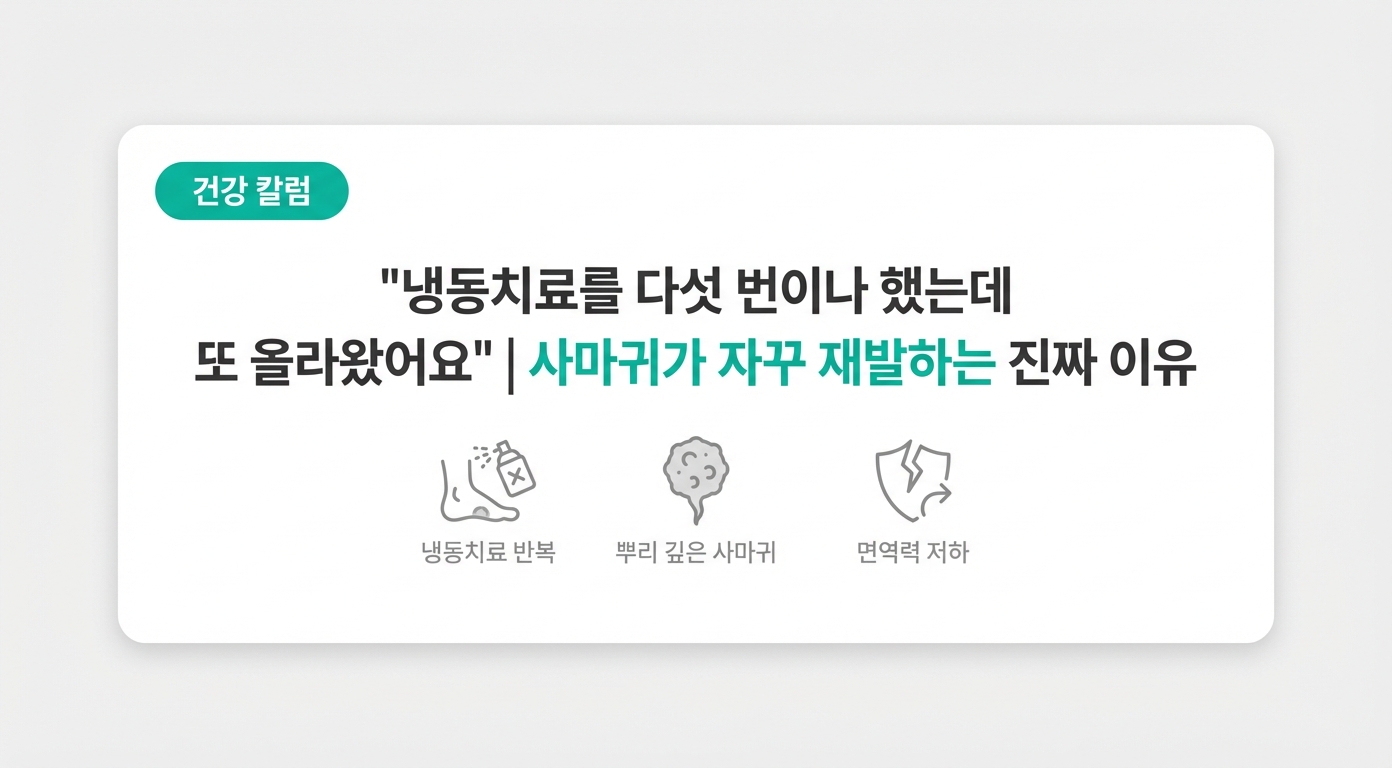
"I've had cryotherapy five times but it came back again" | The real reason warts keep recurring
 They Keep Coming Back, Even After Being Frozen Off
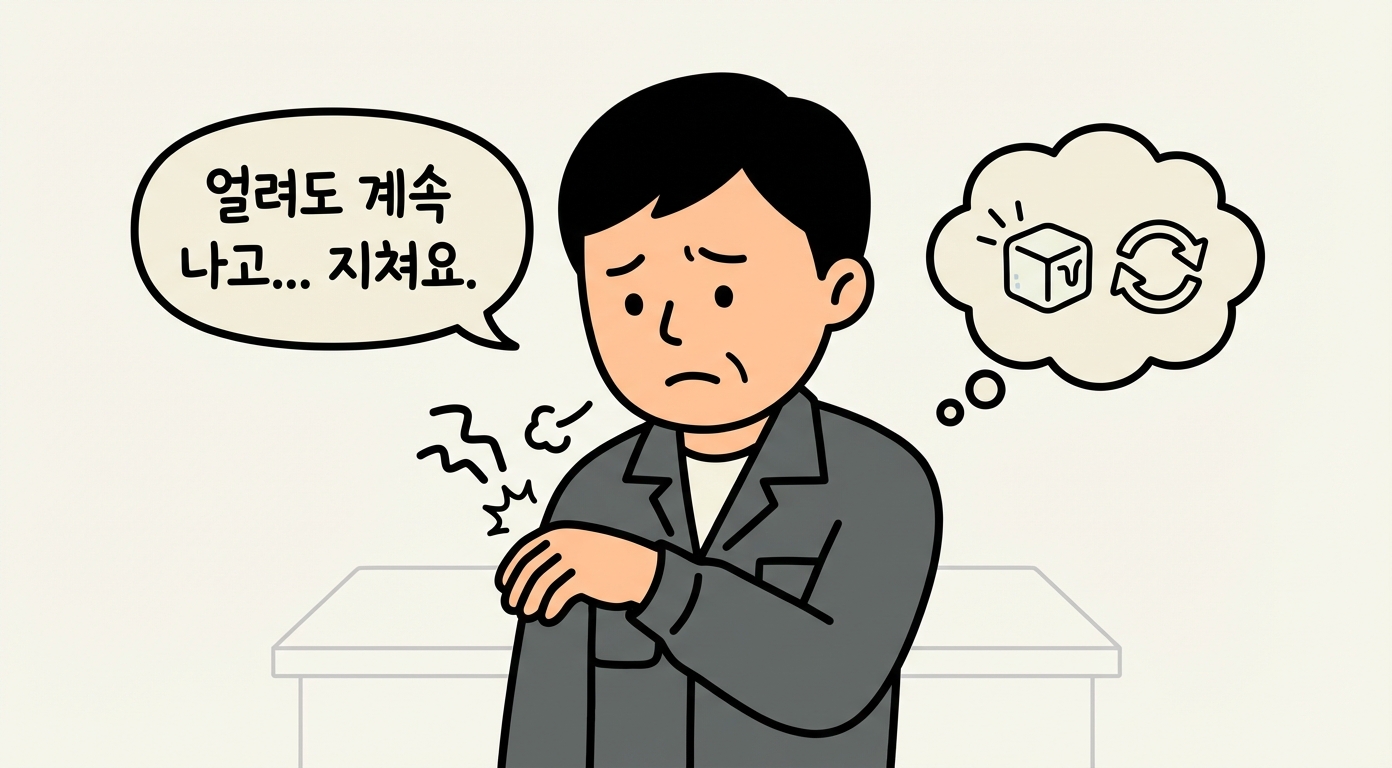
"Something came up on the back of my hand again.
This is the fifth time, and honestly, I'm exhausted."
These were the words of Sang-hun (pseudonym), a 43-year-old self-employed man working interior construction sites, when he first came to see me.
Sang-hun works more than ten hours a day on site.
Two years ago, when a small bump appeared on the back of his right hand, he assumed it was a callus.
But a few weeks later, another one appeared beside it, and then another next to that.
He visited a dermatologist and received cryotherapy — the lesions were frozen with liquid nitrogen.
Blisters formed, scabs developed, and when they fell off the skin looked clean.
But after a month or two, similar bumps would reappear near the same spot.
Back to the dermatologist, back to cryotherapy, back to blisters, back to scabs.
After going through this cycle five times, Sang-hun had grown exhausted with the treatment itself.
"Is there something I'm doing wrong?"
His eyes held a look of fatigue and self-reproach.
He had heard the dermatologist say "your immune system needs to take care of it,"
but no one had ever explained what that actually meant in concrete terms.
Every time I hear such stories, I feel deep empathy.
Among those who struggle with warts, there are so many people like Sang-hun, worn out by repeated treatments.
 If You Pull the Weeds Without Changing the Soil
So why do warts keep coming back even after multiple rounds of cryotherapy?
Warts are caused by human papillomavirus (HPV) infecting the skin.
Cryotherapy works by freezing and destroying the infected skin tissue with liquid nitrogen.
While it can remove the visible lesion, it is difficult to eliminate the virus hiding deep within the skin.
Modern medicine acknowledges that the cure rate for wart treatment is around 50~60%,
and even after treatment, the recurrence rate is reported to reach 25~50%.
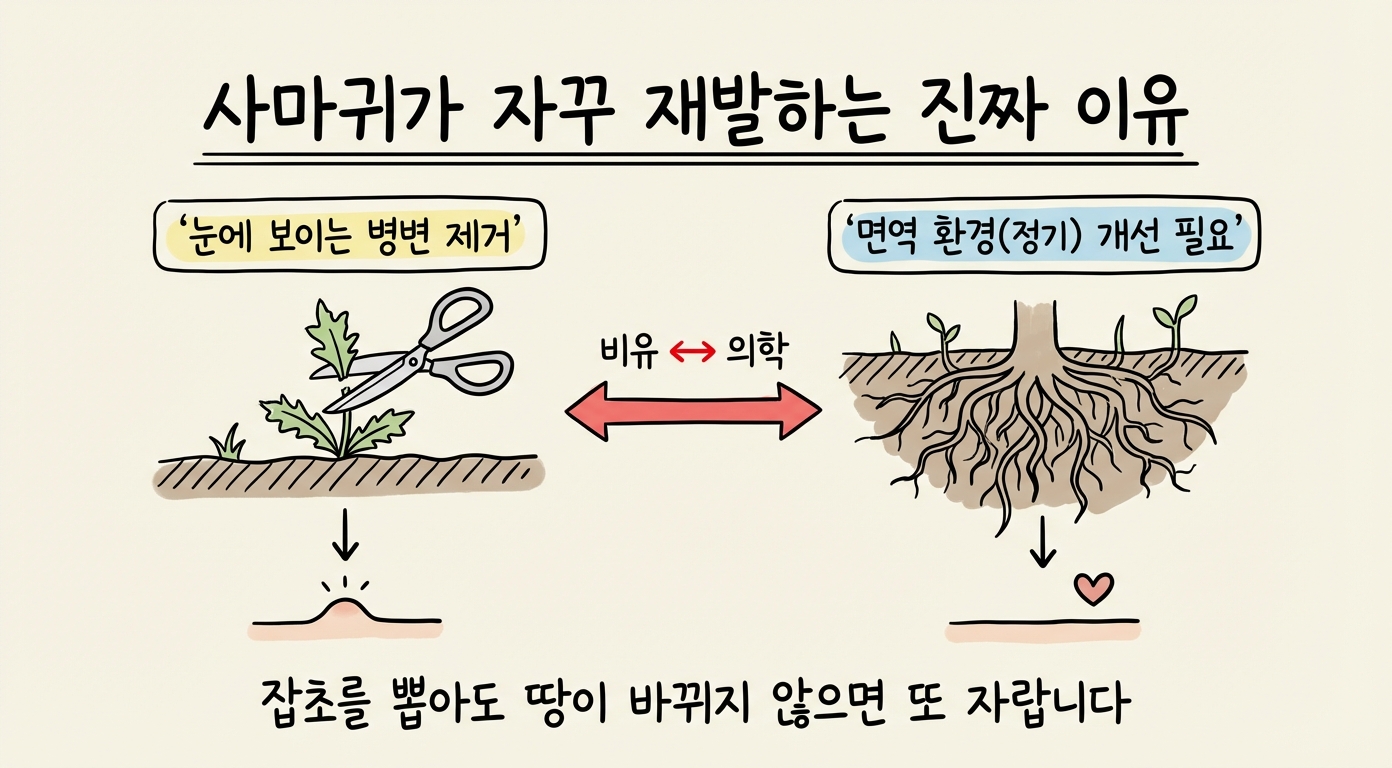
This can be compared to pulling weeds.
No matter how thoroughly you cut away the visible stems and leaves,
if the roots remain underground, the weeds will push up again after rain.
And if the soil is an environment where weeds thrive, new ones will sprout nearby even after the roots are pulled.
In Korean medicine, warts are called 우췌(疣贅), and they are viewed not simply as a surface skin problem but as a condition in which external pathogenic factors take hold in the skin when the body's 정기(正氣) — vital energy — has become deficient.
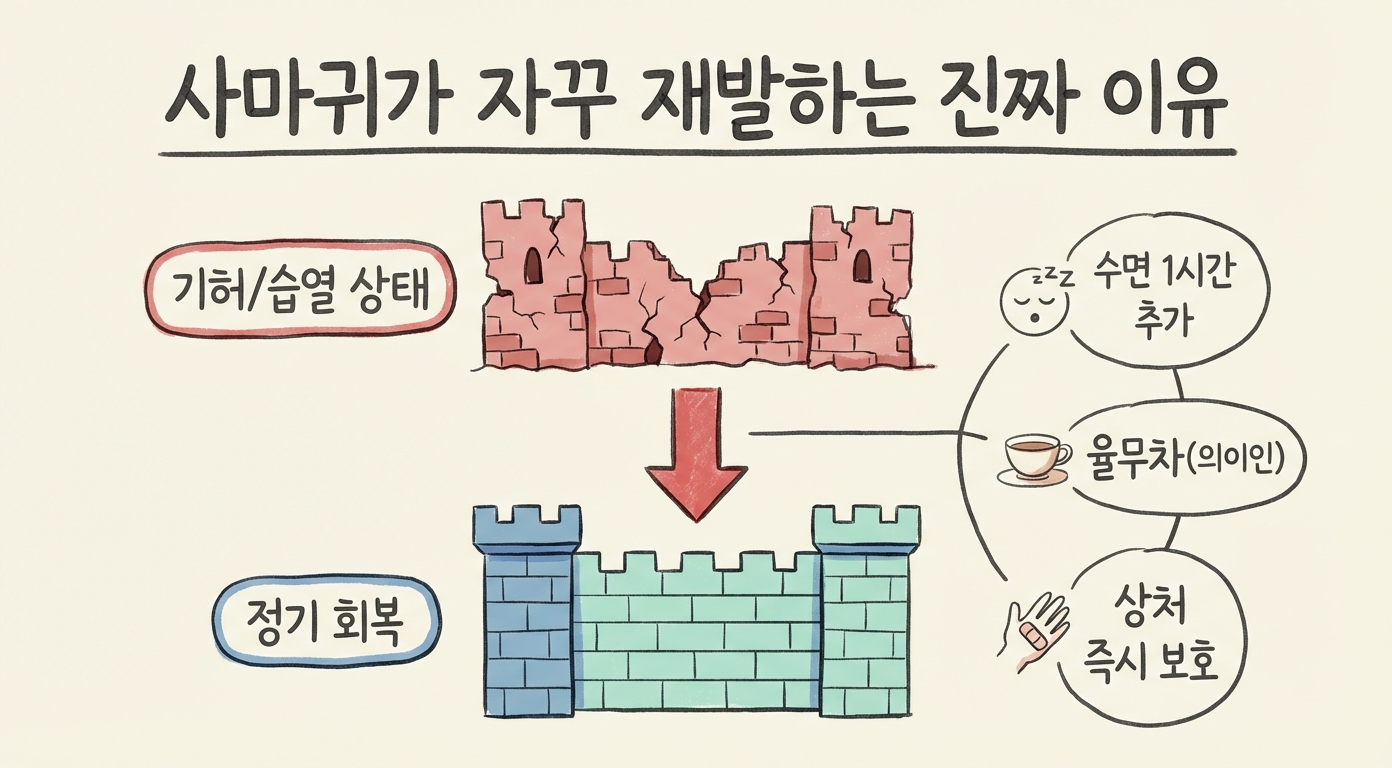
Simply put, when the immune "fortress wall" is strong, a virus cannot establish itself even if it enters; but when the wall has crumbled, no matter how many times you drive out the invader, it returns.
When 기허(氣虛) — qi deficiency — and 습열(濕熱) — damp heat — overlap, the skin's defensive function weakens and an environment favorable for viral proliferation is created.
If cryotherapy focuses on destroying the virus-infected tissue,
the Korean medicine approach focuses on creating a bodily environment in which the virus has difficulty surviving.
I did not view Sang-hun's condition as a simple skin problem.
Chronic fatigue, irregular meals, insufficient sleep — all of these were chipping away at his vital energy.
 Is There a Way Out of This Cycle?
Looking at the lives of people whose warts keep recurring like Sang-hun's, a few common patterns emerge.
First, sleep is insufficient.
The body's immune cells are most active while we sleep, and without adequate sleep, immune function inevitably declines.
Meals are often irregular or consist mainly of convenience food.
When the 비위(脾胃) — spleen and stomach — weakens, the production of qi and blood decreases, and nutrition fails to reach the skin.
Stress is also an undeniable factor.
The more treatment cycles are repeated, the more anxiety accumulates — "what if it comes back again?" — and that stress further suppresses immunity, creating a vicious cycle.
My first advice to Sang-hun was simply to sleep one hour more.
Drinking a daily cup of 의이인(薏苡仁) barley tea is also helpful.
Yi-yi-in (coix seed) has long been used in Korean medicine for wart treatment — it dries dampness in the skin and improves the immune environment.
Developing the habit of immediately disinfecting and covering any cuts on the hands is also important.
The wart virus infiltrates through microscopic gaps in the skin, so those who use their hands extensively in their work must be especially careful.
If warts spread rapidly,
if they appear around the nails and cause deformity,
or if pain intensifies, a medical institution must be visited.
Picking at them or applying irritation can spread the virus to surrounding skin —
the rule is never to touch them with your hands.
 The Time to Rebuild the Fortress Wall
The most important thing in wart treatment is not removing the visible lesion —
not simply suppressing symptoms, but the process of changing the body's environment.
Scooping water out of an overflowing tank is not enough;
the cracks in the tank itself must be repaired so the water does not overflow again.
In Sang-hun's case, combining herbal medicine and acupuncture while gradually correcting his lifestyle habits, three months later no new warts appeared on the back of his hand.
Of course, not everyone follows the same course.
An approach tailored to each individual's constitution and condition is needed, and it is a journey that requires sustained effort.
Listening to the signals the body sends, and not ignoring them, is the beginning.
Your body has a remarkable recovery capacity to find its own balance.
My role is to be a companion who helps find the key to that recovery.
Even if not through me, I sincerely hope you find a healthcare provider who carefully looks not just at the visible lesion but at the whole body.
✍️ Reviewed by Dr. Choi Jang-hyeok, Director of Dongjedang Korean Medicine Clinic