
"The ground feels like it's collapsing and I can't breathe" | Dizziness with panic disorder in a 30s office worker

The Terror of Walking on a Sponge: When My Body Slipped Out of My Control
"On my morning commute in a packed subway car, the ground suddenly seemed to drop away beneath my feet and I felt like I couldn't breathe.
Sweat poured off me like rain, and I felt as though the earth was collapsing — I just sank to the ground right there."
These were the words of Sun-young (pseudonym), a woman in her 30s who came to my clinic door for the first time, unable to hide her anxiety.
Every time I hear such desperate, helpless stories, my own heart grows heavy.
She had been fiercely holding her daily life together when one morning, an extreme bout of dizziness and difficulty breathing came on suddenly, forcing her to rush to the emergency room.
In the midst of a terror that her heart might stop at any moment, she went from ENT to neurology, undergoing multiple detailed examinations — only to be told, with crushing deflation, that there was absolutely nothing structurally wrong with her heart or ears.
Unable to find a clear cause, the fear of not knowing when symptoms might return became an everyday stress, which in turn worsened her dizziness, creating a painful vicious cycle.
All the test results said "normal," yet the patient herself was suffering to the point where ordinary daily life had become impossible.
I'll be honest: in my clinical practice, I've witnessed countless times how that casual reassurance of "nothing wrong with you" sometimes pushes patients even closer to the edge of a cliff.
I did not view Sun-young's symptoms as merely a problem with the vestibular organs of the ear, or as temporary work-related stress.
Deeply empathizing with her sense of devastation — as if the life she'd been running without rest had collapsed overnight — I told her clearly that these symptoms were in no way a sign of weakness or lack of willpower.
Walking on what must feel like a sponge saturated with water, being tossed about in extreme disorientation — I can hardly imagine how frightened she must have been, facing that alone.
So why does something so bewildering happen when the body shows no signs of illness?
 The Body's Warning Lights: A Disrupted Autonomic Nervous System and Stalled Qi
Sun-young's symptoms can be explained in traditional Korean medicine terms as a state of Qi stagnation (기울, 氣鬱) — where the flow of the body's vital energy has become completely blocked due to extreme stress and suppressed emotions.
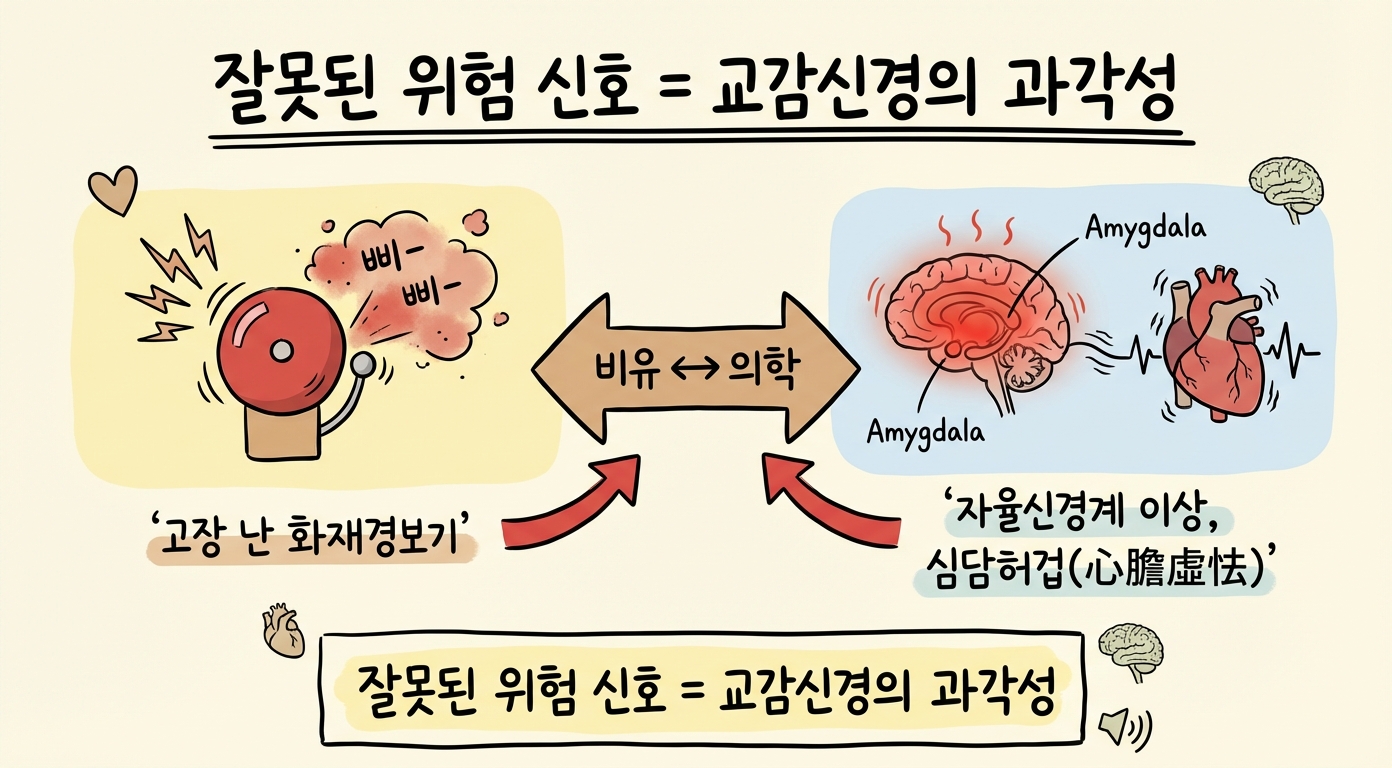
On top of this, the energy of the heart and gallbladder had been fully depleted, resulting in an inevitable manifestation of Simdam Heogeop (심담허겁, 心膽虛怯) — a condition in which even the slightest stimulus triggers profound agitation and anxiety.
Viewed through the lens of Western medicine, this is deeply connected to an autonomic nervous system disorder in which the brain's amygdala — responsible for detecting danger for survival — has become hypersensitive, causing a loss of coordination between the sympathetic and parasympathetic nervous systems.
Even though there is no actual life-threatening situation, the brain and body mistake it for a serious catastrophe, causing blood flow to surge chaotically — which in turn makes the heart pound as if it will burst and triggers dizziness so severe it feels like one might collapse at any moment.
This is much like a malfunctioning fire alarm that goes off at the slightest breeze even when no burglar is present, sounding so piercingly it seems to split the ears. When the fire alarm goes off incessantly, our body's control center falls into chaos.
The brain keeps sending false danger signals, the stomach and heart become constricted and trigger indigestion and palpitations, which in turn amplify the brain's anxiety.
In a situation where the neural networks of the brain and body are so tightly entangled, negatively affecting each other, it is very difficult to find a fundamental solution simply through medications that suppress dizziness.
 How Can a Bowstring Pulled Taut Be Loosened?
So is there a way to turn off the body's warning lights that go off at all hours and escape from that stifling feeling?
Panic-induced dizziness is not a condition that suddenly fell from the sky one day.
It is the result of chronic sleep deprivation and relentless work stress — years of tension suppressed and endured — finally reaching a breaking point.
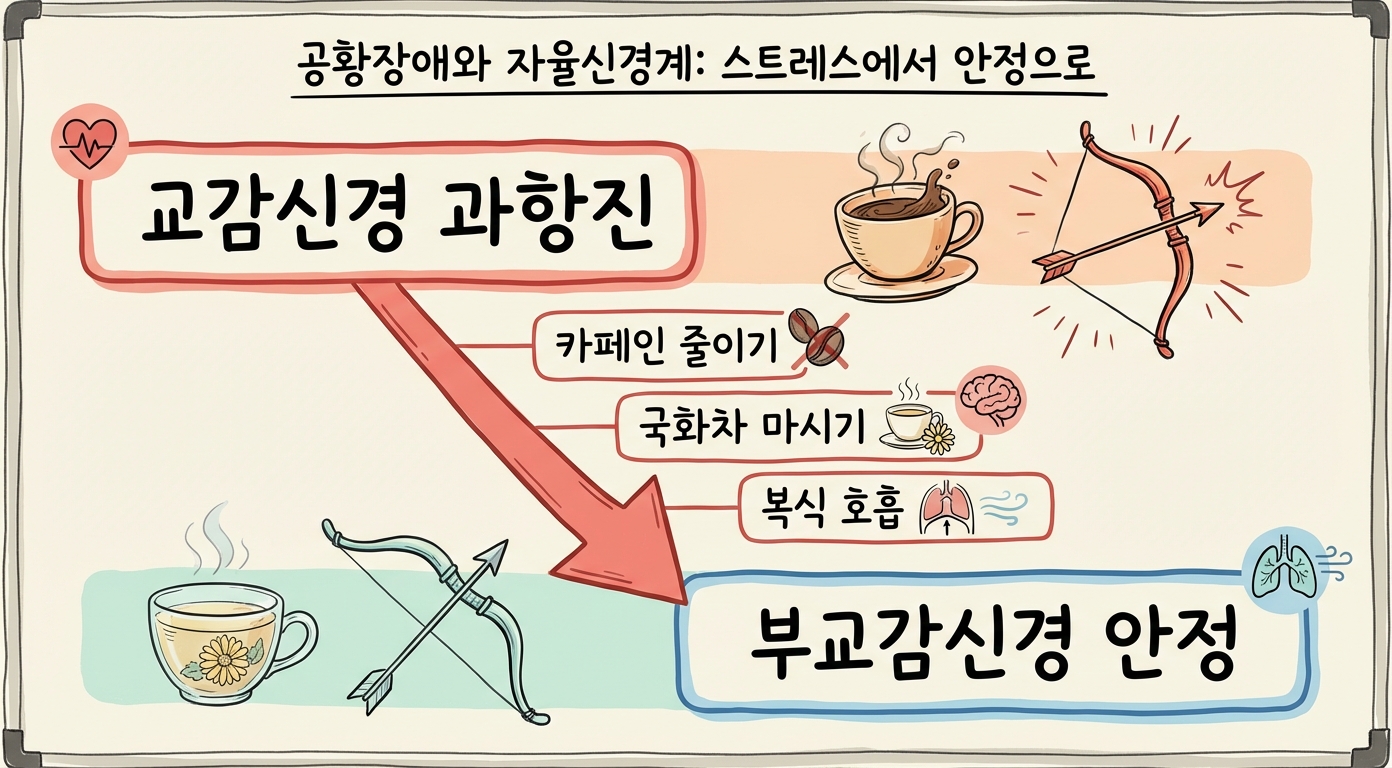
In everyday life, to lower this state of brain hyperarousal, it is important above all to gradually reduce consumption of high-caffeine drinks that stimulate the sympathetic nervous system and cause irregular heartbeats.
Instead of coffee, drinking warm water or chrysanthemum tea, which soothes the mind and body, is a great help in calming the exhausted nervous system.
In addition, through conscious abdominal breathing — breathing in deeply while expanding the lower abdomen and exhaling slowly — one must keep sending the body a gentle signal that it is now safe.
Think of this as the crucial process of applying gentle oil to a tightly drawn bowstring on the verge of snapping, and slowly releasing its tension.
However, there is one important caution I must add here.
If severe dizziness is accompanied by slurred speech, weakness on one side of the body, or double vision — neurological paralysis symptoms — this may be a warning sign of cerebrovascular disease, and you must seek emergency care without delay.
 The Journey to Recovery: Stopping the Malfunction and Reclaiming Your Own Rhythm
True healing does not mean suppressing the surging anxiety and dizziness with powerful sedatives and temporarily numbing them away.
It must be the arduous but essential process of fundamentally restoring the body's depleted internal environment so that the brain and body can find stability on their own.
Carefully tailored herbal medicine treatment — gently releasing the tightly knotted energy in the chest and replenishing the heart's depleted energy — becomes an excellent tool for helping the disrupted autonomic nervous system find its footing again.
Please quietly listen to the desperate signals your body is sending and gently encourage yourself with warmth.
Your body holds a far more remarkable and resilient power of recovery within it than you might think.
It is simply temporarily lost and wandering in the midst of an intense life.
My role is to serve as a guide who helps untangle the complex knots of body and mind, and to find together with patients the key that enables them to heal themselves.
Even if not through me — I sincerely cheer for you to meet a genuine healthcare provider who can fully empathize with the weight of that deep fear you carry, and who can restore the lost rhythm of your whole body beyond surface symptoms through an integrative perspective, so that you may recover your peaceful daily life.
✍️ Reviewed by Dr. Choi Jang-hyeok, Director of Dongjedang Korean Medicine Clinic