
Chronic Benign Paroxysmal Positional Vertigo and Indigestion, Why Do They Always Come Together?

 🧾 Answer First | Core Conclusion
Are you experiencing dizziness where the world spins while your stomach churns and you feel bloated right now?
Hello.
I am Dr. Choi Jang-hyuk, director of Dongjejang Korean Medicine Clinic.
Many office workers I see in my clinic treat ear and gastrointestinal problems as separate issues.
They go to an ENT when dizzy and visit an internist when their stomach feels uncomfortable.
However, chronic benign paroxysmal positional vertigo recurrence and indigestion are actually the same problem connected by one neural network.
When the ear becomes unstable, our brain immediately declares an emergency state.
And to conserve energy, it stops the stomach's activity first.
This is why stomach queasiness and dizziness always appear as a set together.
You can only escape these two terrible symptoms by finding fundamental nervous system stability.
I will share 3 methods you can implement immediately, so please try them.
 ✅ Action | Immediate Implementation
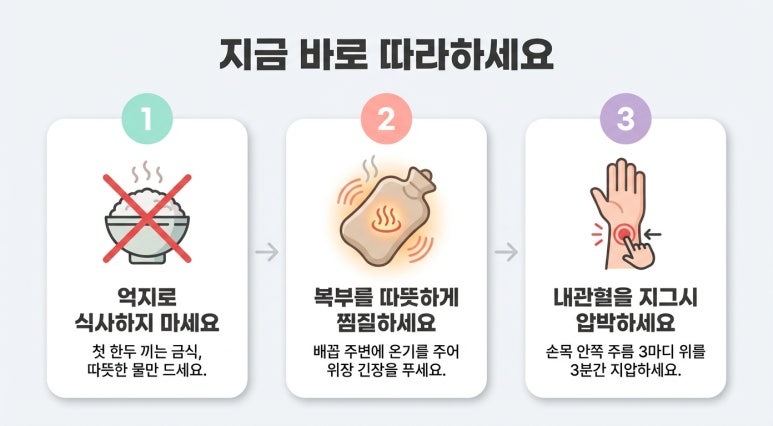
If dizziness suddenly worsens when you feel bloated, immediately practice the following 3 things.
70% of symptoms will quickly subside with just this routine.
1️⃣ Do not force yourself to eat
Some people force themselves to eat despite feeling dizzy and weak.
But at this moment, your stomach is completely stopped.
If food enters, you will definitely bloat severely.
Skip the first meal or two boldly and drink only warm water in small sips.
Giving your stomach time to rest helps your brain nerves stabilize quickly.
2️⃣ Warm compress your abdomen
When your abdomen gets cold, stomach muscles contract even more strongly.
Place a heat pack or warm water bottle around your belly button.
If you're at the office, you can attach a disposable heat pack to your abdomen or hold a tumbler of warm water against your belly for a while.
When warmth is delivered, the tense stomach nerves gradually relax.
As the stomach tension eases, stress signals going to the brain decrease, greatly helping relieve dizziness.
3️⃣ Press the Neiguan acupoint firmly
The best acupressure point when dizzy is the 'Neiguan acupoint.'
It's located three finger widths above the crease on the inner side of your wrist.
Press this spot firmly with your thumb for 5 seconds and release, repeating for 3 minutes.
It has an excellent effect in settling stomach queasiness and stabilizing the autonomic nervous system.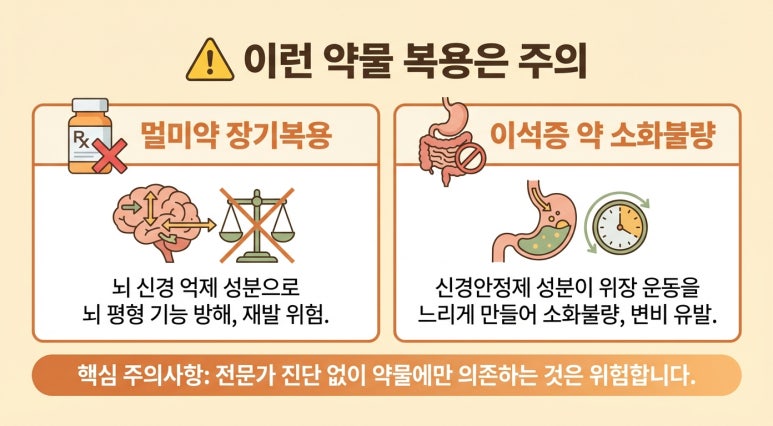 🚨 Warning | Critical Warning Signs You Must Check
It is very dangerous to rely solely on medication when dizzy and feeling like you might vomit.
Especially pay attention to the following two situations.
✔ Be careful of side effects from long-term motion sickness medication use
Most drugs that relieve dizziness contain ingredients that suppress brain nerves.
Short-term use masks symptoms, but prolonged use interferes with the brain's own process of finding balance and adapting.
When you stop the medication, dizziness may recur more severely than before, creating a vicious cycle[1].
✔ Avoid the trap of vertigo medication causing indigestion
Nerve stabilizers or sedatives don't just suppress ear nerves.
They also slow down stomach movement in our bodies.
Because of this, many people report that while dizziness decreases after taking medication, their stomach feels blocked and they develop constipation[2].
If your stomach still feels uncomfortable and you continue to feel dizzy even after taking medication, you must stop immediately and get re-evaluated by a specialist.
 🧠 The Why | Root Cause Analysis
So why is your stomach upset when your ear hurts?
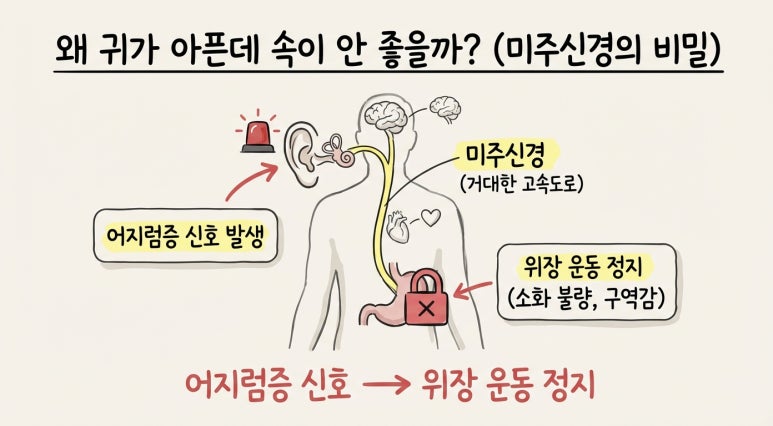
Our bodies have a massive superhighway called the 'vagus nerve.'
This nerve connects the brain, ears, and stomach all together.
To put it simply, it's like when a building catches fire, emergency alarms ring throughout all floors.
When otoliths fall in the inner ear's balance organ or pressure problems develop, severe dizziness signals occur.
This signal then travels via the vagus nerve superhighway and immediately sends a warning to the stomach.
It commands: "Your body is in danger right now! This is not the time to digest food!"
When extreme stress from dizziness occurs, our body excessively activates the sympathetic nervous system.
This is an 'extreme tension state' our body creates for survival.
Conversely, the parasympathetic nervous system that handles digestion completely shuts down.
Blood flow to the stomach is cut off and stomach wall muscles become rigid and tight.
Ultimately, digestive fluid secretion stops and stomach acid refluxes, causing severe indigestion and nausea.
📊 Proof | Cases and Evidence
Many of my clinical patients previously visited internal medicine departments for stomach issues.
However, they only heard that endoscopy showed no abnormalities.
A stressed office worker in his 30s always carried digestive aids with him.
He said his stomach churning prevented him from concentrating on work.
However, after my diagnosis, the real cause was chronic instability of the inner ear.
Because the dizziness persisted microscopically, his stomach had no time to rest.
From my experience, when I relaxed the hardened stomach muscles through acupuncture and prescribed herbal medicine to stabilize the autonomic nervous system, significant improvement appeared.
Countless times within just 2 weeks of starting treatment, I confirmed that indigestion and chronic dizziness simultaneously subsided.
Korean medicine treatment that improves blood circulation around the ear and removes waste products is a good method to simultaneously address the root cause of both symptoms[3][4].
 🔚 Closing | Summary and Encouragement
Chronic dizziness and indigestion are not mere inconveniences.
They are your body's desperate SOS signals pleading for help.
Don't waste time and energy taking separate medications for ear and stomach problems.
By correcting the balance of your autonomic nervous system, your body's central axis, you can solve both stubborn symptoms at once.
No longer give up your daily life to dizziness and bloating.
I will guide you on the best path to restore your comfortable and healthy everyday life.
✍️ Reviewed by Dr. Choi Jang-hyuk, Director of Dongjejang Korean Medicine Clinic
❓ FAQ
Q. Can I just take digestive aids when I feel dizzy and bloated?
No, if the root cause is a balance organ problem in the ear, digestive aids alone won't completely solve it.
Your stomach nerves are tightened due to the stress of dizziness.
Rather than temporary digestive aid use, treatment that soothes balance nerves and stabilizes the autonomic nervous system must be combined for your stomach to feel comfortable.
Q. Why does my stomach become more acidic and uncomfortable when I take dizziness medication?
The sedative ingredients in dizziness medications powerfully suppress the stomach's normal movements.
This dramatically reduces digestive fluid secretion and stops intestinal movements.
Consequently, severe indigestion, stomach acidity, and constipation are inevitable common side effects.
Q. How does a Korean medicine clinic treat chronic dizziness and indigestion?
Through acupuncture and herbal medicine, we restore the lost balance of the autonomic nervous system connecting the ears and stomach.
We improve microcirculation around the ear to strengthen the balance organ, and warm and relax the stiffened and cold stomach.
We focus on normalizing the body's interconnections to treat both symptoms simultaneously.
📚 References
[Western Medicine]
[1] BMJ Best Practice (2023). "Vertigo - Approach and Management"
[2] NICE (2022). "Nausea and vomiting - management and drug induced causes"
[Korean Medicine]
[3] Korean Medicine Society CPG (2021). "Korean Medicine Clinical Practice Guideline for Vertigo"
[4] Journal of Korean Oriental Internal Medicine (2019). "Research on Correlation between Phlegm Dizziness (痰暈) and Functional Dyspepsia"
Head & Face
Chronic Benign Paroxysmal Positional Vertigo and Indigestion, Why Do They Always Come Together?
View Program