
"I starved myself to lose weight but I ended up eating more" | The real reason diet failures keep repeating

 A Weight That Numbers Cannot Explain
"Doctor, honestly, I don't eat.
I skip breakfast, and lunch is just salad.
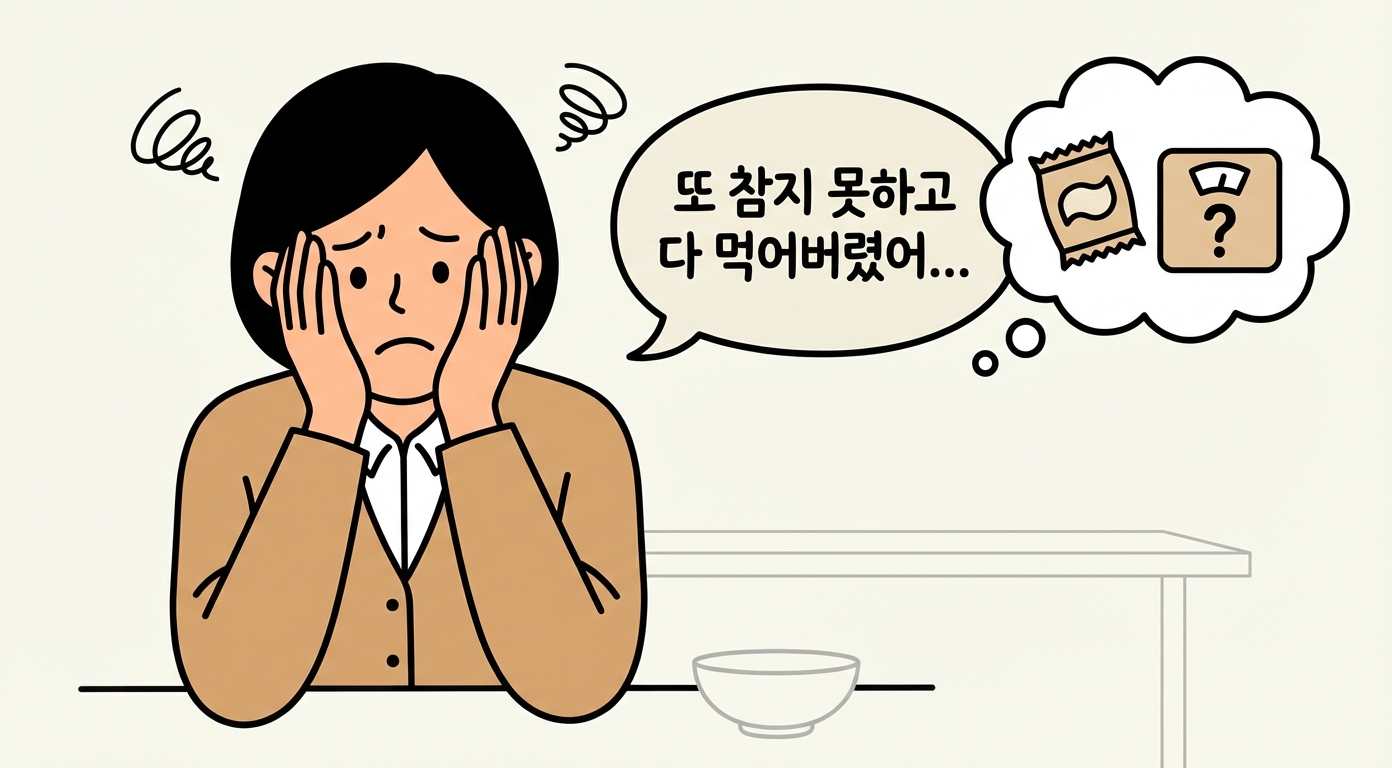
But every night I explode.
Ramen, chips, ice cream — everything.
After it's all gone, I feel so ashamed that I starve myself again the next day."
These were the words of Eun-jung (pseudonym), a woman in her forties working in an office, when she first came to see me.
Eun-jung stood 162 cm tall and weighed 78 kg.
After her internist told her that her blood sugar and cholesterol were borderline, she resolved to diet.
She tried the trendy eating plans, attempted intermittent fasting.
The first month or two seemed to show results, but she never managed to sustain it past three months.
On stressful days, late-night binge eating inevitably followed, and after that came guilt, self-loathing, and another round of extreme restriction.
This cycle had been repeating for two years.
"I don't know if my willpower is weak, or if it's just my constitution."
That one sentence from Eun-jung resonated deeply with me.
I did not view Eun-jung's problem as a simple failure of appetite control.
 It Is Not the Mouth That Decides What We Eat — It Is the Mind
In Korean medicine, particularly Sasang constitutional medicine,
most diseases are seen as arising when innate emotional tendencies are combined with acquired psychological conflict.
Simply put,
each person has a different direction in which the mind responds to stress, and when that direction reaches an extreme, the body breaks down.
Master Lee Je-ma wrote in the Dongui Suseowon:
When the emotional nature loses its balance and is greatly stirred, it is no different from cutting the viscera with a knife.
Once shaken greatly even once, it is said that recovery may take ten years.
What is striking is that this description, written 130 years ago, overlaps remarkably with the latest Western research.
A 2025 meta-analysis found that approximately 45% of obese individuals display
emotional eating — eating in response to negative emotions such as stress or depression.
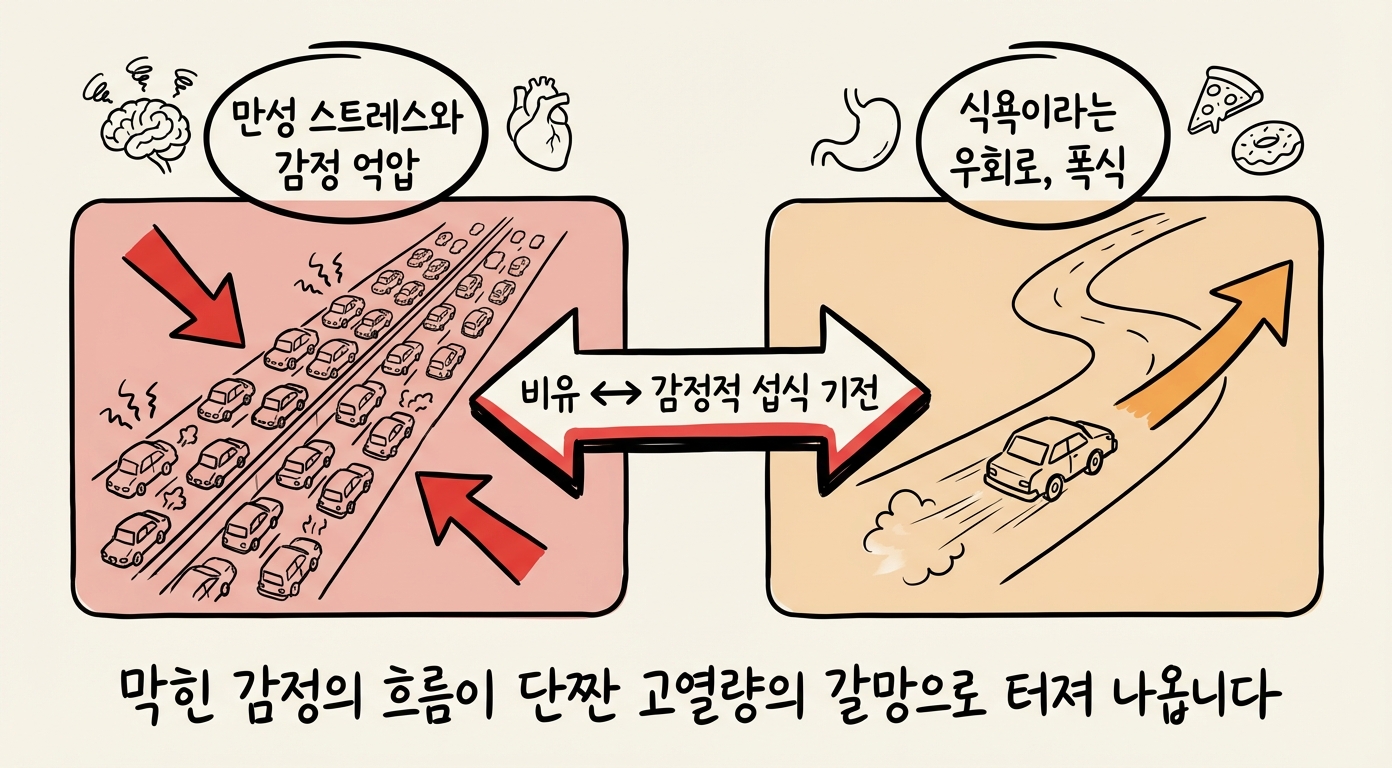
Chronic stress causes excessive secretion of cortisol, a hormone that amplifies cravings for salty, sweet, high-calorie foods.
Just as a highway traffic jam leaves all vehicles immobilized, the blocked flow of emotion under stress bursts out through the detour of appetite.
On top of that, repeated binge eating desensitizes the brain's reward circuits — more and more food is needed to achieve the same satisfaction.
This operates by the same mechanism as drug addiction.
 So Why Is "Eating According to Your Constitution" Not Enough?
Many people think that "constitutional dieting" means Tae-eum types eat this and So-eum types eat that, and the weight will come off.
But this is far removed from the true intent of Sasang constitutional medicine.
What Eun-jung needed was not coix seeds or soybeans said to be good for Tae-eum types.
What Eun-jung needed first was to understand the structure of the mind that was driving the nightly binge eating.
Sasang constitutional medicine states that when the emotional nature of the Tae-eum type reaches an extreme, "there is no end to indulgence and pleasure."
This corresponds precisely to what modern neuroscience calls the elevation of the reward threshold — the state of eating and eating and never feeling satisfied.
On the other hand, it is said that when the So-eum type's emotional nature is shaken, "preferences become unsettled."
Trying this and that but not knowing what to eat — a pattern where eating habits themselves lose direction.
Even with the same obesity, the direction in which the mind collapses differs.
So the same diet plan cannot solve it.
Like tailoring a bespoke suit, the first step is to identify in which direction that person's emotional nature has tilted, and then help find the point of mental balance appropriate to it.
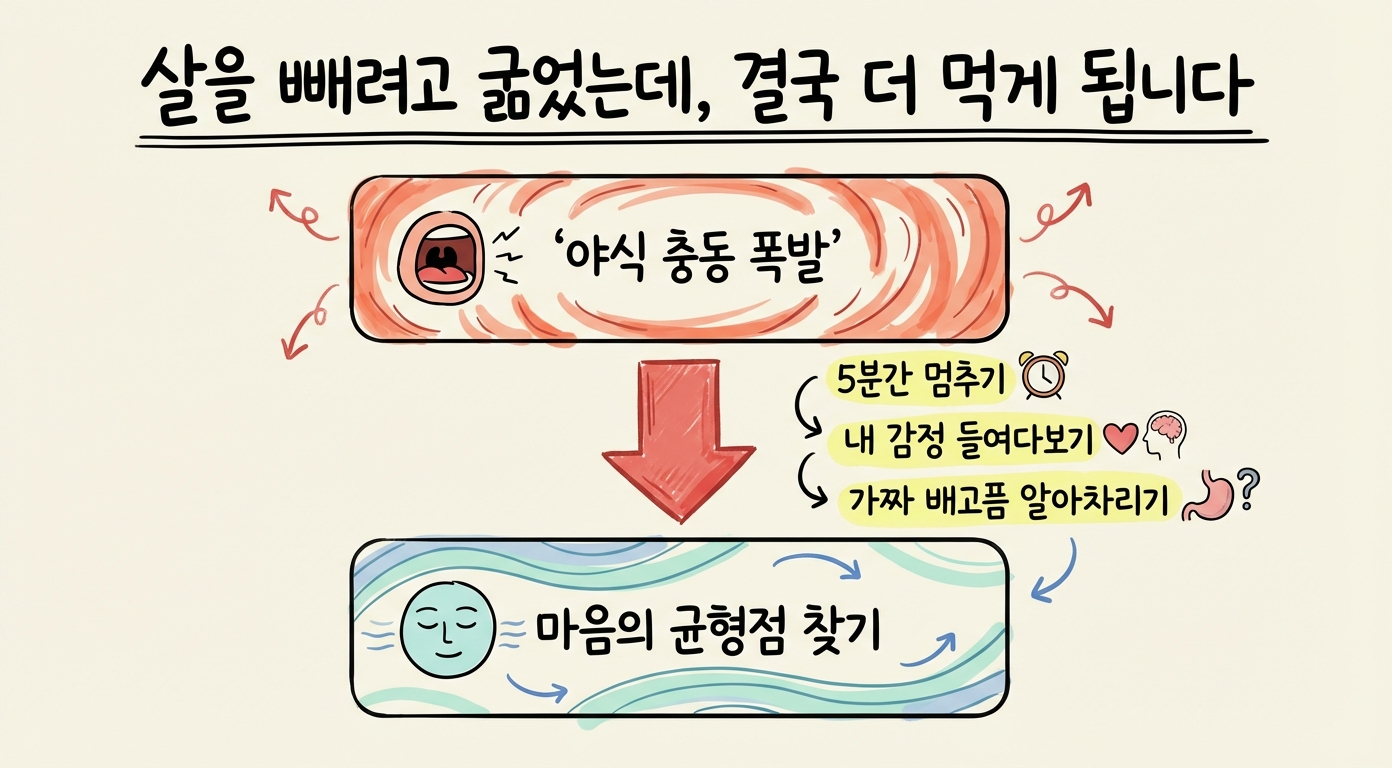
Try developing the habit of sitting with nothing for just five minutes when a late-night craving strikes, looking inward at your emotions.
"Am I physically hungry right now, or is my heart empty?" — this single question alone can stop half of binge episodes.
If cycles of binge eating and restriction have been repeating for more than two weeks, or if severe guilt and depression accompany eating, this is not a matter of willpower — it is a state that absolutely requires professional help.
 The Key to Changing Your Weight Is Not on the Scale
Over three months of treatment, Eun-jung did not receive a meal plan.
Instead, she learned how to observe her own emotional patterns,
and began to recognize her own unique way of responding to stress.
Weight loss followed as a byproduct.
Please listen to the signals your body sends.
The appetite that comes every night may not be a signal of hunger —
it may be the sound of emotions that were suppressed all day long, searching for an outlet.
Your body has a remarkable capacity for recovery.
But for that recovery to work properly, mental balance must come first.
My role is to be a companion in finding that point of balance together.
Even if not through me, I sincerely hope you find a healthcare provider who carefully tends to the whole body.
Losing weight begins not with eating less, but with caring for the mind.
✍️ Reviewed by Dr. Choi Jang-hyeok, Director of Dongjedang Korean Medicine Clinic