"It burns when I urinate but tests say I'm normal" | The hidden cause of chronic cystitis recurring after menopause

 Signals Sent from a Parched Field
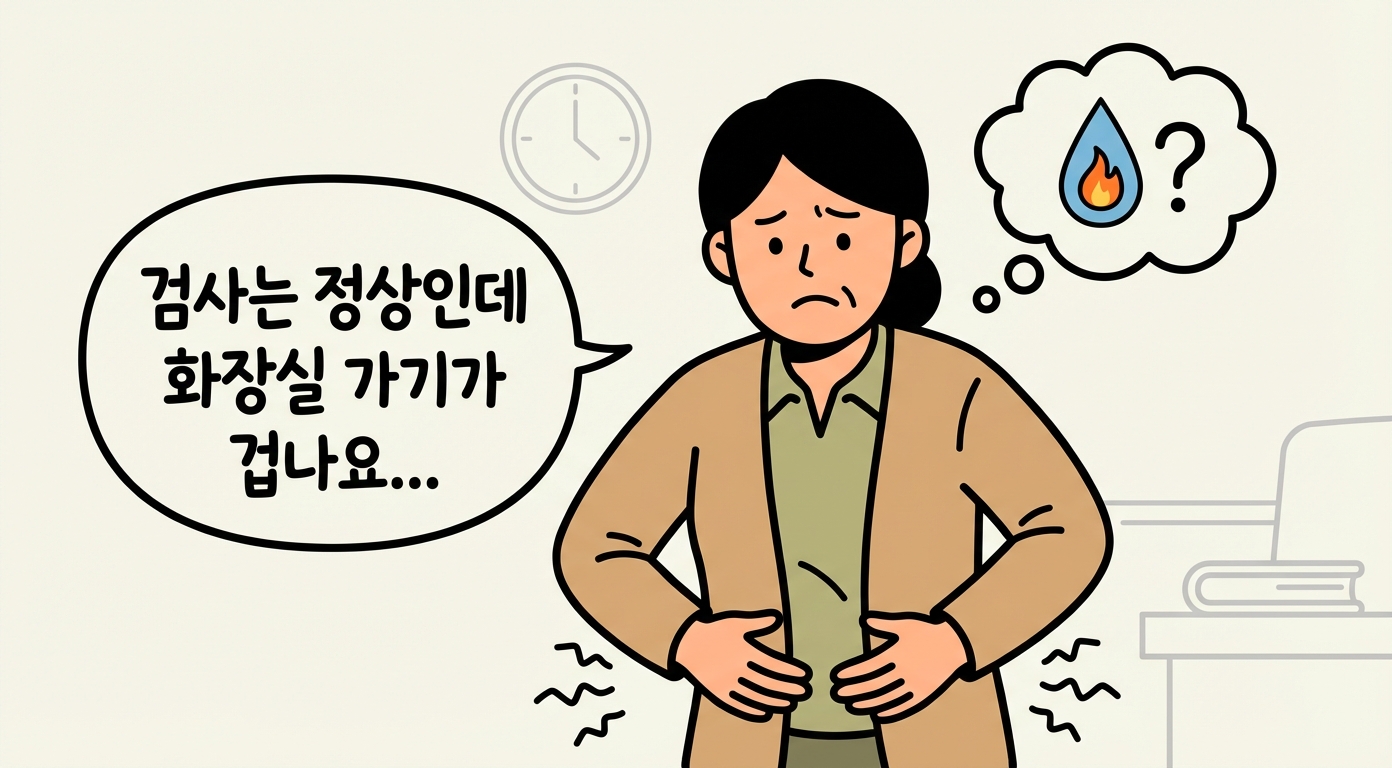
"Every time I urinate, it feels like fire. But when they do tests, no bacteria come up.
My lower abdomen always feels heavy, and I wake up two or three times at night.
People say this is just what happens at my age — am I the only one being dramatic?"
These were the words of Sun-young (pseudonym), a 53-year-old academy instructor, when she first came to see me.
Sun-young taught back-to-back classes from morning to evening and found it difficult to go to the bathroom in between.
So she drank as little water as possible, and throughout her classes the heavy sensation in her lower abdomen weighed on her constantly.
The symptoms had appeared gradually over the two years since menopause began.
At first it was just a mild sensation of residual urine, but it worsened suddenly around the time of a cold snap the previous winter.
She had been to three different urology clinics.
Taking antibiotics would help for a few days before the symptoms returned.
Urine tests showed no bacteria, and a cystoscopy was normal.
"The moments I was told nothing was wrong were when I felt the most lost."
Sun-young said quietly.
I did not view Sun-young's symptoms as a simple bladder infection.
The fact that the tests were normal could mean that bacteria were not the problem — but rather that the environment surrounding the bladder itself was changing.
Every time I hear a story like this, I feel deep empathy for the patient's suffering.
Because being told there is no visible cause can sometimes sound like being told, "Your pain has no basis."
So what is the true nature of this pain that the tests cannot identify?
 The Drying Well, the Rising Fire
In Korean medicine, this state is called 음허화왕(陰虛火旺) — yin deficiency with fire effulgence.
It refers to the state in which the body's moisture — its vital fluids — diminishes, and as a result heat rises upward relatively.
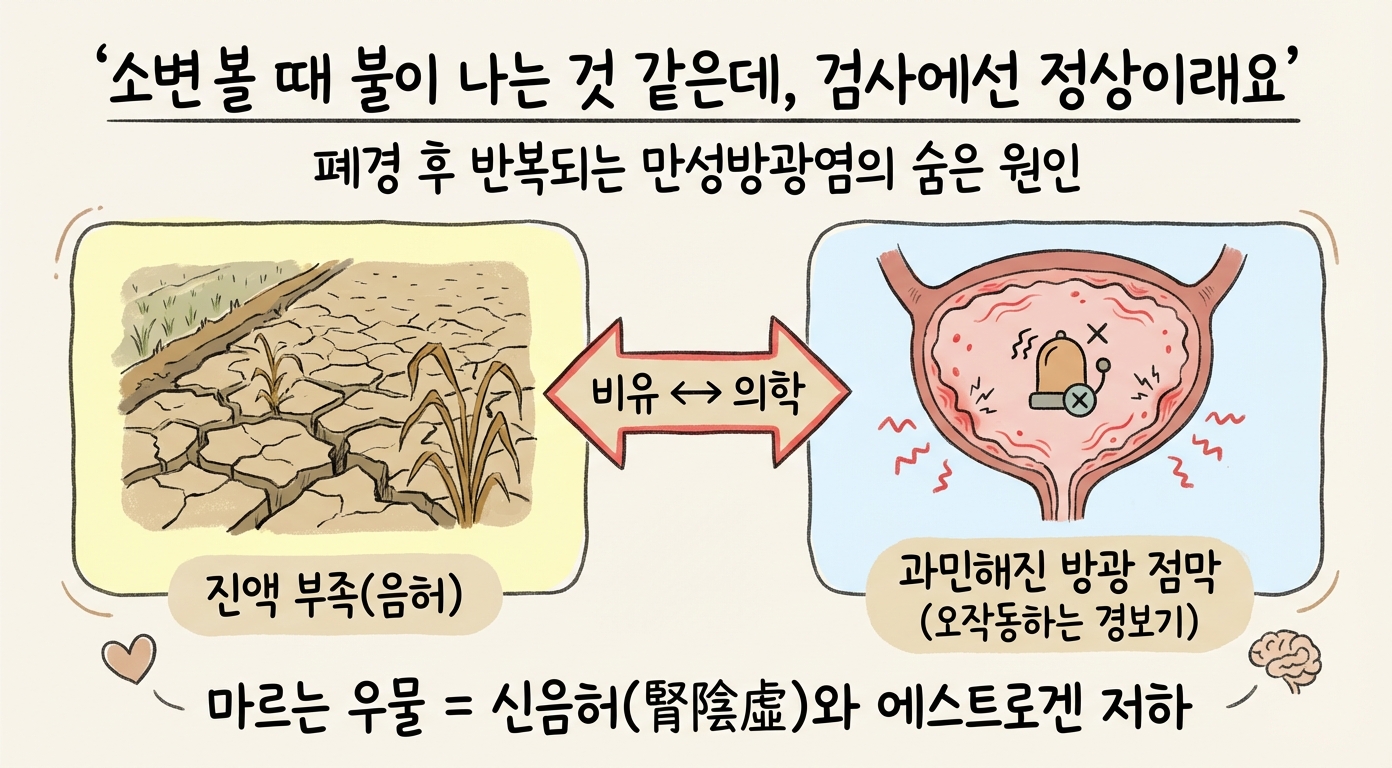
Thinking of a parched rice paddy makes this easy to understand.
When there is enough water, the paddy floor is moist and soft; when the water recedes, the soil cracks and splits.
The lining of our bladder is no different.
When the power that maintains moisture and lubrication diminishes, the lining becomes thin and more easily irritated.
In Korean medicine, the source of this power is the kidney (腎).
신음허(腎陰虛) — kidney yin deficiency — refers to the state in which the kidney's function of nourishing and moistening the body has weakened.
As we age, and especially after passing through menopause, this nourishing capacity naturally diminishes.
Modern medicine also well recognizes that after menopause, as estrogen decreases,
the urinary tract lining becomes thinner and the defensive barrier weakens.
Kidney yin deficiency in Korean medicine and estrogen decline in modern medicine are two different languages pointing to the same phenomenon.
There is one more important point here.
A bladder whose lining has dried out becomes like a faulty alarm system.
Even without actual bacterial invasion, it overreacts to minor stimulation and sends signals of pain and frequent urination.
This is precisely why symptoms persist even when no bacteria are found in tests.
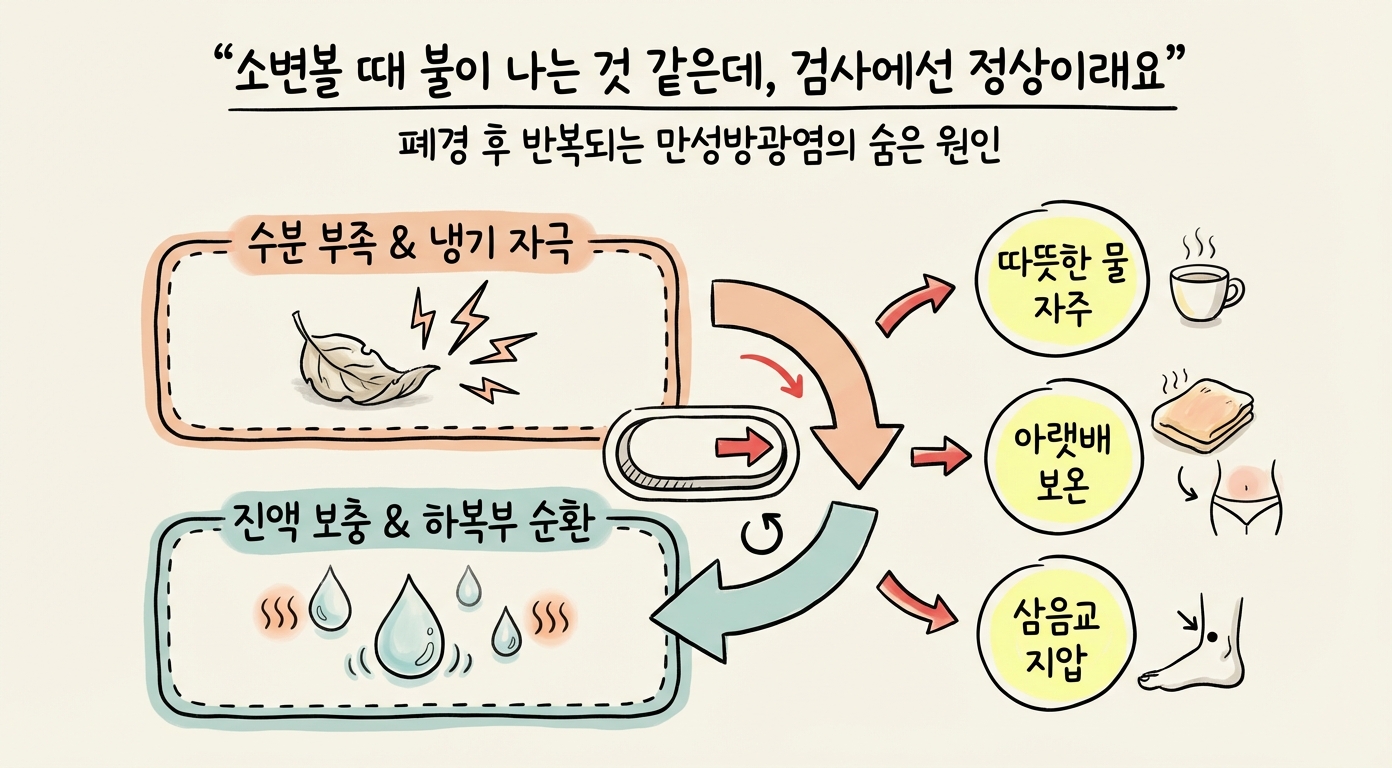
This process creates a vicious cycle.
Deficient vital fluids cause the lining to dry out,
a dry lining triggers hypersensitivity,
repeated urinary frequency makes one more reluctant to drink water,
and the lining dries out even further.
This is why simply suppressing symptoms is not enough — the cycle itself must be broken.
 Is There a Way Out of This Dryness?
The first thing to revisit is, paradoxically, water.
Many people like Sun-young reduce their water intake out of concern about needing the bathroom.
But when fluids are insufficient, urine becomes more concentrated, and concentrated urine further irritates an already sensitive lining.
Rather than drinking a lot of water at once, it is better to sip small amounts frequently.
Caffeinated drinks such as coffee and green tea can irritate the bladder, so I recommend reducing them.
Cold wind and cold temperatures also interfere with blood circulation in the lower abdomen, worsening symptoms.
Many people notice a difference just by keeping the lower abdomen and lower back warm, especially in winter.
The habit of placing a warm water bag on the lower abdomen is also helpful.
In Korean medicine, gently pressing the 삼음교(三陰交) acupoint on the inner leg is sometimes recommended.
This acupoint is where the qi of the kidney, liver, and spleen converge, and it helps with lower abdominal circulation and replenishing vital fluids.
Pressing firmly on both sides alternately for about 3 minutes before sleep is beneficial.
If blood appears in the urine, or if high fever accompanies the symptoms, or if lower back pain worsens, this may not be a simple chronic condition — please visit a medical institution immediately.
 The Well That Fills Again
I was honest with Sun-young.
I told her these symptoms would not end with one or two rounds of medication.
But if she steadily followed the process of changing the body's environment, things would certainly change.
Three months later, Sun-young was able to go two hours during class without worrying about the bathroom.
Please listen to the signals your body is sending.
Just because the tests cannot identify something does not mean your pain is trivial.
Your body possesses a remarkable capacity to restore its own balance.
My role is to serve as a guide who helps you find the key to that recovery together.
Even if it is not with me, I strongly encourage you to find a healthcare provider who looks carefully at your whole body.
Even a dried-up well can find its water again.
An approach tailored to each person's constitution and condition is where that water begins to flow.
✍️ Reviewed by Dr. Choi Jang-Hyuk, Director of Dongjedang Korean Medicine Clinic
Women's Health
"It burns when I urinate but tests say I'm normal" | The hidden cause of chronic cystitis recurring after menopause
View Program