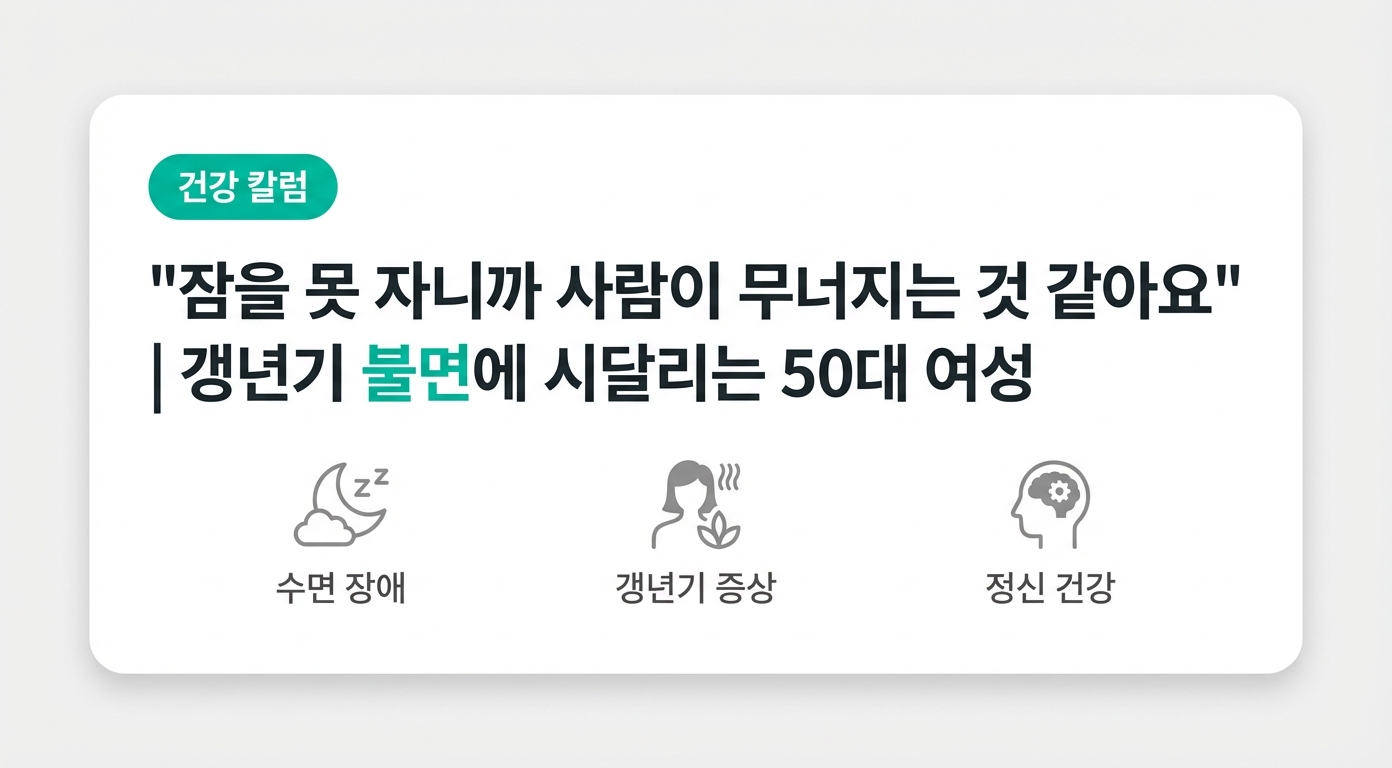
"Not being able to sleep makes me feel like I'm falling apart" | A 50s woman suffering from menopausal insomnia

 The Nights Spent in a Drying Fish Tank
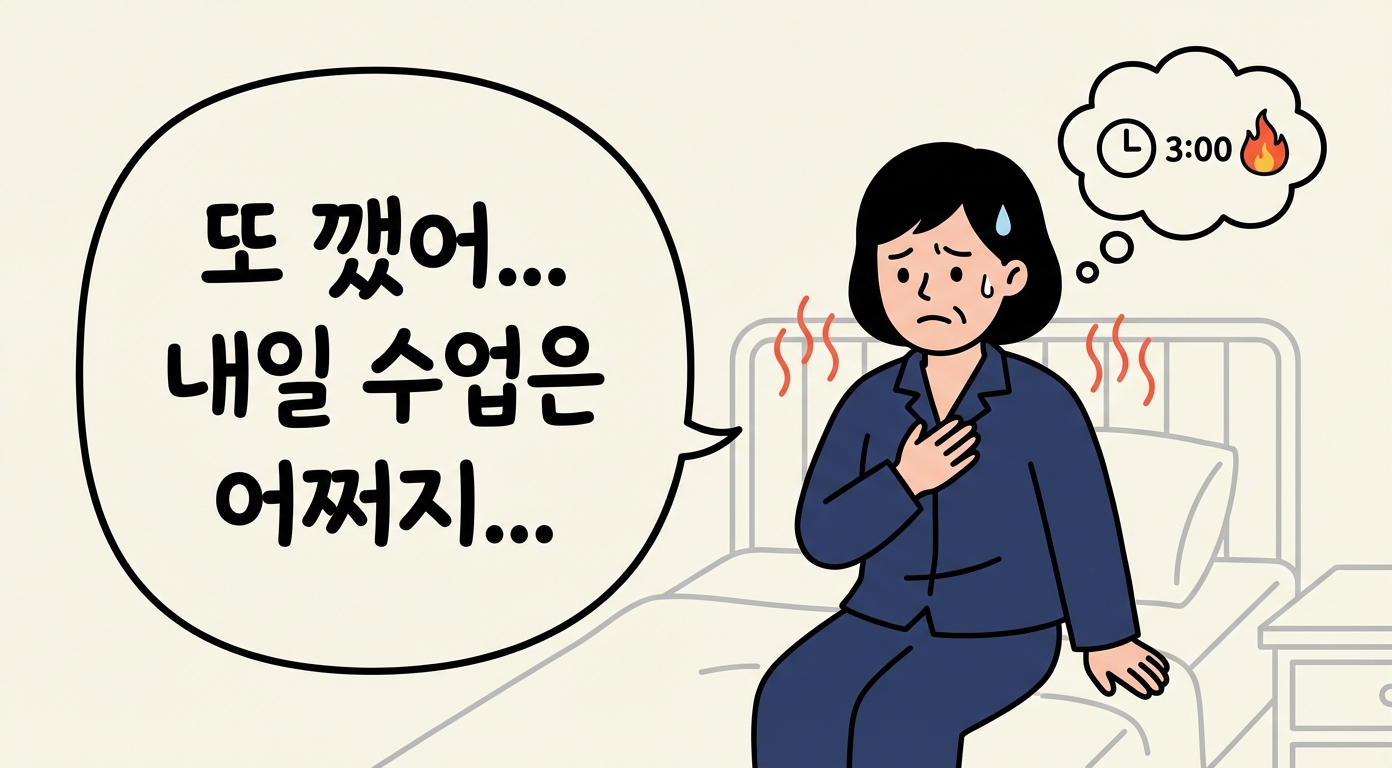
"I jolt awake at two or three in the morning with my heart pounding and sweat running down my back.
When I lie down to go back to sleep, my mind starts spinning — I worry about tomorrow's lessons, what if I collapse — those are the only thoughts I have.
When I get up in the morning, I feel like I'm walking through fog all day."
These were the words of Sun-young (pseudonym), a 52-year-old elementary school teacher, when she first came to see me.
Sun-young had taught children for over twenty years — she was someone who had lived a more regular life than almost anyone.
Yet from the previous autumn, as her menstrual cycle began to go awry, even the most basic thing — sleep — started to fall apart.
What had begun as the occasional early morning waking became almost nightly by winter, and she became a body that could not get through the day without coffee.
She would muddle up children's names during class, snap at her husband over small things in the evening, and go into the bathroom to cry alone.
The sleeping pills prescribed by her internist she had stopped after just a few days, afraid of becoming dependent.
At the gynecologist she was told only, "You're in early menopause," and came back with nothing more.
Blood tests: normal. Thyroid: normal.
"The tests say everything's fine, so why can't I sleep?"
The exhaustion of several months was plain to see in Sun-young's eyes.
I did not view Sun-young's insomnia as simply a sleep problem.
Every time I hear a story like this, it weighs on me.
Losing sleep is not merely a problem of the night — it is something that shakes the whole of one's waking life.
So why is it that women in this particular stage of life experience these kinds of nights?
 The Fire That Burns Every Night — Where Does the Heat Come From?
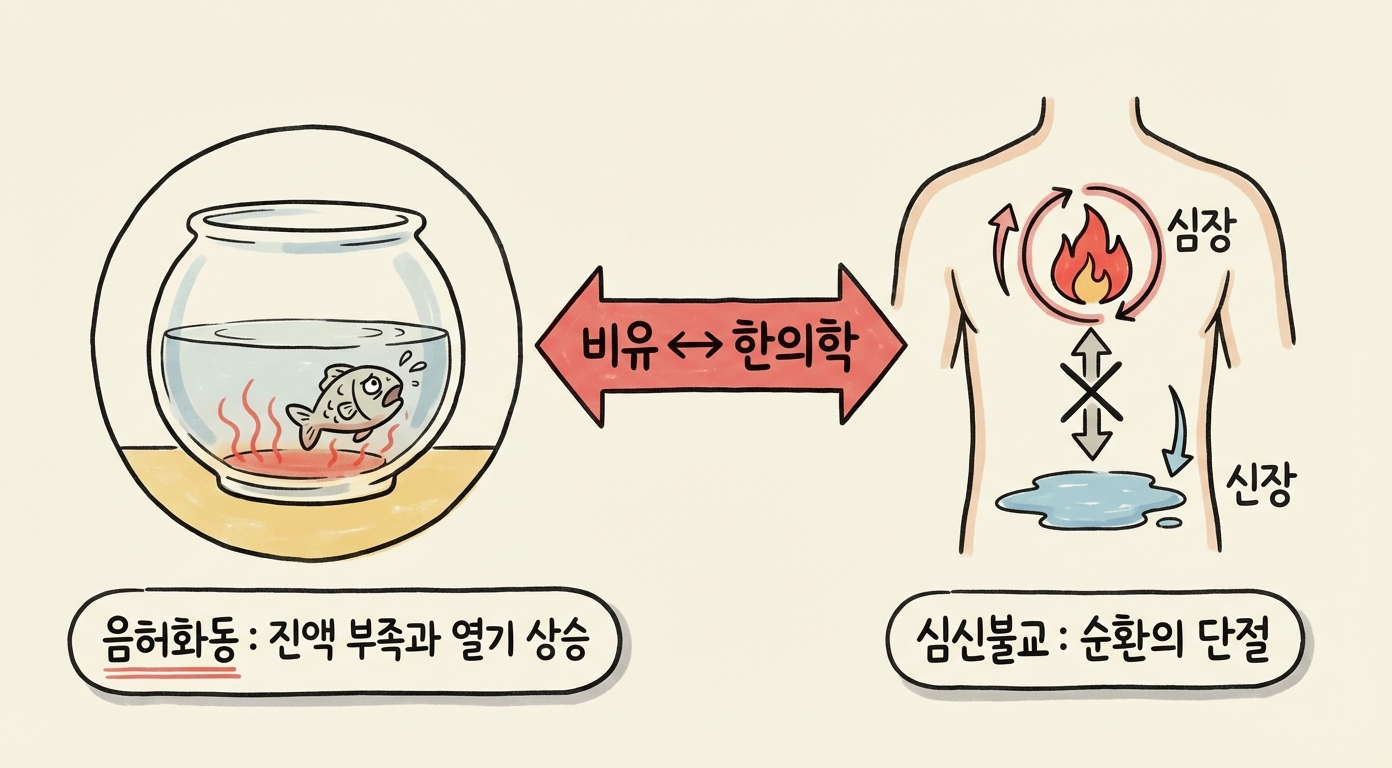
In Korean medicine, this state is called 음허화동(陰虛火動) — yin deficiency with fire stirring.
Simply put, as the body's vital fluids and yin energy diminish,
heat rises relatively upward as a result.
Imagine the water in a fish tank gradually drying up.
When the water is plentiful, the fish swim comfortably; but as the water level drops, the fish struggle and the heat from the tank floor transfers directly.
What happens in the body of a woman during menopause is similar to this.
As estrogen — the female hormone — decreases, the "water level" within the body falls,
and the balance of body temperature, emotions, and sleep that had previously been well regulated begins to waver.
Modern medicine also recognizes that the decrease in estrogen disrupts the thermoregulatory center in the brain's hypothalamus.
Like a building's cooling system breaking down, the body's heat does not dissipate properly even when night comes.
This is why it is difficult to fall asleep, and why waking from heat and sweating occurs even after finally falling asleep.
In Korean medicine, one more important concept is seen here.
That is 심신불교(心腎不交) — the disharmony between the heart and the kidney.
Normally, the fire (火) of the heart should descend to warm the kidney,
and the water (水) of the kidney should rise to cool the heart.
When this circulation is blocked, the chest races and the head flushes hot while the hands and feet are cold —
the upper and lower body fall out of sync.
This then entangles with itself to produce the complex of symptoms: insomnia, night sweats, palpitations, and anxiety.
 How to Refill a Drying Fish Tank
So is there a way to refill this drying fish tank?
The first thing to examine is daytime habits.
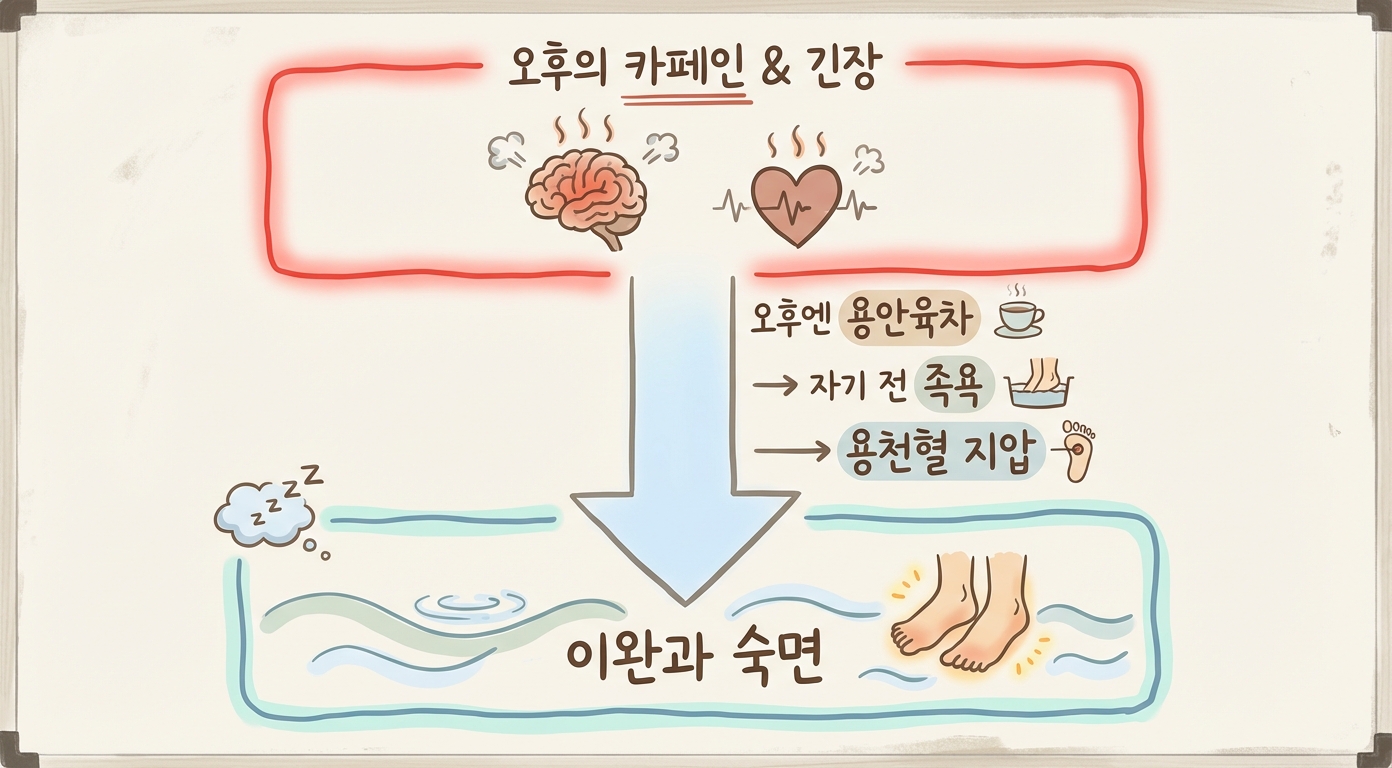
People who are sleep-deprived, like Sun-young, tend to lean on coffee from the morning;
caffeine after 2 p.m. becomes a link in a vicious cycle that worsens nighttime wakefulness.
If cutting out coffee entirely is difficult, try keeping just one cup in the morning and switching to warm water or a calming tea such as longan fruit tea (용안육차) in the afternoon.
In the evening, the body needs a routine that sends the signal, "It's time to rest now."
About an hour before bed, soaking the feet in warm water around 40°C helps draw the heat that has gathered in the upper body downward.
Slowly pressing the Yongcheon acupoint (湧泉穴) — the concave center of the sole of the foot — with the thumb helps release tension considerably.
However, if palpitations are very severe or if anxiety is overwhelming enough to dominate daily life, lifestyle management alone may not be sufficient.
In such cases, please see a medical professional for specialized consultation without fail.
What is needed is not simply suppressing symptoms, but a process of changing the body's environment.
 For the Day Mornings Become Something to Look Forward To Again
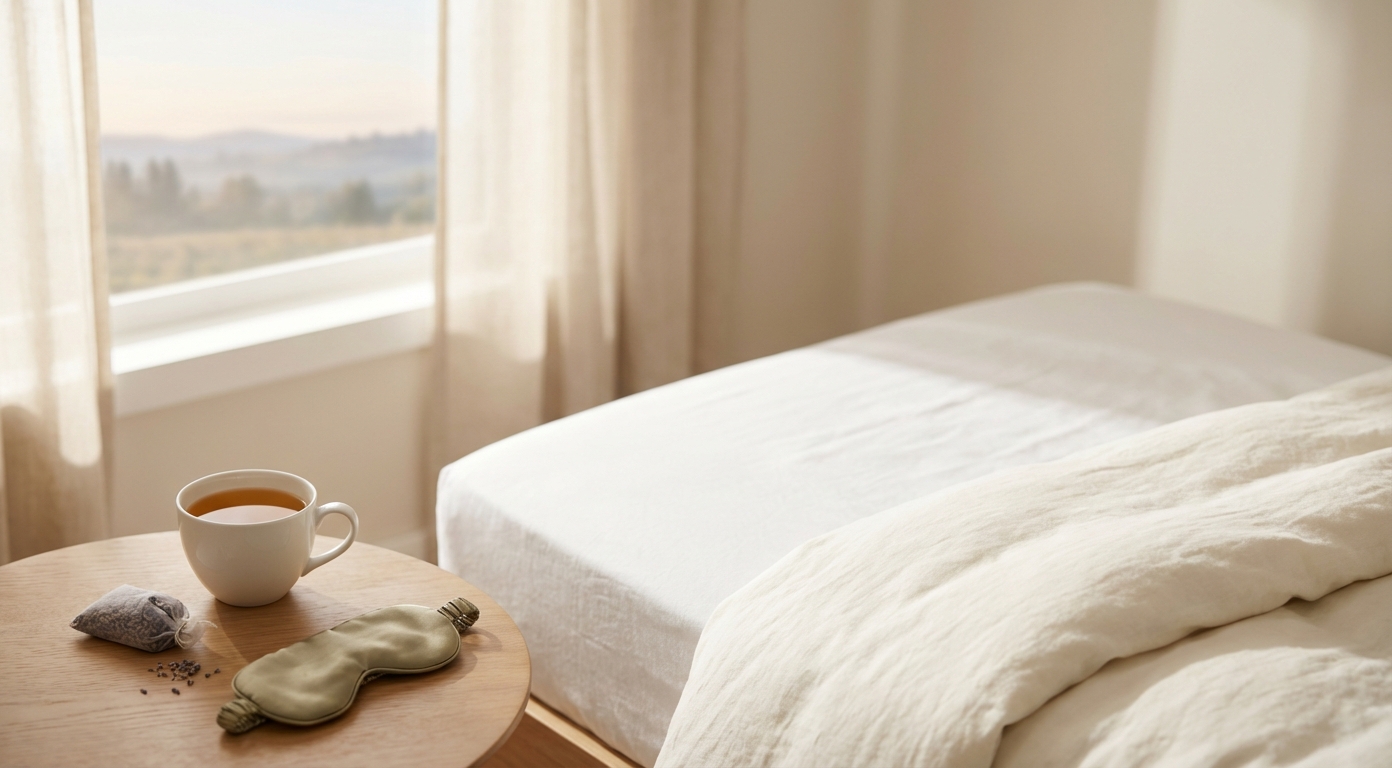
Three months later, Sun-young's early morning waking had decreased noticeably,
and she began to rediscover the feeling of "I actually slept" upon waking in the morning.
The muddles over children's names during class had almost disappeared as well.
Menopausal insomnia is not simply a problem of being unable to sleep.
It is a signal the body is sending — that the balance of body and mind is being shaken.
When you listen to that signal, the path to recovery opens.
Your body possesses a more remarkable capacity to heal than you might think.
The strength that has sustained you over the years has not disappeared — it has simply lost its way for a moment.
My role is to serve as a helper who, tailored to each person's constitution and condition, helps find the key to that balance together.
Even if it is not with me, please find a healthcare provider who looks carefully at your whole body.
Just as clear water slowly fills a drying fish tank again, peaceful nights can return.
✍️ Reviewed by Dr. Choi Jang-hyeok, Director of Dongjedang Korean Medicine Clinic