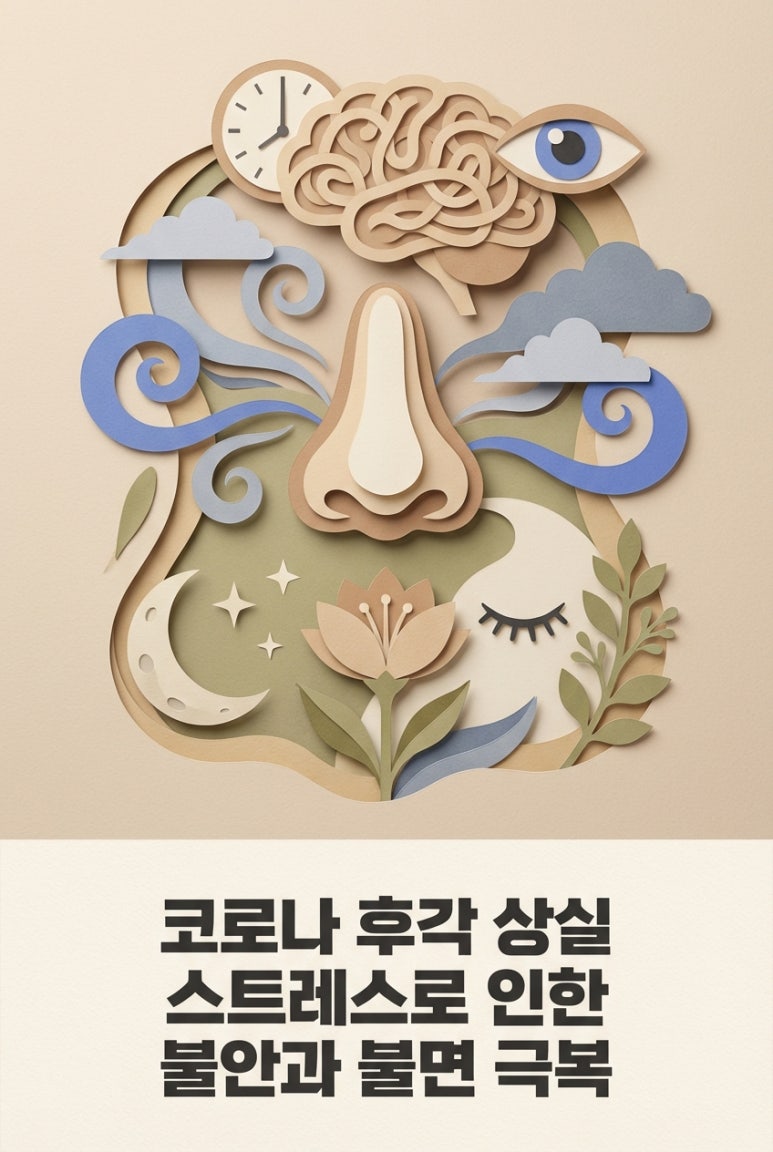
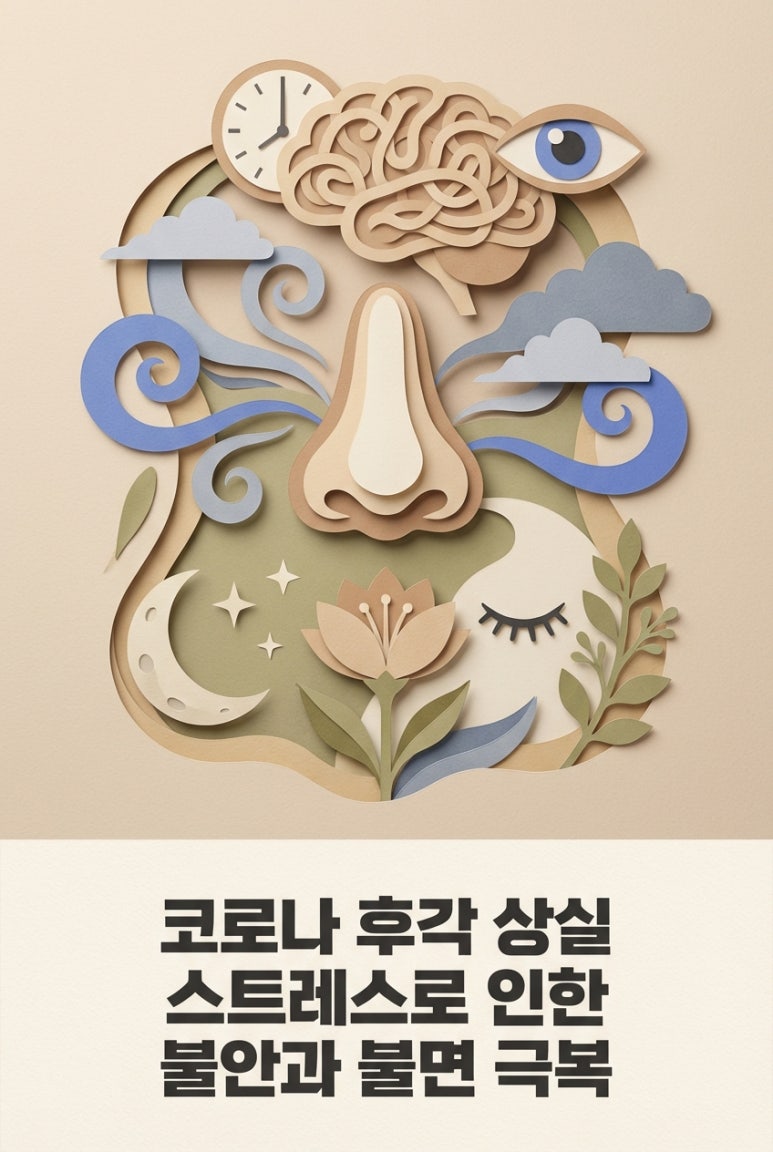
How to Overcome Loss of Smell and Insomnia from Long COVID Symptoms
 🧾 Answer First | Key Conclusion
At lunchtime, colleagues laugh saying the coffee smells good.
But have you ever felt sudden fear because you couldn't smell anything?
Are you worried that you might never be able to smell again?
Many people cannot sleep at night due to anxiety that makes their hearts race.
Hello.
I am Dr. Choi Jang-hyuk, director of Dongjejdang Korean Medicine Clinic.
Loss of smell and insomnia that came after COVID-19.
These cannot be solved simply by forcing the brain to sleep with sleeping pills.
Many of the patients I have seen in clinical practice were suffering from the dual hardship of reduced smell and sleep disorders.
Restoring the balance of disrupted autonomic nervous system and helping the body find stability on its own is the fastest and safest path to recovery.
If you want to awaken your body's natural healing power without relying on medication,
try implementing these three methods starting tonight.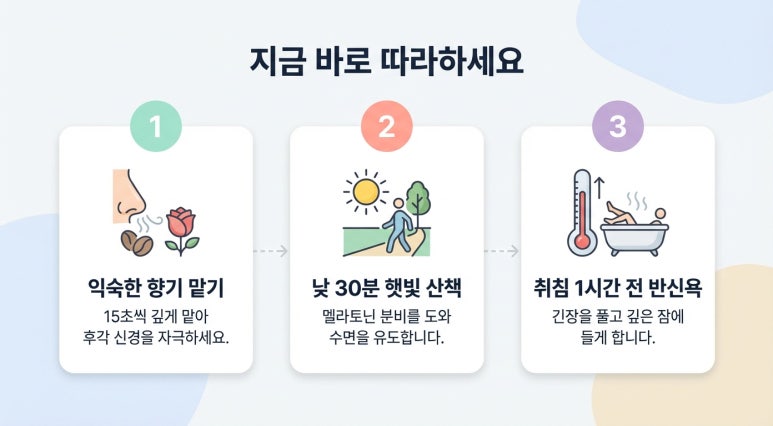 ✅ Action | Immediate Implementation
If you are looking for ways to sleep without sleep-inducing medications, consistently practice these three methods that can be applied immediately in daily life.
1️⃣ Olfactory Training by Smelling Familiar Scents
Morning and evening, deeply inhale familiar and strong scents such as coffee, lemon, eucalyptus, and rose for 15 seconds each.
There is no need to be disappointed even if you cannot smell anything immediately.
Simply imagining the scent while looking at the object is sufficient.
Our brain gently stimulates the olfactory nerve through past memories.
Consistent stimulation twice a day becomes the first step in opening the blocked sensory pathway.
2️⃣ Thirty-Minute Walks in Sunlight During Daytime
Sunlight is an excellent remedy that helps promote melatonin, our body's natural sleep hormone.
Take a light 30-minute walk during lunch hour.
It supplies sufficient oxygen to the brain.
The sunlight energy accumulated during the day naturally acts as a natural sleep aid when night arrives.
3️⃣ Warm Water Bath for 30 Minutes Before Bedtime
One hour before bedtime, take a shower or partial bath with warm water.
It calms the sympathetic nervous system that has been tense throughout the day.
The timing when body temperature rises slightly and then gradually decreases is important.
At this point, our brain most easily falls into deep sleep.
 🚨 Warning | Critical Warning Signs to Check
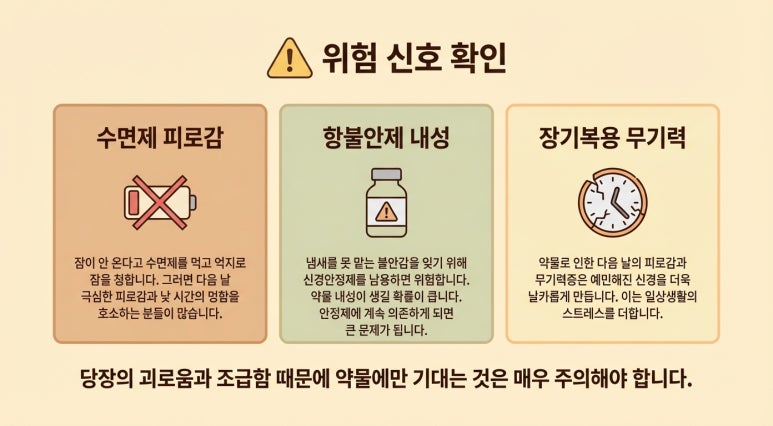
Be very careful about relying solely on medications due to immediate suffering and impatience.
✔ Side Effects of Long COVID Sleep Medication
Many people take sleeping pills because they cannot sleep, forcing themselves to sleep.
As a result, many people complain of extreme fatigue and daytime drowsiness the next day.
Medication may have disconnected consciousness.
However, the brain and nerves are not truly resting, so sleep quality actually worsens.
✔ Risk of Tolerance to Anti-anxiety Medication for Loss of Smell
It is dangerous to overuse sedatives to forget the anxiety of not smelling.
There is a high probability of developing drug tolerance.
Continued dependence on sedatives becomes a major problem.
The brain's natural ability to regulate emotions and sleep gradually diminishes.
✔ Next-Day Fatigue from Long-Term Sleep Medication Use
Next-day fatigue and lethargy from medication make the sensitized nerves even sharper.
This adds stress to daily life.
As a result, it creates a vicious cycle that delays smell recovery.
Medication is only temporary help.
Remember that it is not a fundamental solution.
 🧠 The Why | Understanding the Root Cause
So why does extreme anxiety arrive and sleep fail to come just because you cannot smell?
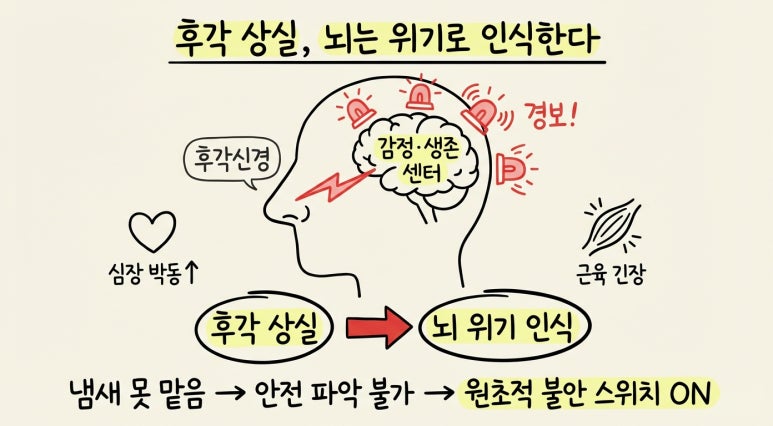
Our olfactory nerves are very directly connected to the center in the brain that controls emotions and survival instincts.
This is different from sight or hearing.
Smell is the sense that travels most directly to the areas of our brain responsible for emotion and survival.
Therefore, when we cannot smell, our brain determines that it cannot assess whether the surrounding environment is safe.
It recognizes this as an immediate crisis situation.
Like being left alone in a dark, unfamiliar forest with wild beasts, the primitive anxiety switch turns on.
When the brain mistakes a crisis situation, the sympathetic nervous system, which acts as the body's alarm bell, becomes overexcited.
The heart beats faster and stronger than usual.
Breathing becomes shallow and rapid, digestive fluid secretion stops, and muscles become tense.
The body and brain remain on high alert throughout the night, standing watch.
It is medically inevitable that deep and comfortable sleep cannot occur in such circumstances.
📊 Proof | Cases and Evidence
This is the actual story of a patient in his mid-30s who came to me.
This patient experienced severe anxiety from loss of smell that occurred after COVID-19 infection.
He struggled greatly, failing multiple times in attempts to discontinue COVID insomnia and sedative medications.
He was staying up all night with eyes wide open every night, making even his work life precarious.
I did not forcefully disable the patient's brain function.
Instead, I prescribed herbal medicine for autonomic nervous system stabilization that calmed the frightened heart and restored balance to the autonomic nervous system.
Additionally, I combined this with olfactory recovery Korean medicine treatment to improve blood flow around the hardened facial and olfactory nerve areas[3].
By the third week of treatment, the patient began to faintly smell body wash during showers.
As anxiety decreased, the sleep pattern naturally recovered to over 80% of normal range.
According to research, the recovery speed is significantly faster when combining olfactory training with psychological support for autonomic nervous system stabilization[1]. 🔚 Closing | Summary and Encouragement
Loss of smell and insomnia from COVID-19 is a tunnel that definitely has an end.
Just because you cannot smell right now does not mean you have permanently lost sensation.
What you need most right now is to gently release the tension in the brain caught in fear first.
When you manage your body's anxiety, comfortable sleep naturally comes.
After sleeping well, neuronal regeneration and recovery also accelerate much faster.
If you struggle tossing and turning alone every night, do not hesitate to ask for help.
I will do my utmost to help you regain a comfortable daily life as soon as possible.
✍️ Reviewed by Dr. Choi Jang-hyuk, Director of Dongjejdang Korean Medicine Clinic
❓ FAQ
Q. When does COVID-related loss of smell return?
Most patients gradually recover their sense of smell within 2 weeks to 1 month.
However, there are exceptions.
If extreme stress and lack of sleep persist, recovery can take several months or longer.
Therefore, consistent olfactory training should be conducted from the early stages of onset.
At the same time, it is very important to achieve stability of body and mind.
Q. Should I stop taking sleeping pills immediately?
It is not recommended to suddenly discontinue medication on your own.
Abrupt discontinuation shocks the brain.
You may experience side effects such as even worse insomnia or intensified anxiety attacks.
Be sure to consult with a professional and gradually reduce the dosage.
Combining Korean medicine treatment that fundamentally stabilizes the autonomic nervous system is the safest approach.
Q. How does a Korean medicine clinic treat long COVID insomnia?
We prescribe acupuncture and customized herbal medicine that gently release excessively tense brain and nerves.
This is not a forceful method that strains the body.
It works on the principle of helping patients find the correct sleep rhythm on their own by promoting whole-body blood circulation.
Additionally, treatment that promotes circulation in the facial area to aid olfactory nerve regeneration is conducted in parallel.
📚 References
Western Medicine Perspective
[1] BMJ Best Practice 2022. "Long COVID Post-COVID-19 condition - Management of sleep disturbances and anosmia"
[2] NICE 2021. "COVID-19 rapid guideline: managing the long-term effects of COVID-19"
Korean Medicine Perspective
[3] Korean Association of Oriental Medicine 2022. "Clinical Practice Guidelines for Long-Term Effects of COVID-19 in Korean Medicine"
[4] Korea Institute of Oriental Medicine NIKOM 2021. "Mechanisms of Korean Medicine Treatment for Sleep Disorders and Anxiety Disorders"
Head & Face
How to Overcome Loss of Smell and Insomnia from Long COVID Symptoms
View Program