"I don't want to go to school" repeated every morning | The body and mind behind a child's school refusal
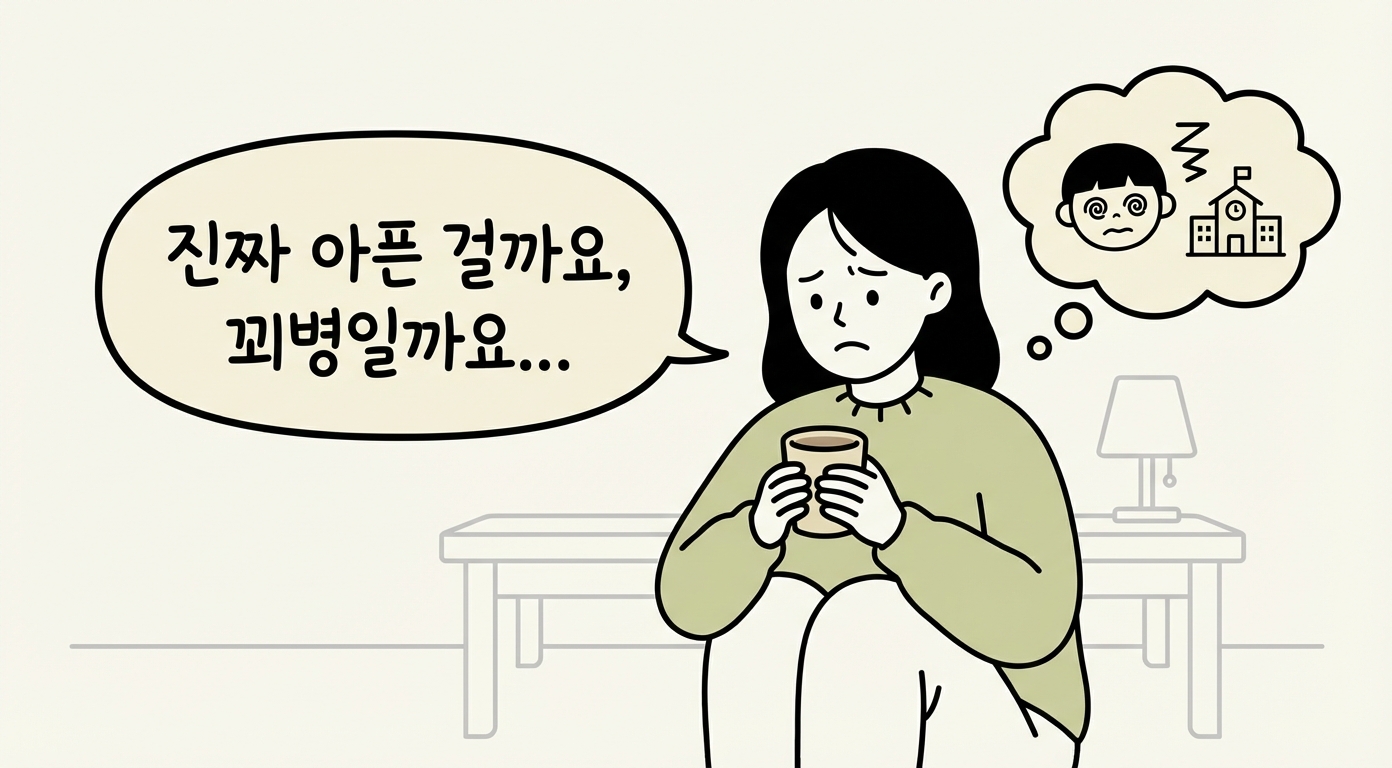 A Child Who Cried Every Morning — What Those Tears Were Saying
"Doctor, my child cries every morning saying his head hurts.
When I try to send him to school, he collapses saying his legs have no strength.
He can't eat and says he feels like he's going to throw up."
That was how nine-year-old Jun-seo's (not his real name) mother spoke as she took her seat.
Jun-seo was in the third grade of elementary school, the only child of a dual-income household.
Day after day he was going to two after-school academies and not getting home until past nine in the evening.
When he moved up to third grade, his homeroom teacher changed and his friendships shifted, and since the second semester he had started complaining of headaches and dizziness every morning.
At first they went to a pediatrician.
Blood tests were done; even a brain MRI was taken — but all results came back normal.
"The tests say there's nothing wrong, but my child is crying saying he really hurts.
I don't know whether he's pretending to be sick, or whether I've done something wrong."
In the mother's voice there was worry and guilt woven together.
The symptoms that repeated every morning led to school refusal, and whenever the parents pressed him, the child withdrew further.
The withdrawn child's symptoms worsened, and the parents' guilt deepened — a vicious cycle that kept going.
I didn't look at Jun-seo's headaches as a simple head problem.
It was necessary to look together at the child's digestive state, the quality of his sleep, and how he expressed his emotions.
Every time I meet a child like this, I find myself deeply empathizing with the parents as well.
Because when a child says he is in pain, the person suffering most is the parent by that child's side.
So then — why does a child with no abnormalities on tests hurt every morning?
 A Headache Doesn't Only Come from the Head
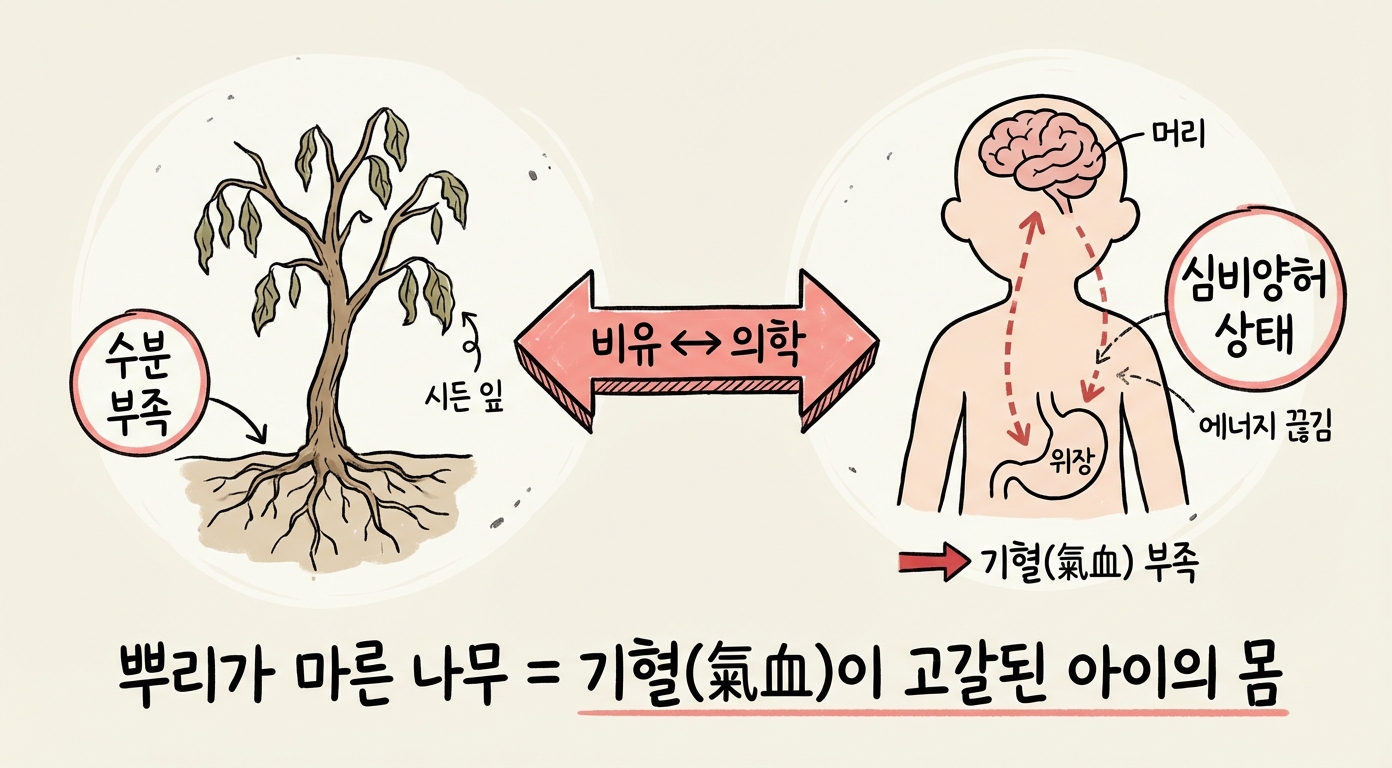
In Korean medicine, this kind of condition is viewed through the lens of 심비양허(心脾兩虛).
심비양허 refers to a state in which both 심(心) — which governs the mind — and 비(脾) — which handles digestion — are weakened together.
Think of it as the energy of both the mind and the body being depleted at the same time.
Picture a small device whose battery is nearly dead.
The screen flickers, the sound cuts in and out, and buttons respond slowly.
A child's body is the same.
With insufficient energy, even getting up in the morning becomes a struggle — the head hurts, there's no appetite, and the legs feel drained.
In medicine, this is called functional somatic symptoms.
There is no structural abnormality on tests, but the autonomic nervous system is overreacting,
causing real symptoms such as headaches, abdominal pain, and dizziness.
The child is not making it up.
The body is genuinely in pain.
In Korean medicine, a child whose 기혈(氣血) is depleted is like a small tree with dried-out roots.
The wilting leaves and drooping branches are not a problem with the leaves.
It is because water cannot reach the roots.
A headache is not a problem with the head — it is a signal arising from blocked energy circulation throughout the whole body.
Stress weakens digestive function; poor digestion reduces nutritional absorption; nutritional deficiency weakens 기혈(氣血) further; and weakened 기혈(氣血) makes emotional regulation harder.
The child's body and mind are constantly influencing each other in this way.
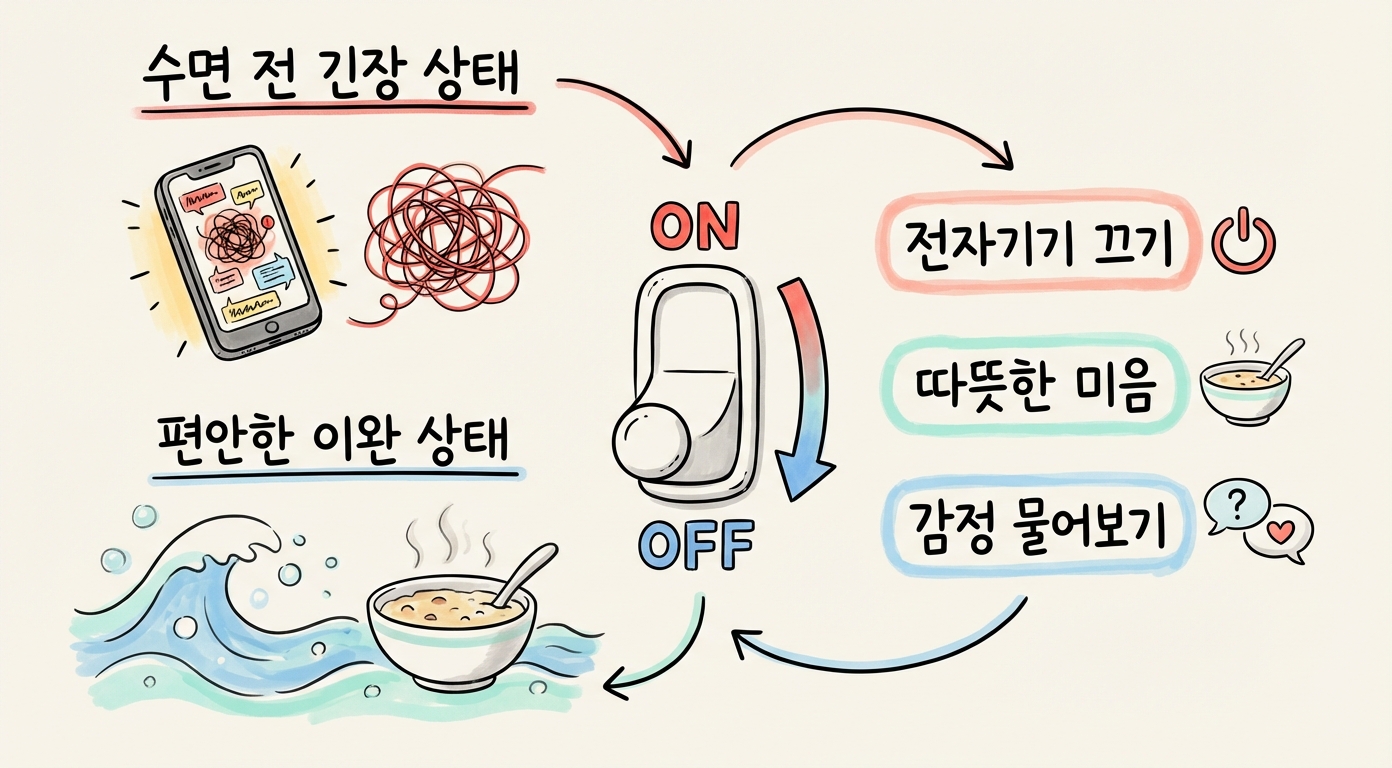 So What Can We Do for the Child?
The first thing to revisit is the child's sleep.
Simply going to bed before ten at night can help with growth hormone secretion and autonomic nervous system stability.
In the thirty minutes before sleep, instead of smartphones or tablets, try replacing that time with a quiet conversation between parent and child, or reading a light picture book together.
In mealtimes as well, there is something not to be overlooked.
Rather than forcing a child who skips breakfast to eat a full meal, it is better to start with something easily digestible, like warm porridge or rice gruel.
For a child with a weak 비위(脾胃), a warm bowl of broth is far more helpful than cold milk or bread.
And above all, create an environment where the child can put his feelings into words.
Rather than pressing with "Why don't you want to go to school?", it is better to ask "Where does your body feel uncomfortable today?"
A child's ability to organize emotions into words is still growing.
That is why the pain of the heart appears first as physical symptoms.
If your child's headaches or stomachaches continue for more than two weeks, or if weight loss is noticeable, or if sleep is severely disrupted, be sure to visit a specialized medical institution for a thorough evaluation.
 Until the Day the Child's Body Greets Morning Again
Two months later, a message came from Jun-seo's mother.
She said the child was getting up on his own in the morning and getting ready for school.
Of course, it didn't change overnight.
It was the result of a process that worked in tandem — raising the body's overall energy, restoring digestive function, and improving sleep quality.
I believe that treating a child is not simply suppressing symptoms, but a process of changing the body's environment.
Because each child's constitution and condition is different, even the same headache requires a different approach.
Please listen to the signals your child's body is sending.
Within those small signals lies the key to recovery.
A child's body has a far more remarkable capacity for recovery than an adult's.
My role is to be a supporting presence, searching together for the path that allows that recovery capacity to function properly.
Regardless of whether it is with me, please do make sure to meet medical professionals who will look carefully at your child's body and mind together.
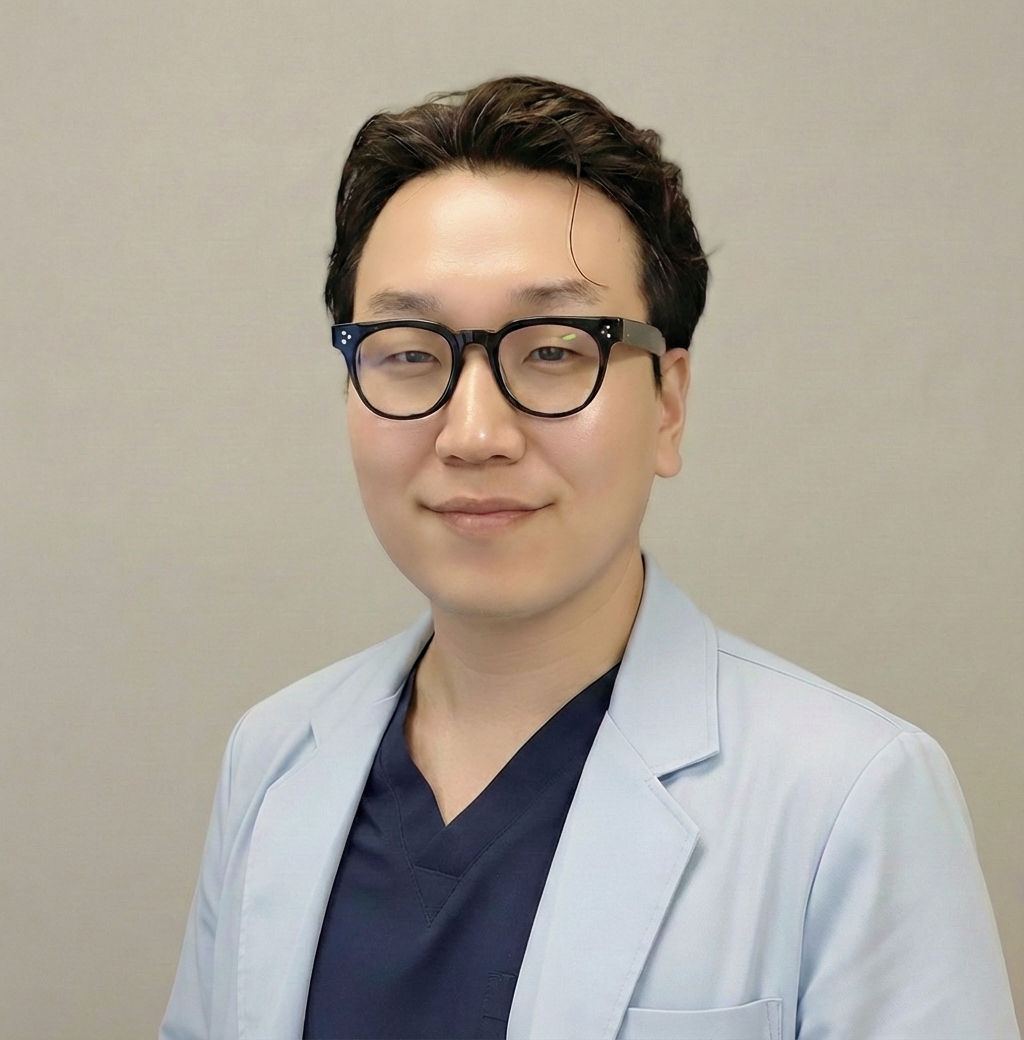
✍️ Reviewed by Dr. Choi Jang-Hyuk, Director of Dongjedang Korean Medicine Clinic
Pediatric
"I don't want to go to school" repeated every morning | The body and mind behind a child's school refusal
View Program