
Column April 8, 2026
"Our child is the smallest in class, what should we do" | Height growth in a child who does not eat or sleep well

Jang-Hyuk Choi, KMD
Head Doctor
 In the Time He Stopped Growing, the Centimeters a Mother Counts
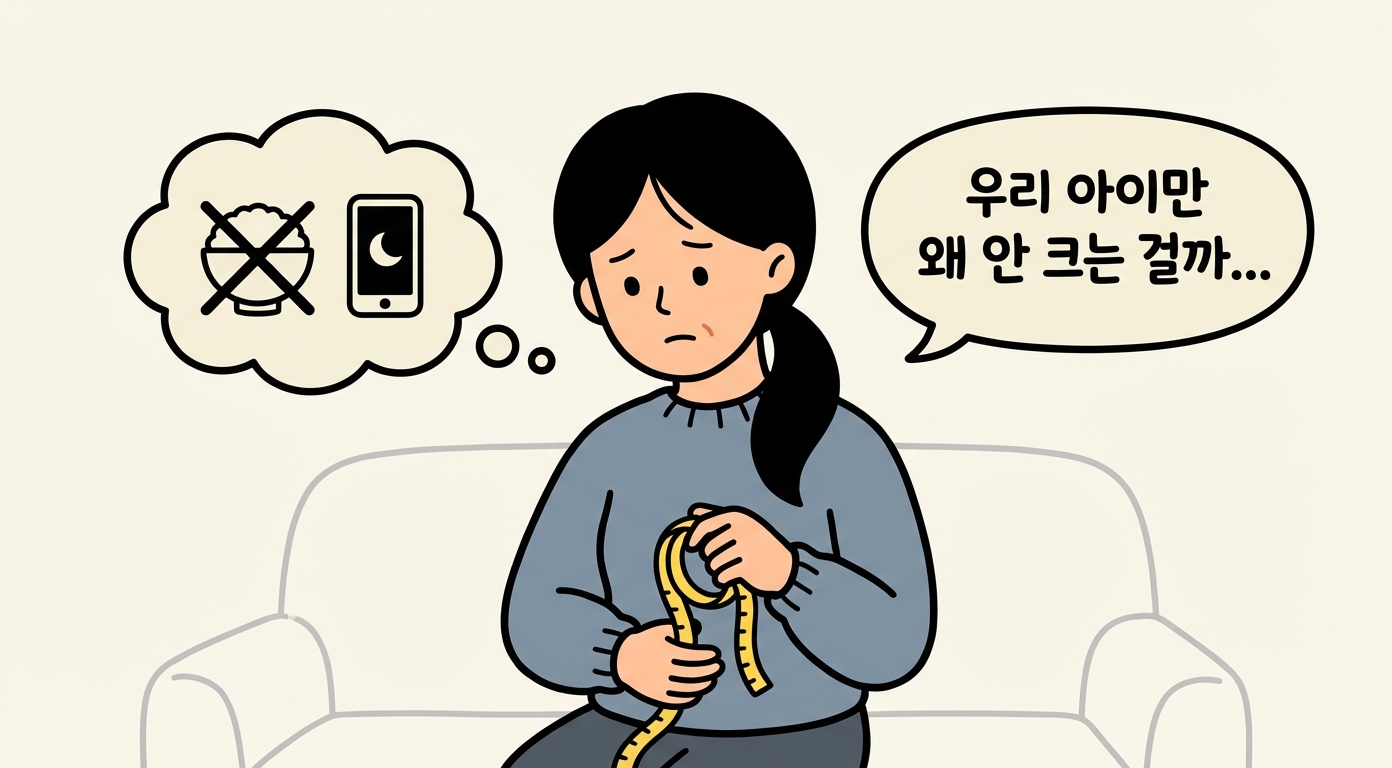
"He's come in as number one in the class height order — right at the front. Last year he was still somewhere in the middle, but after they measured him this year, I got a real shock."
That was what Jun-seo's mother said the first time she came to see me. Jun-seo (not his real name) is in the fourth grade of elementary school.
Jun-seo was a busy child attending three after-school academies. He would get home at nine in the evening, watch YouTube, and barely fall asleep past eleven at night. In the mornings he couldn't get up and regularly skipped breakfast, and in the evenings he'd eat just a little meat and bread, spending more than forty minutes on a single meal.
"He hasn't grown even one centimeter in six months. The pediatrician did a bone-age scan and said it's normal. If it's normal, why isn't he growing?"
Jun-seo's mother's voice carried both anxiety and a guilt turned inward on herself. She wondered whether she should start growth hormone injections, whether she was doing something wrong. Jun-seo, too, was gradually shrinking into himself after being told by friends that he was short.
I didn't look only at Jun-seo's height. I thought we needed to look together at what he ate, how he slept, and the overall rhythm of his daily life.
If test numbers are normal but the body isn't growing, the answer may lie somewhere other than the numbers.
**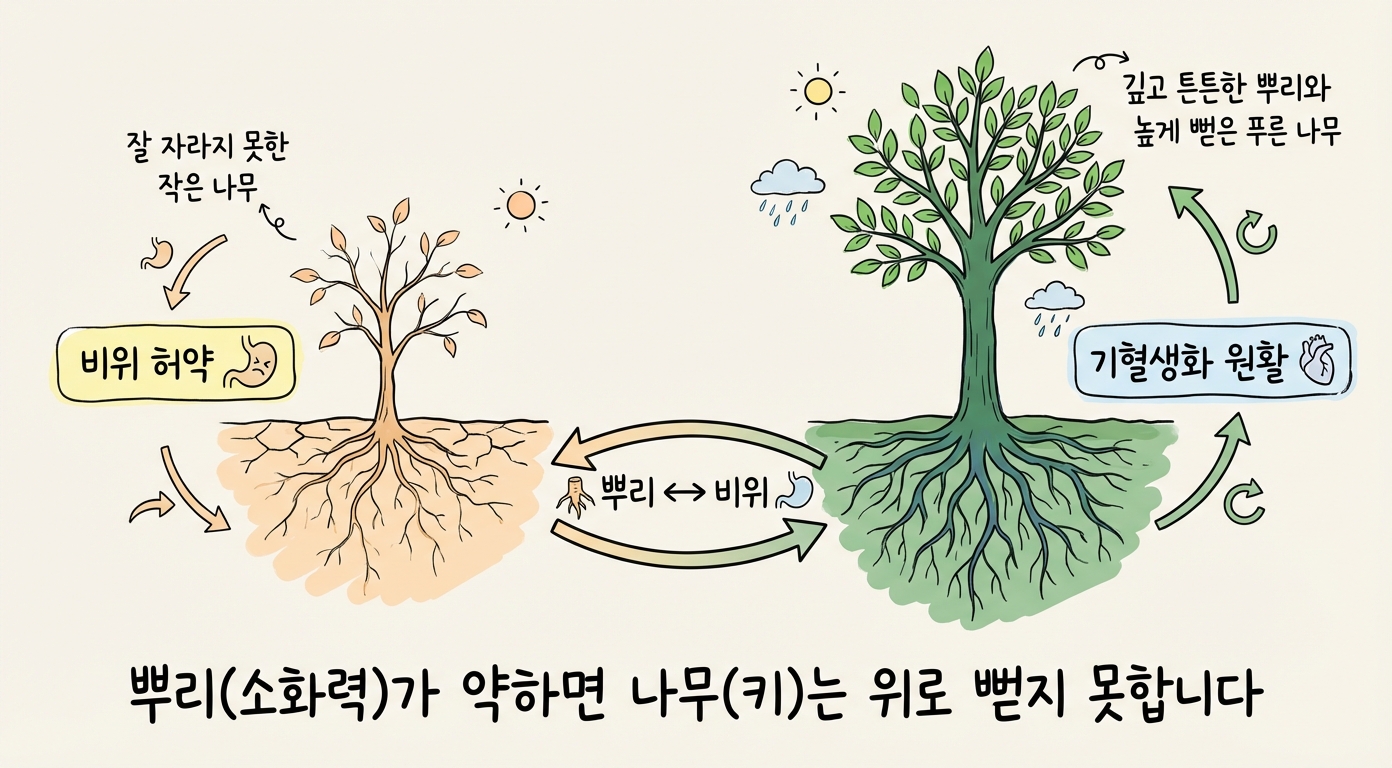A Tree with Weak Roots Cannot Grow Upward**
In Korean medicine, two things are always considered together when talking about a child's growth. **One is 비위(脾胃) — the function governing digestion and absorption — and the other is 신(腎), the function that leads bone growth and physical development.**
The 비위(脾胃) is called 후천지본(後天之本), meaning "the foundation of what comes after birth." It refers to the base through which the body generates energy by eating, digesting, and absorbing food after birth. In tree terms, the 비위(脾胃) is the root. The root must be strong to draw up water and nutrients from the soil, and only then can the trunk grow upward. No matter how good the soil, a tree with weak roots cannot grow.
**A child like Jun-seo, with strong food preferences and weak digestive capacity, is in a state where these roots cannot do their job properly.** When 기혈생화(氣血生化) — the process of generating qi and blood from food — is weakened, the energy available to reach bones and muscles falls short.
**On top of this, sleep problems compound the issue.** Modern medicine also confirms that growth hormone is secreted most abundantly during deep sleep. The period between 10 p.m. and 2 a.m. is especially important. Think of this window as a construction crew working at night. While the child sleeps deeply, the body's construction crew builds up bone and repairs muscle. But a child who doesn't fall asleep until past eleven is stealing that crew's working hours away.
In Korean medicine, this condition is called 심비양허(心脾兩虛). **It describes a state in which the mind is restless and sleep does not come easily, while digestive function is also weakened.** **A child's mind, stirred up by a smartphone at night, cannot rest, and the stomach with no appetite in the morning cannot replenish strength.** **Digestion and sleep may look like separate problems, but in truth they are deeply intertwined within a single body.**
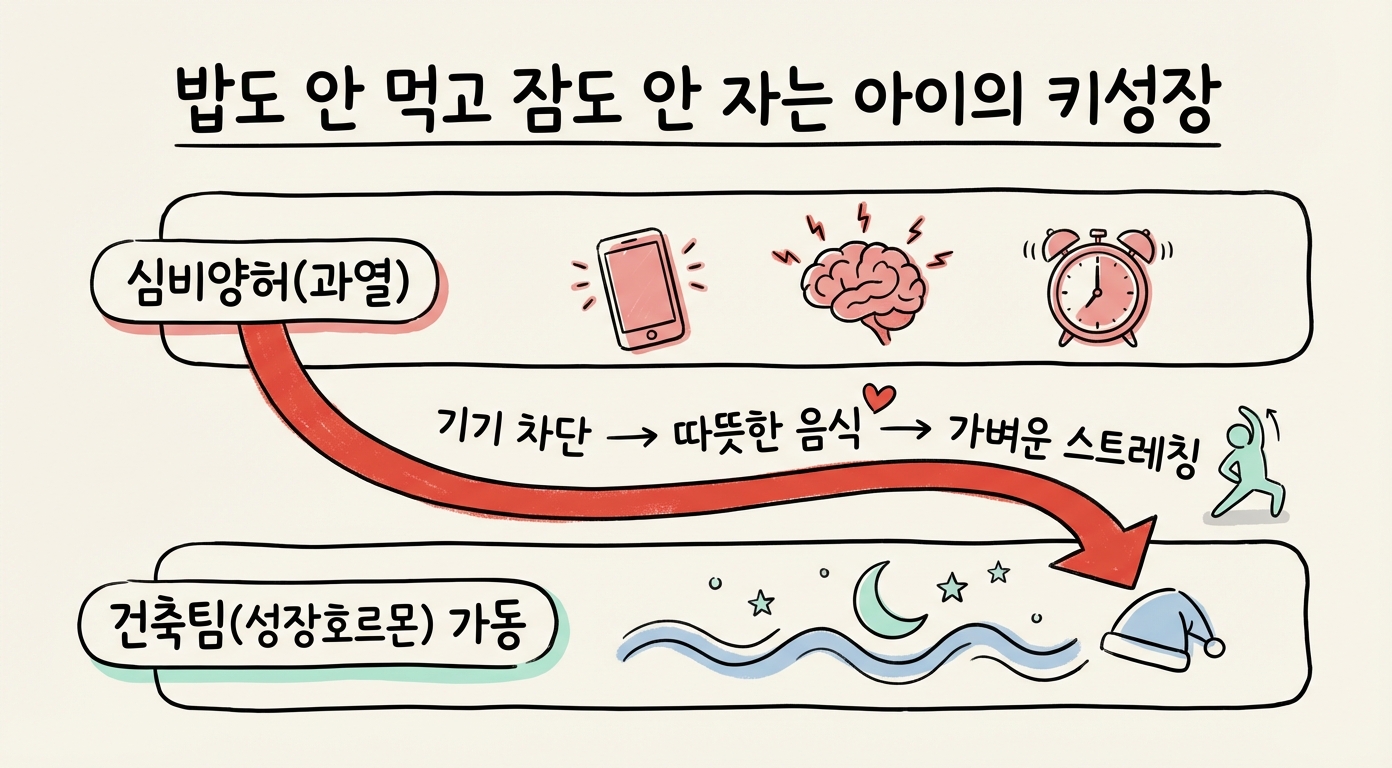 So What Can Parents Do?
There are three key pillars in a child's growth. **Eating, sleeping, and moving.**
**When it comes to eating, absorption matters more than quantity.** Rather than forcing a child to eat more, it is better to give warm, easily digestible food at regular times. If there is a habit of skipping breakfast, even just a warm bowl of porridge can ease the burden on the 비위(脾胃). Reducing cold drinks and flour-based snacks is also a way to protect digestive capacity.
**When it comes to sleeping, routine comes before hours.** Build the habit of going to bed before 10 p.m., and set aside smartphones and screens at least an hour before bedtime. In a quiet environment, a child's mind must slowly settle before it can enter deep sleep.
**When it comes to moving, any exercise that gives appropriate stimulation to the growth plates will do.** Activities that move the body gently up and down — such as jump rope, basketball, and stretching — are good. However, excessive strength training or overexertion can put undue strain on the growth plates, so adjust according to the child's physical capacity.
If your child's growth rate slows noticeably or the gap with peers widens suddenly, be sure to visit a specialized medical institution for a thorough evaluation.
**Your Child's Body Is Still Trying to Grow**
Jun-seo was cared for with a focus on first improving digestive absorption and simultaneously enhancing sleep quality. Four months later, his mother said, "These days he asks for food on his own." More meaningful than how many centimeters he had grown was the return of his appetite and daily rhythm.
A child's growth is not a matter of pushing a number higher. **It is the process of bringing balance to the whole body — eating, sleeping, and moving.** **Like an orchestra performance, the three instruments of digestion, sleep, and exercise must each play in their proper tempo for a child's body to finally grow with full force.**
Please listen to the small signals your child's body sends. Not eating well, not sleeping well — both are ways the body is asking for help. Your child's body already holds within it a remarkable power to grow. My role is to be a supporting presence, working together to create the physical conditions in which that power can be properly expressed. Regardless of whether it is with me, please do make sure to meet a medical professional who will look carefully at your child's whole body.
✍️ Reviewed by Dr. Choi Jang-Hyuk, Director of Dongjedang Korean Medicine Clinic
Related Program
Pediatric
"Our child is the smallest in class, what should we do" | Height growth in a child who does not eat or sleep well
View Program