"The sight of stairs makes me sigh" | Chronic knee pain in a 50s housewife
Halted Steps — The Story the Knee Is Telling
"The moment I see stairs, I sigh.
Going down, the inside of my knee aches, and in the morning it's so stiff I have to knead it for a long time before I can walk.
I can't squat down to make kimchi anymore."
These were the words of Sun-young (pseudonym), a 54-year-old housewife, the first time she came to see me.
Sun-young worked part-time at a grocery store on weekdays, standing for more than five hours a day, and when she got home, housework was all hers.
Going out on weekend hiking trips with her neighborhood group had been her only joy, but last autumn, after a hike, her knee swelled badly and she had to give that up too.
She first went to an orthopedic clinic.
After an X-ray, the answer was "the cartilage has worn a bit, but not severely for your age."
She took anti-inflammatory medication for more than three months, but it was only comfortable while taking it — stopping brought the ache right back.
The pain continued, moving made her fearful, lack of movement weakened her leg muscles, weight increased, and the knee grew more strained — a vicious cycle.
"The test says it isn't severe, but I don't understand why it hurts so much."
Every time I hear stories like this, I feel deeply for the patient's frustration.
I didn't see Sun-young's knee pain as a problem with just one joint.
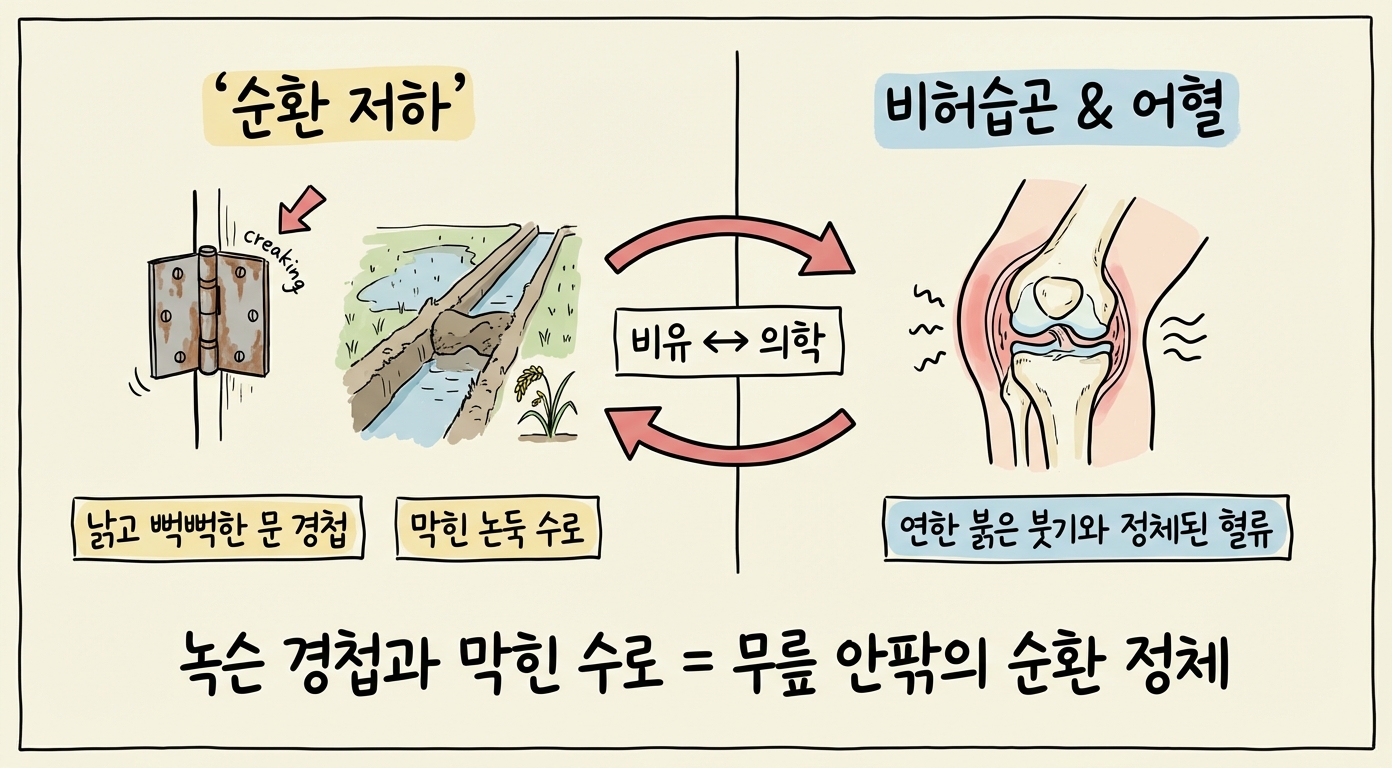 A Rusty Hinge and a Blocked Waterway — Reading Beyond the Knee
The knee is one of the joints in our body that bears the most load.
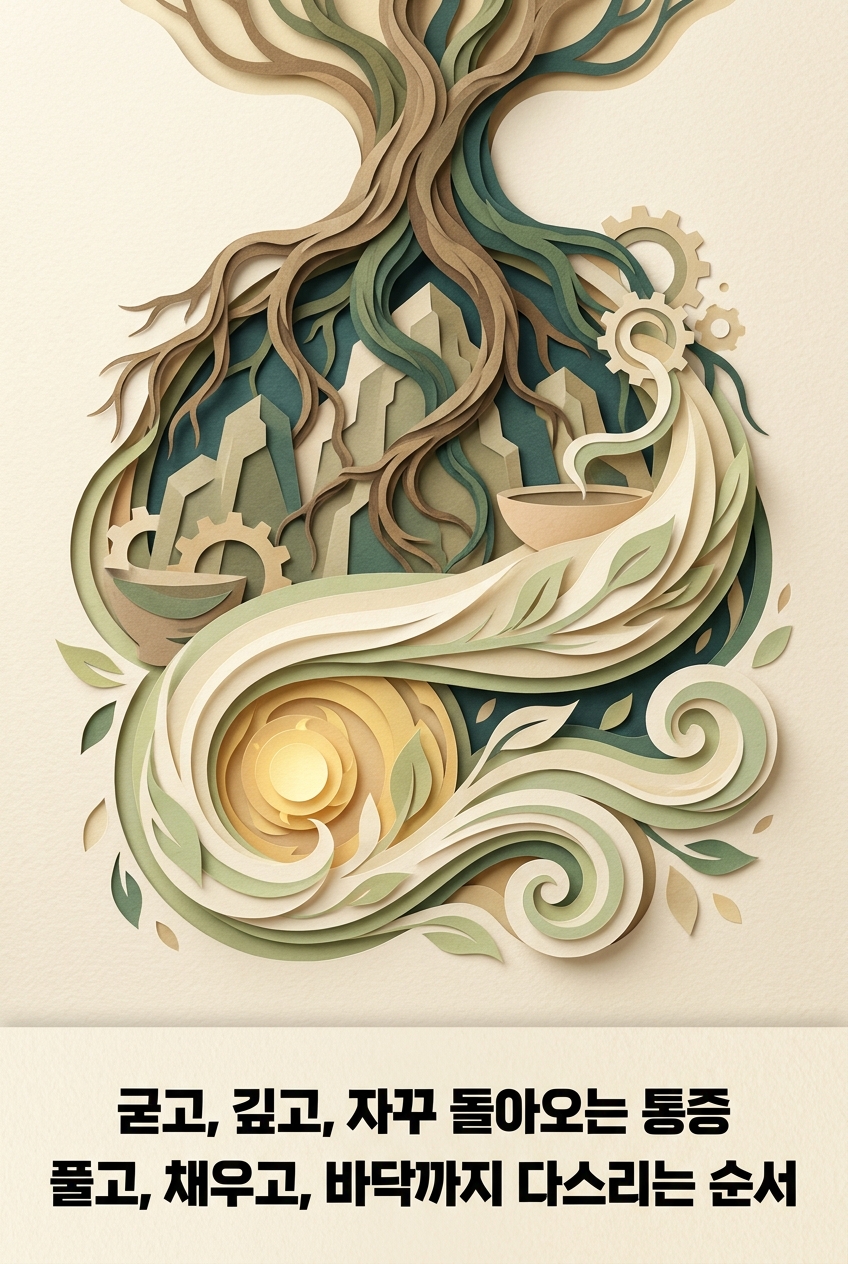
In Korean medicine, this kind of chronic knee pain is viewed not as simple joint wear, but as the result of broken-down circulation and balance throughout the whole body.
Imagine a door hinge that has been used for many years.
The hinge becomes stiff not only because it is old, but also because it has rusted without lubrication.
The knee is the same.
It is true that cartilage wears — but when blood circulation around the joint decreases and waste products accumulate, even the same degree of wear manifests as far greater pain and stiffness.
In Korean medicine, this condition is explained through the concepts of 비허습곤(脾虛濕困) and 어혈(瘀血).
비허습곤(脾虛濕困) refers to the state in which digestive function weakens and unnecessary moisture — accumulated waste — builds up in the body.
어혈(瘀血) refers to blood that is not circulating properly but stagnating where it should flow.
The analogy of an irrigation channel through rice paddies makes this easy to understand.
Just as rice grows when water flows well through the paddy, cartilage and ligaments function properly when clear 기혈(氣血) flows through the joint.
When the channel is blocked, water pools and stagnates, and the paddy becomes barren.
Sun-young's knee was in exactly that state.
Modern medicine also recognizes that when the quality and quantity of synovial fluid (활액) — the joint's lubricating fluid — decreases, the cartilage's protective function weakens.
Ultimately, when circulation inside and around the joint is not flowing freely, pain can feel severe even when imaging tests appear mild.
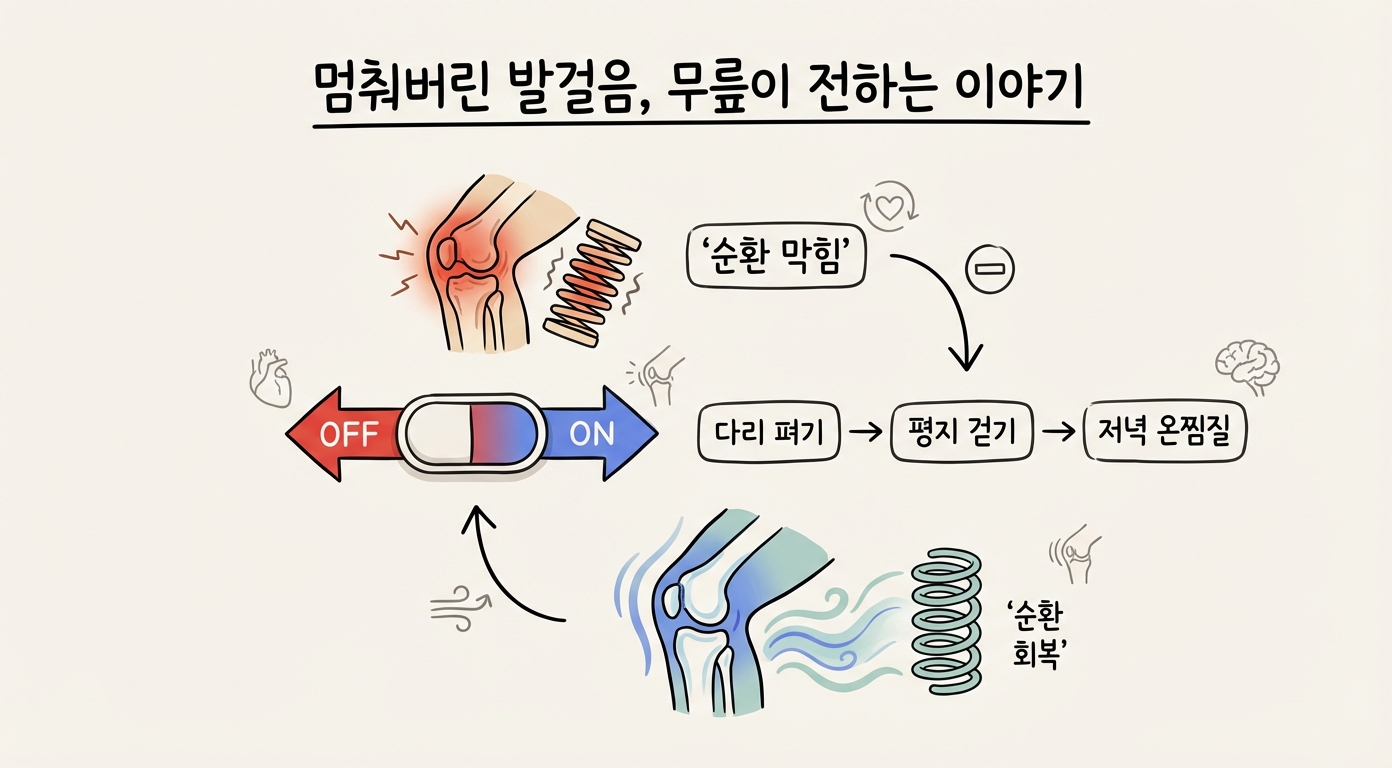 So What Can Be Changed in Daily Life for the Knee?
For those who stand all day or maintain a squatting posture for long periods like Sun-young, repetitive strain accumulates in the knee joint.
When reduced activity weakens the quadriceps (대퇴사두근) — the muscles at the front of the thigh — the stabilizing force on the knee disappears and the joint becomes unstable.
The first thing to try is slowly straightening and bending the leg while seated in a chair — fifteen repetitions, three times a day.
Not a demanding exercise at all — simply waking up the thigh muscles alone makes the knee considerably more stable.
Walking on flat ground is also good.
At this time, it is important to avoid slopes and wear cushioned athletic shoes.
Wrapping the knee area with a warm towel in the evening loosens the stiffened circulation and you can feel the morning stiffness diminish.
Diet cannot be left out either.
Reducing flour-based foods and cold foods, and choosing foods of a warming nature — this alone reduces the moisture accumulation inside the body and many people find their joints feeling lighter.
However, if the knee suddenly swells severely, feels hot, or hurts to the point of being unable to bear weight, please visit a medical institution for an accurate diagnosis.
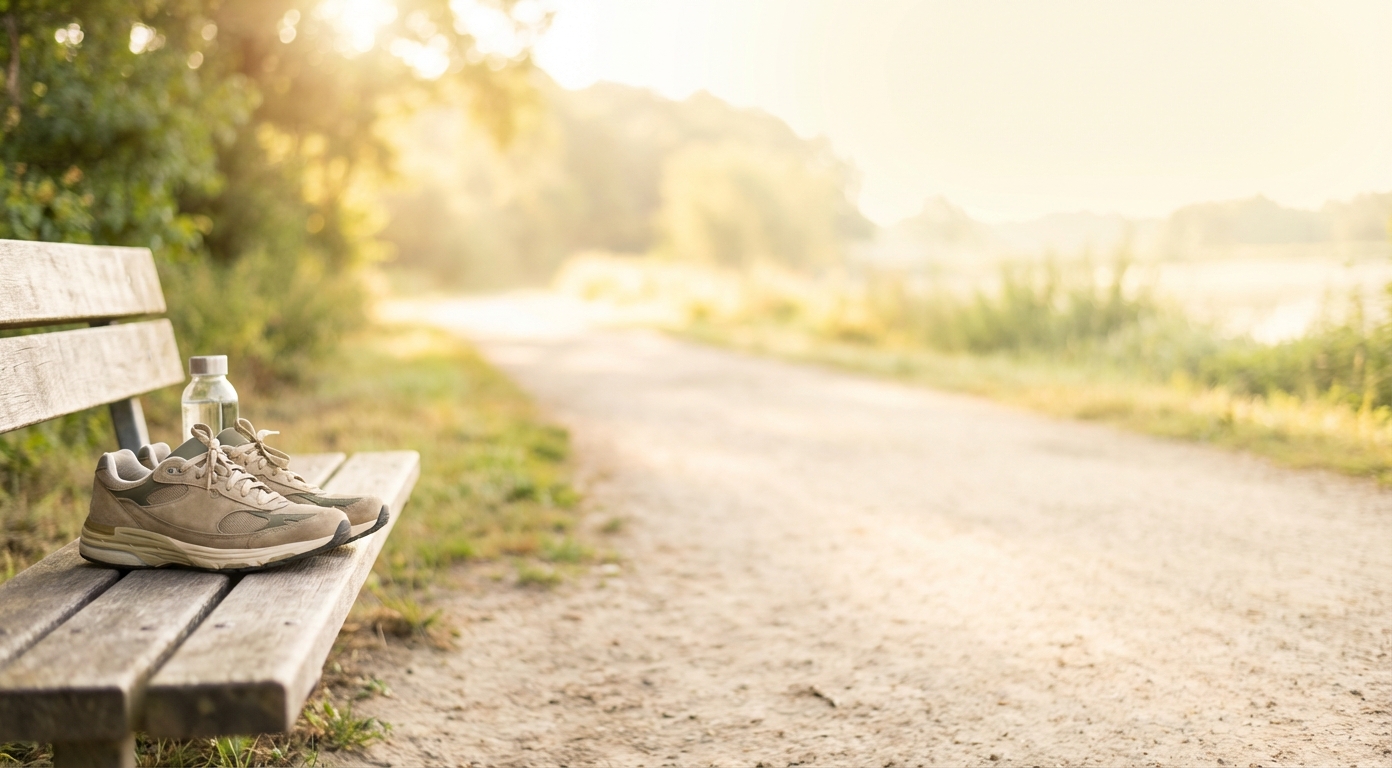 For the Day She Stands on the Trail Again
I did not only treat Sun-young's knee.
The approach was to strengthen weakened digestive function to clear the moisture, restore lower-body circulation, and balance the muscles around the joint together.
Not simply suppressing symptoms, but a process of changing the whole-body environment so that the joint could recover its own healing capacity.
Three months later, Sun-young began walking the trails of a low mountain again.
Please listen to the signals your body is sending.
The aching in the knee is not simply aging — it is a message from the body asking for help.
Your body has a remarkable capacity for recovery.
My role is to be a companion in finding the key to that recovery together.
Even if not with me — please find a healthcare provider who will look carefully not just at the knee, but at the whole body.
✍️ Reviewed by Dr. Choi Jang-Hyuk, Director of Dongjedang Korean Medicine Clinic
Pain
"The sight of stairs makes me sigh" | Chronic knee pain in a 50s housewife
View Program