"Injections help only temporarily and then it hurts again" | Chronic tendinopathy, the SOS signal from tendons
 The Story of a Tendon Worn Out Waiting to Heal
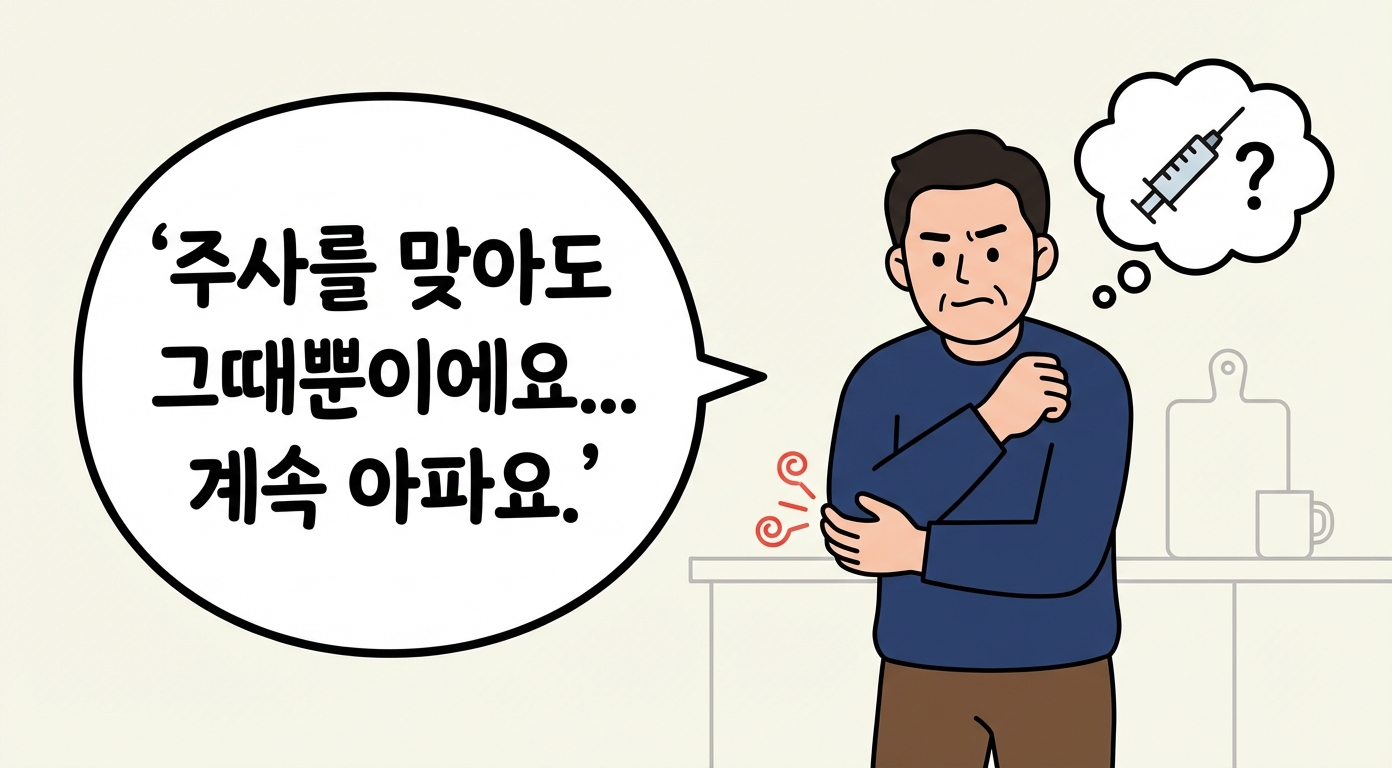
"At first it was just a slight ache in the elbow. But now even lifting a cup is hard.
I've had injections several times — I feel better right after, but two or three months later it always comes back."
These were the words of Jin-woo (pseudonym), a man in his forties running a small restaurant, the first time he came to see me.
Jin-woo spent the whole day lifting heavy pots, prepping ingredients, and using his arm without rest.
He was first diagnosed with tennis elbow at an orthopedic clinic and took anti-inflammatories.
The pain would settle for a while, then return — and he tried steroid injections too.
The pain subsided, but only temporarily.
He also tried PDRN (salmon-derived) injections and prolotherapy, but a few months later the same spot would inevitably throb again.
An MRI showed microscopic damage in the tendon, but he was told it was not severe enough for surgery.
Jin-woo said "this middle ground is the hardest." Not needing surgery, but not getting better either.
I didn't just look at Jin-woo's elbow.
I examined the muscle tension around the tendon, the flow of 경근(經筋) extending up to the wrist and shoulder, and the chronic circulatory impairment created by repetitive overuse.
Every time I hear stories like this, I feel deeply for the patient's pain.
So why does the same pain keep returning even after injections?
 Three Treatments, One Goal: How to Revive the Tendon
To understand chronic tendinopathy, it helps to first know the difference between "tendinitis" and "tendinosis."
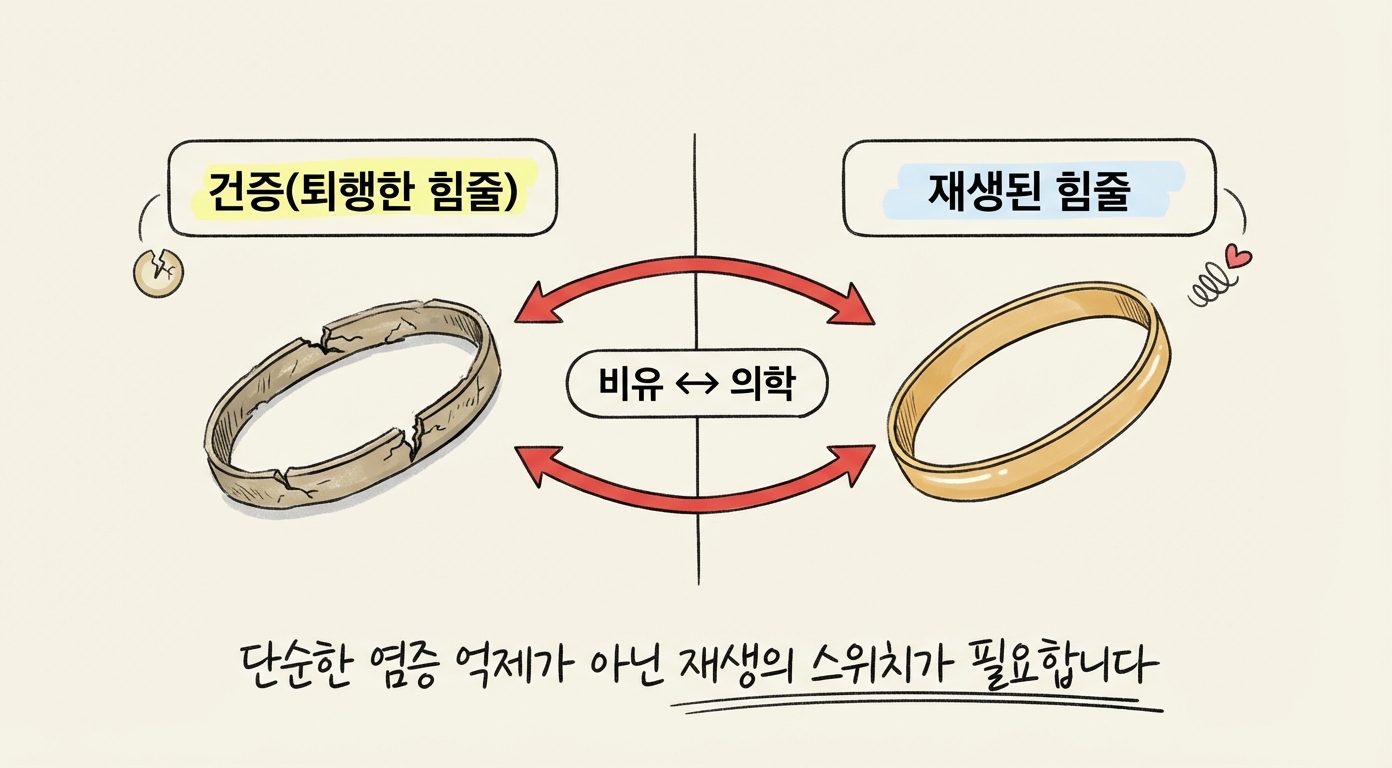
In the early stage, it is 건염(tendinitis) — inflammation of the tendon.
Over time, it transitions to 건증(tendinosis) — degeneration of the tendon itself without inflammation.
Like an old rubber band that has lost its elasticity and become brittle, the collagen fibers of the tendon lose their alignment and weaken.
At this stage, simply treating inflammation is not enough for true recovery.
PDRN injection — known as salmon injection — involves injecting DNA fragments extracted from salmon testes into the damaged area.
When these DNA fragments stimulate adenosine A2A receptors on cell surfaces, new blood vessels form, fibroblasts are activated, and collagen synthesis is promoted.
Simply put, it is like digging an irrigation channel in dry land to supply water — delivering regenerative materials and signals to the blood-deprived tendon.
Prolotherapy involves injecting a concentrated glucose solution into weakened tendons or ligaments.
What the glucose triggers is inflammation.
By intentionally causing local inflammation, it restarts the body's natural healing process.
It is as if an old wound that has been neglected and left unhealed is deliberately roused so the body begins its repair work again.
When the inflammatory response is triggered, fibroblasts gather, new collagen forms, and the loosened ligaments and tendons tighten.
In Korean medicine, chronic tendinopathy is viewed within the category of 근비(筋痺).
Heated acupuncture needles (가열식 화침) are inserted precisely into the deep damaged ligament or fascial area, and the handle of the needle is briefly heated to deliver thermal energy directly deep into the tissue.
Unlike moxibustion, which burns the surface, the key is to minimize skin damage while delivering heat precisely to the necessary depth — like repairing only internal pipes without touching the building's exterior walls.
When this deep thermal stimulus reaches the poorly vascularized, slow-healing tendon tissue, the body secretes heat shock proteins (열충격단백질), growth factors are activated, and local blood flow increases.
As this process unfolds, the degenerated tendon tissue begins to be replaced by new collagen.
All three treatments take different approaches, but share the same ultimate goal:
To switch the regeneration signal back on in degenerated tendon tissue.
 So Why Is One Treatment Alone Not Enough?
For cases like Jin-woo — where pain persists even after multiple injection treatments — there is a common thread: the focus was only on the tendon itself.
But chronic tendinopathy is often not a problem with the tendon alone.
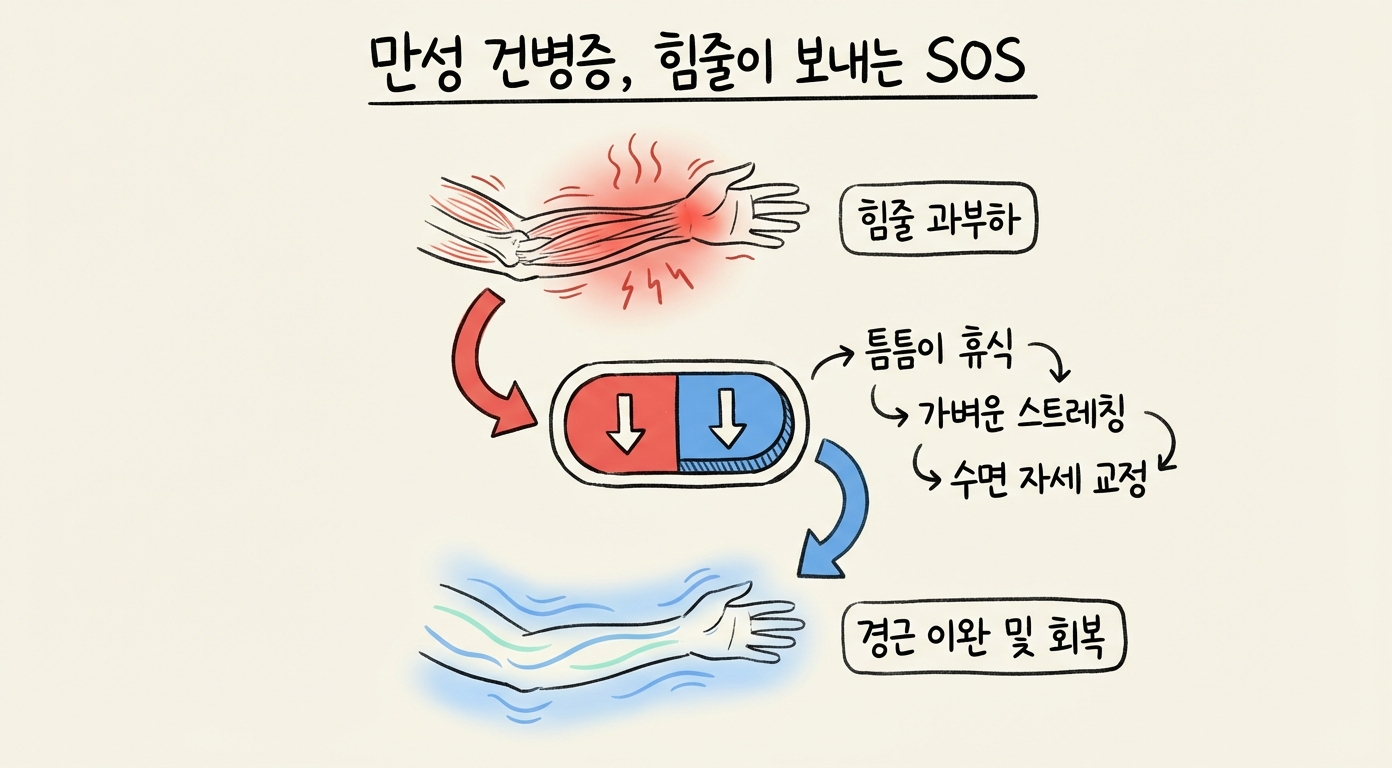
Behind the weakened elbow tendon, instability in the shoulder joint, fascial tension extending to the wrist, and overall circulatory decline are all working together.
In Korean medicine, this is explained through the concept of 경근(經筋).
Tendons do not exist in isolation — they are connected in one flow along muscles and fascia.
If tension in one area is not released, another area becomes overloaded, and the same spot sustains repeated damage.
Self-management in daily life is just as important as treatment.
Taking breaks between repetitive movements, gently warming up the wrist and elbow before using the affected area, and adjusting sleeping position so the arm is not compressed.
These small habits play a major role in sustaining the effects of treatment.
If elbow or shoulder pain persists for more than three months and begins to limit daily activities, an accurate diagnosis is essential.
There are not a few cases where what is brushed off as simple muscle pain progresses to tendon rupture.
 The Tendon Also Needs Time to Heal
I spoke honestly with Jin-woo.
Treating chronic tendinopathy is not finished in one or two sessions — it is a journey of waiting for the degenerated tendon to be filled with new collagen.
If the PDRN injection supplies the materials for regeneration, prolotherapy lights the spark of healing, and heated acupuncture needle delivers heat deep without touching the surface to awaken the regeneration signal — then for all of these treatments to take hold, the body must have time to heal on its own.
It is not simply suppressing symptoms, but a process of changing the body's environment.
I do not just look at one tendon — I examine the flow of the 경근(經筋) that the tendon connects to, and the balance of the whole body that governs that flow.
Only when treatment is tailored to each individual's constitution, lifestyle patterns, and occupational load does the cycle of recurring pain finally break.
Please listen to the signals your body is sending.
Your body has a remarkable capacity for recovery.
My role is to be a companion in finding the key to that recovery together.
Even if not with me — please find a healthcare provider who looks carefully not just at one tendon, but at the whole body.
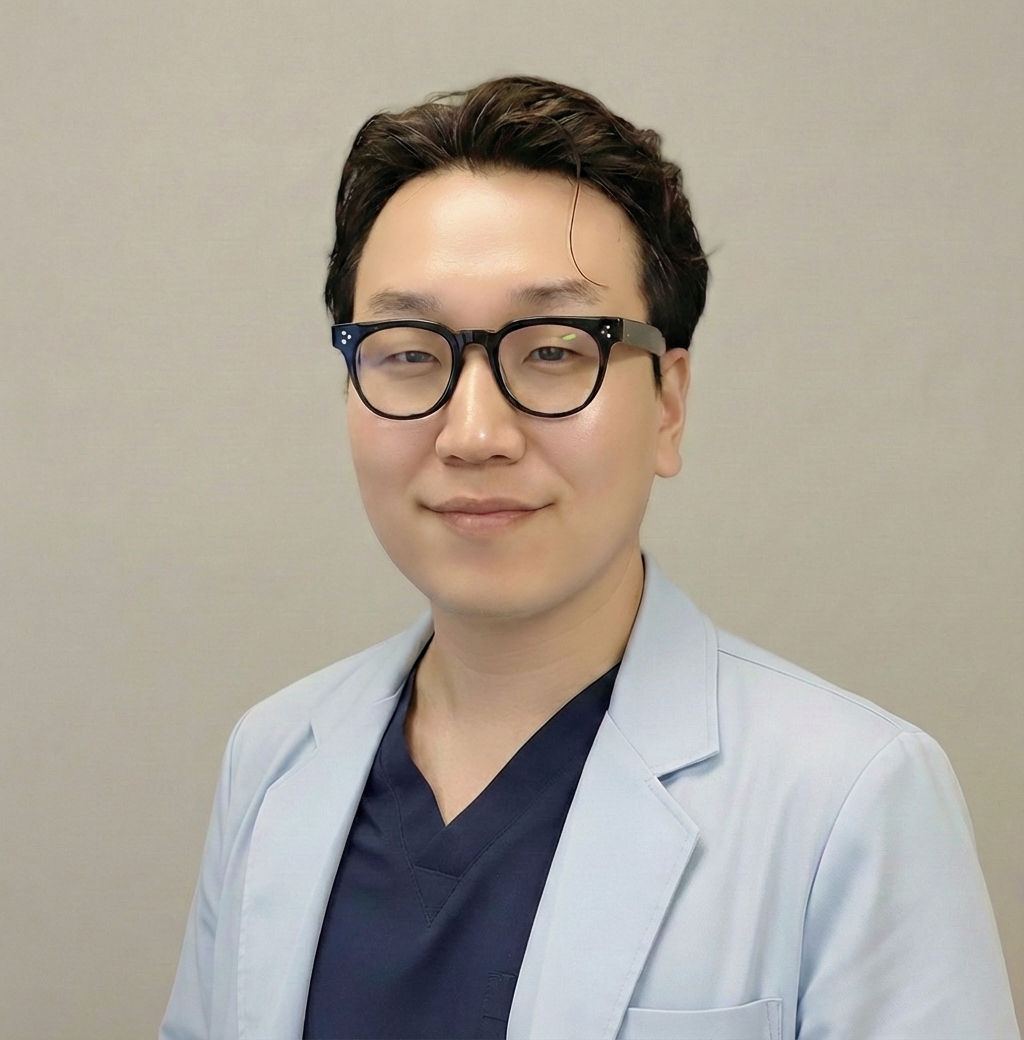
✍️ Reviewed by Dr. Choi Jang-Hyuk, Director of Dongjedang Korean Medicine Clinic
Pain
"Injections help only temporarily and then it hurts again" | Chronic tendinopathy, the SOS signal from tendons
View Program