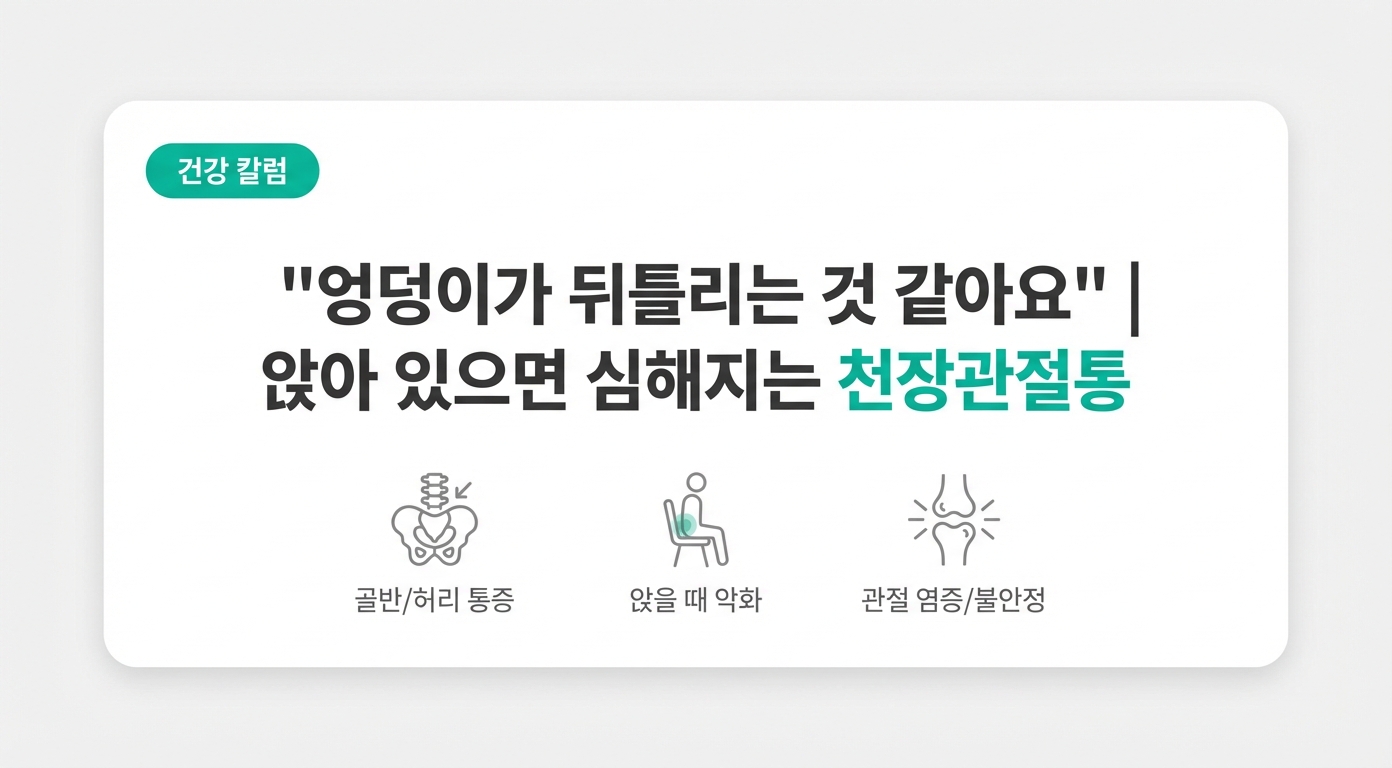
"It feels like my buttocks are twisting" | Sacroiliac joint pain that worsens when sitting

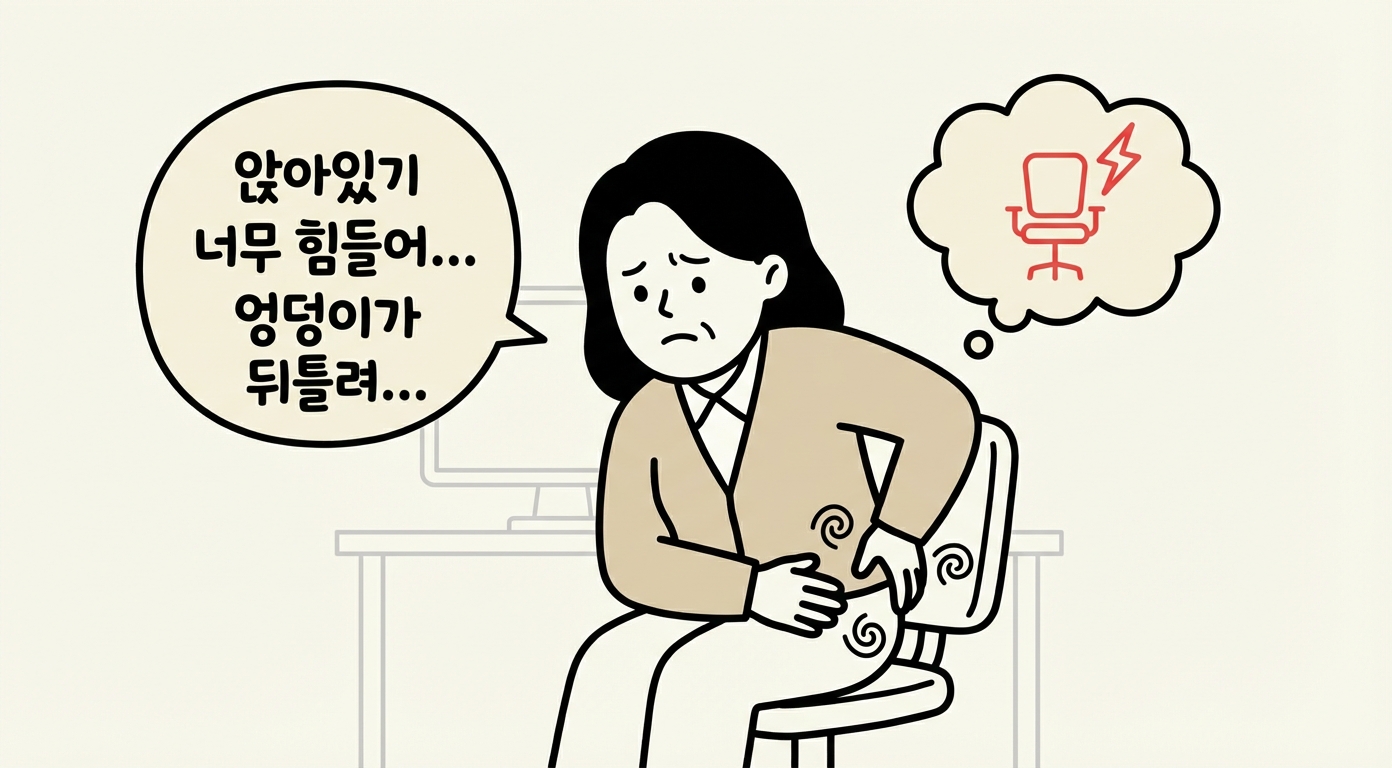 The Pain on the Chair — The Hip Pain Nobody Understands
"My hip feels like it's being twisted.
There's a heavy pressing sensation on just one side.
When I stand up after sitting for a long time, my lower back hurts so sharply I can't take a single step."
These were the words of Sun-young (pseudonym), a 42-year-old planning manager at an IT company, the first time she came to see me.
Sun-young sits in a chair for more than eight hours a day, five days a week.
Lunch was often eaten quickly at her desk, and after work, childcare for her two elementary school children was waiting.
Last autumn, project deadlines piled up and overtime continued for over two weeks.
Around that time, a heavy, pressing pain like a stone lodged in one side of her hip began.
She first went to an orthopedic clinic.
X-rays and even an MRI were taken, but the answer that came back was "it's not a disc — there are some mild degenerative changes."
Anti-inflammatory painkillers and physical therapy helped for a few days, but the moment she sat down again, the pain returned without fail.
"The MRI was taken and nothing major was found.
But I'm in pain every day — I started wondering if I was just being dramatic."
Hearing that the throbbing in her hip during meetings made it impossible to focus on the presentation content, my heart grew heavy.
I didn't see Sun-young's pain as simply a lower back problem.
I paid attention to the back of the pelvis — specifically the tension in the joint called the sacroiliac joint and the surrounding muscles and ligaments.
So why was this pain, invisible to tests, tormenting Sun-young every day?
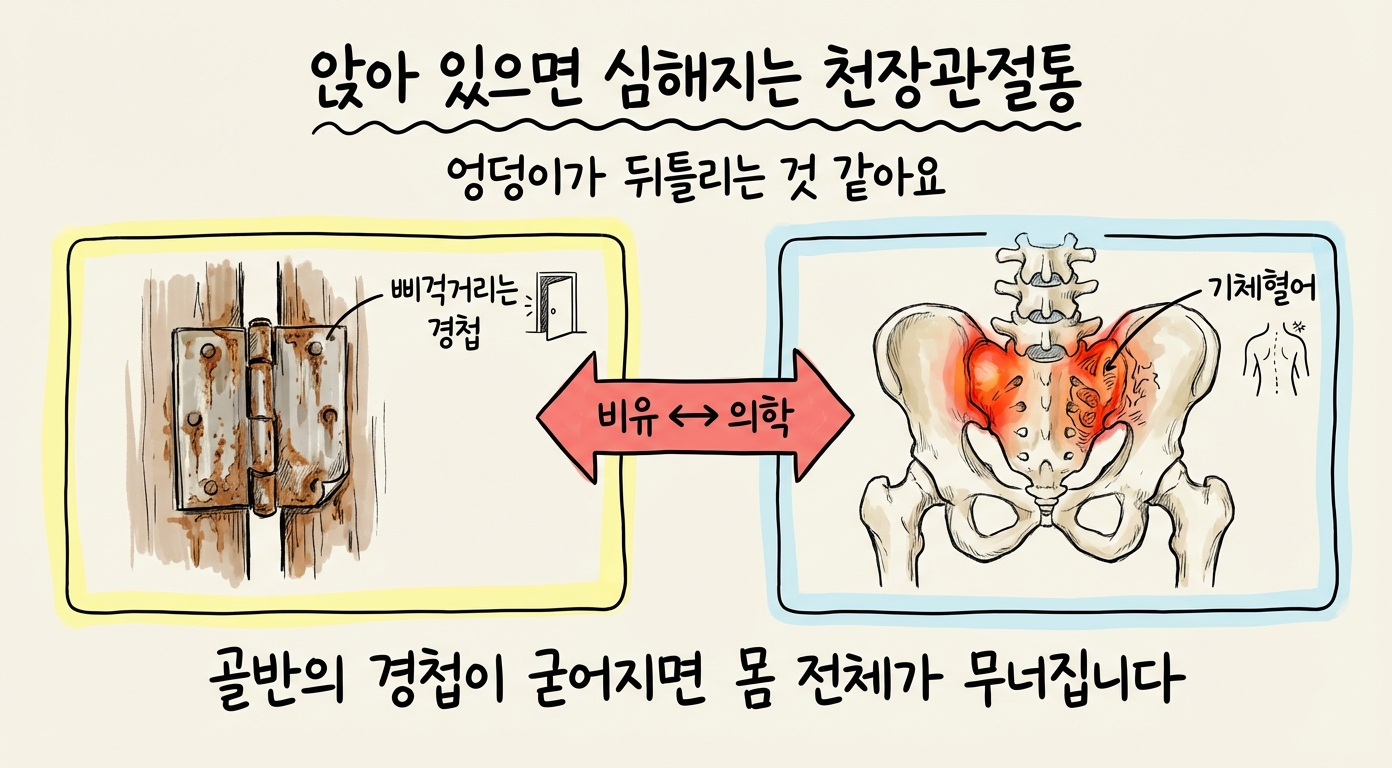 When the Pelvic "Hinge" Starts to Creak
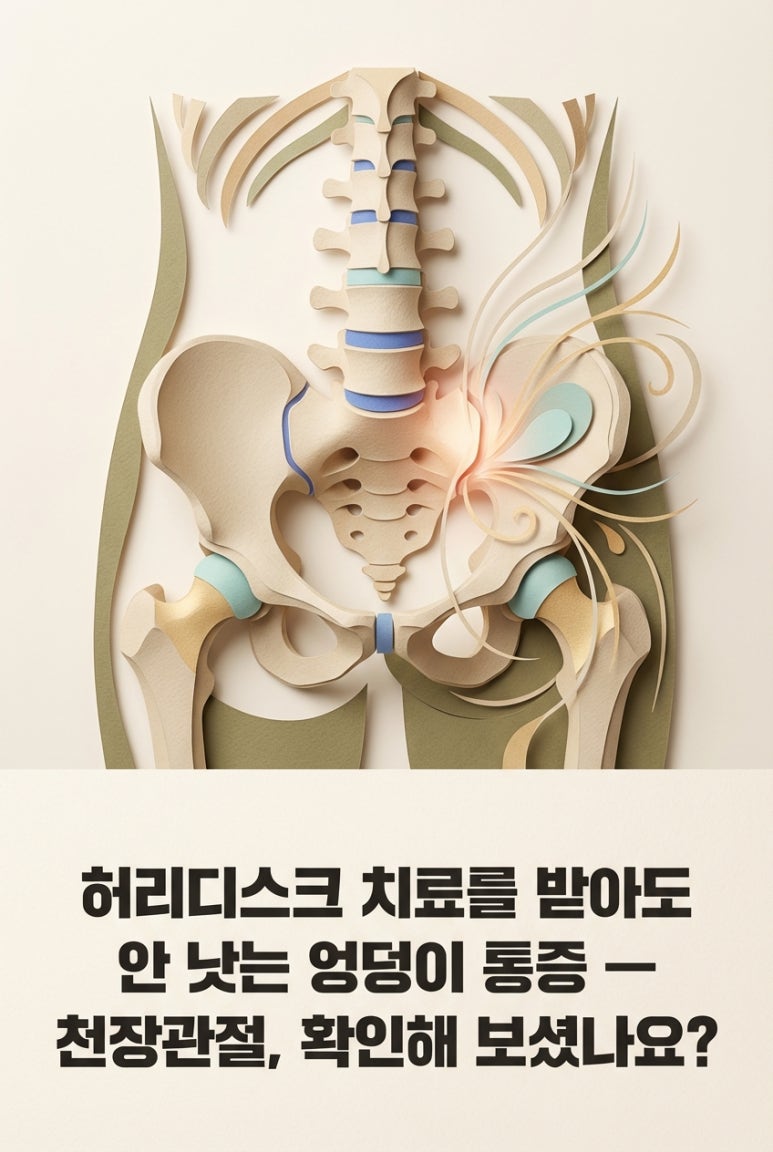
At the back of our pelvis, there is a joint that connects the spine to the pelvic bone.
This is the 천장관절(薦腸關節) — the sacroiliac joint.
This joint does not move much, but it serves as the link that transfers the weight of the upper body to the lower body.
Like the hinge of a door.
A hinge is easy to overlook, but when it starts to creak, the entire door fails to open properly.
In Korean medicine, this kind of pain is interpreted as 기체혈어(氣滯血瘀) — a state in which the flow of 기(氣) and 혈(Blood) has become blocked and stagnated in one place.
When sitting for long periods, the circulation of 기혈(氣血) around the pelvis slows, and the 경근(經筋) — the meridian sinews wrapping the muscles and ligaments — become rigid.
Modern medicine has also found that prolonged sitting places abnormal stress on the ligaments around the sacroiliac joint and creates imbalances in the surrounding muscles.
The pelvis is often compared to the foundation of a building.
When the foundation tilts to one side, cracks appear in the walls and even the roof is affected.
That was Sun-young's situation.
The compensating habit of leaning to the opposite side to avoid pain on one hip worsened pelvic asymmetry.
Its effects spread to tightness in the thighs and stiffness in the lower back.
Pain was collapsing posture, and collapsed posture was amplifying pain — a continuing cycle.
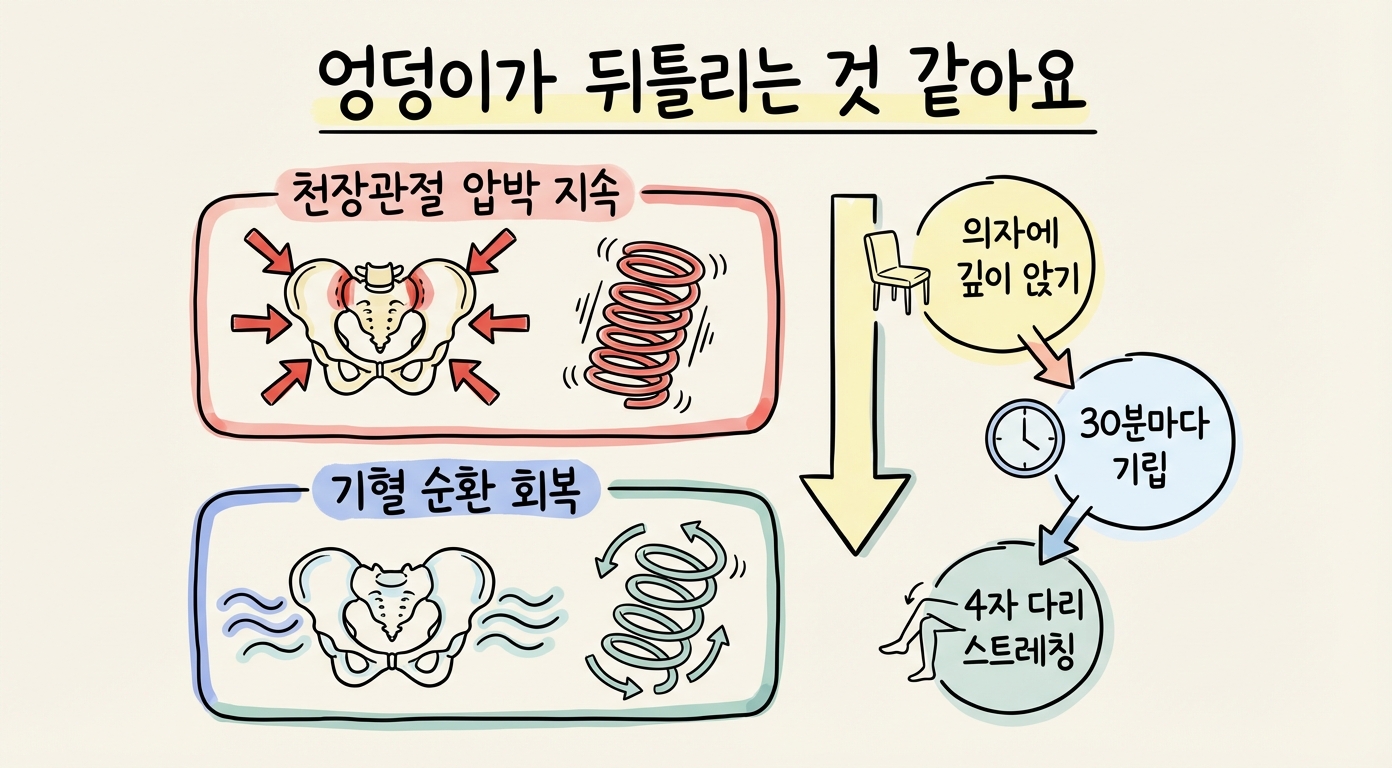
So Can One Break Free from This Distortion?
For someone like Sun-young who must sit in a chair every day, is there no way out of this pain?
Fortunately, there are ways to reduce the burden placed on the pelvis in daily life.
First, it is worth revisiting sitting habits.
Sitting deeply in the chair and leaning the lower back against the backrest reduces pressure on the sacroiliac joint.
The habit of crossing one leg twists the pelvis and places uneven force on the sacroiliac joint — consciously avoiding this is important.
Simply standing up and moving the body briefly every 30 minutes revives blood flow around the pelvis.
Simple stretches also help.
While sitting in the chair, placing one ankle on the opposite knee and slowly leaning the upper body forward gently releases the area around the sacroiliac joint and the piriformis muscle.
In bed, bending the knees and slowly letting them fall to both sides is also good for relieving pelvic tension.
However, if the pain extends down into the leg, or becomes so severe in the morning that straightening the back is difficult, self-management alone is not enough.
Please seek medical care without pushing yourself.
In Korean medicine, the approach uses acupuncture and pharmacopuncture to release 어혈(瘀血) around the sacroiliac joint and relax the 경근(經筋), while Chuna manipulation (추나요법) is used to correct the structural balance of the pelvis.
The direction is not simply suppressing pain, but helping the body recover its own balance.
 When the Pelvis Is at Ease, the Day Changes
Two months later, Sun-young was able to sit through afternoon meetings without worrying about hip pain.
I still remember her smiling and saying, "Ah, so this is what sitting comfortably feels like."
Sacroiliac joint pain is common, but it is a pain that is easy to drag on without an accurate diagnosis.
Please listen to the signals your body is sending, and do not take that discomfort for granted.
Your body shows a remarkable capacity for recovery when given the right support.
My role is to be a companion in finding the key to that recovery together.
Even if not with me — please find a healthcare provider who will look carefully at the whole body and help you reclaim comfort in your pelvis.
✍️ Reviewed by Dr. Choi Jang-Hyuk, Director of Dongjedang Korean Medicine Clinic
Pain
"It feels like my buttocks are twisting" | Sacroiliac joint pain that worsens when sitting
View Program