Chronic Tendinopathy: When Tendons Become 'Worn-out Rubber Bands' — What's the Difference Between Salmon Injection, Prolotherapy, and Fire Needle Acupuncture?
 🧾 Answer First | Core Conclusion
I can't pick up a water cup because my elbow hurts, it's hard to wash my hair because my shoulder feels stiff
— If this pain has persisted for more than 3 months, it may not be simple 'muscle pain.'
Chronic tendinopathy is a condition where the tendon tissue itself has undergone degenerative changes.
Anti-inflammatory medications or steroid injections make it difficult to achieve fundamental resolution,
and 'regenerative therapy' that revives tendon tissue is needed.
In Western medicine, salmon injection (PDRN) and prolotherapy,
and in Korean medicine, heated fire needle acupuncture each help tendon regeneration in different ways.
From now on, I'll explain the mechanism and differences of each treatment, and which to choose in which situations.
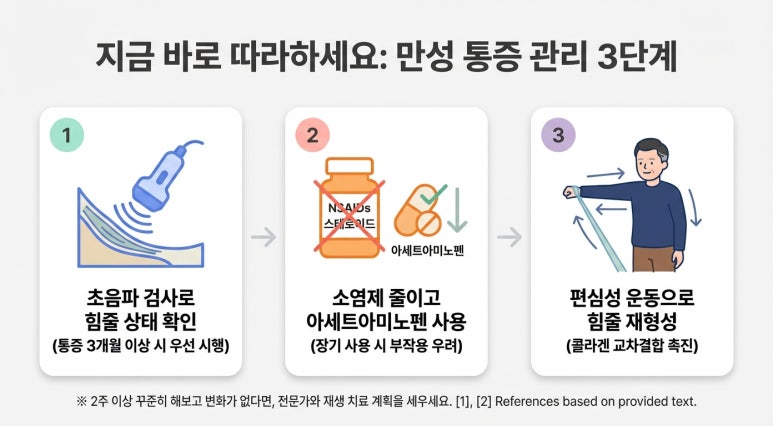 ✅ Action | Immediate Steps
1️⃣ Check for 'tendinopathy' possibility if pain has lasted more than 3 months
If pain in tendon areas—elbow, shoulder, Achilles tendon, below the knee—persists for more than 3 months, ultrasound examination to confirm tendon status is a priority. Since chronic tendinopathy involves degenerative changes rather than inflammation, improvement with anti-inflammatory medications alone is difficult.
2️⃣ Reduce repeated use of anti-inflammatory and steroid medications
NSAIDs and steroid injections reduce pain short-term, but long-term use can actually interfere with tenocyte proliferation and reduce collagen synthesis[1]. Pain control should be switched to acetaminophen-based alternatives, and a fundamental treatment plan should be established.
3️⃣ Start with eccentric exercise
Eccentric exercise, which applies appropriate load to the tendon in reverse, promotes cross-linking formation of collagen fibers and helps tendon reformation[2]. Regardless of injection therapy, exercise must accompany treatment to maximize effects. If there is no change after consistent practice for 2+ weeks, establishing a regenerative therapy plan with a specialist is the fastest approach.
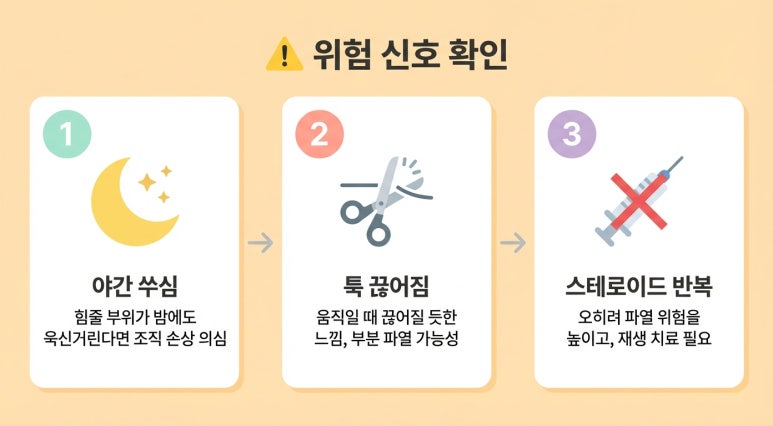 🚨 Warning | Critical Warning Signs to Check
✔ Throbbing pain even at rest at night
If the tendon area throbs even at night, tissue damage may have progressed significantly beyond simple overuse.
✔ Feeling of a lump along the tendon when pressed, or sensation of 'snapping'
If you feel a lump along the tendon during movement or sensation of snapping, partial tear should be suspected.
✔ Receiving steroid injections 3 or more times in the same area
Repeated steroid injections can cause fatty degeneration of the tendon and paradoxically increase rupture risk.
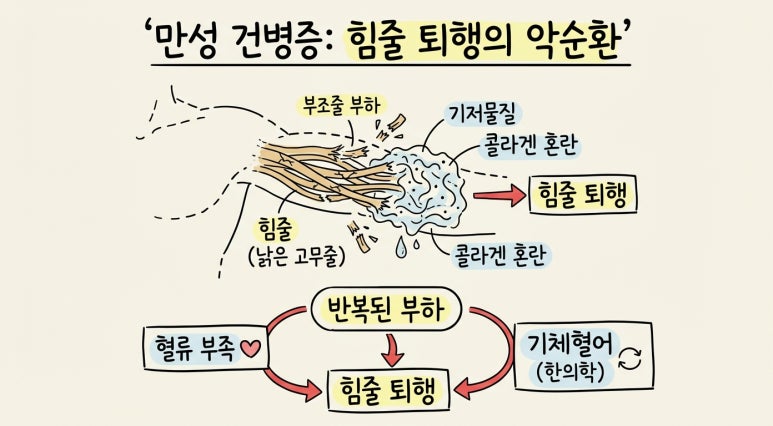 🧠 The Why | Root Cause Analysis
Why doesn't tendinopathy heal easily?
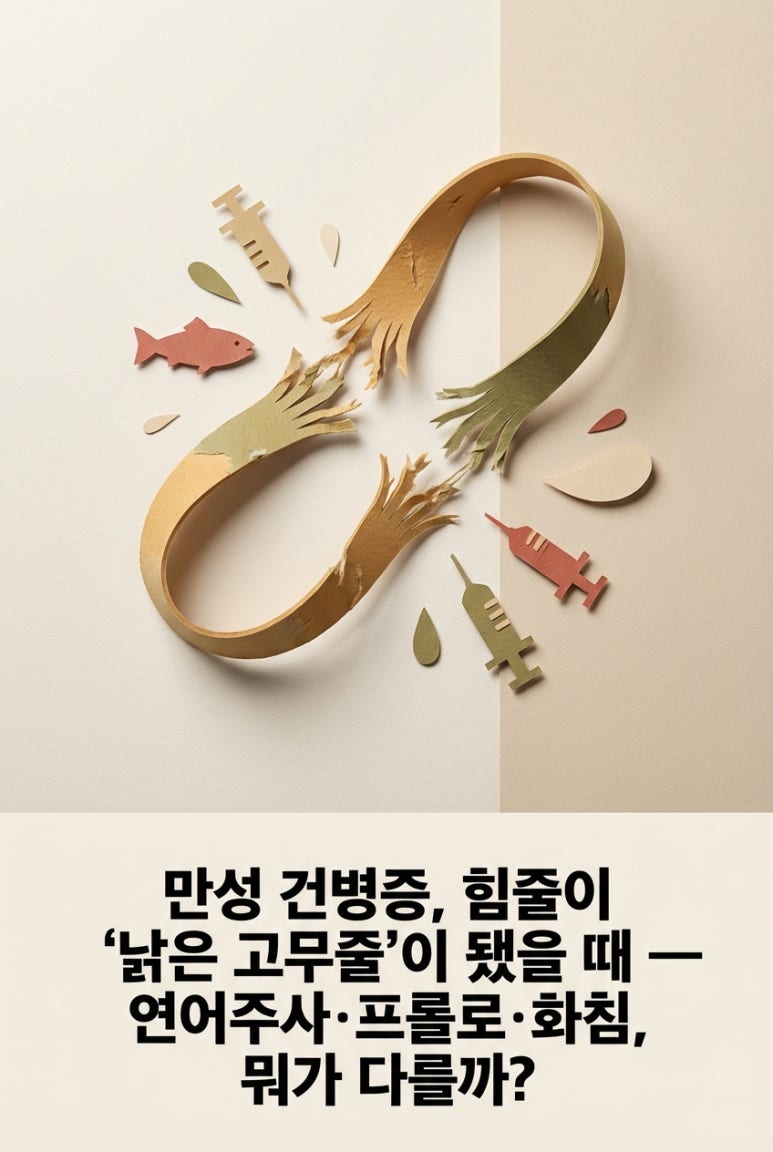
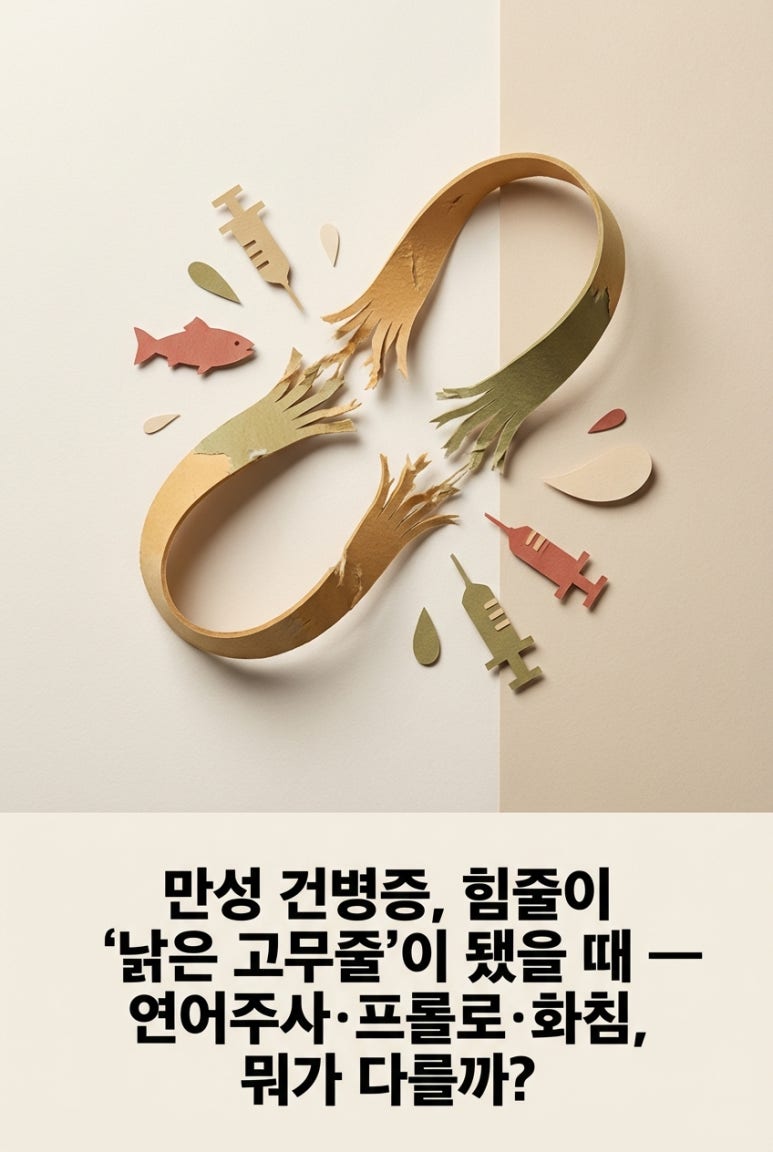
We can compare tendons to rubber bands.
A new rubber band is elastic and stretches well. But an old rubber band cracks, loses elasticity, and eventually breaks.
Chronic tendinopathy is precisely this 'worn-out rubber band' state.
Historically, tendon pain was viewed as 'tendinitis,' meaning inflammation.
But actual histological examination of tendon tissue in chronic pain patients reveals almost no inflammatory cells[3].
What is found instead are degenerative changes: disordered collagen fiber arrangement, ground substance becoming gel-like, and abnormal blood vessel formation.
The histological core of chronic tendinopathy consists of four elements:
increased tenocyte count, increased ground substance, disordered collagen fibers, and neovascularization[4]. Particularly since tendons have very limited blood flow, once damaged, natural recovery is extremely slow. If the rate of repeated loading exceeds the rate of damage recovery, tenocyte expression decreases and degeneration progresses.
In Korean medicine, tendons are categorized under 'Jin (筋)'.
Tendinopathy corresponds to a state where Jin becomes stiff and painful due to loss of nutrition from Liver Blood Insufficiency (肝血不足).
Additionally, the core pathomechanism is blockage of Qi and Blood circulation (氣滯血瘀), preventing sufficient nutrition from reaching the tendon area.
This concept aligns with what Western medicine describes as 'degeneration due to blood flow insufficiency.'
Heated fire needle acupuncture is precisely a method that resolves this deep Qi and Blood circulation stagnation with heat (溫), aiming to directly resolve blood stasis and cold congelation in deep structures untouched by superficial treatment.
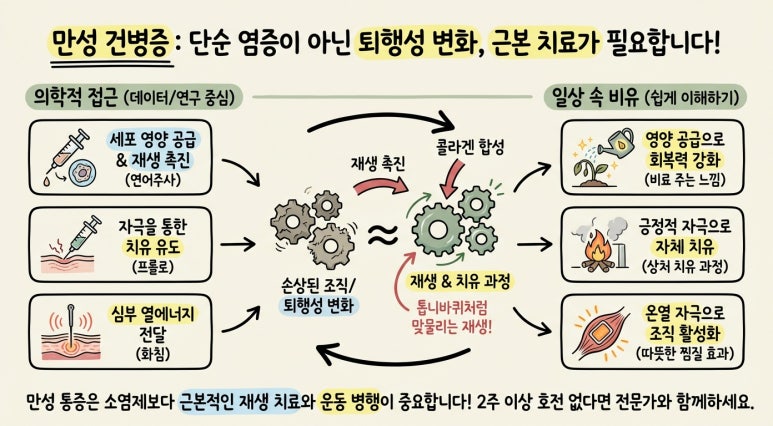 📊 Proof | Cases and Evidence
Salmon Injection (PDRN) — Direct Supply of Raw Materials for Cell Regeneration
This method involves injecting polydeoxyribonucleotide (PDRN) extracted from salmon into the damaged area.
PDRN activates adenosine A2A receptors to induce anti-inflammatory responses and promotes fibroblast proliferation[5]. In simple terms, it works by directly delivering 'nutritional raw materials' to cells that produce tendons, helping new collagen form. It also improves blood flow, making it particularly useful for tendon areas with slow recovery. It is a specialized pharmaceutical approved by the US FDA and Korean KFDA, with very low risk of side effects.
Prolotherapy — Deliberately Creating Inflammation to Stimulate Healing
High-concentration glucose (dextrose) solution is injected at weakened tendon and ligament attachment points.
This stimulus triggers localized inflammatory response, and this inflammation promotes secretion of growth factors (TGF-β, PDGF, VEGF, etc.), leading to tissue proliferation and reformation[6]. According to a 2024 systematic literature review in the Korean Journal of Orthopedic Surgery, combining prolotherapy with exercise showed the best clinical results in Achilles tendinopathy[7]. However, recent meta-analyses report that the effectiveness of prolotherapy for rotator cuff tendinopathy did not show clear superiority over control groups[8], suggesting effectiveness may vary by location.
Heated Fire Needle Acupuncture — Directly Delivering Heat to Deep Tissue in Korean Medicine Regenerative Therapy
A thick needle is precisely inserted into the deep ligament and deep fascial areas causing pain, and then the needle handle is briefly heated to deliver heat stimulus deep into the tissue. This differs from 'fire acupuncture (火鍼)' where heated needles are directly applied to skin. Rather than burning the surface to deliver heat, it minimizes skin damage while precisely delivering heat to only the necessary depth.
Deep ligaments and deep fascia have limited blood flow, slow recovery once damaged, and easily become fixed points of chronic pain. Since heating from poultices or moxibustion delivers heat from the surface, they cannot adequately stimulate these deep structures. Heated fire needle acupuncture delivers heat directly to depth via the needle, improving local microcirculation and inducing tissue recovery responses.
Heat stimulus reportedly shifts macrophage polarity from M1 (inflammatory) to M2 (anti-inflammatory and regenerative)[9], and needle stimulation itself activates fibroblasts in connective tissue to promote collagen synthesis and rearrangement[11]. Studies applying fire needle acupuncture to chronic tendinopathy patients such as tennis elbow have reported significant pain reduction with only several treatments[10].
Core Comparison of Three Treatments
Salmon injection supplies 'raw materials' to cells, prolotherapy uses 'intentional stimulation' to make the body heal itself, and heated fire needle acupuncture delivers heat directly to deep tissue beyond reach of superficial stimulation, resetting the microenvironment itself. Ultimately, all three share the common principle of 'initiating a new healing process in degenerated tendons.'
In my clinical experience, many patients come to us only after repeatedly using anti-inflammatory and steroid medications, seeking help too late. After switching to regenerative therapy, I observe that about seven out of ten patients report pain reduction of over 50% within 2-3 months.
🔚 Closing | Summary and Encouragement
Chronic tendinopathy is not a pain that heals with patience alone.
True recovery begins only when appropriate regenerative stimulus is applied to degenerating tendons.
Salmon injection, prolotherapy, fire needle acupuncture
— Which treatment is right depends on tendon condition, pain location, and patient constitution and living environment.
Don't deliberate alone; taking the first step of accurately assessing your condition with a specialist is essential.
You don't have to bear this discomfort alone.
If you would like a consultation that can examine constitution and lifestyle habits together, please feel free to contact us.
✍️ Reviewed by Director Choi Chang-hyuk, Dongjae-dang Korean Medicine Clinic
❓ FAQ
Q. What's the difference between salmon injection and prolotherapy?
Salmon injection (PDRN) directly supplies nucleic acid components needed for cell regeneration. Prolotherapy triggers localized inflammation with high-concentration glucose, causing the body to initiate its own healing response. Salmon injection has minimal post-procedure pain, while prolotherapy may cause swelling or stiffness for 2-3 days post-procedure. Both treatments may be used in combination depending on patient condition and location.
Q. Is there risk of burns with heated fire needle acupuncture?
Heated fire needle acupuncture first inserts the needle, then briefly heats the handle portion, so it doesn't burn or scald skin. Many patients describe it as "warmth spreading from a deep area" or "a heavy heat sensation passing briefly." The intensity and duration of stimulation are adjusted to match patient condition, and normal daily activities are possible immediately after treatment.
Q. Does this mean anti-inflammatory medication is ineffective for chronic tendinopathy?
Anti-inflammatory medications are effective for acute inflammation, but chronic tendinopathy's core is degenerative change rather than inflammation. Moreover, long-term anti-inflammatory use can actually suppress the natural healing process necessary for tendon regeneration. While short-term use during severe pain is appropriate, fundamental treatment should approach with regenerative therapy and exercise.
📚 References
[Western Medicine (WM)]
- [1] Nirschl RP. Elbow tendinosis/tennis elbow. Clin Sports Med. 1992
- [2] Alfredson H. The chronic painful Achilles and patellar tendon: research on basic biology and treatment. Scand J Med Sci Sports. 2005
- [3] Khan KM et al. Time to abandon the "tendinitis" myth. BMJ. 2002;324:626-7
- [4] Alfredson H et al. In vivo investigation of ECRB tendons with microdialysis technique. J Orthop Res. 2000
- [5] Squadrito F et al. Pharmacological activity and clinical use of PDRN. Front Pharmacol. 2017
- [6] Moon SH, et al. Prolotherapy. J Korean Orthop Assoc. 2018;53(5):393-399
- [7] Systematic literature review of proliferative therapy in musculoskeletal disorders. J Korean Orthop Assoc. 2024;59(4):256
- [8] Prolotherapy is not superior to control for rotator cuff tendinopathy. Clin Shoulder Elbow. 2025 (PMC12698348)
[Korean Medicine (KM)]
- [9] Fire Needling Acupuncture Suppresses Cartilage Damage by Mediating Macrophage Polarization. J Pain Res. 2022;15:1071-1081
- [10] Fire Needle Acupuncture Treatment for Lateral Epicondylitis. ResearchGate. 2017
- [11] Langevin HM et al. Subcutaneous tissue fibroblast cytoskeletal remodeling induced by acupuncture. J Cell Physiol. 2006;207(3):767-74
Pain
Chronic Tendinopathy: When Tendons Become 'Worn-out Rubber Bands' — What's the Difference Between Salmon Injection, Prolotherapy, and Fire Needle Acupuncture?
View Program