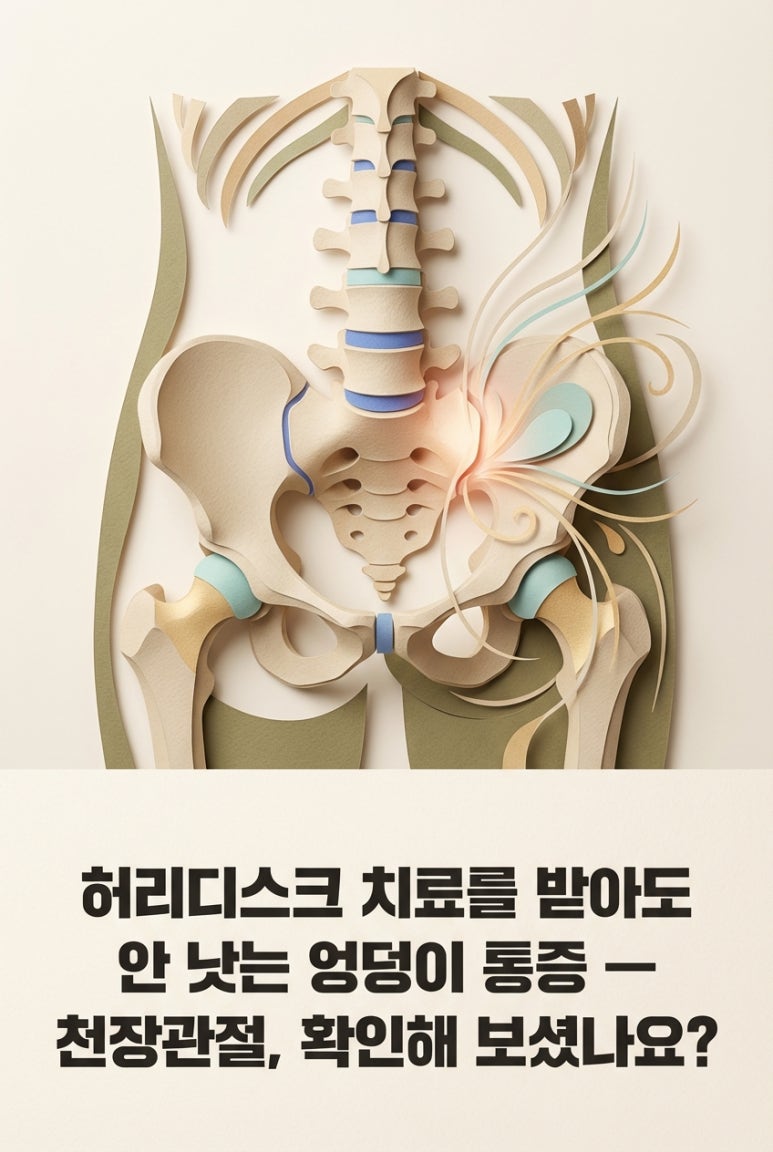

Hand Numbness, You Thought It Was Cervical Disc Disease, But It's 'Thoracic Outlet Syndrome'?

 Many people mistake thoracic outlet syndrome for cervical disc disease.
Of course, there are many cases where patients have both cervical disc disease and thoracic outlet syndrome together.
Many patients receive only cervical disc-related treatment without improvement
and are diagnosed with this condition later.
Thoracic outlet syndrome is a condition that even experienced doctors easily miss in diagnosis.
Today, let's learn about thoracic outlet syndrome.
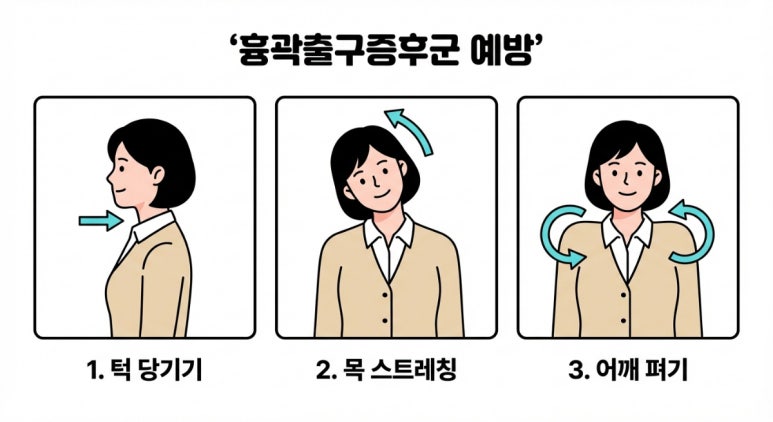 ✅ Action | Exercises and precautions that help with prevention and treatment of thoracic outlet syndrome
If thoracic outlet syndrome is suspected, follow these guidelines.
Try these three things right now.
1️⃣ Maintain proper posture
When working on the computer, keep your shoulders back.
Tuck your chin so your neck and shoulders are in a straight line.
Hunched posture makes compression worse.
2️⃣ Do simple stretching
Tilt your neck side to side throughout the day.
Do shoulder rolls backward.
You need to release tension in the muscles.
3️⃣ Consult with a professional
Self-diagnosis is difficult.
Consult with a Korean medicine doctor or medical doctor like me.
Accurate diagnosis and an appropriate treatment plan are important.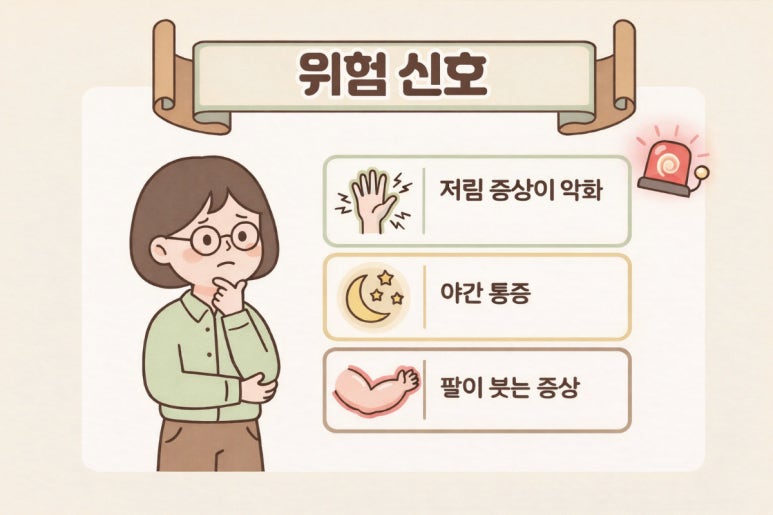 🚨 Warning | Warning signs you must check
If the following symptoms appear, seek medical attention immediately.
✔ Worsening numbness
Numbness in the hands or arms gradually worsens.
It becomes difficult to perform daily activities.
✔ Nighttime pain worsens
You cannot sleep at night due to the pain.
Pain is worse at night.
✔ Decreased sensation and muscle weakness
Sensation in the hands or arms becomes dull.
You feel a weakening of muscle strength.
✔ Skin color changes and swelling
Skin color changes or swelling becomes severe.
Symptoms suggesting circulatory problems are present.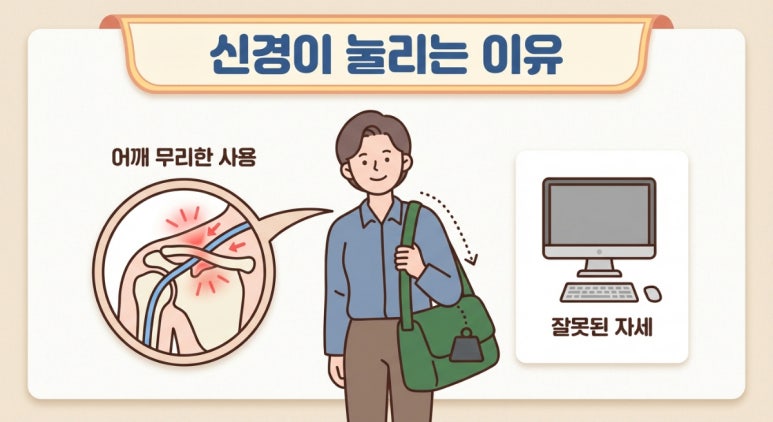 🧠 The Why | Why is the nerve compressed in the shoulder area when the neck is not affected?
Unlike cervical disc disease,
thoracic outlet syndrome occurs in the space between the neck and shoulders.
In other words, the narrow space around the collarbone is the problem.
Many nerve trunks and blood vessels pass through this narrow space.
When the narrow space through which many nerves and blood vessels pass becomes even narrower due to surrounding muscle tension or collarbone deformation,
compression of nerves and blood vessels causes symptoms similar to cervical disc disease[2].
Of course, there are differences.
Cervical disc disease does not compress blood vessels.
This difference creates an important distinguishing point in symptom differentiation.
So why does that space become narrower?
Traffic accidents or aftereffects of trauma can be the cause.
Incorrect posture or repetitive arm use are also problems.
I think of the patients I have seen in my clinical practice.
Many office workers who use computers for extended periods experience this.
Those who frequently lift heavy objects are also common.
Do you work hunched over for more than 8 hours a day?
Do you have a habit of carrying heavy bags on one shoulder only?
This condition is common in such people.
 📊 Proof | Case study
I remember one middle-aged male patient.
He had suffered from hand numbness and arm pain for several months.
He received cervical disc treatment at another hospital. However, there was no improvement.
Frustrated, he came to our Korean medicine clinic for an examination.
Upon examination, numbness worsened with specific postures.
Pain increased when pressure was applied below the collarbone.
We diagnosed thoracic outlet syndrome and provided consistent acupuncture treatment and posture correction. We also combined herbal medicine treatment.
As the compression of the nerves and blood vessels decreased, all symptoms improved.
Hand numbness decreased and he became more comfortable. He received consistent treatment for approximately 3 months.
The results showed significant improvement.
Even with similar symptoms, the causes can be different. Proper identification allows for proper treatment.
🔚 Closing
The causes of hand numbness are very diverse.
Do not assume it is cervical disc disease.
It could be caused by something else, like thoracic outlet syndrome.
Do not worry alone; consult comfortably.
✍️ Reviewed by Director Choi Jang-hyeok of Dongjjedang Korean Medicine Clinic
❓ FAQ
Q. What type of person is prone to thoracic outlet syndrome?
Those who use computers for extended periods are prone to it.
Those who lift heavy loads are also at risk.
Many people who have suffered neck and shoulder injuries in traffic accidents develop it.
Incorrect posture is the main cause.
Q. How do you distinguish between thoracic outlet syndrome and cervical disc disease?
With thoracic outlet syndrome, numbness occurs when you raise your arm.
It tends to worsen with specific postures.
With cervical disc disease, pain occurs when you move your neck.
Neck pain often accompanies it.
Accurate differentiation requires examination by a professional.
Q. Can thoracic outlet syndrome be treated at a Korean medicine clinic?
Yes, it can be treated at a Korean medicine clinic.
Acupuncture, acupuncture with herbal medicine, and herbal medicine treatment are provided.
Acupuncture relieves tense muscles and reduces nerve compression.
Herbal medicine promotes blood circulation and alleviates inflammation.
It strengthens the body's vital energy to aid recovery.
Postural misalignment is also corrected together.
📚 References
[Western Medicine (WM)]
[1] UpToDate (2023). "Thoracic outlet syndrome"
[2] Mayo Clinic (2022). "Thoracic outlet syndrome - Symptoms & causes"
[Korean Medicine (KM)]
[3] Korean Journal of Oriental Medicine (2021). "Recent advances in Korean medicine treatment of thoracic outlet syndrome"
[4] Korean Journal of Acupuncture & Moxibustion Medicine (2020). "Study on the effectiveness of acupuncture treatment in patients with thoracic outlet syndrome"
Pain
Hand Numbness, You Thought It Was Cervical Disc Disease, But It's 'Thoracic Outlet Syndrome'?
View Program