
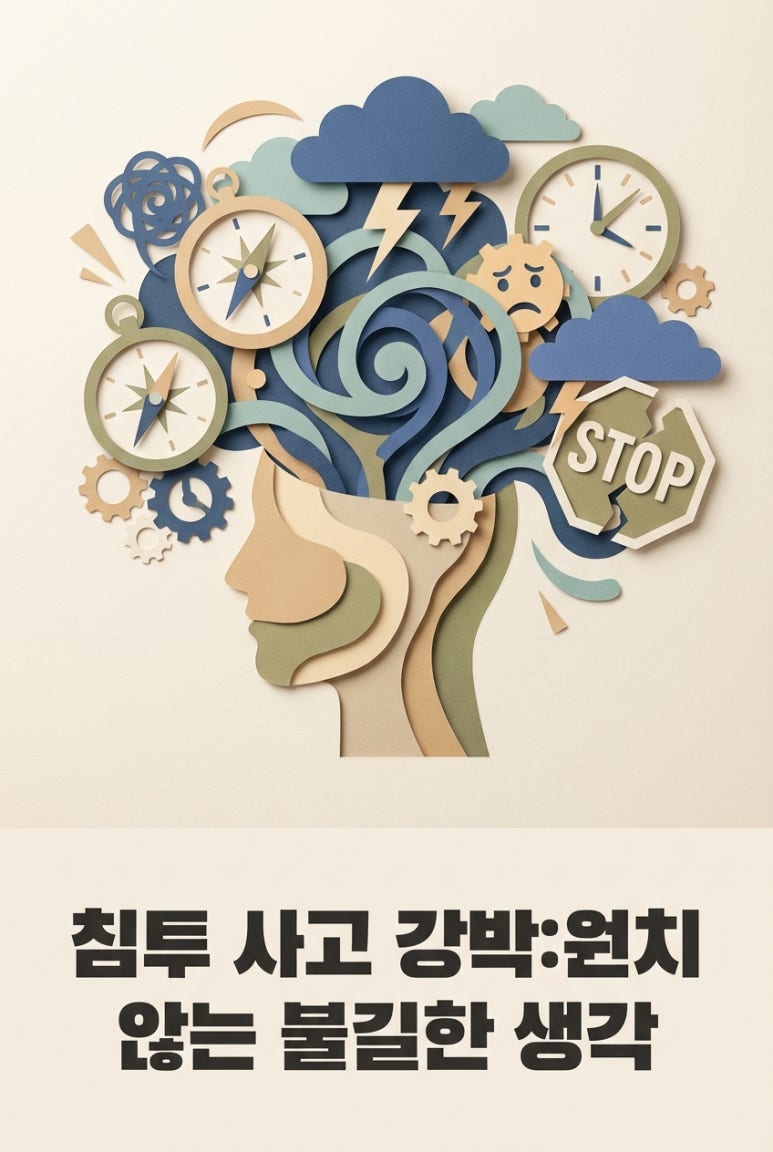
Intrusive Thought Obsession: Unwanted Ominous Thoughts

 🧾 Answer First | Core Conclusion
Are you suffering from terrifying and ominous thoughts that come to mind at any moment?
Thoughts like "What if I hurt someone I love?" or "What if I suddenly feel like jumping out while driving?"
Hello.
I am Choi Jang-hyuk, director of Dongjejdang Korean Medicine Clinic.
Let me be very clear from the start.
Those terrible thoughts are absolutely not your true nature.
This is not your fault.
It is merely a kind of "error message" created by your brain exhausted from excessive stress and suppressed overwork.
So please put your mind at ease first.
You are absolutely not losing your mind.
From now on, just follow these 3 steps that I will show you.
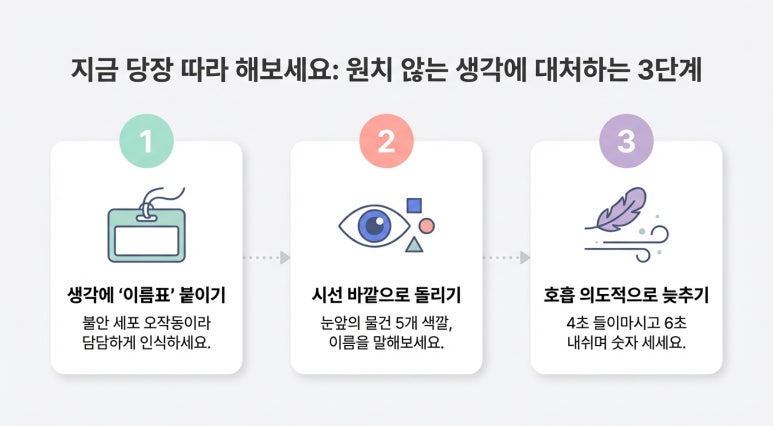 ✅ Action | Immediate Implementation
When unwanted intrusive thoughts sharply pierce your mind, you must act this way right now.
1️⃣ Label your thoughts
Say calmly to yourself inside, "Oh, my brain's anxiety cells have malfunctioned again."
This is the most certain and quick first step to separate terrible thoughts from your true self.
2️⃣ Immediately redirect your attention outward
You must clearly name the color and name of 5 objects visible before your eyes by speaking them out loud.
This is a very effective method to forcibly pull your brain's attention from the swamp of anxiety back to reality.
3️⃣ Intentionally slow down your breathing
Breathe in deeply through your nose for 4 seconds, and exhale slowly through your mouth for 6 seconds.
While breathing, slowly count from 1 to 10 in your mind.
Even maintaining this breathing technique for just 3 minutes becomes the most powerful emergency treatment to turn off the switch of an overly sensitized nervous system.
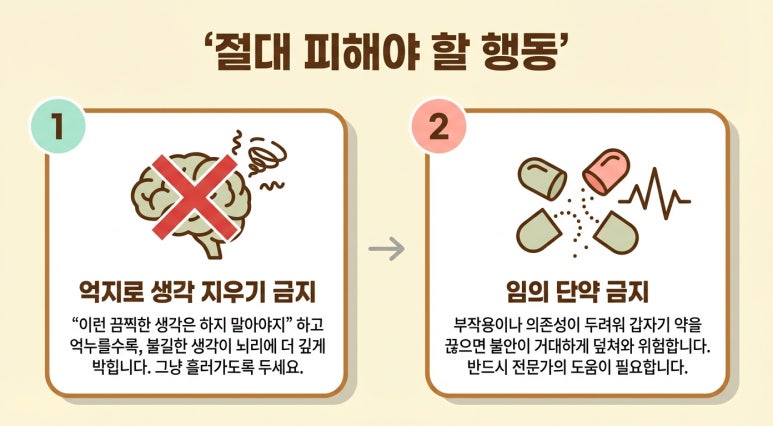 🚨 Warning | Critical Warning Signs You Must Check
However, there are two fatal dangerous behaviors you must absolutely avoid at this time.
✔ Do not desperately try to erase your thoughts by force
The more you suppress a thought by saying "I must not have such terrible thoughts," the more deeply and strongly that ominous thought becomes embedded in your mind.
It is the same principle as when you close your eyes and are told not to think of a polar bear, but polar bears fill your mind.
You must simply let those thoughts flow away like water.
✔ Do not arbitrarily stop taking psychiatric medications
You must never suddenly stop antidepressants or tranquilizers you are taking out of fear of side effects or dependency.
If you attempt to stop medication arbitrarily, the suppressed anxiety can come crashing down like a giant wave all at once, and symptoms can worsen to an uncontrollable state.
When reducing medication, expert guidance and a careful plan are absolutely essential.
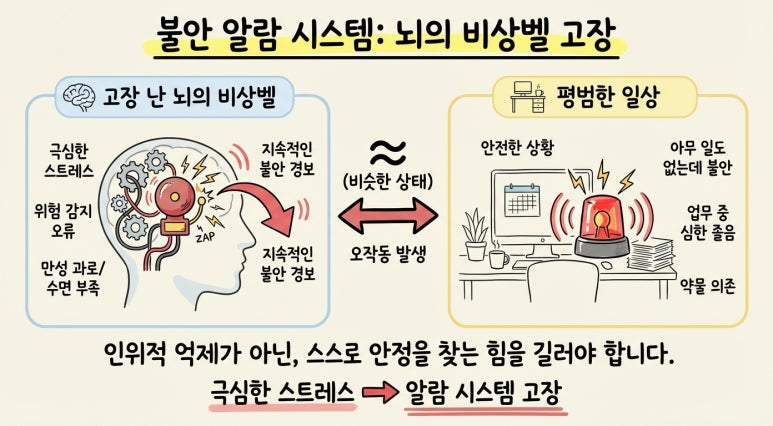 🧠 The Why | Root Cause Analysis
So why do these ominous thoughts keep coming to mind beyond your control?
Based on many patients I have seen in my clinic, the core cause is most often extreme overwork and sleep deprivation accumulated over a long period.
A Broken Brain's Emergency Alarm
Our brain has an "anxiety alarm system" that immediately detects danger.
When stress exceeds its threshold, this alarm system completely malfunctions.
Even in perfectly ordinary daily life with no real danger, the loud emergency alarm keeps going off.
Many office workers take psychiatric medications daily to cover up this terrible anxiety.
Of course, medication is essential in urgent crisis moments.
However, artificially suppressing brain nerves and only temporarily covering up symptoms cannot be a fundamental solution.
Many people suffer from severe daytime drowsiness that ruins their work all day.
Many others live in daily fear of staying awake all night without sleeping pills.
Rather than external suppressants, you must develop the body's own power to find stability.
📊 Proof | Case Studies and Evidence
This is the story of a man in his late 30s, an office worker, whom I directly treated in clinical practice.
He suffered severely from intrusive thoughts of "What if I suddenly turn the steering wheel" while driving to work every morning.
Taking tranquilizers reduced his anxiety, but he remained in a dazed state throughout the day, causing frequent critical mistakes at work.
After coming to see me, I immediately started herbal medicine treatment to wash away the brain's fatigue substances and stabilize the autonomic nervous system.
At the same time, we designed a gradual medication reduction plan over 8 weeks to prevent withdrawal symptoms.
Three months after starting treatment, this patient began sleeping soundly for over 7 hours a night without sleeping pills.
He completely regained his brain's robust power to naturally let ominous thoughts pass without holding onto them[3].
 🔚 Closing | Summary and Encouragement
The fact that ominous thoughts keep coming to mind is, paradoxically, clear evidence that you desperately long for ordinary daily life and family safety.
So please never blame yourself and suffer.
This is a condition from which you can sufficiently return to daily life once you clear away the extreme fatigue accumulated in your brain and restore your autonomic nervous system balance.
If you are currently agonizing alone every night over heavy medication side effects, I strongly encourage you to find the healthiest way for your body to find stability on its own.
✍️ Reviewed by Choi Jang-hyuk, Director of Dongjejdang Korean Medicine Clinic
❓ FAQ
Q. Is intrusive thought obsession a type of panic disorder?
Yes, it can be classified within the broader category of panic disorder in that it involves severe anxiety.
This is because it is accompanied by sudden heart palpitations or severe breathing difficulties alongside unwanted terrifying thoughts that greatly interfere with daily life.
Q. Is it possible to manage the condition with only Korean medicine treatment after stopping psychiatric medications?
Yes, but the medication discontinuation process must proceed very gradually and safely.
The best approach is to first stabilize the brain and autonomic nervous system with herbal medicine, then gradually reduce the dose of Western medications in stages to prevent serious withdrawal symptoms.
Q. Can anxiety be managed without daytime drowsiness, a side effect of anti-anxiety medications?
Yes, this is entirely possible through treatment that balances the body's inherent autonomic nervous system.
Korean medicine treatment is never a method of artificially anesthetizing or suppressing the brain, so it can effectively reduce anxiety and obsessive thoughts while maintaining a clear and alert mind.
📚 References
Western Medicine
[1] NICE 2023. "Generalised anxiety disorder and panic disorder in adults: management"
[2] BMJ Best Practice 2022. "Panic disorder - Management"
Korean Medicine
[3] Korean Association of Oriental Medicine CPG 2021. "Korean Medicine Clinical Practice Guideline for Panic Disorder"
[4] NIKOM 2020. "Latest Insights in Korean Medicine Treatment of Anxiety and Obsessive-Compulsive Disorders"