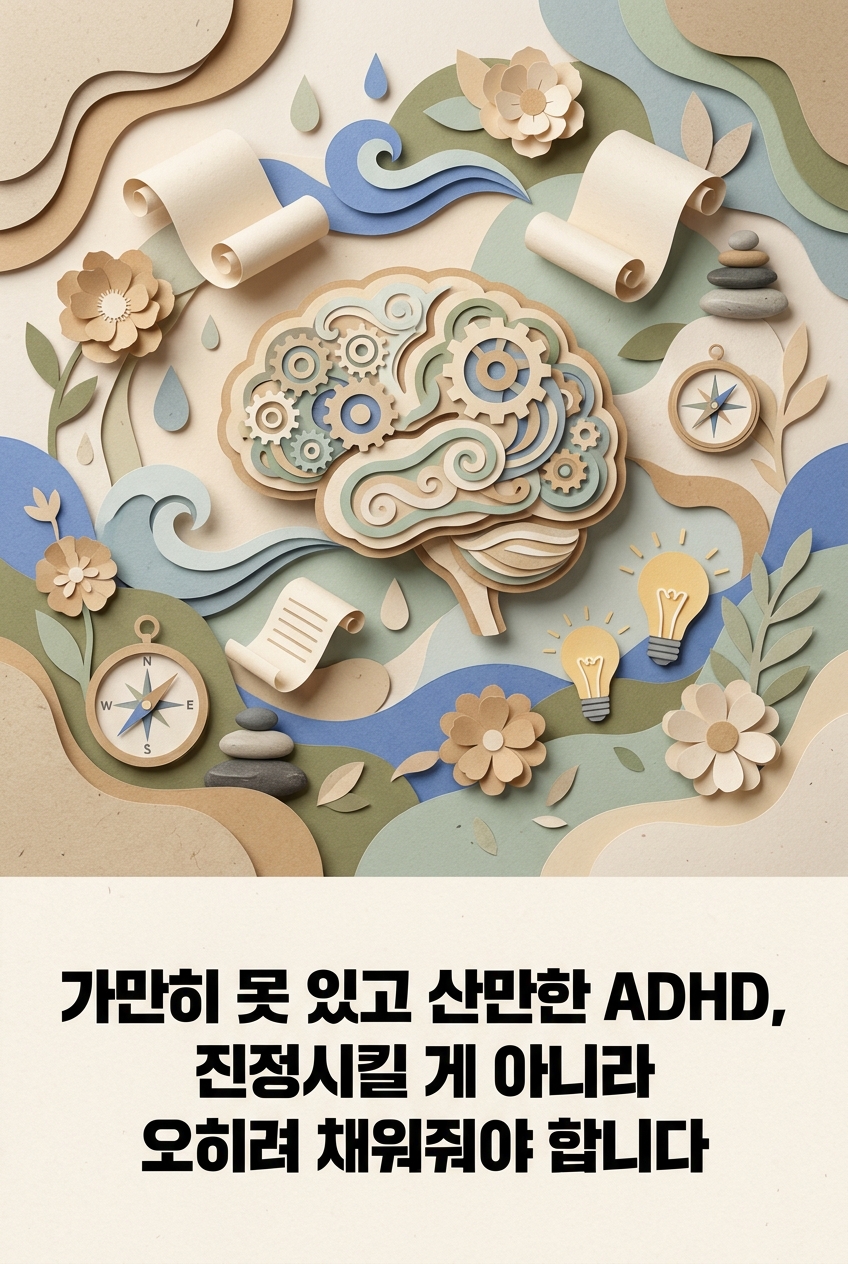
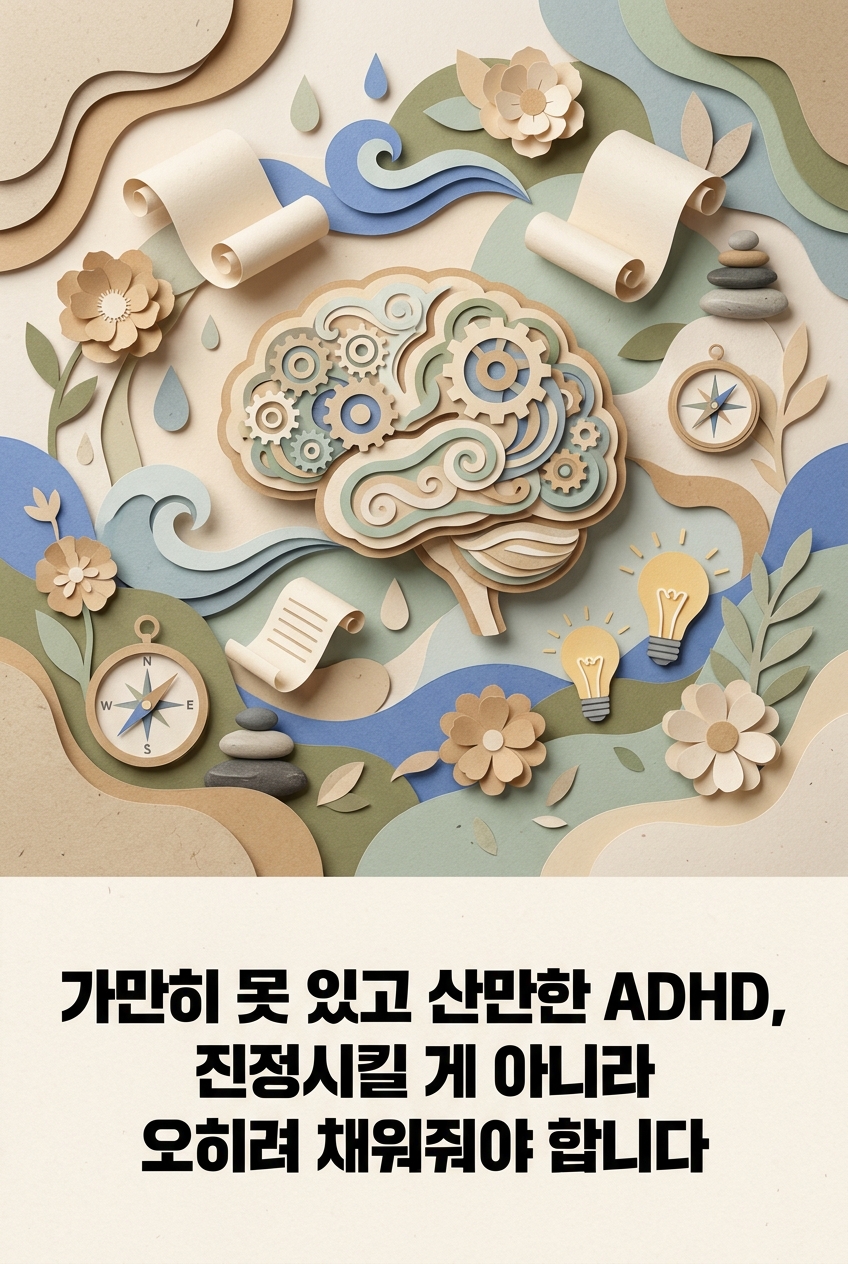
ADHD: Can't Stay Still and Scattered—Don't Sedate It, Fill What's Missing Instead

 🧾 Answer First | Core Conclusion
Can't sit still, constantly getting distracted, suddenly irritable over minor things.
Your child can't sit quietly for even a moment.
When you see this, everyone thinks, "I need to calm them down."
I'm Choi Jang-hyuk, director of Dongjedang Oriental Medicine Clinic.
But ADHD is the opposite.
While the surface appears overflowing, the inside is actually lacking.
So pressing down creates problems, and stability comes from filling what's deficient.
The fact that stimulants work in Western medicine proves this point.
This "contradiction between appearance and reality" is the core of ADHD,
and the treatment direction is opposite to depression or anxiety.
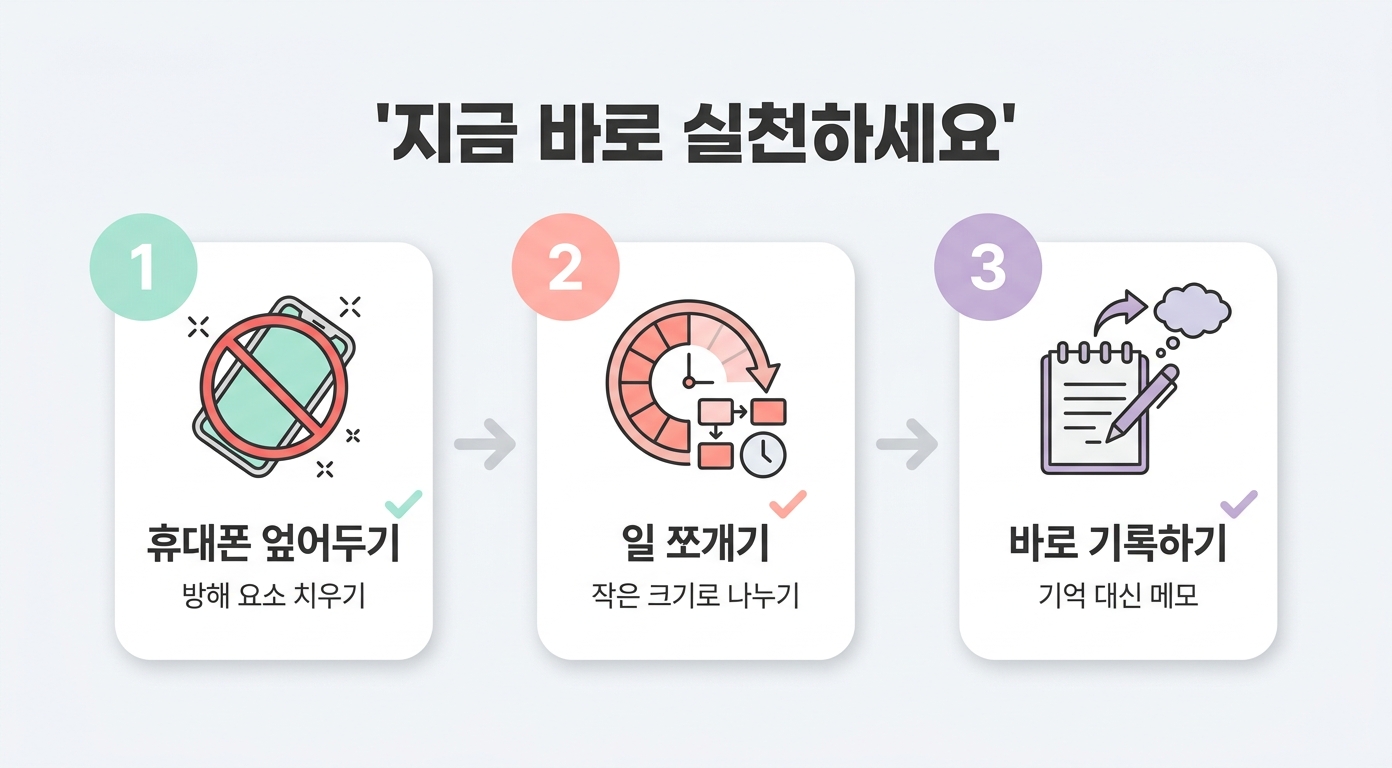 ✅ Action | Immediate Practice
While diagnosis and treatment are determined in consultation, there are things you can start in daily life right now.
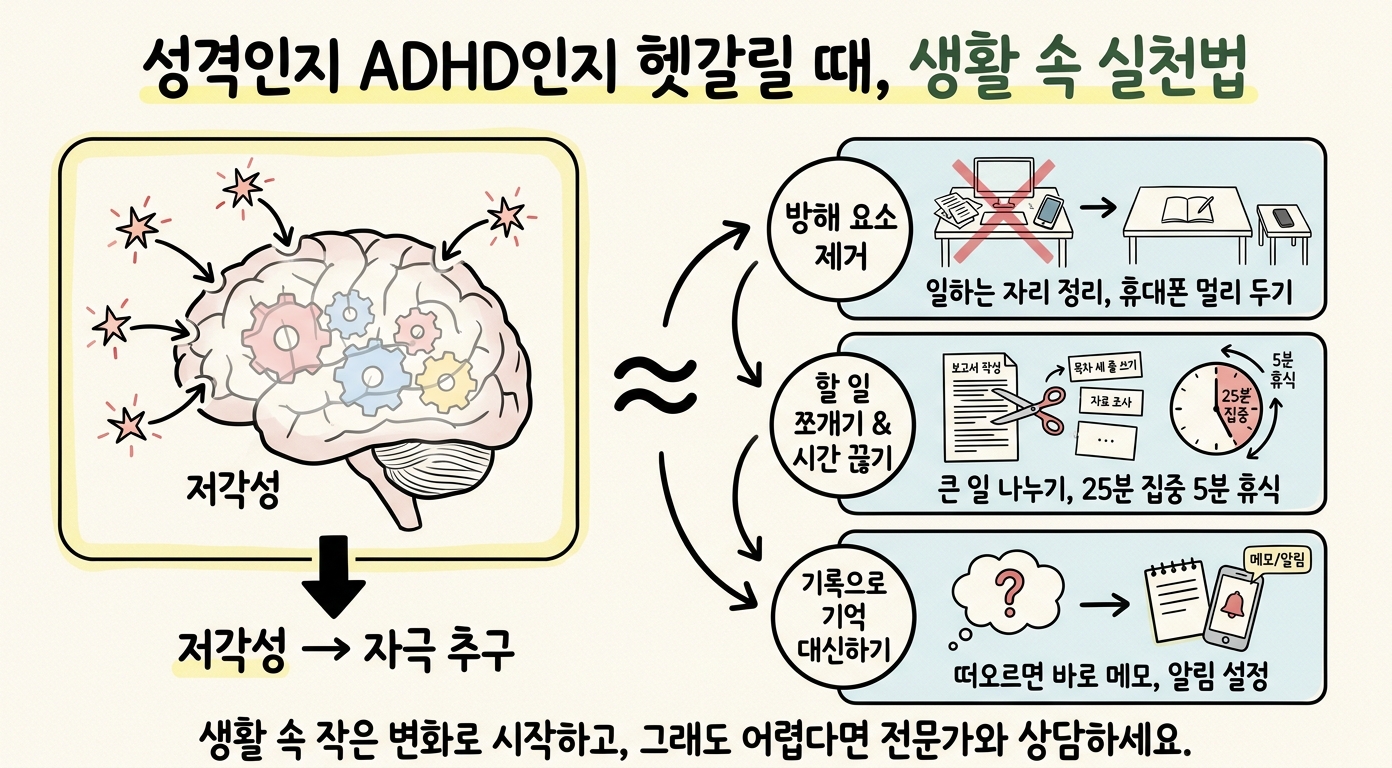
1️⃣ Remove distractions from your workspace
Keep only the task at hand and hide everything else from sight.
Turn your phone face-down or put it in another room.
The more scattered your attention, the easier you're drawn to visible stimuli.
Reducing distractions is better than forcing willpower.
2️⃣ Break large tasks into smaller pieces and set time limits
Holding onto a long task all at once causes your focus to leak midway.
Instead of "write a report," divide it into manageable chunks like "write three bullet points for the outline."
Working 25 minutes then taking a 5-minute break is also effective.
3️⃣ Replace memory with written records
Trying to hold promises and tasks in your head causes them to slip away.
Write them down in notes or reminders as soon as they occur to you.
The goal isn't to prevent forgetting, but to make it okay to forget.
If after 2-3 weeks your work and daily life continue to fall apart,
it's fastest to consult a professional to determine whether it's personality or ADHD.
 🚨 Warning | Red Flags You Must Check
Everyone is scattered sometimes. But if the following overlap, it's worth having evaluated.
✔ Long history across multiple settings — Not recent but longstanding, showing similar patterns across home, school, and work.
✔ Significant impact on daily life — Repeatedly missing deadlines, appointments, and items, causing mounting problems in work and relationships.
✔ Difficulty controlling impulses — Words jump out first, and waiting or holding back are uniquely difficult.
✔ Physical signals accompany it — Constipation, bloating, facial flushing, and shallow sleep occurring together.
✔ Depression or anxiety overlap — Long-standing with declining self-esteem and accompanying helplessness or anxiety.
 🧠 The Why | Examining the Cause
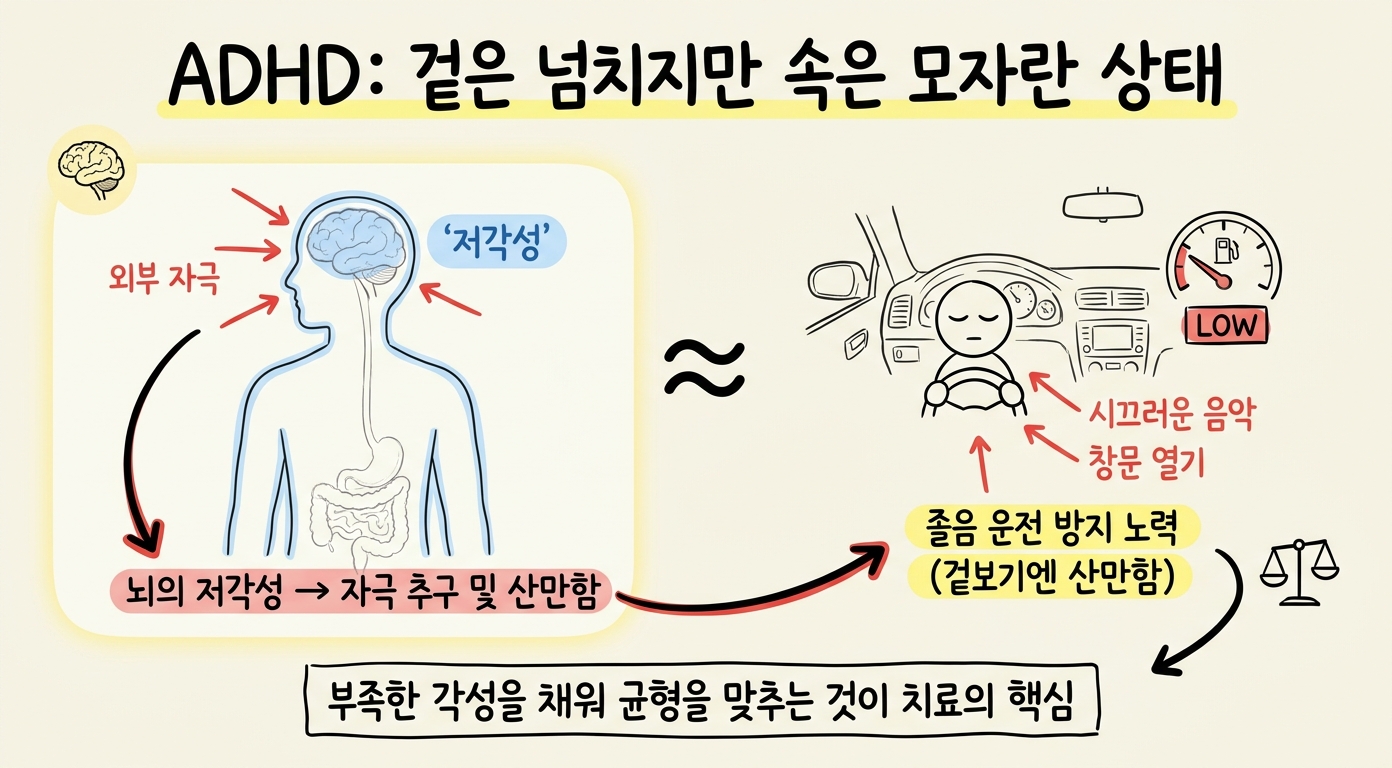
From appearance alone, ADHD seems to have overflowing energy.
So it seems right to calm it down.
But the inside is different.
Research shows ADHD involves a lower baseline arousal level in the brain.
With insufficient arousal, the brain continuously seeks stimulation to awaken itself, which appears outwardly as scatteredness and restlessness. That's why stimulants work.
It's not about suppressing excess, but raising deficient arousal—which paradoxically brings calm.
Using sedatives to suppress goes in the wrong direction.
This diverges from depression and anxiety.
Depression is depressed and closed, so it must be lifted. Anxiety is trembling agitation, so it must be calmed.
ADHD appears elevated on the surface but lacks arousal within, so stability comes from filling the deficiency and balancing.
The path to management is entirely different.
Oriental medicine views this through each person's inherent constitution.
Neuropsychiatric symptoms are ultimately the body's response to each person's constitutional clarity or cloudiness (心志淸濁).
Up to this point, it's the same as depression and anxiety.
However, ADHD has one unique characteristic.
In an unstable state, it's a type where the mind becomes elevated and scattered when forcibly using one's weak function (inferior function).
Someone who showed complete focus when using their strength,
collapses when forcibly squeezing their weak function in an unsuitable role.
While you can't change your inherent constitution, you can change how you use it.
There's a path where you react directly to stimuli, and another where you choose once and regulate your response.
Whether through stimulants or training, both ultimately make this regulatory path easier to use.
Western and Oriental medicine are essentially pointing to the same place with different language.
 📊 Proof | Cases and Evidence
A man in his 40s working in an office came in saying, "My mind suddenly got worse."
He couldn't handle report writing for even ten minutes.
It turned out that after his promotion, he took on planning and document work—his weakest area.
In field work, he had been more focused than anyone else.
His elevated state had become fixed from forcibly squeezing his weak function in an unsuitable position.
Research supports this.
ADHD children showed low autonomic nervous system activity in their baseline state and under stimulation, remaining in a low-arousal state, and stimulants raised this low activity to normal levels[1]. Brain wave analysis also showed that stimulants act not by suppressing but by raising insufficient cortical arousal[2]. This matches the picture of "surface overflow, inner deficit."
The problem is that prolonged elevated state exhausts the body.
Sustained tension disrupts the intestines and stomach, and metabolic waste that should be eliminated accumulates inside.
This debris amplifies symptoms and weakens the body further, creating a vicious cycle.
In fact, patterns of intestinal environmental disruption and mild inflammation throughout the body are reported in various psychiatric symptoms including ADHD[3][4].
 🔚 Closing | Summary and Encouragement
That's why sequence matters.
First, you must clear the accumulated debris that has weakened the body.
Through constitutional detoxification and diet programs, we clear stagnant waste in the intestines and stomach, restore elimination, and rebuild the body first.
Next, with constitutional prescriptions and mental stabilization, we manage the root cause of elevation—the bias of forcibly using weak function in unsuitable situations—so it doesn't accumulate again.
Food is less the cause and more the passage through which waste enters and exits.
So we carefully manage diet simultaneously while managing the root cause to prevent relapse.
It's difficult to gauge alone whether scatteredness is personality, ADHD, or just appears that way from overexertion in unsuitable situations.
If you'd like to examine constitution and body condition together, please feel free to inquire through the Dongjedang Constitutional Detoxification and Diet Program.
By the way, the contradiction between appearance and reality also applies to obsessive-compulsive disorder. However, OCD operates in the opposite direction from ADHD, so I'll explore that separately in the next article.
✍️ Reviewed by Choi Jang-hyuk, Director of Dongjedang Oriental Medicine Clinic
❓ FAQ
Q. Isn't it right to calm someone down if they're scattered?
Based on appearance alone, that seems correct. But ADHD involves low arousal on the inside, so stability comes from filling the deficiency rather than suppressing it. The reason stimulants work in Western medicine is exactly this.
Q. How is it different from depression and anxiety?
Depression is depressed and closed, so it should be lifted. Anxiety is agitated and trembling, so it should be calmed. ADHD appears elevated on the surface but lacks arousal within, so stability comes from filling the deficiency to create balance. The management directions are opposite.
Q. Why discuss detoxification and diet for ADHD?
Prolonged elevation causes waste to accumulate in the intestines and stomach, creating a vicious cycle that weakens the body. That's why we first clear what's accumulated to restore the body, then manage the root cause through constitutional prescriptions and mental stabilization.
Q. Can I do this while taking medication?
Yes. Constitutional management and dietary adjustment work alongside medication without conflict. If you're taking medication, please let us know during consultation.
📚 References
[Western Medicine]
- Conzelmann A, et al. Autonomic hypoactivity in boys with ADHD... — Low autonomic arousal in ADHD and stimulant normalization. DOI
- Rowe DL, et al. Stimulant drug action in ADHD... — Stimulants raise insufficient cortical arousal. DOI
- Nikolova VL, et al. Perturbations in Gut Microbiota Composition in Psychiatric Disorders — Intestinal disruption and inflammation in psychiatric illness (including ADHD). DOI
[Oriental Medicine/Integrated] 4. Wang Q, et al. The microbiota-gut-brain axis and neurodevelopmental disorders — Gut-brain axis and neurodevelopmental disorders. DOI 5. Reich N, et al. Using caffeine as a chemical means to induce flow states — Mechanism of filling arousal to support focus. DOI
(Source: PubMed)
Mental Health
ADHD: Can't Stay Still and Scattered—Don't Sedate It, Fill What's Missing Instead
View Program