

Q I am a self-employed individual in my 50s. I feel fine during the day, but my neck feels stiffer when I wake up in the morning. I have a straight neck; could the pillow be the problem? I've heard that high pillows are bad; what kind of pillow should I use?
A Yes, the pillow is a significant factor. High pillows fix the neck in a bent position while sleeping, worsening a straight neck. When lying on your back, a pillow that supports the cervical curve by about 6 to 8 cm is suitable, while when sleeping on your side, a shape that provides support at shoulder height is ideal.
Detailed Answer
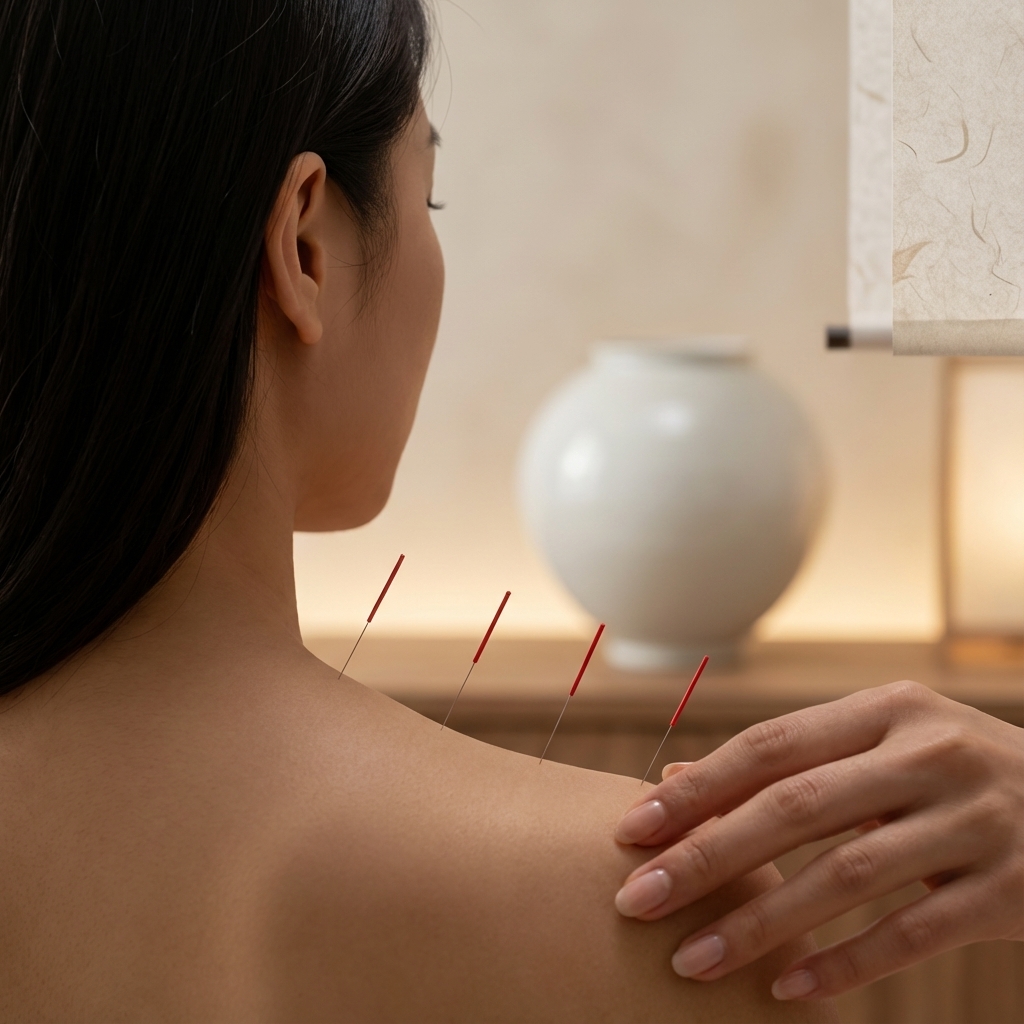
Since sleep accounts for about one-third of the day, the neck posture during this time has a significant impact on cervical spine health. A high pillow fixes the cervical spine in a flexed (head-down) position for 6 to 8 hours, reinforcing the straight neck posture and causing the muscles and ligaments at the back of the neck to stiffen while stretched, leading to morning stiffness. Conversely, a pillow that is too low or non-existent causes cervical hyperextension. When lying on your back, a height of 6–8 cm that supports the space beneath the neck curve is appropriate; for those who sleep on their side, it must be higher by the width of the shoulder to keep the cervical spine in a straight line. From a Korean medicine perspective, increased stiffness in the morning is a significant signal. Since the circulation of Qi and blood slows down at night, individuals who already have Qi stagnation and blood stasis in the neck and neck experience further stagnation of blood during sleep, leading to more severe morning stiffness. Furthermore, sleeping exposed to cold wind or allowing sweat to cool can cause pathogenic wind, cold, and dampness to invade, sometimes resulting in stiff neck (a condition where the neck cannot be turned upon waking). Starting in their 50s, the liver and kidneys gradually weaken, often compounded by a condition called "muscle and vein excess yang," where the regenerative capacity of muscles and bones declines. The direction treatment should go alongside pillow replacement is to restore circulation by releasing hardened fascia and adhesions using acupuncture and moxibustion, aid in the regeneration of ligaments weakened by aging through thread embedding and fire acupuncture, and strengthen the liver and kidneys with herbal medicine tailored to one's constitution to create a body where Qi and blood circulate well even overnight.
Related FAQs
-
Q
I am a 38-year-old bank employee who has had forward head posture for 10 years. Honestly, I am curious: is it realistically possible to restore the original neck curve for a neck that has been like this for 10 years? Or is pain management the best option?
#Possibility / Realistic Goals
-
Q
I am a 44-year-old logistics center manager with early-stage cervical disc herniation. The orthopedic doctor says that surgery might be necessary if the condition worsens, but is it possible to manage this with traditional Korean medicine treatments without surgery?
#Possibility / Realistic Goals
-
Q
I am a 47-year-old woman working in a sewing factory. I have a forward head posture and stiff shoulders as a matter of course, and lately, my arms have been tingling as well. Are the tingling in my shoulders and arms also due to the forward head posture, or are there other underlying conditions?
#Comorbidities
-
Q
I am a 36-year-old developer in my third year of working from home. I have started treatment for straight neck syndrome, but how should I change my home desk environment to prevent recurrence?
#Lifestyle Management
-
Q
I am a 42-year-old housewife looking to start exercising. There are so many exercises said to be good for forward head posture that I am confused. Please tell me just a few key exercises I can do at home every day.
#Lifestyle Management