"My chest races impatiently like an engine spinning in neutral and anger surges suddenly" | Adult ADHD with emotional dysregulation in a 40s office worker

Like a Car with Failed Brakes: The Runaway Mind That Cannot Stop
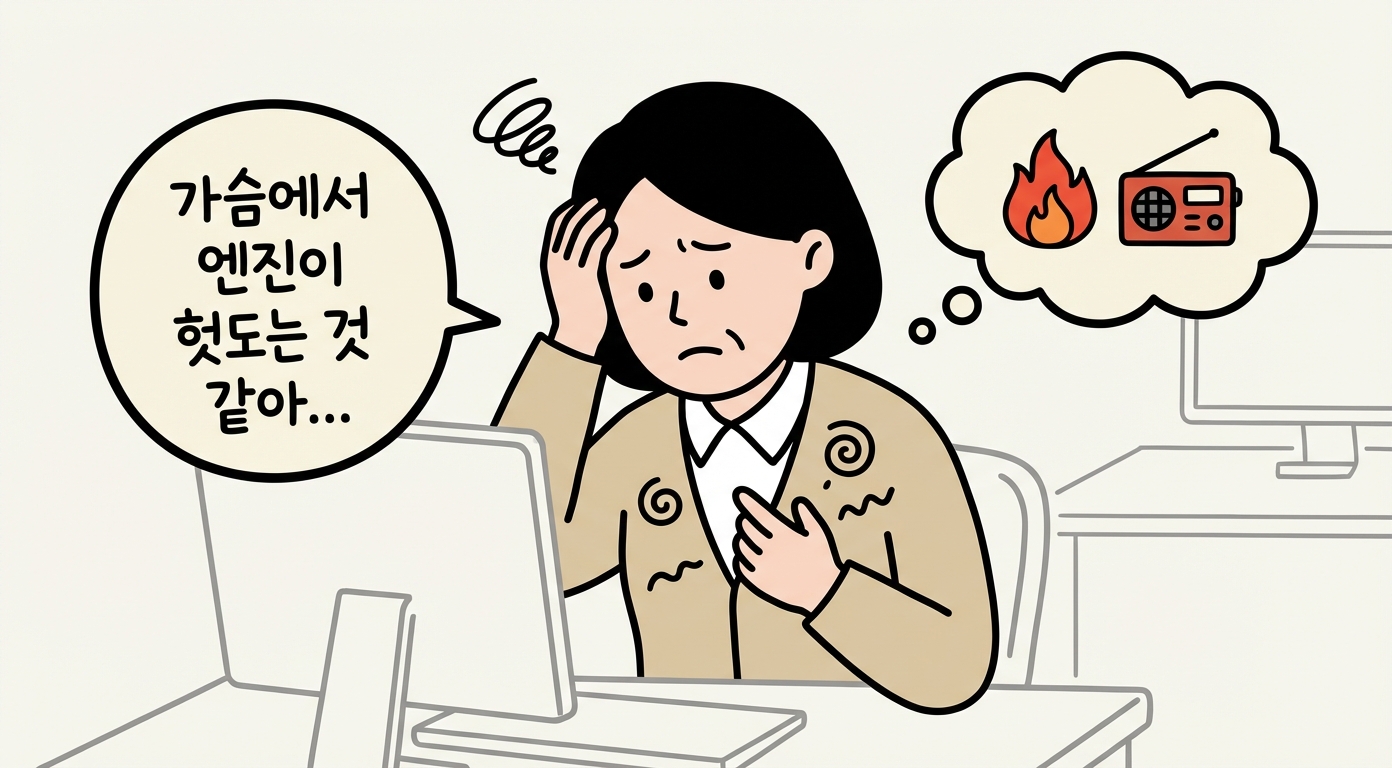
"Doctor, I feel like there are several radios playing in my head at the same time.
It's as if an engine is always spinning uselessly in my chest, and I get hit by sudden, overwhelming anger over the most trivial things — I feel like I'm going crazy."
These were the words of Seong-jin (pseudonym), a worker in his 40s, who breathed out a deep sigh before even sitting down when he first came to see me.
On the surface he was keeping up a respectable, diligent work life — but inside he was perpetually tormented by a precarious restlessness as if someone were always chasing him.
At some point, his concentration began to plummet during meetings, and uncontrollable rage would erupt over a colleague's innocuous remark — leaving him with a deep sense of defeat and guilt at his own loss of control.
At first, he visited a psychiatrist, received a finding of adult ADHD tendencies, and tried taking prescribed medication.
But he said the pills only left him feeling foggy, without at all resolving the heavy pressure of an engine spinning uselessly in his chest or the physical sensation of something tightly knotted at his solar plexus.
Every time I hear stories like this in my clinic, my heart feels heavy too.
I did not see Seong-jin's symptoms as simply a problem of chemical imbalance in the brain or lack of willpower.
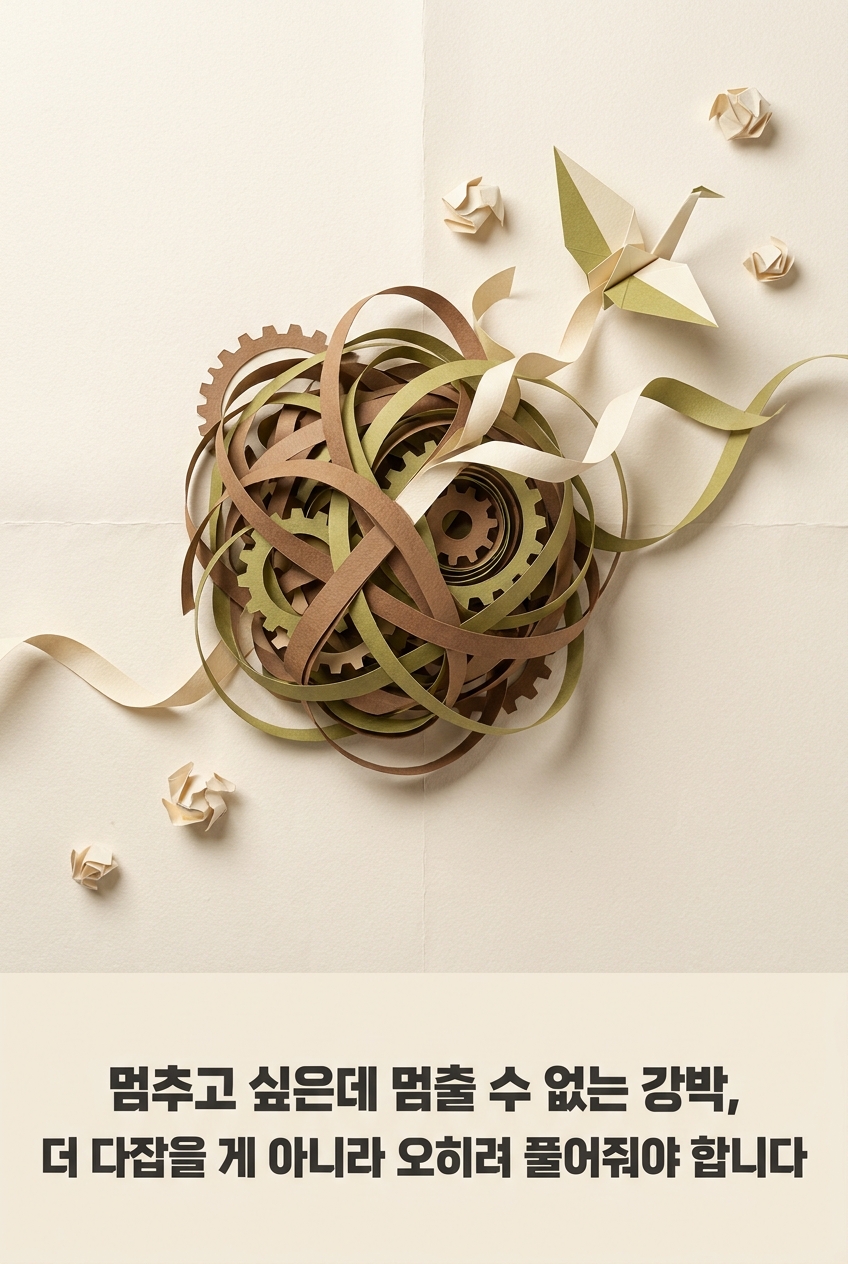
I couldn't help but deeply empathize with his description of being like a car with broken brakes — doing everything possible to maintain daily life on the outside, while on the inside the mind was running away in an unstoppable surge.
So why did this frustrating vicious cycle begin in the first place?
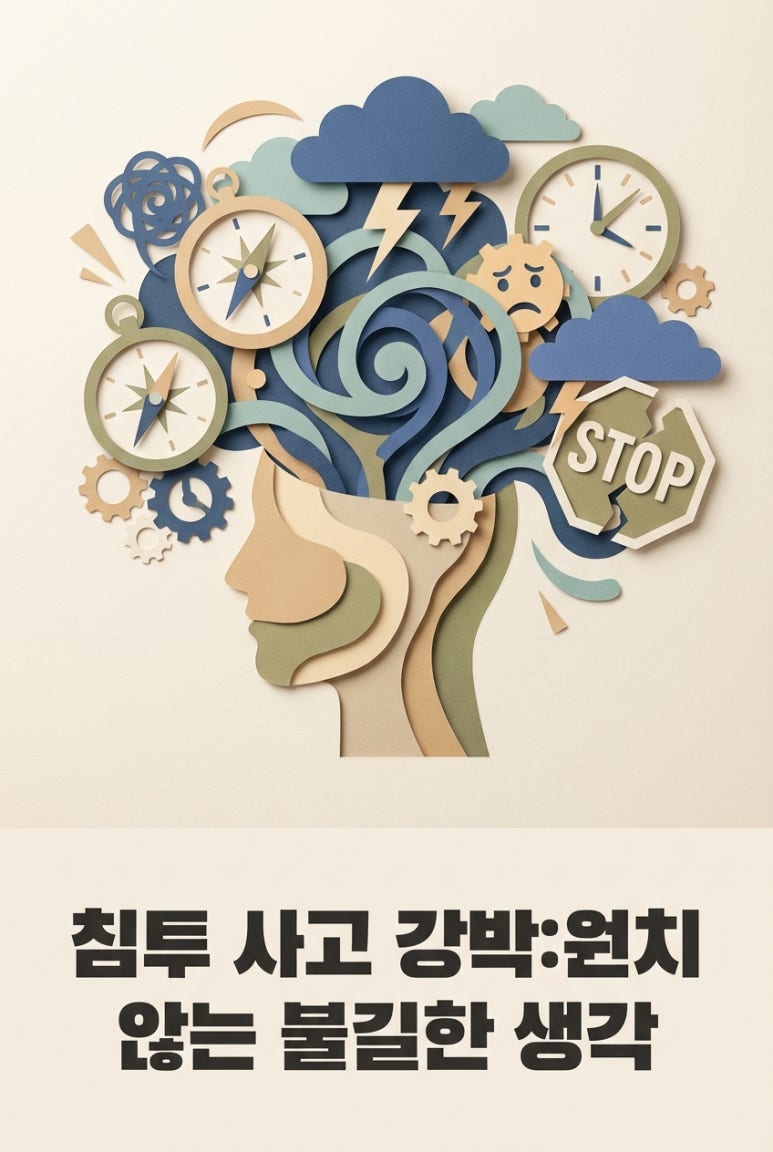
 The Noise in the Head and the Spinning Engine: The Body's "Overload" Signal
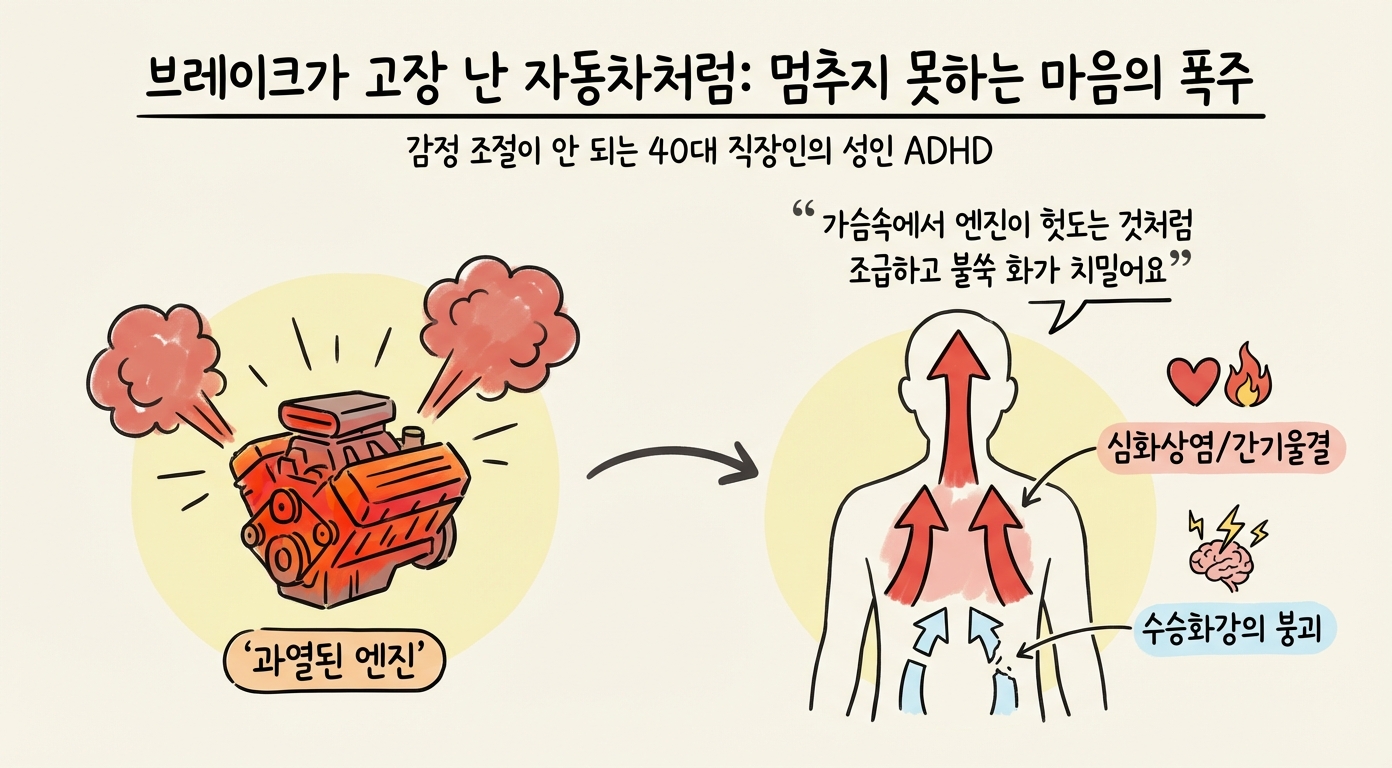
The uncontrollable emotions and distractibility Seong-jin was experiencing are, from a Korean medicine perspective, the classic manifestation of 간기울결 (肝氣鬱結) — qi tightly knotted due to extreme stress — combined with 심화상염 (心火上炎), heat pooling in the heart and surging upward.
This "fire (火)" goes beyond simply a high body temperature; it refers to unnecessary internal heat that disrupts the body's energy flow and makes the nerves extremely sharp and irritable.
This can be likened to an overheated engine whose coolant has dried up, roaring and spinning uselessly.
In modern Western medicine as well, these symptoms closely correspond to a state of hyperarousal of the autonomic nervous system and a reduction in the regulatory function of the brain's prefrontal cortex.
When ongoing tension and stress chronically overstimulate the sympathetic nervous system, the body's energy surges upward — heat rises into the head and the brain is subjected to endless overload.
Our body is fundamentally designed to operate on the principle of 수승화강 (水昇火降) — cool energy rising, hot energy descending — to maintain health.
But when fatigue and stress completely block this circulatory pathway, the mind's intersection becomes like an 8-lane highway with broken traffic lights — total chaos — and eventually physical chest tightness is induced as well.
Where in My Daily Life Did the Spark of This Restlessness Begin?
Then is there no way to escape this stifling restlessness and reclaim a quiet daily life?
We must first quietly reflect on where in our daily life the sparks of this restlessness began.
Many workers habitually drink several cups of coffee to push through tasks and fatigue, and after work try to relieve stress through frequent drinking.
But when the chest already harbors a blazing fire within, these stimulating habits do nothing to manage the body's heat — they are like plugging more cords into an already overloaded circuit breaker, making the nerves even sharper.
Even if tomorrow's work won't leave your mind, at least two hours before sleep you must put down the smartphone that continuously provides visual stimulation.
Instead, lie comfortably and breathe slowly and deeply.
An intentional time of relaxation — deliberately drawing the trapped heat in the chest slowly down toward the lower abdomen — is absolutely necessary.
Also, if during work you feel chest pressure and restlessness welling up, stop for a moment, rub your hands together to warm them, then press and release the knotted muscles where the back of the neck meets the shoulder line — this can help reduce upward pressure.
However, if chest tightness or pain is accompanied by difficulty breathing and seriously threatens daily functioning, visit a medical facility immediately to rule out cardiovascular causes.
 Not Suppression, but a Time for Tuning: Toward a Quiet Daily Life Once More
To be honest, there are times when it would be easiest for me to simply write a prescription and tell patients to take their medication.
But the difficulties of adult ADHD and emotional dysregulation are not problems to be forcibly controlled and buried by chemically manipulating the brain with drugs.
What is needed is an integrative approach that listens carefully to the subtle signals the body sends, corrects the collapsed balance throughout the body, and changes the body's very environment so that it can cool its own heat and find stability on its own.
Your body has a remarkable capacity for self-recovery — it can find stability again, as long as it is shown the right direction.
My role is to be a sensitive guiding companion through customized herbal medicine and acupuncture — gently unraveling knotted qi and soothing the fire of the heart — helping the body move once more in harmony, like the precisely interlocking gears of an analog clock.
If every day you carry a chest about to burst and spend your days in guilt, please — even if not with me — find a healthcare provider who deeply empathizes with your heart and can see the whole picture of the body, so that you may truly reclaim your lost peace of mind.
Reviewed by Director Jang-Hyuk Choi, Dongjedang Korean Medicine Clinic
Mental Health
"My chest races impatiently like an engine spinning in neutral and anger surges suddenly" | Adult ADHD with emotional dysregulation in a 40s office worker
View Program