
Stiff, Deep, and Recurring Pain — The Order to Release, Fill, and Address the Foundation
 🧾 Answer First | Core Conclusion
You've probably experienced it — after an injection or acupuncture, things felt better temporarily, but days later, that same spot started hurting again.
It's not because the treatment was weak or because the condition is incurable.
Our body's tissues recover best when stimulated appropriately, but when the timing is missed, one side becomes too stiff while the other becomes too weak.
That's why, even with the same 'acupuncture,' we adjust the tone with regular needles within the normal range, release adhered fascia that has stiffened from missed timing with a flat needle (gujichim), and strengthen weakened and stretched tissue with thread embedding (maeseun) and heated moxibustion needles (hwachim). We confirm the exact location with ultrasound, and if it keeps recurring, we address the body's entire environment with herbal medicine.
Today, I'll explain how these treatments are divided along one curve and which one fits your pain.
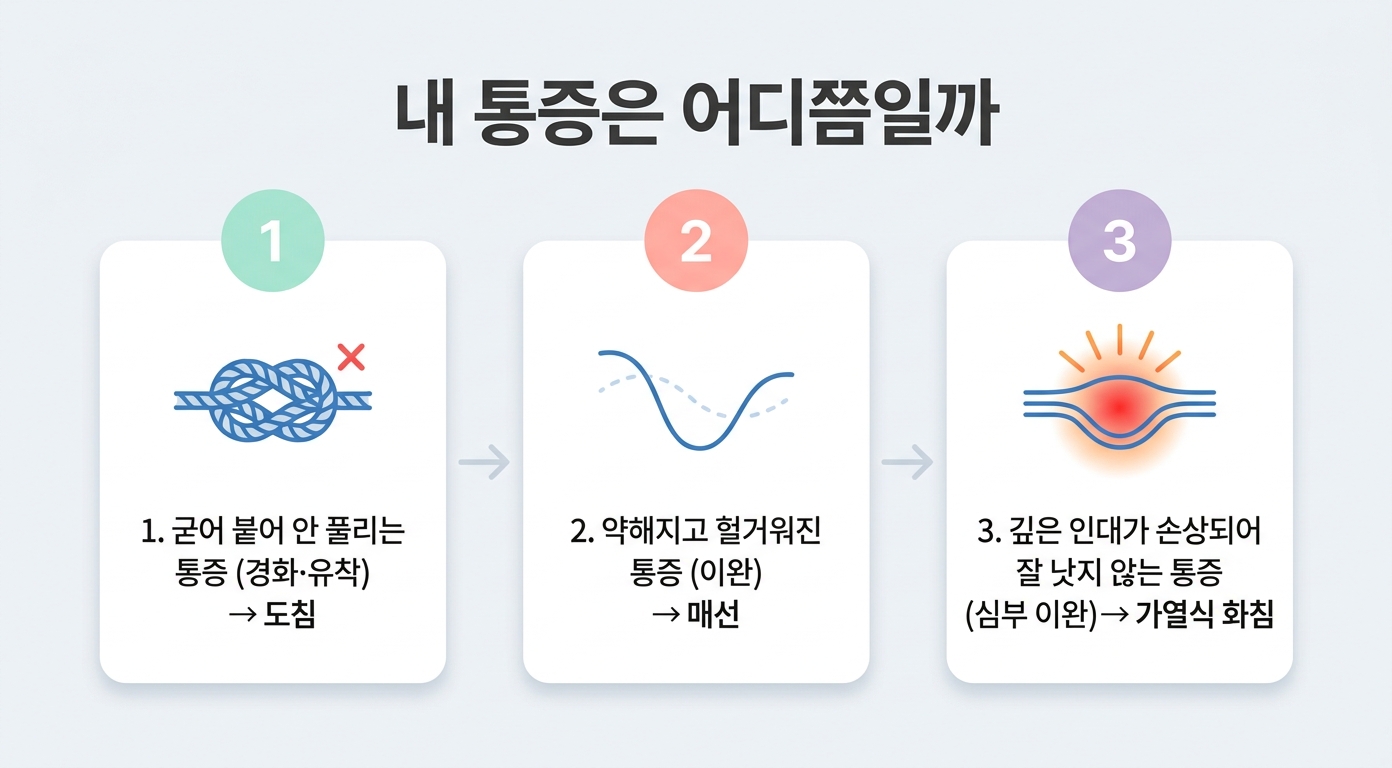
✅ Action | Where Does My Pain Sit on the Curve
The most basic approach is adjusting the intensity of stimulation with regular acupuncture.
If you're in the normal range, this alone is sufficient.
The problem arises when timing is missed and you shift to either end of the curve.
1️⃣ Stiff and Unyielding Pain (Fibrosis and Adhesion) → Gujichim (Flat Needle)
If your chronic shoulder, knee, or wrist is stiff, doesn't improve with stretching or massage, and repeats in the same spot — your tissues may have become 'adhered.' Gujichim uses a flat-bladed needle tip to directly separate these stuck tissues.(Gujichim Treatment in Detail)
2️⃣ Weakened and Loosened Pain (Laxity) → Thread Embedding (Maeseun)
If ligaments or fascia have become weak and loose from repeated injury — it's not stiffness but rather weakness. Thread embedding places absorbable thread in the tissue, and as the thread gradually dissolves, new collagen fills in, strengthening the weakened tissue from within.(Thread Embedding Treatment in Detail)
3️⃣ Deep Ligament Damage with Poor Healing (Deep Laxity) → Heated Moxibustion Needle (Heated Hwachim)
If chronic pain continues deep within, and heat packs or shallow needles only provide temporary relief — deep ligaments weakened by repeated damage with poor blood flow and self-recovery capacity may be the issue. Heated hwachim combines the mechanical stimulation of the needle with heat to drive both collagen regeneration and strengthening of the damaged ligament. It revives weakened deep tissue from within, rather than just warming the surface.(Heated Moxibustion Needle Treatment in Detail)
➕ Ultrasound for Precise Location
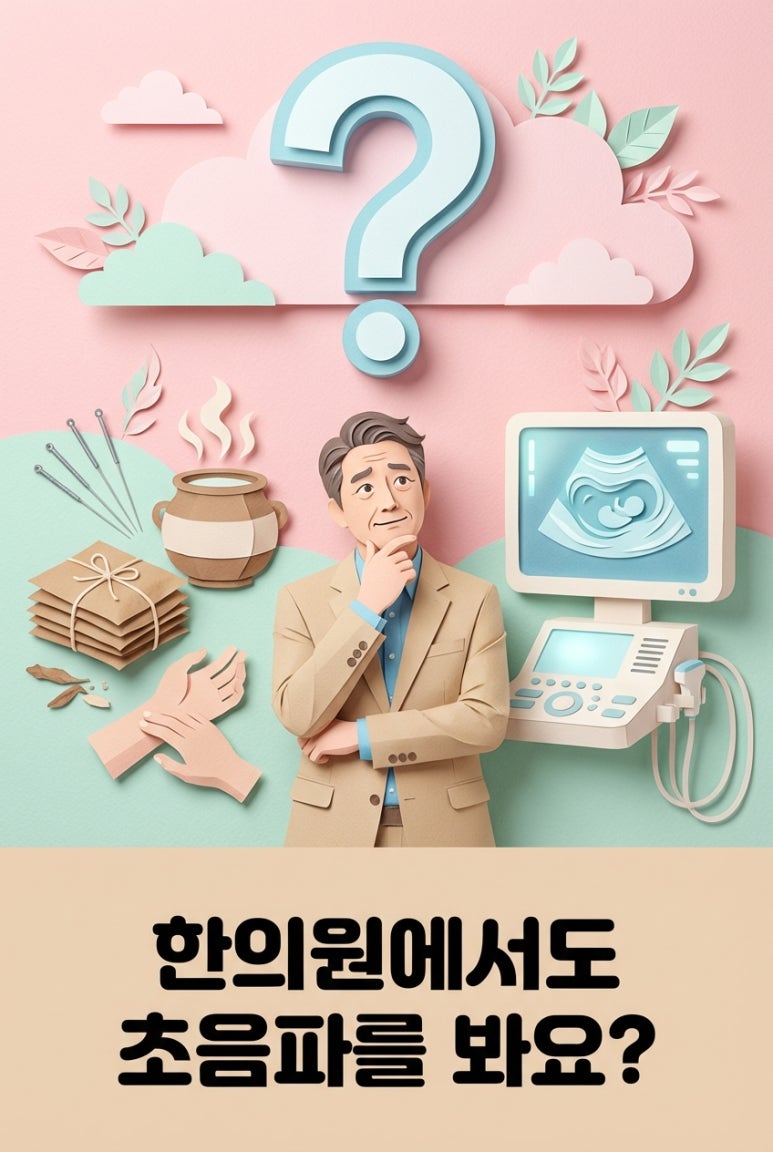
These three approaches are more active procedures than regular acupuncture, so precise location and depth are crucial. We use ultrasound to view the condition of deep ligaments, fascia, and tendons in real time while positioning the needle.(Korean Medicine and Ultrasound)
It's okay if you can't determine which category you fall into yourself.
Identifying the type of pain first is the quickest path forward.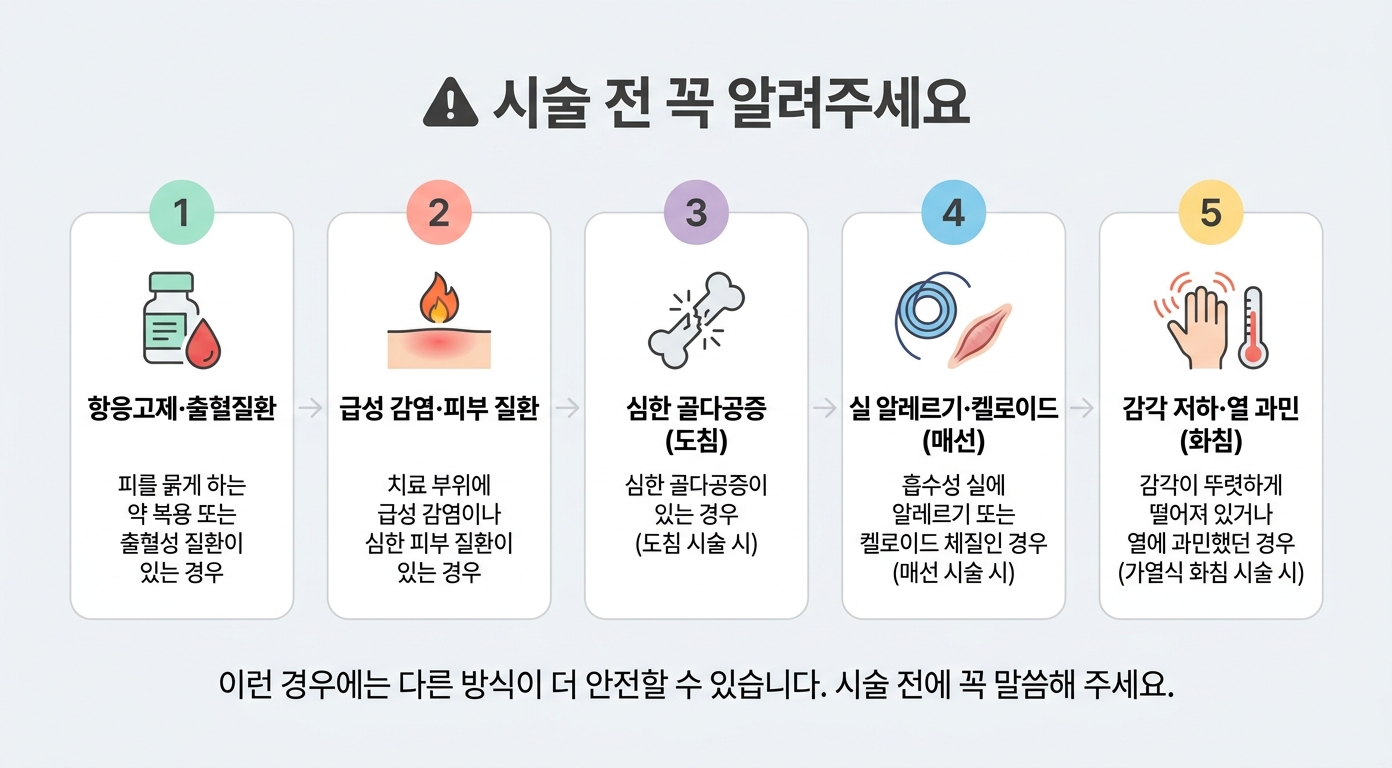
🚨 Warning | What to Tell Us Before Treatment
✔ If you're taking anticoagulants (blood-thinning medication) or have a bleeding disorder
✔ If you have acute infection or severe skin disease in the treatment area
✔ If you have severe osteoporosis (for gujichim)
✔ If you've had allergies to absorbable thread or have keloid-prone skin (for thread embedding)
✔ If you have significantly reduced sensation or are sensitive to heat (for heated hwachim)
In these cases, alternative approaches may be safer.
Please let us know before treatment.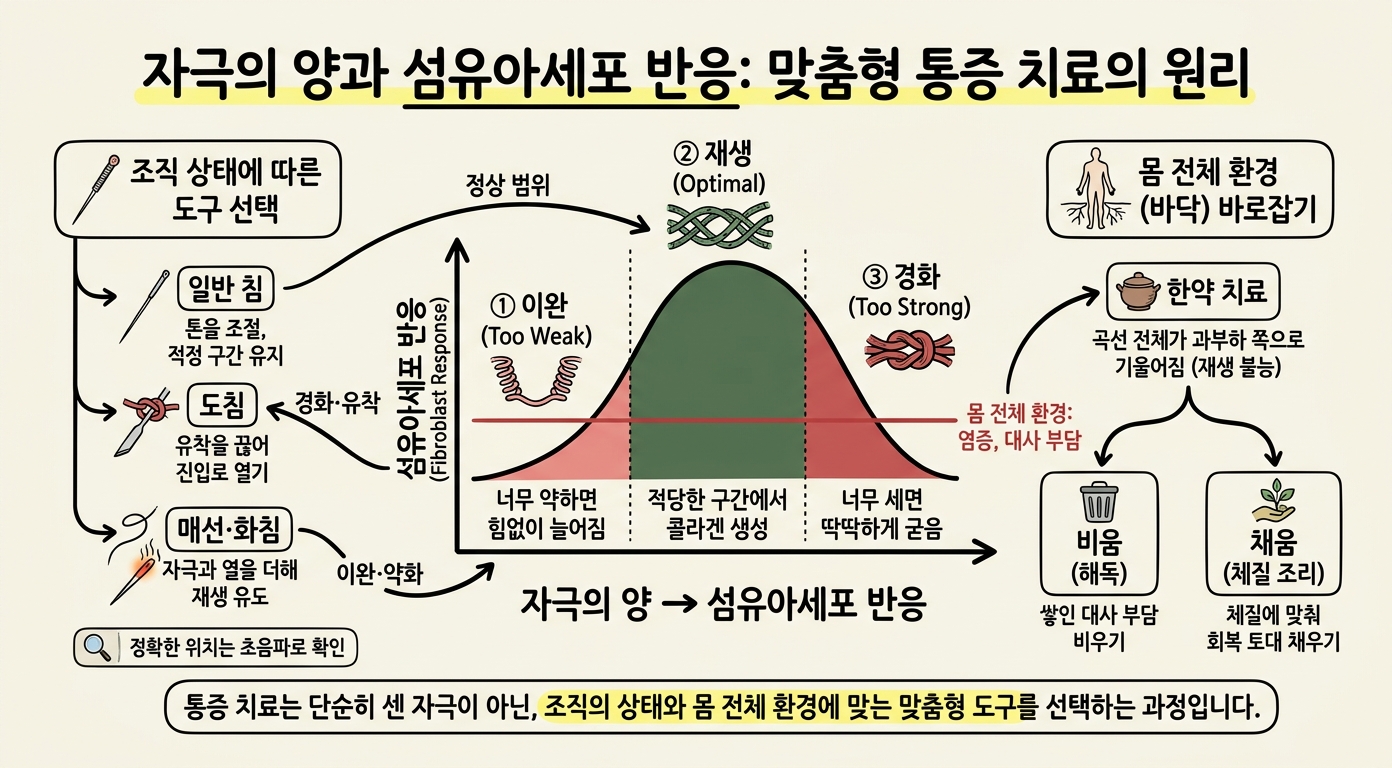
🧠 The 'Why' | Where Does My Tissue Sit on One Curve
Our fascia and ligaments are home to cells called fibroblasts.
These cells respond in three different ways depending on the amount of stimulation they receive. Excessive stimulation causes them to harden and stiffen (fibrosis), insufficient stimulation causes them to weaken and stretch (laxity), and only in the optimal range in between does new collagen build up to strengthen the tissue (regeneration).
That's why pain treatment isn't about simply giving stronger stimulation.
It's about understanding where your tissue currently sits on this curve and choosing the appropriate tool for that position. This is why the same 'acupuncture' is used in different ways.
If you're still in the normal range — we adjust the tone with regular acupuncture.
By adjusting the intensity and depth of stimulation, we keep the tissue within the optimal range. Most pain is managed here.
If timing has been missed and tissue has become too stiff (fibrosis and adhesion) — we use gujichim to release it.
Once tissue has stuck together firmly, regular acupuncture cannot reach it. A tangled knot won't come undone by driving a thick nail hard; it must be cut. Gujichim cuts that adhesion with its flat-bladed tip to open a pathway.
If treatment has been missed and tissue has become too weak (laxity) — we fill it with thread embedding and heated hwachim.
Tissue that has become loose and stretched from repeated injury must receive stimulation to rebuild collagen. Thread embedding uses mechanical stimulation from absorbable thread, while heated hwachim adds heat on top — both reaching deep ligaments with poor blood flow that struggle to heal themselves — to drive regeneration and strengthening.
In summary, one end of the curve has tissue too stiff for gujichim, the middle has optimal conditions for regular acupuncture, the other end has tissue too weak requiring thread embedding and heated hwachim, and we confirm the precise location of all these procedures with ultrasound. The tissue became this way not from weak willpower but from accumulated repeated posture and missed timing.(This coordinate is discussed more deeply in our literature review on stimulus dose and connective tissue response.)
But there's a foundation beneath this curve itself.
It's the environment of the entire body where fibroblasts live.
If there's underlying low-grade inflammation throughout the body from obesity or metabolic burden, the same stimulus will tilt the entire curve toward overload, and instead of regeneration, everything results in inflammation no matter what you do. This is also why pain magnitude is more dependent on nerve sensitivity than injury magnitude, and why that sensitivity is swayed by systemic inflammatory environment.
So if local procedures alone keep having recurring problems, herbal medicine treatment that corrects the foundation itself beneath the curve becomes necessary. First, we 'empty' the accumulated metabolic burden (detoxification), then we 'fill' the foundation for recovery with prescriptions matching your constitution (constitutional treatment). Emptying comes first, filling comes second. If external treatment moves one point on the curve, internal treatment corrects the foundation the curve sits on. The emptying process is covered in our Principle of Gandosui Intermittent Fasting, and the process of filling according to constitution is covered in Beyond 12 Weeks of Dieting.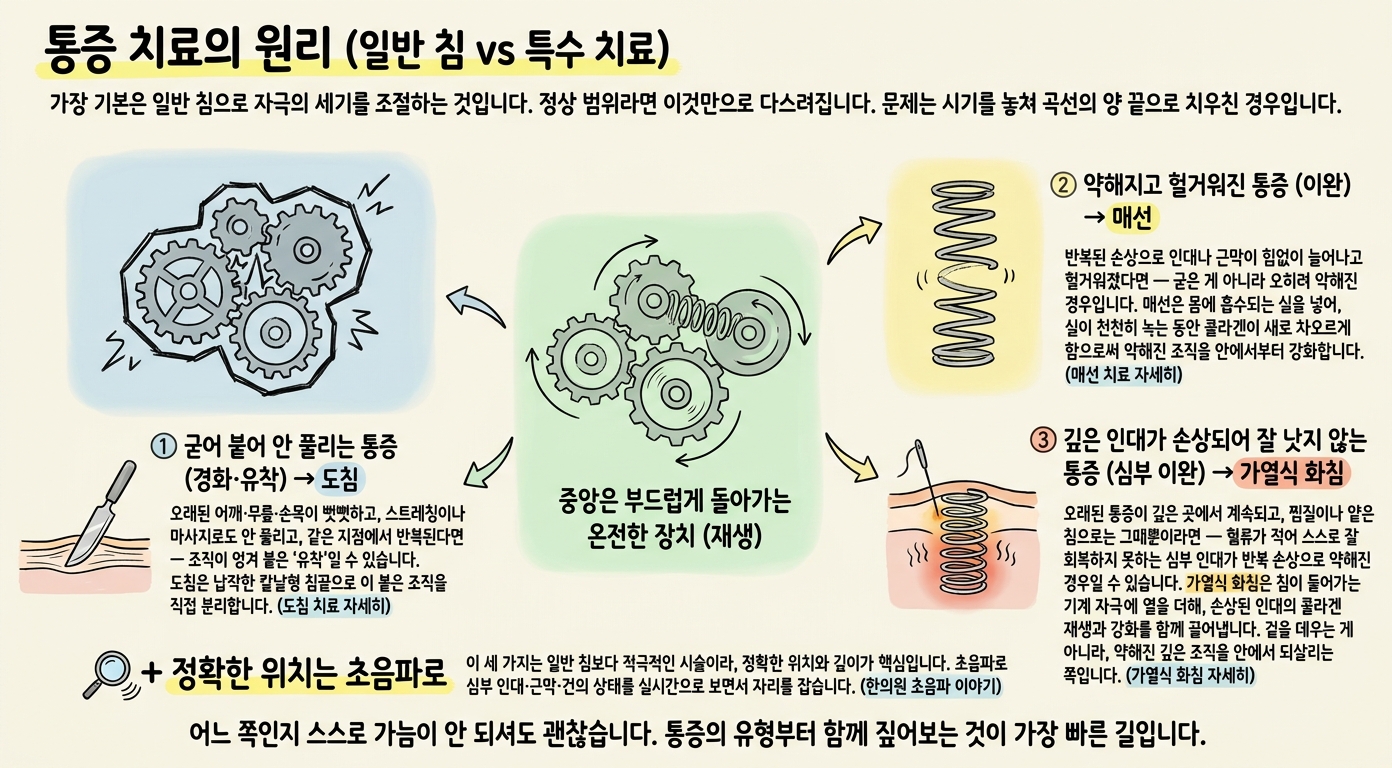
📊 Proof | The Curve is Visible in Data
The 'optimal range' isn't just a metaphor — it's an actual measured value.
Acupuncture manipulation reached peak tissue response around two rotations, with response actually decreasing beyond that (Langevin 2006), and deeper needle insertion showed better results than 2mm shallow insertion in shoulder myofascial pain, both immediately after treatment and at 3-month follow-up (Ceccherelli 2001).
Heated moxibustion needle category (warm needle) showed superior pain and functional improvement over other treatments in knee osteoarthritis according to meta-analysis (Jin & Guan 2022), and in cell experiments, fibroblast proliferation increased approximately 2.5-fold with optimal deformation.
The challenge is how to precisely target this optimal range.
A 40-something office worker who spent over a year in front of a computer came in with shoulder pain lasting over a year, but regular acupuncture only helped temporarily — it would stiffen again in a few days. Ultrasound revealed thick, adhered fascia around the rotator cuff — it was the stiff end of the curve where stimulation couldn't reach. After gujichim opened a pathway through that adhesion and we filled the weakened areas with other stimulation, that same spot didn't stiffen as quickly as before. The pain wasn't created by that person's willpower but by years of the same posture.
In this way, even the same procedure requires precise location and depth to be effective; if misaligned, its effectiveness drops or becomes unnecessary stimulation.
That's why we show you with ultrasound "here's the problem," and confirm changes before and after treatment together.
However, imaging isn't everything. There are cases where ultrasound looks fine but pain persists, and cases where tissue looks severely damaged but pain is mild, so the center of diagnosis is direct examination of the patient — looking, listening, and palpating — while ultrasound is the tool to confirm and explain that clinical judgment.
🔚 Closing | Summary
Acupuncture is not one thing in the face of stiff, deep, and recurring pain.
We release adhered tissue with gujichim, fill weakened tissue with mechanical stimulation from thread embedding, revive deep ligament damage with heated hwachim that adds heat, and confirm location with ultrasound.
And at the root of recurring pain lies the environment of the entire body, which herbal treatment addresses together as a foundation.
Not all pain requires all these treatments.
But if pain has been chronically stiff, won't resolve, and repeats in the same area — these become meaningful options.
If you've grown weary of the same area hurting repeatedly, we encourage you to identify the cause of your pain together.
At our Dongjdang Pain and Neurology Clinic, we offer methods matching your condition,
and if systemic environment is involved, we also guide you through our Detoxification and Diet Program.
✍️ Reviewed by Director Choi Jang-hyuk, Dongjdang Korean Medicine Clinic
❓ FAQ
Q. Can't we just use regular acupuncture?
Most pain can be managed simply by adjusting stimulation intensity with regular acupuncture. Gujichim, thread embedding, and heated hwachim are added options when timing has been missed and tissue has become too stiff (adhesion) or too weak (laxity), when regular acupuncture alone cannot reach the problem area.
Q. Gujichim, thread embedding, heated hwachim — they're all 'acupuncture' in the end, so what's the difference?
They're the same 'acupuncture' but with different directions.
Gujichim uses a flat-bladed needle tip to cut and release stiffened, adhered tissue.
Thread embedding and heated hwachim work oppositely, strengthening weakened tissue through collagen regeneration.
The difference between the two is the type of stimulation — thread embedding's main mechanism is mechanical stimulation from absorbable thread, while heated hwachim adds thermal stimulation to revive deep ligaments.
We release what's stiff and fill what's weak — different approaches for different pain characteristics.
Q. Must we always see ultrasound before acupuncture?
Regular acupuncture is possible without ultrasound.
However, for precision procedures like gujichim, heated hwachim, and thread embedding where precise location and depth matter, or for deep tissue treatment, we confirm with ultrasound before proceeding.
Q. Why do we talk about diet and detoxification for pain?
Obesity and metabolic burden create low-grade inflammation throughout the body, which prolongs pain.
If pain keeps recurring despite local procedures alone, treating the systemic environment together with herbal medicine and detoxification may be necessary.
Q. Do we receive multiple treatments at once?
It depends on the condition.
Sometimes we divide stages, first using gujichim to release stiffened adhesion then maintaining stimulation afterward, but often one approach is sufficient.
What's appropriate is determined individually after examination.
Q. Is this very painful treatment?
You may notice a thicker needle tip than regular acupuncture (gujichim) or a brief heavy heat sensation passing (hwachim), but treatment time is short and stimulation intensity is adjusted to your condition.
It's not a procedure that cuts skin or causes burns.
Q. Is it legal for Korean medicine doctors to use ultrasound?
Yes. The Supreme Court's Full Bench Judgment in December 2022 confirmed that Korean medicine doctors' use of ultrasound diagnostic devices is legal, and this was finally confirmed by dismissal of re-appeal in June 2024.
📚 Reference Materials
[Modern Medicine]
- Khan KM, Scott A. Mechanotherapy: how physical therapists' prescription of exercise promotes tissue repair. Br J Sports Med 2009.
- Ceccherelli F, et al. Needle insertion depth and shoulder myofascial pain. Acupunct Electrother Res 2001.
- Langevin HM, et al. Acupuncture—connective tissue mechanotransduction. J Cell Physiol. 2006.
- Fibroblast proliferation and differentiation with mechanical deformation (approximately 2.5-fold increase in proliferation with optimal deformation). Sci Rep 2022.
- Supreme Court December 22, 2022 Full Bench Judgment — Confirmation of legality of Korean medicine doctors' use of ultrasound diagnostic devices.
[Korean Medicine]
- Jin S, Guan X. Meta-analysis of heated needle effects on knee osteoarthritis. Ann Palliat Med 2022.
- Choi Jang-hyuk. Connective tissue adaptive response to stimulus dose and integrated model of external and internal treatment in Korean medicine. Sowonjae, 2026.
Pain
Stiff, Deep, and Recurring Pain — The Order to Release, Fill, and Address the Foundation
View Program