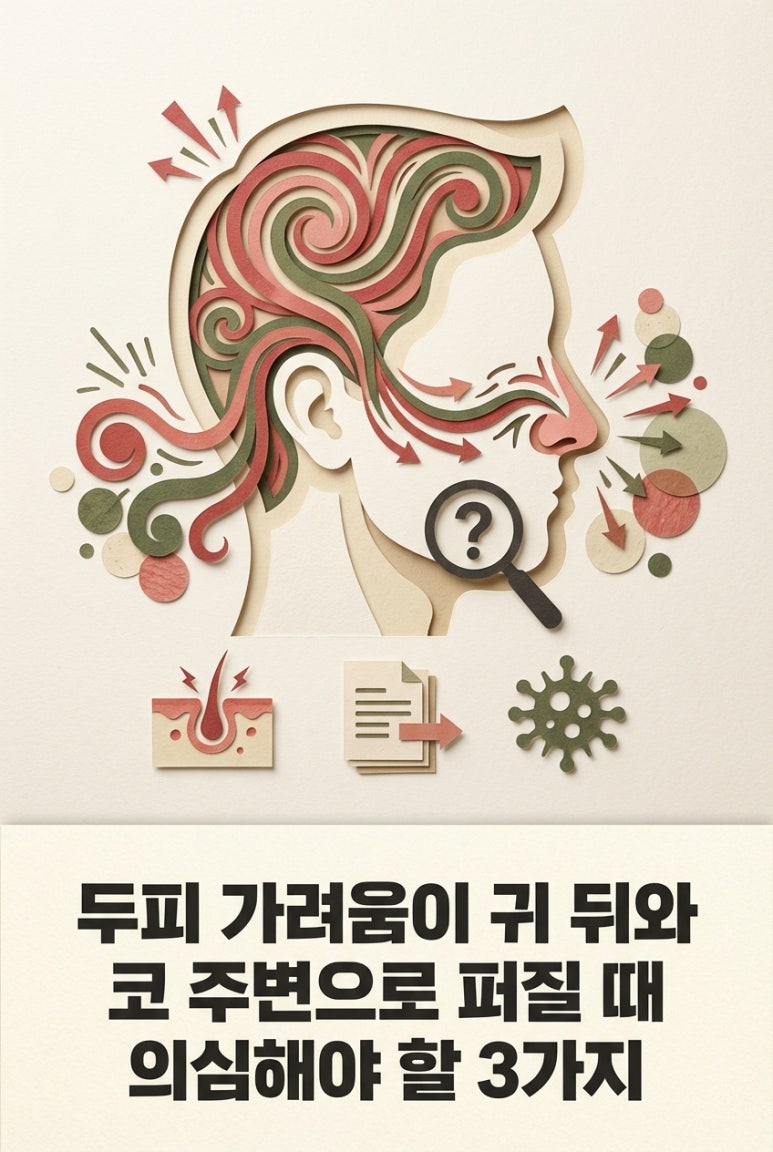
"My scalp itches and I scratched it, but now the area behind my ears and next to my nose are red and itchy": 3 Things to Suspect When Scalp Itching Spreads to Behind the Ears and Around the Nose

 🧾 Answer First | Key Conclusion
You must be experiencing unspoken stress from itching every night and flaking scales.
Hello.
I am Choi Jang-hyuk, director of Dongjejdang Korean Medicine Clinic.
If scalp itching spreads to your ears and nose, this is not simple dandruff.
It is a clear signal that seborrheic dermatitis is spreading to your face.
Do not panic, and first try the 3 coping methods I will share with you.
Proper initial management alone can significantly prevent symptoms from worsening.
 ✅ Action | Immediate Implementation
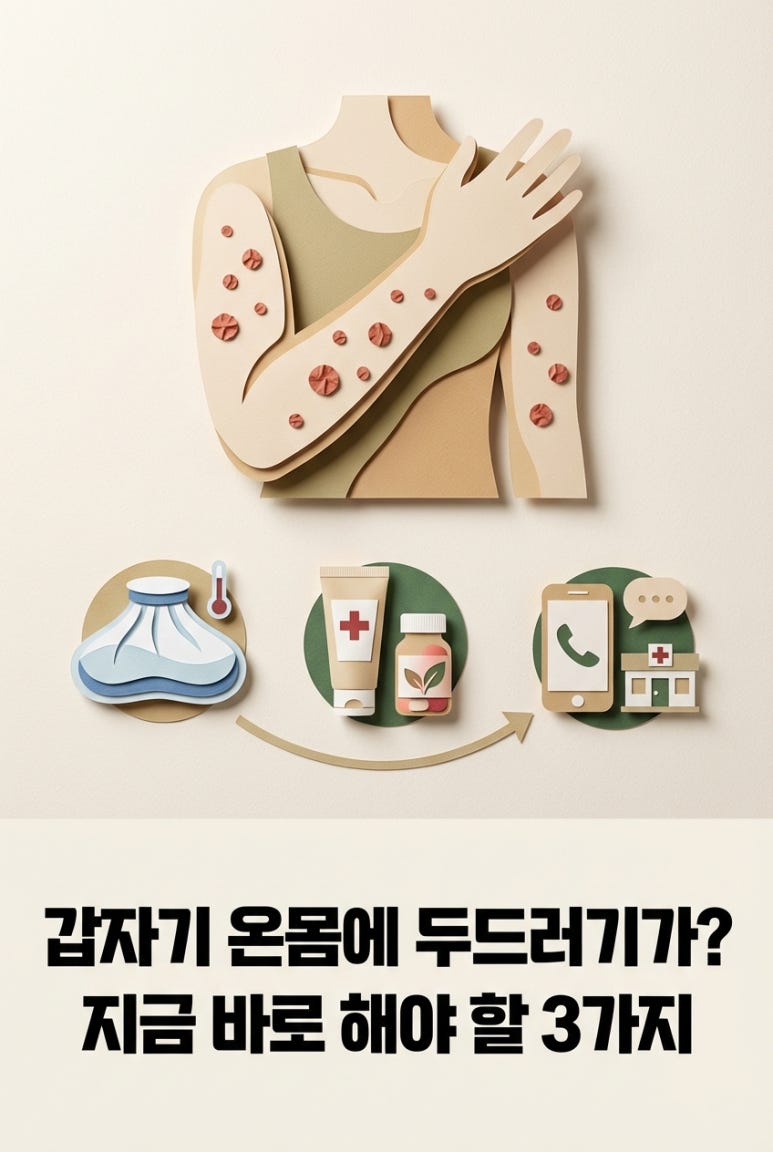
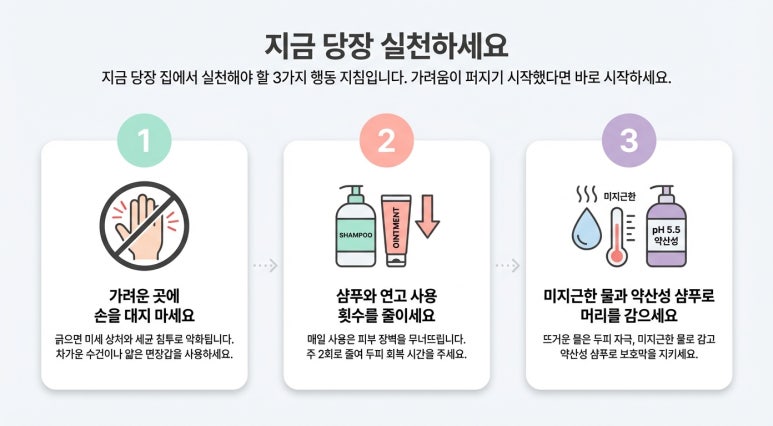
These are 3 action guidelines you should implement at home right now.
If itching has started to spread, begin immediately.
1️⃣ Do not touch the itchy areas with your hands
This is the most difficult principle to follow but the most important one.
When you scratch due to itching, tiny wounds form, and bacteria penetrate through these gaps.
Secondary infection makes symptoms uncontrollably worse.
When itchy, do not scratch but calm it by gently applying a cold towel.
Wearing thin cotton gloves while sleeping is also a good way to prevent unconscious scratching during sleep.
2️⃣ Reduce the frequency of shampooing and ointment use
Are you using antifungal shampoo or steroid ointment daily?
Frequent use actually destroys the skin barrier.
You should reduce usage to about twice a week.
You need to give your scalp time to recover on its own.
3️⃣ Wash your hair with lukewarm water and weakly acidic shampoo
Hot water irritates the scalp and raises its heat.
Sebum secretion also increases.
Wash with lukewarm water similar to body temperature.
Instead of squeaky-clean shampoos, use weakly acidic shampoo similar to skin's pH level.
This way you can protect your scalp's protective barrier.
 🚨 Warning | Warning Signs That Must Be Checked
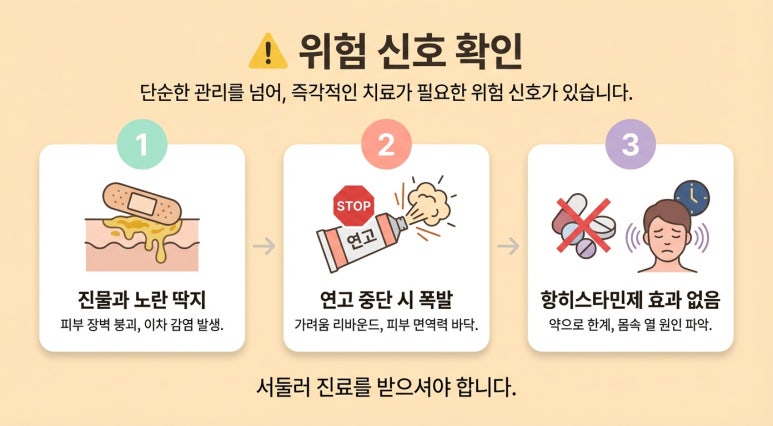
There are warning signs that require immediate treatment beyond simple management.
If any of the following symptoms apply to you, you should seek medical attention promptly.
✔ When discharge comes from behind the ears or thick yellow crusts form
It means the skin barrier has completely collapsed and secondary infection has occurred.
Neglecting this condition deepens the inflammation.
In severe cases, it can lead to hair loss.
✔ When rebound phenomena appear where itching explodes when you stop using ointment
This is when symptoms only improve while applying steroid ointment.
When you stop, symptoms become much worse than before.
This is a strong warning that your skin immunity has hit rock bottom.
✔ When itching does not stop every night despite taking antihistamines daily
It means you have reached the limit with medication that only reduces surface inflammation.
Heat is continuously rising from inside your body, so you must find the real cause.
 🧠 The Why | Root Cause Analysis
Why does itching that starts on the scalp spread to the area behind the ears and around the nose?
These areas are where sebaceous glands are most concentrated in our body.
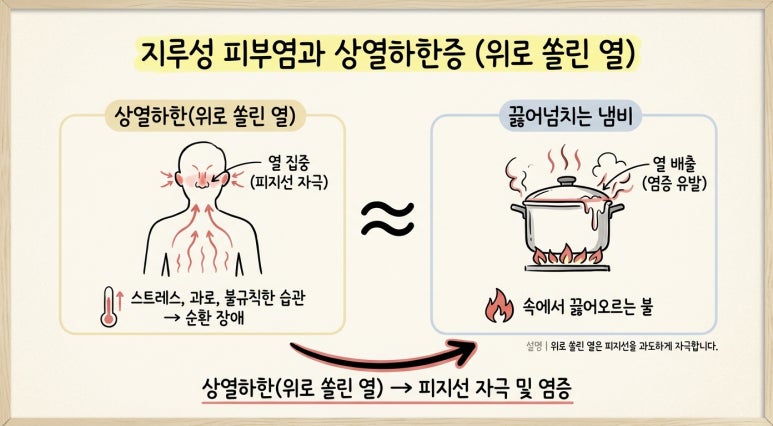
In Korean medicine, this phenomenon is viewed from the perspective of 'heat above and cold below syndrome'.
Modern people suffer from stress, overwork, and irregular eating habits.
This blocks the body's circulation.
Hot heat rises upward while cold qi sinks downward.
Like a pot boiling over on a gas stove, heat in the body concentrates in the head and face.
This excessively stimulates the sebaceous glands.
Using antifungal shampoo or dermatological ointment for long periods only covers up symptoms.
Frequent use actually makes the skin barrier thin and sensitive.
Even small irritations easily cause redness and itching.
If you do not extinguish the fire rising from within, the embers on the surface will continue to burn.
Normal skin maintains its barrier by secreting appropriate sebum.
However, heat concentrated upward abnormally increases sebum secretion.
Excess sebum becomes food for resident skin bacteria.
These resident skin bacteria transform into fungal bacteria and release inflammatory substances.
These substances cause severe inflammation and itching in the skin.
Prolonged steroid use thins the dermis layer of the skin.
Capillaries dilate, falling into a vicious cycle of chronic flushing and itching[1].
📊 Proof | Cases and Evidence
This is a story of a patient in their 30s working at a company whom I treated in my clinic.
When taking and applying dermatological medication, they were fine.
However, as soon as they stopped the medication, itching spread to their entire face and they came to see me.
They were unable to sleep due to scratching every night, making daily life difficult.
To reduce steroid side effects, I gradually reduced the use of existing medication.
At the same time, I prescribed herbal medicine to reduce heat concentrated in the scalp and face.
I combined acupuncture treatment to open blocked qi and blood circulation.
I made the heat floating upward in the body circulate downward.
Just one month after starting treatment, the patient was able to sleep soundly through the night without waking up.
Based on my experience, more than 80% of patients show significantly reduced itching within 4 weeks after starting heat-regulating treatment.
Korean medicine research has also confirmed that treatment controlling body heat significantly lowers the recurrence rate of seborrheic dermatitis.
It has been verified that it also helps restore damaged skin barriers[4].
 🔚 Closing | Summary and Encouragement
Scalp itching spreading to the face and behind the ears is an urgent distress call from the body's internal imbalance.
Do not just try to wash away visible scales and redness on the surface.
Treatment that merely temporarily covers symptoms has its limits.
You must start real treatment that reduces heat deep within the body.
Do not worry alone or rely only on strong medications and shampoos.
From my experience, if you correct your body's circulation in time, anyone can regain clear skin.
I support your healthy future.
✍️ Reviewed by Choi Jang-hyuk, Director of Dongjejdang Korean Medicine Clinic
❓ FAQ
Q. Why does seborrheic dermatitis get worse when you stop using ointment?
It is because of the 'rebound phenomenon' caused by steroid ointment.
When inflammation is suppressed with ointment for a long period and suddenly stopped, problems occur.
Suppressed inflammation bursts out all at once.
Itching and redness can become extreme, so you need a process of gradually reducing usage with professional help.
Q. Can I use dandruff shampoo from a pharmacy every day?
Daily use is absolutely not recommended.
You should not use shampoo containing antifungal ingredients too frequently.
It washes away not only bad bacteria but also the scalp's normal protective barrier and beneficial bacteria.
Your scalp can become drier and itching can worsen.
Use it only about twice a week.
Q. How does a Korean medicine clinic treat seborrheic dermatitis?
We mainly prescribe herbal medicine to reduce heat concentrated in the head.
We combine acupuncture and pharmacopuncture treatment to circulate hot qi rising upward downward.
Rather than just calming surface inflammation of the skin.
We strengthen the body's weakened immunity and damaged skin barrier from within to break the cycle of frequent recurrence.
📚 References
[Western Medicine (WM)]
[1] NICE (2021). "Seborrhoeic dermatitis - Management"
[2] BMJ Best Practice (2022). "Seborrhoeic dermatitis - Diagnosis and management"
[Korean Medicine (KM)]
[3] Korean Association of Oriental Medicine (2020). "Scalp Disease Clinical Practice Guidelines - Seborrheic Dermatitis"
[4] NIKOM (2019). "Korean Medicine Treatment Mechanisms for Heat Above and Cold Below Syndrome-related Scalp Diseases"
Skin
"My scalp itches and I scratched it, but now the area behind my ears and next to my nose are red and itchy": 3 Things to Suspect When Scalp Itching Spreads to Behind the Ears and Around the Nose
View Program