
"It feels like the brakes in my head are broken" | Checking OCD in a 30s office worker who constantly checks work emails
 The Monitor That Won't Turn Off After Work: The Pain of an Overheated Brain
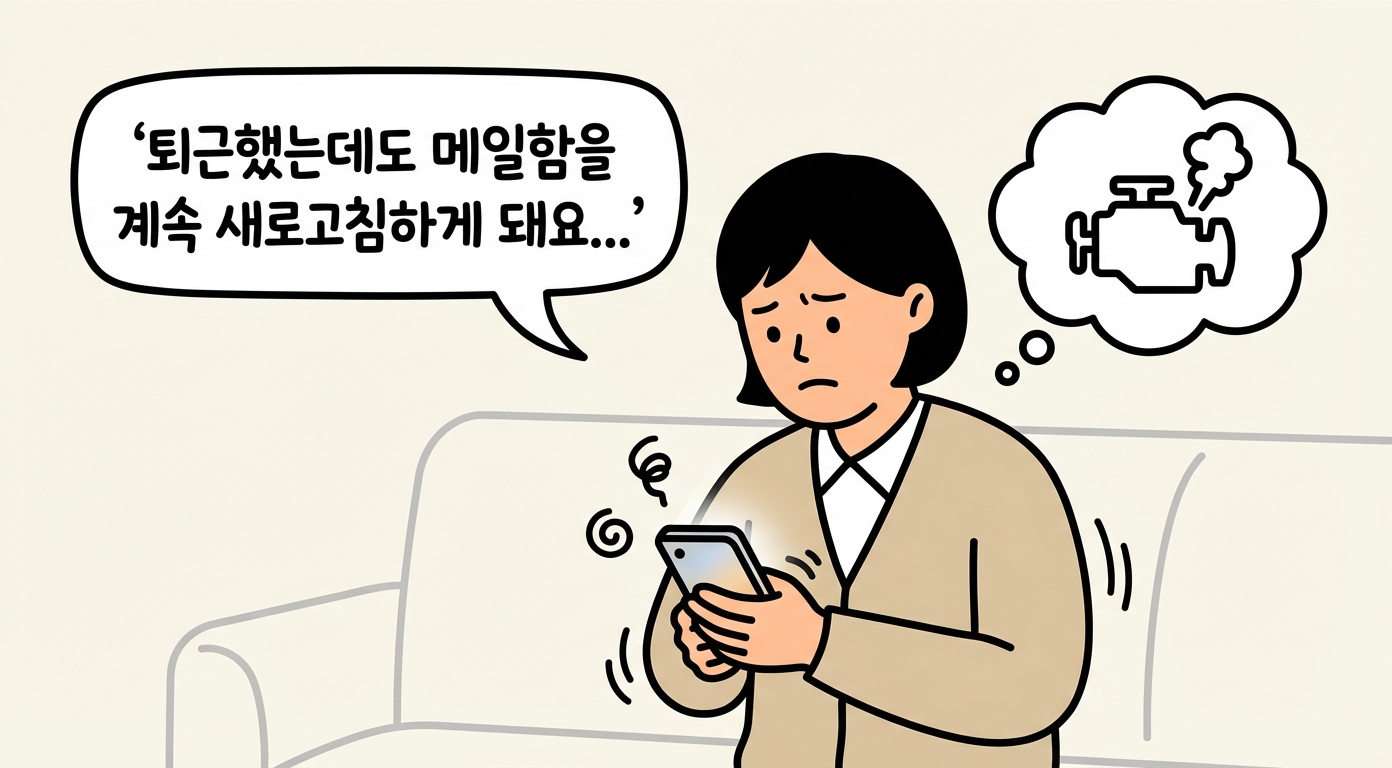
"It feels like the brakes in my head have failed.
Even after leaving work and coming home, I feel phantom vibrations from my phone even when it hasn't actually buzzed, and I keep refreshing my inbox.
If I don't check, I feel like I'll go crazy; when I do check, my heart pounds."
These were the words of Ji-won (pseudonym), a worker in her 30s, who confided in me with a pallid face when she first came to see me.
Working as a marketer at an IT company, buried day and night in a constant stream of work messages and project deadlines, Ji-won had been suffering from the feeling that even after leaving work, her brain was stuck in a perpetual on-shift state.
Even when the day's work was done, if she didn't check her inbox, her heart would race as if about to burst — and even lying in bed, she couldn't cut off the tail of thoughts about tomorrow's tasks by her own will.
At first she visited a psychiatrist and tried a mild sedative, thinking it must just be heavier work stress lately.
But when the medication took effect she felt briefly drowsy; when it wore off, she was shaken even more severely by the returning anxiety.
The compulsive act of checking the screen gave a fleeting sense of relief, but immediately brought deep feelings of defeat and guilt — leading to a cruel vicious cycle that gnawed at her relentlessly.
Most frustrating of all was that a comprehensive hospital checkup had returned a completely clean verdict — no abnormalities in the heart or nervous system — yet every night she was still being chased by invisible anxiety.
I did not see Ji-won's symptoms — her hand trembling as she repeatedly lit up her phone screen even as she sat down in my clinic — as simply a common occupational hazard of modern life or mere psychological sensitivity.
Every time I hear the stories of patients drying up day by day in this invisible pain, I feel deep, unbearable sadness and empathy as a healthcare provider.
To be honest, even I, in the early days of opening my clinic, spent nights sleeplessly refreshing my inbox late into the night — so I understand that feeling better than anyone.
You are not unusually sensitive; please don't be too hard on yourself.
So why, even after leaving work, does our brain fail to rest and keep orbiting an endless track of anxiety?
 The Broken Brakes and the Dried-Up Coolant
In Korean medicine, the state in which the body's qi becomes entangled and the organs are harmed by thoughts chasing their own tails is called 사려과다 (思慮過多) — a condition where excessive thinking damages the spleen (which governs digestion) and the heart (which governs the mind).
When thoughts multiply, qi becomes knotted, ultimately undermining the central axis that circulates the body's energy.
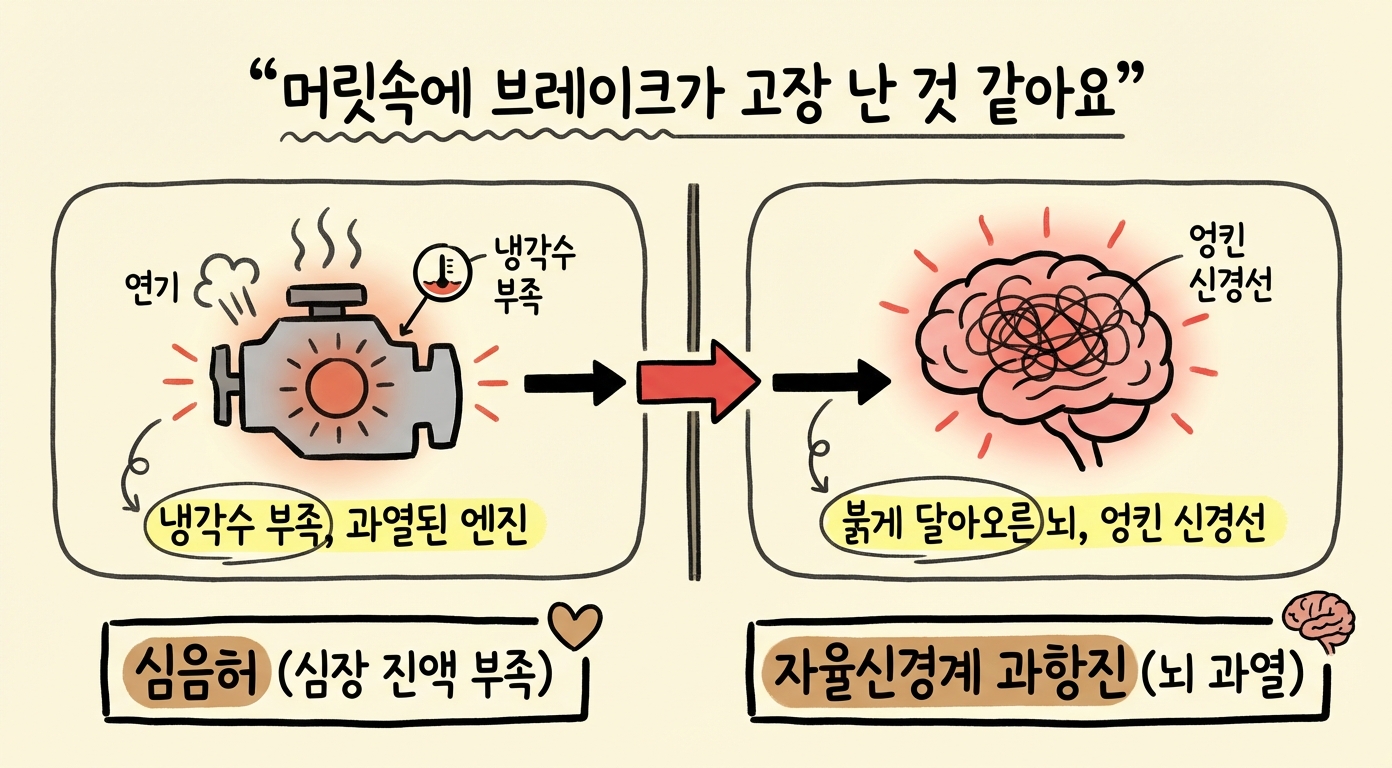
Persistent stress and tension cause 심음허 (心陰虛) — a condition in which the heart's fluids dry up, generating deficient heat and making it impossible to settle — overheating the brain relentlessly like an engine whose coolant has run dry, and abnormally amplifying anxiety.
Modern Western medicine also explains this phenomenon as closely linked to the hyperactivation of the sympathetic nervous system within the autonomic nervous system.
The endless stream of digital information and ever-present work pressure continuously excites our body's crisis response system — the sympathetic nervous system.
When this excitement continues, stress hormones such as cortisol are secreted in excess, ultimately raising the fatigue of the entire nervous system to extreme levels, clouding the brain's normal judgment, and triggering compulsive checking behaviors.
Eventually, when this exhaustion has long been neglected and reaches the stage of 심담허겁 (心膽虛怯) — where the heart and courage have weakened so that even the smallest stimulus causes the heart to sink with fear — the problem becomes far more serious.
At this point, patients like Ji-won begin to unconsciously repeat compulsive behaviors — feeling phantom phone vibrations, or reopening an inbox they've already checked many times — like a car with a stone jammed on the accelerator, hurtling forward against their own will.
Extreme physical exhaustion and uncontrollable mental compulsion powerfully and negatively feed each other, ultimately destroying the body's safety warning system and robbing patients of the daily tranquility they rightfully deserve.
The Endless Tail of Thought — How Can We Turn Off the Daily Switch?
So how can we cut off this relentlessly chasing tail of thought, and safely turn off the switch of this overloaded daily life?
We need to carefully look back at the environment we face every day.
The exhausting modern habit of never letting go of the smartphone even after coming home — always remaining on the extension of work — is the most fatal cause that fundamentally blocks our brain from unwinding and shifting into a gentle rest mode.
A point I repeatedly emphasized to Ji-won: the most important first step is sending the brain a clear signal of rest through physical disconnection.
At least two hours before going to bed, all electronic devices — smartphone, tablet, laptop — should be placed in another room, out of sight entirely.
At first, the very fact that the device isn't nearby may trigger a different kind of anxiety — but you must give your body the time to slowly grow accustomed to that gap.
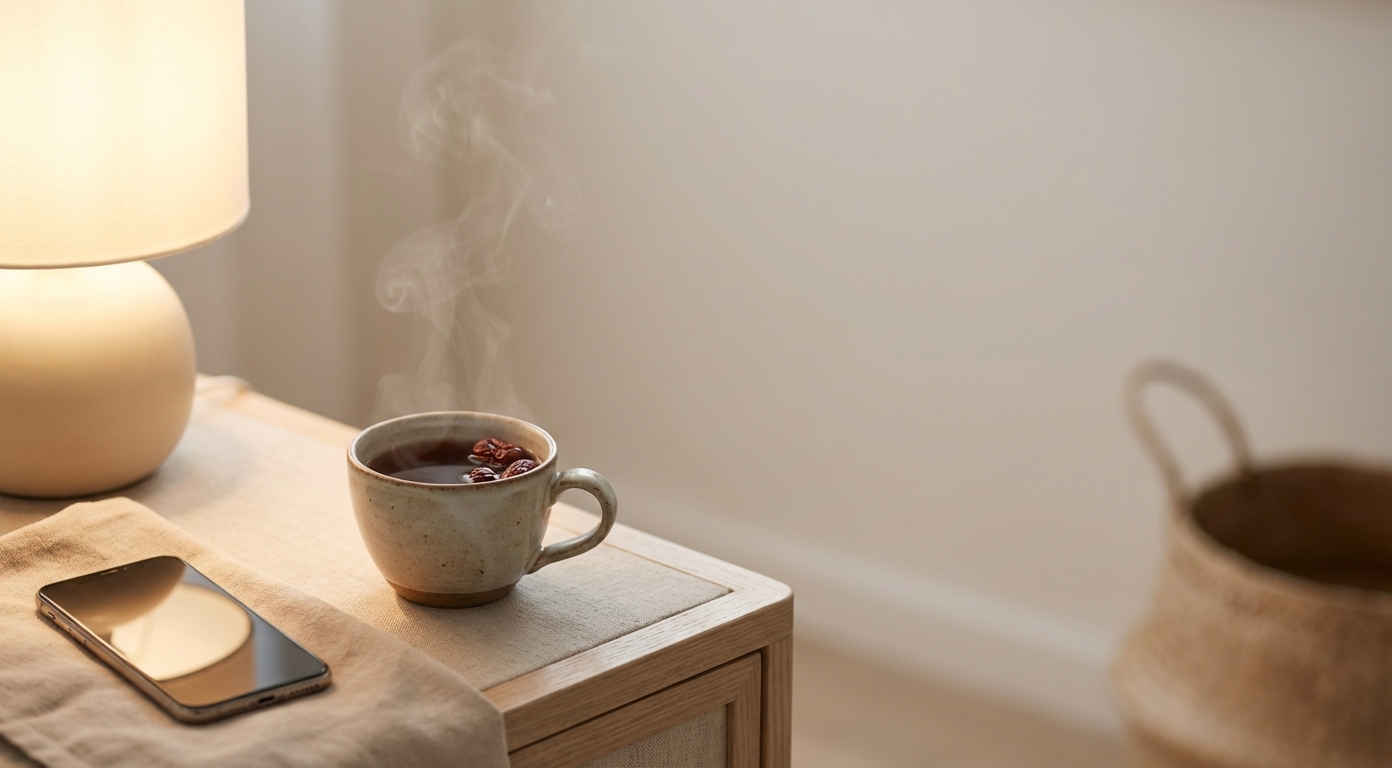
Instead, take a slow shower with warm water, or with soft dim lighting on in the room, do gentle neck and shoulder stretches while focusing entirely on your own breathing and body sensations.
These slow, sequential steps will draw the overheated heat that has surged upward in the head calmly downward — becoming a quiet ritual that turns off the brain's switch and grants the body and mind a full rest.
After meals or before sleep, brewing jujube tea — which warms the digestive system and gently calms a tense mind — and savoring it slowly can also be of great help in activating the parasympathetic nervous system.
However: if beyond everyday anxiety you feel severe chest pain or an acute panic attack that makes breathing difficult, or if extreme depression and lethargy washes over you, please do not try to endure it alone. Seek emergency care or a psychiatrist immediately.
**The Quiet Journey of Recovery — Reclaiming the Reins of Your Life**
Treatment at Dongjedang Korean Medicine Clinic does not stop at temporarily suppressing outwardly visible anxiety symptoms with medication.
We look at the body as a single, intricately connected organism — replenishing the dried and exhausted roots that have long been under stress, and calmly correcting imbalances of the organs.
This is a very delicate and integrative process of rebuilding the robust internal environment where the body itself can put the brakes on excessive arousal — not through external force, but from within.
A meticulous herbal prescription tailored to each patient's unique constitution, life history, and depth of symptoms restores the shattered balance of the autonomic nervous system to its original orbit.
This process of Korean medicine treatment is not magic that creates miracles at once — it is like the hands of a clockmaker gently realigning gears that have gone out of mesh.
Just as gears that have found their proper place ultimately produce accurate, stable time, our body too, once it finds its center, can play the comfortable rhythm of daily life again.
My role does not stop at mechanically diagnosing and handing over medication — it is to be the steadfast companion who helps you find the key that opens the tightly locked door, so that you may fully reclaim the reins of your life that have long been taken from you.
It doesn't have to be me — but please do not dismiss your heavy, dark pain as mere sensitivity or weakness of character.
Please find a warm, wise healthcare provider who will look deeply into the connection between body and mind and sincerely empathize with your story, so that you may recover the lost tranquility of your days and the deep sleep of quiet nights.
You are never alone.
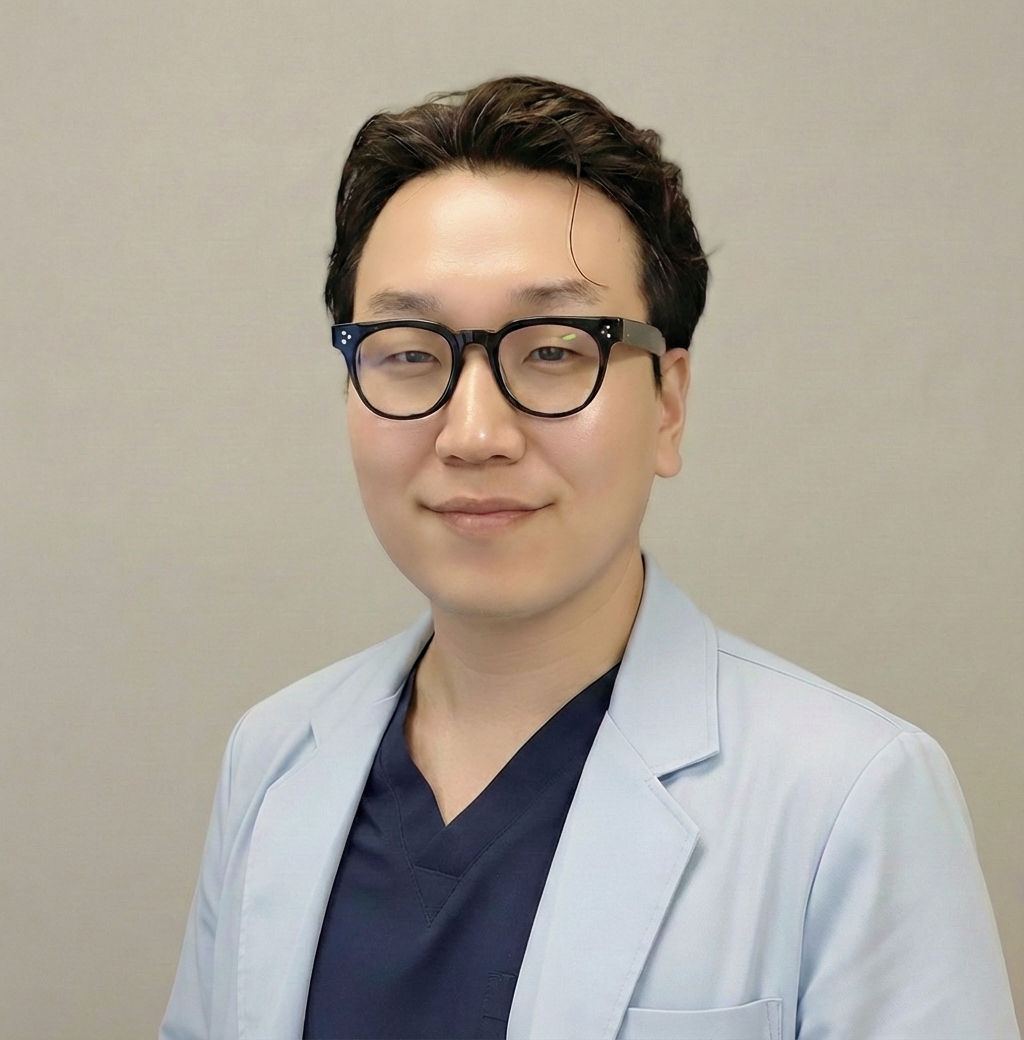
Reviewed by Director Jang-hyeok Choi, Dongjedang Korean Medicine Clinic