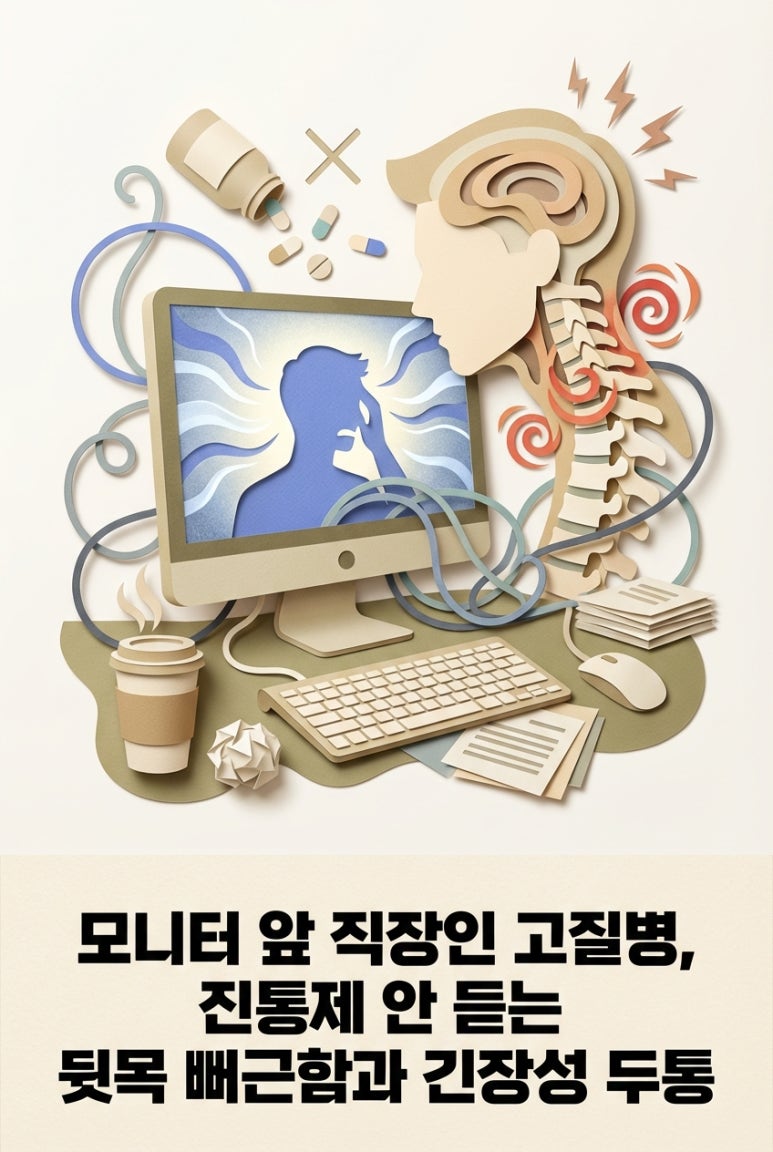
Office Workers' Chronic Condition in Front of Monitors: Neck Stiffness and Tension Headaches That Don't Respond to Pain Relievers

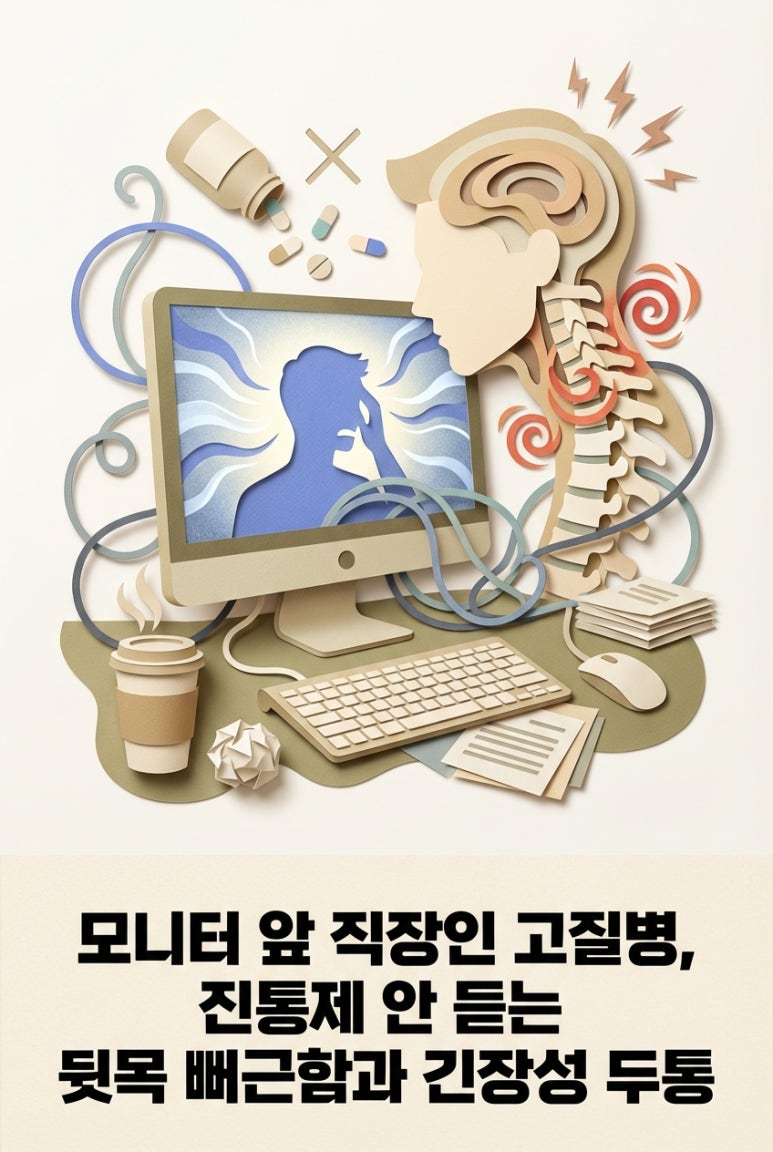 🧾 Answer First | Key Conclusion
Do you work in front of a monitor all day long?
You may be reaching for pain relievers again because of neck stiffness.
Hello.
I am Choi Jang-hyuk, director of Dongjjedang Korean Medicine Clinic.
Pain relievers temporarily deceive your brain to make you forget the pain.
The real cause of headaches that don't respond to medication is elsewhere.
It is the neck muscles that have hardened like stone and excessive stress.
You need to release the stiffened muscles and improve blood flow to the brain.
Only then can you stop relying on frustrating medications.
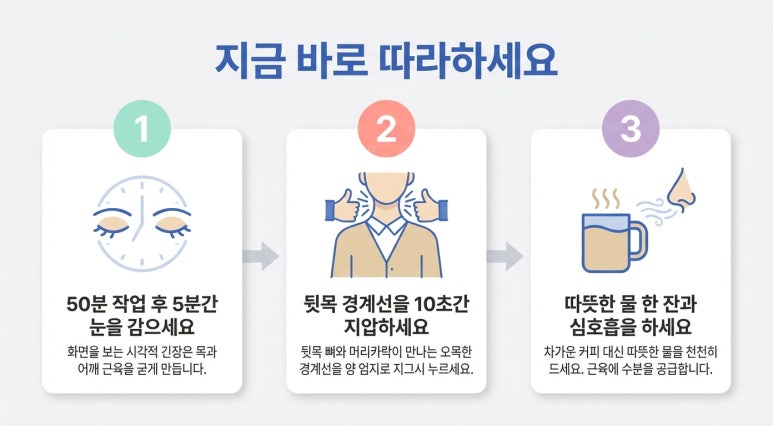 ✅ Action | Immediate Implementation
Before taking a pain reliever, try these three things right now from where you're sitting.
1️⃣ Close your eyes for 5 minutes after 50 minutes of work
Visual strain from looking at screens hardens neck and shoulder muscles.
If you've been concentrating for 50 minutes, take your eyes off the monitor.
Then close your eyes completely for 5 minutes.
Simply blocking visual stimulation significantly reduces pressure at the back of your neck.
2️⃣ Apply pressure to the back of your neck border for 10 seconds
There is a hollow boundary line where the back of your neck bone meets your hairline.
Press this spot firmly with both thumbs.
Apply gentle pressure for 10 seconds while exhaling.
The tightly bunched muscles will release.
Blood flow to your head improves immediately.
3️⃣ Drink a glass of warm water and take deep breaths
Instead of cold coffee, slowly drink warm water.
And breathe deeply through your nose.
This supplies moisture to your muscles and calms overly excited nerves.
Your body's tension decreases and headaches gradually subside.
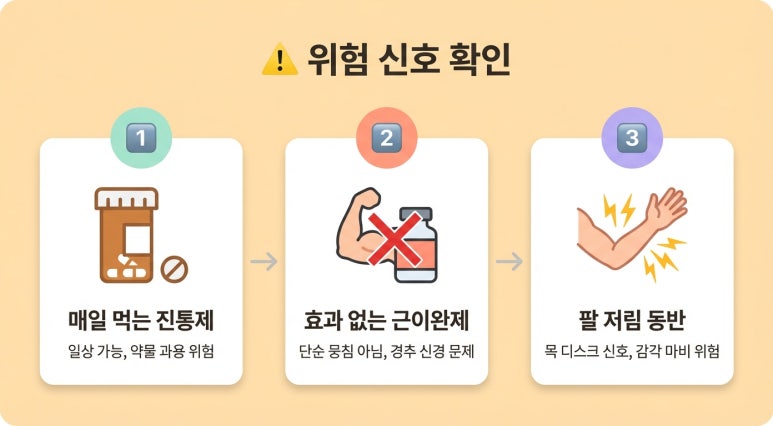 🚨 Warning | Warning Signs You Must Check
However, headaches and neck stiffness may not be simple fatigue.
These are the warning signs I carefully watch for in clinical practice.
✔ When daily pain reliever use is necessary to maintain daily activities
Are you taking pain relievers more than 3 days a week?
If so, you likely have progressed to medication overuse headache.
Your brain's inherent ability to self-regulate pain has been compromised.
✔ When muscle relaxants have no effect whatsoever
Muscle relaxants purchased at pharmacies may not relieve neck and shoulder tension.
This is not something to overlook.
It goes beyond simple muscle tension.
The cervical nerves or ligaments may have become severely stiffened.
✔ When tingling sensation occurs in the arms or fingertips along with headaches
This is a strong signal that a cervical disc is directly compressing a nerve.
It is problematic to continue taking only headache medication.
Sensory numbness symptoms may develop.
If these warning signs appear, stop taking pain relievers immediately.
You must receive accurate examination from a specialist.
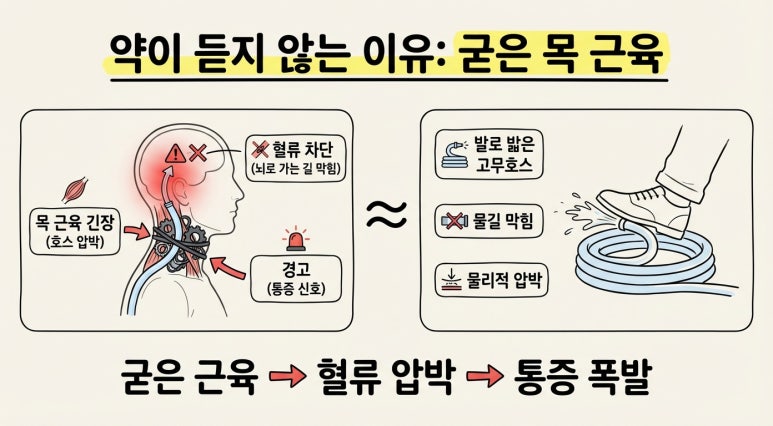 🧠 The Why | Root Cause Analysis
So why doesn't medication work at some point?
The problem is the posture of thrusting your neck toward the monitor.
This posture causes extreme tension in the back neck muscles throughout the day.
What happens when the muscles at the back of our neck become rigid?
It compresses the blood vessels and nerves going up to the head, like stepping on a rubber hose.
This is the typical mechanism of tension-type headache development.
The important point here is the role of pain relievers.
Pain relievers only temporarily turn off the nerve switch that makes the brain feel pain.
They cannot relax even 1mm of the physically hardened muscle.
As a result, the compressed blood vessels and nerves remain unchanged.
You simply cannot feel the pain.
As the medication wears off over time, the suppressed pain returns explosively with greater intensity.
Stomach problems and medication tolerance that appear with daily pain reliever use stem from this incorrect approach.
📊 Proof | Cases and Evidence
This is a case of a man in his late 30s, an office worker I met in clinical practice.
He suffered daily from headaches that didn't respond even to pain relievers.
He was very anxious because even strong medications wouldn't relax his muscles.
I performed precise acupuncture treatment on his hardened back neck.
I directly released the bunched muscle bundles.
At the same time, I combined customized herbal medicine treatment to clear blood flow to the brain.
By the third week of treatment, the patient completely stopped the pain relievers he had relied on daily.
According to research, Korean medicine conservative treatment has significant effects in reducing pain intensity in tension-type headache patients[3].
I did not cover the surface pain with medication.
This is the result of finding and treating the real cause deep within the body.
 🔚 Closing | Summary and Encouragement
Now you must break free from the painful vicious cycle of relying only on pain relievers.
Frequent neck stiffness and headaches are your body's desperate signals.
The path to stopping medication is not far away.
Relieving the tension of rigidly stiffened muscles comes first.
And stabilizing blood flow to the brain is the first step.
I hope you escape the grip of pain and regain a comfortable daily life.
I will do my best to help you.
✍️ Reviewed by Choi Jang-hyuk, Director of Dongjjedang Korean Medicine Clinic
❓ FAQ
Q. Why don't pain relievers work for headaches?
Because the muscle tension causing the pain is not resolved at all.
Pain relievers only block the nerve so your brain doesn't feel pain.
If muscles are hardened and compressing blood vessels, any medication is only temporary.
Q. Are there side effects to taking headache medication daily?
Yes, there are significant side effects.
In addition to stomach problems, you can develop a new disease called medication overuse headache.
You must break the vicious cycle of worsened pain when medication wears off.
Q. How does a Korean medicine clinic treat tension-type headaches?
Acupuncture treatment releases stiffened muscles, and herbal medicine reduces overall body tension.
Clean, warm blood is supplied around the neck and shoulder area.
We help patients develop a strong body that can overcome pain without medication.
📚 References
[Western Medicine (WM)]
[1] NICE (2021). "Tension-type headache: Management and Diagnosis"
[2] BMJ Best Practice (2022). "Tension-type headache - Treatment algorithm"
[Korean Medicine (KM)]
[3] Korean Medical Association CPG (2020). "Korean Medicine Clinical Practice Guideline for Headaches"
[4] NIKOM (2021). "Korean Medicine Conservative Treatment for Neck Pain and Tension-Type Headaches"
Head & Face
Office Workers' Chronic Condition in Front of Monitors: Neck Stiffness and Tension Headaches That Don't Respond to Pain Relievers
View Program