

"My body feels heavy as a rock but my eyes won't close" | Chronic fatigue-related insomnia in a 40s male office worker
The Voice Behind the Symptoms: What a Switch That Won't Turn Off Is Saying
"My body feels as heavy as a stone—utterly exhausted—but when I lie down to sleep, it's like the switch in my head is broken and just won't turn off."
"Even relying on energy drinks and sleep aids, waking up in the morning feels like hell."
These were the words Mr. Kang Min-jae (pseudonym), a man in his 40s, said when he first came to see me.
The first impression of him as he opened the door to the clinic was of someone on the verge of collapsing from exhaustion—yet his eyes were in a state of excessive tension.
Struggling daily with late-night overtime and heavy performance pressure, he told me that at some point, even when his body was completely drained, a strange insomnia had begun to take hold—his eyes would become wide awake every night.
At first he visited a nearby clinic and was prescribed sleep medication, but even forcing his eyes shut with the medication's effect, the morning fog that lingered for hours afterwards made him feel worse, and his work efficiency dropped sharply.
For months, the vicious cycle repeated—pouring strong caffeine into himself during the day to fight fatigue, then tossing and turning at night unable to fall asleep—and deep frustration had taken root within him.
After sleep studies and various hospital tests found no clear organic cause or abnormality, he spoke of his frustration and helplessness.
I did not view Mr. Kang's symptoms as merely a temporary malfunction in the part of the brain that governs sleep.
This was a state of serious depletion—like an old engine running idle, its fuel completely exhausted yet still unable to shut off, grinding away at its own insides.
Every time I hear the story of the invisible suffering experienced by modern people robbed even of their right to peaceful sleep by endless overwork and stress in today's society, I find myself deeply empathizing.
So why, even when the body is so utterly exhausted it seems about to collapse, can the brain not turn off its own wakefulness switch, condemning the person to this lonely, sleepless night?
A Drained Battery and a Flashing Warning Light—The Body's Circulation Comes to a Stop
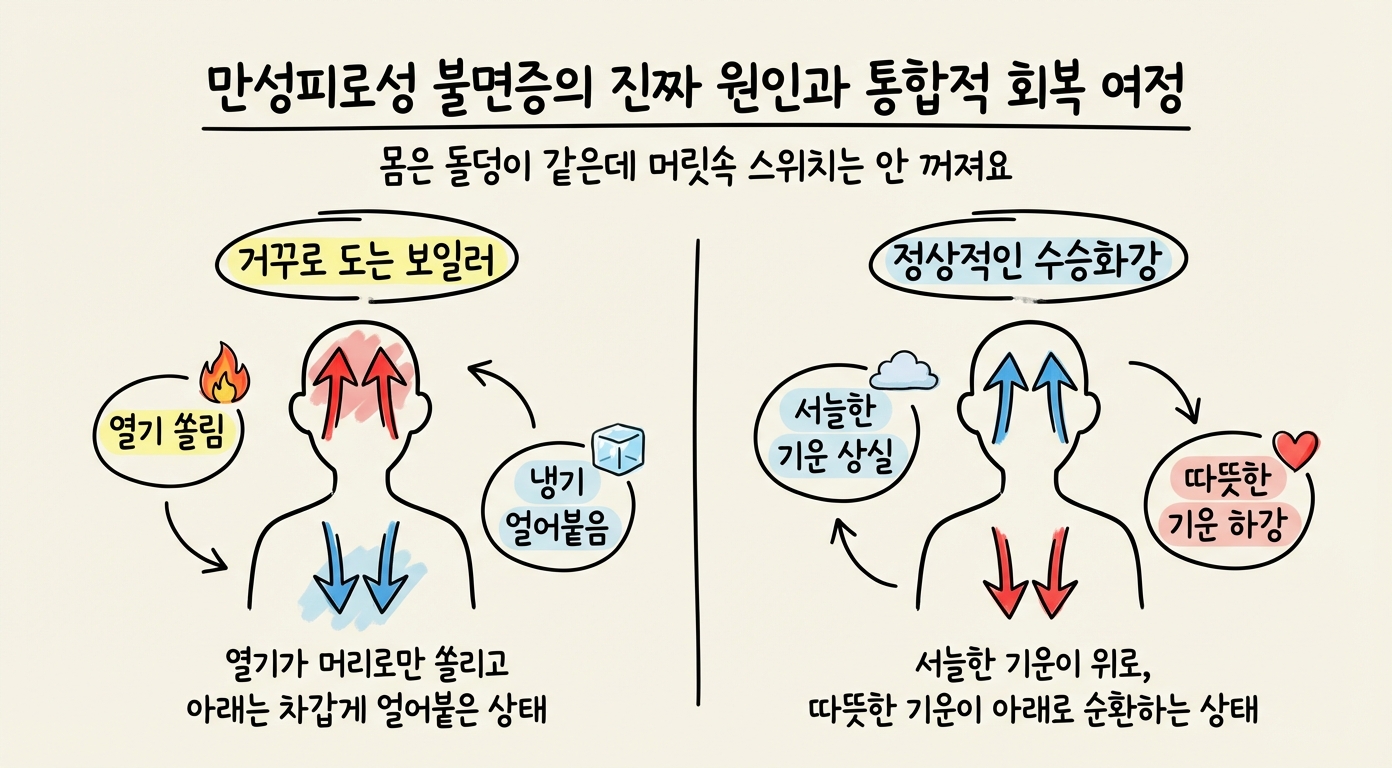
In Korean medicine, symptoms like Mr. Kang's are explained as Eum-heo Hwa-dong (陰虛火動)—a state in which the body's clear vital fluids have dried up and deficient heat rises upward.
The "fire" referred to here is not a symptom of physical high fever, but an unnecessary overheating phenomenon that occurs when the calm energy that stabilizes our body is depleted due to ongoing stress and accumulated overwork.
This is very much like a dried-out radiator—the coolant that should be cooling the car's hot engine has evaporated, so even minor friction causes the temperature to shoot up immediately.
From a modern medical perspective, this can also be interpreted as a state in which the sympathetic nervous system has been continuously over-activated, completely disrupting the normal balance of the autonomic nervous system.
When extreme tension continues day and night, the heart races, the brain maintains a state of excessive arousal, and there is a mechanism by which it cannot enter the deep stages of sleep.
In other words, the parasympathetic nervous system—which should be replenishing the energy spent during the day and allowing the body to relax comfortably—has lost its function, and the alarm system that should only activate in dangerous situations is ringing incessantly even in the quiet of night.
This vicious cycle, each part exerting negative influence upon the other in an unbroken chain, completely blocks the harmonious flow of the body.
For healthy sleep to arrive, the harmonious circulation called Su-seung Hwa-gang (水升火降)—in which warm energy descends and cool energy rises—must flow smoothly.
However, the patient's body is currently like a boiler running in reverse—due to excessive stress, hot energy rushes up only to the head while the lower abdomen becomes cold and frozen, and the energy channels between up and down are completely blocked.
The heat concentrated in the head generates endless chains of thought and anxiety, disrupting sleep; and the cold lower abdomen forms a vicious cycle that further compounds chronic fatigue throughout the body.
When this imbalance persists for a long time, it goes beyond merely being unable to sleep at night and extends to functional decline throughout the body's organs—including indigestion and chest tightness—weighing down daily life even further.
When Daytime Tension Calls Up Nighttime Wakefulness: How to Empty the Day
So is there any way to open these blocked channels of circulation, reclaim the disrupted rhythm of sleep, and escape from this suffocating state?
Work worries that circle through the mind until late at night, and the blue light from smartphones that strongly stimulates the brain, continuously send a false signal to our brain that it is still daytime.
This thoroughly interferes with the normal secretion of melatonin hormone that induces healthy sleep, and drives our delicate nervous system into a precarious state like an overloaded fuse box that could trip at any moment.
Therefore, rather than forcing yourself to seek sleep by relying on sleeping pills, what is needed more than anything is a gradual process of emptying out the night environment, allowing the body to naturally release tension and relax.
Taking a warm half-bath one to two hours before sleep—raising body temperature slightly and then letting it gradually fall—can softly relax muscles that have been tense throughout the day.
This becomes a very natural and effective method for drawing the hot heat concentrated in the head downward and helping the autonomic nervous system stabilize.
Also, the habit of forcing sleep with strong caffeine taken to forget the surging fatigue, or alcohol relied upon to release tension, ultimately further burdens the brain's fatigue—this must absolutely be avoided.
If severe palpitations or frequent difficulty breathing in daily life frequently accompany the severe insomnia, this may be a warning signal of cardiovascular disease, and immediate medical examination at a nearby institution is recommended.
After complex evening meals, simply setting aside heavy thoughts for a while, taking a light neighborhood stroll, and breathing long and deep can softly soothe nerves that have been hyperactivated all day.
Slowly drinking a warm cup of jujube tea or Solomon's seal tea before bed, nurturing the tense digestive system, can also be wonderful Korean medicine wisdom for finding peace of mind and helping the body's circulation.
Rather Than Forcing the Switch Off, Allowing the Body to Breathe Deeply on Its Own

Listening attentively to the subtle signals the body sends and understanding the meaning of the pain behind them is the most important first step in overcoming chronic fatigue and insomnia.
True treatment of chronic fatigue insomnia is not simply suppressing brain function by force through powerful sleeping pills, but must be an integrative process—watering the parched earth with the life-giving rain of recovery, gently bringing down the heat that has risen upward, and creating an environment in which the body can make its own natural recovery.
Korean herbal medicine and acupuncture treatment meticulously tailored to each patient's unique constitution and the depth of their current symptoms serve as faithful aids that untangle the complex knots of energy within the body, helping natural, comfortable drowsiness to arrive—not by force, but organically.
Mr. Kang, too, through consistent practice of emptying the night environment and integrative treatment, is now meeting comfortable mornings—breathing deeply on his own, without sleep medication.
Your body, even through long periods of suppression and relentless fatigue, has a remarkable resilience to find its own balance when given the right direction for circulation.
Just as a knot that tightens further when you try to force it undone in a rush—the problem of deep sleep, too, is a journey that requires not attacking the surface appearance of symptoms but patiently working from the root causes, one by one.
My role is to be a warm ally who helps you find the key to that healing—so you can reclaim the harmonious balance of body and mind that you have lost over all this time.
Even if it's not me, I sincerely hope you will meet good medical practitioners who deeply empathize with your exhausting daily life and listen to what your body is saying, who carefully examine the overall circulation of your vital energy, and help you greet a clear and refreshed morning once again.
Director Choi Jang-hyeok, Dongjedang Korean Medicine Clinic