

"My body feels heavy as a waterlogged cloth and I don't want to do anything" | Burnout depression in a 30s office worker
A Body Sinking Endlessly to the Bottom: Burnout's Silent SOS
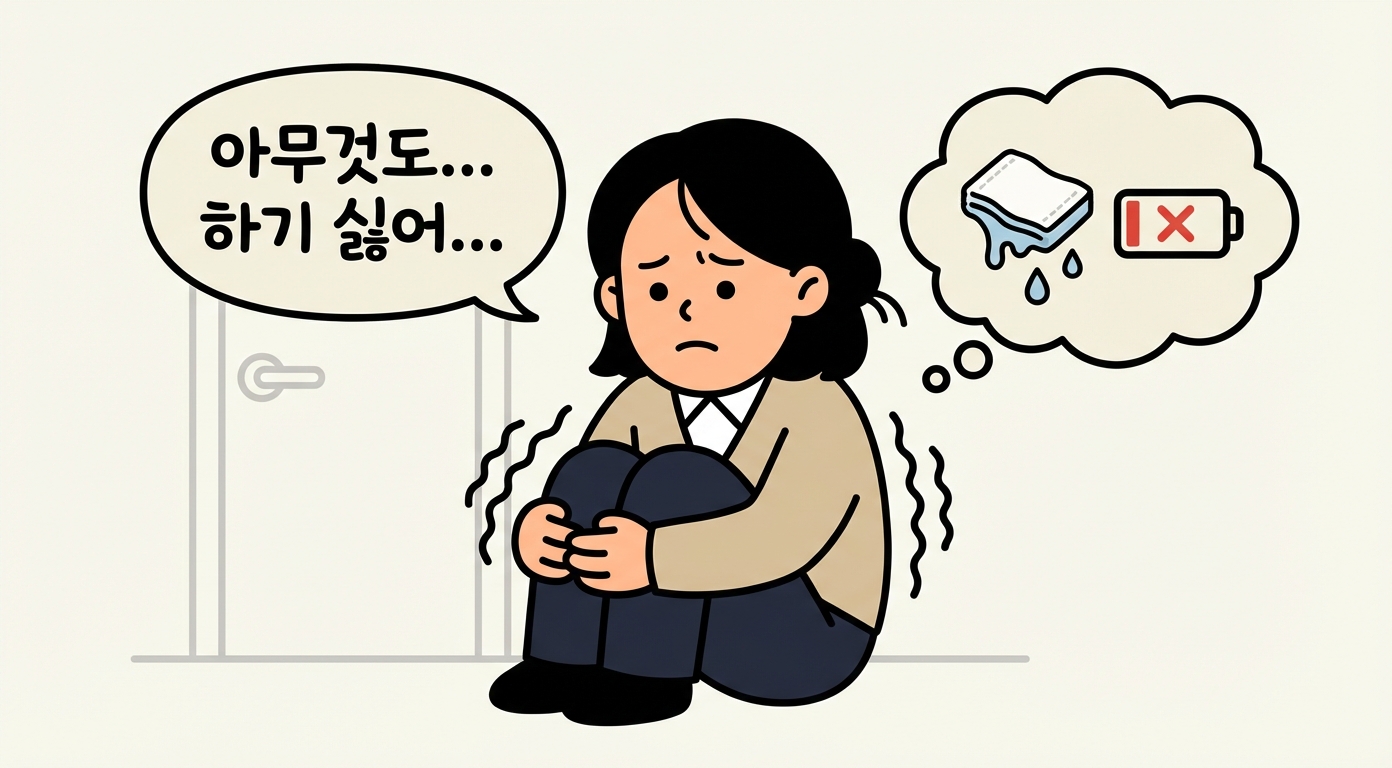
"Even after sleeping dead to the world all weekend, the fatigue doesn't lift at all. Just opening my eyes in the morning and getting my body up feels unbearably difficult and frightening.
My body feels as heavy as a wet, waterlogged cotton ball, and I feel pathetic for not wanting to do anything."
These are the words Ji-min (pseudonym), a worker in her 30s, breathed out with a deep sigh when she first came to see me.
From the heavy footsteps with which she entered the clinic, it was already clear she was deeply exhausted — she had been pushing herself relentlessly through years of unrelenting work pressure.
At some point, she began collapsing straight to the floor when she came home from work and opened the front door, and an extreme lethargy began taking hold in which even bathing felt too bothersome.
At first, sensing the seriousness of her condition, she visited a nearby internal medicine clinic, received IV fluids, and underwent various detailed blood tests — but every time, the answer came back that all her numbers were perfectly normal.
Trying to forcibly summon energy by drinking strong coffee and barely holding on in a state of artificial alertness, she fell into a dreadful cycle every day of crashing back into the floor with even more severe exhaustion the next day.
While the test results said everything was normal, the invisible weight of pain she felt every day was gradually darkening and pressing down on her entire life.
I did not see Ji-min's symptoms as simply a lack of personal willpower or a temporary accumulation of fatigue.
Every time I hear the stories of patients who have collapsed like this in my clinic, I deeply empathize with the helplessness and endless listlessness they bear alone.
To be honest, even I, in the midst of a ceaseless schedule of consultations, sometimes feel a gnawing lethargy eating away at me — which is why I understand that hopelessness better than anyone.
So then why does a body that shows no abnormalities on any tests experience such deep suffering, as if it is sinking endlessly to the bottom?
Depleted Energy and Accumulated Waste: The Body's Engine Seized to a Stop
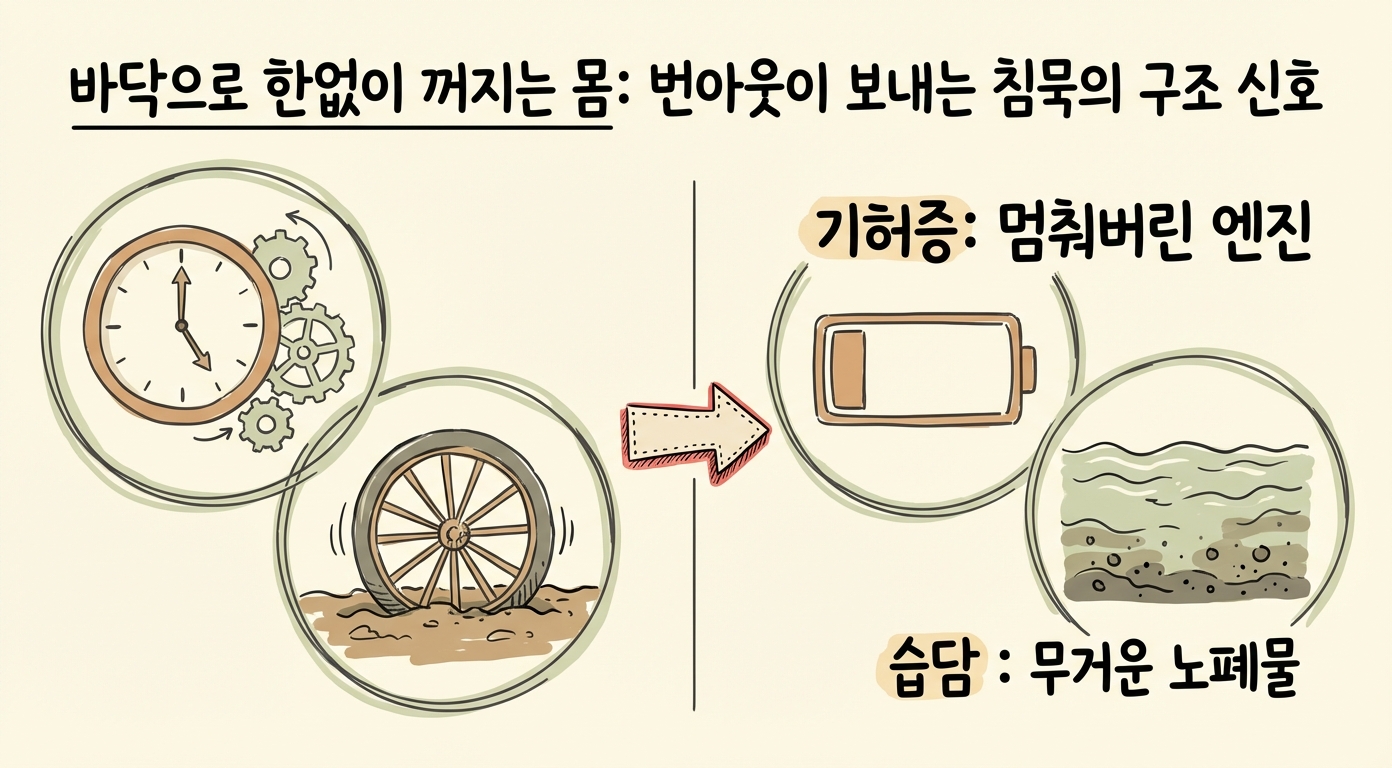
In Korean medicine, the state of extreme lethargy that makes normal daily functioning impossible — like Ji-min's — is diagnosed as a combination of 기허증 (氣虛證) (a complete depletion of vital life energy to its very bottom) and 습담 (濕痰) (the layering accumulation of heavy waste matter due to reduced circulation).
Here, 기허증 (氣虛證) refers to a state in which the fundamental fuel that drives the body's movement runs out — like a clock whose spring has fully unwound — losing its warmth and with the functions of life activity slowly grinding to a halt.
Even from the perspective of modern Western medicine, this corresponds to burnout syndrome: a prolonged period of stress in which the balance of the autonomic nervous system collapses and the adrenal glands — responsible for secreting stress hormones — become completely exhausted, resulting in the loss of the body's normal coping capacity.
When a state of unremitting tension continues night and day, the brain ultimately declares a forced shutdown to protect itself. This causes metabolism to drop sharply, and undigested residue begins to accumulate throughout the body.
When vital life force is depleted and the body's clear circulation comes to a halt, our body becomes like a cart wheel stuck in mud — no matter how hard it tries to push forward, it only spins uselessly in place and sinks deeper.
When there is insufficient energy to move, circulation of qi and blood stagnates; when circulation stagnates, the heavy waste of 습담 (濕痰) accumulates, making the body feel heavier and heavier in a vicious cycle — each side inflicting critical harm on the other and hardening into a stubborn pattern.
My Life Has Run Dry — Where Do I Start to Refill It?
So where and how should we begin to refill and recover a daily life that has already run completely dry?
Looking closely at the daily lives of patients who have fallen into the deep swamp of lethargy, most have perfectionist tendencies and work pressure that ties itself in knots — keeping the brain in a state of tension deep into the night and severely degrading sleep quality.
This ultimately causes the body's precious energy to be scraped out to the very bottom — like a bank account in the negative — eventually leading to a state of complete physical bankruptcy where not even the interest can be repaid.
Caffeinated drinks and spicy, stimulating high-calorie late-night snacks consumed habitually in an attempt to forcibly rouse the body's vitality may offer the exhausted brain a fleeting moment of comfort, but in the long run they heavily burden the digestive tract with 습담 (濕痰), making the body feel even more sluggish the following day.
Therefore, rather than forcing yourself to drag up a heavy body out of bed in the morning and berating yourself, a necessary step is to lie comfortably and gently repeat abdominal deep breathing — softly coaxing the autonomic nervous system that has stiffened overnight back awake.
For meals, slowly savoring warm, clear broth or soft porridge-type foods that don't burden the digestive system — chewing deliberately — and gradually warming the function of the spleen and stomach that has become cold and stiff is of great help.
However, if this lethargy is accompanied by sudden unexplained weight loss, severe dizziness causing blurred vision, or a physical sense of paralysis that makes daily functioning completely impossible, this may not be simple burnout but a warning signal of a serious endocrine disorder or neurological condition — you must visit a medical facility for thorough testing without delay.
 Not Forced Alertness, but the Journey of Natural Recovery
The complete treatment of lethargic depression and deep burnout is never simply about suppressing the patient's listlessness with temporary medication and forcibly rousing an exhausted brain.
It must be a patient process of refilling the clear energy depleted to its very bottom, gently restoring the body's circulation that has ground to a halt, and positively transforming the fundamental soil of the environment in which our body is rooted.
The Korean medicine approach — tailored to each patient's unique constitution and current state of the internal organs, clearing blocked qi and replenishing deficient fluids — serves to gradually awaken the remarkable self-healing capacity that our bodies have been endowed with since birth.
Now, I gently invite you to quietly listen to the desperate, silent signals your exhausted body is sending, and to set down, just for a moment, the whip with which you have been ceaselessly driving yourself.
Your body holds within it a remarkable and resilient capacity for recovery — it can rise again at any time, as long as you kindly show it the right direction.
My role is not merely to erase the symptoms visible on the surface, but to be a steadfast companion who walks side by side with patients, searching together for the key to lost vitality.
It doesn't have to be me — please find an experienced healthcare provider who can fully understand your tired body and wounded spirit, and who will walk alongside you with a warm gaze to the very end.
And may you break free from the grinding daily burden that felt as endlessly heavy and distant as waterlogged cotton, and brilliantly rediscover the light, buoyant stride of life.
✍️ Reviewed by Director Jang-hyeok Choi, Dongjedang Korean Medicine Clinic