Thought It Was Dandruff: 5 Critical Signs of Early Psoriasis You Cannot Miss
 🧾 Answer First | Key Conclusion
If white flakes are continuously falling from your scalp, you've tried changing dandruff shampoo three times, but it's not improving,
it may not be dandruff.
Hello.
I am Choi Jang-hyuk, director of Dongjedang Korean Medicine Clinic.
Psoriasis is a different condition from dandruff.
Dandruff is a problem of excessive sebum secretion and fungal infection, while psoriasis is a chronic inflammatory disease caused by the immune system attacking its own skin.
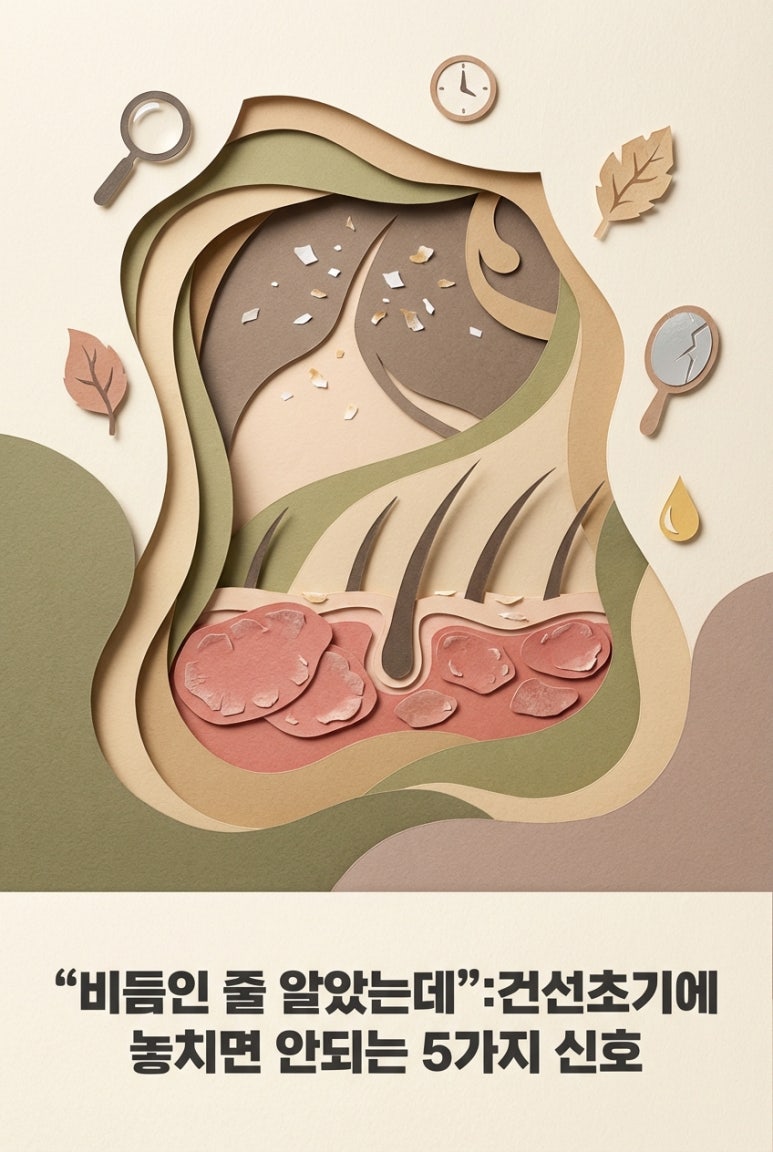
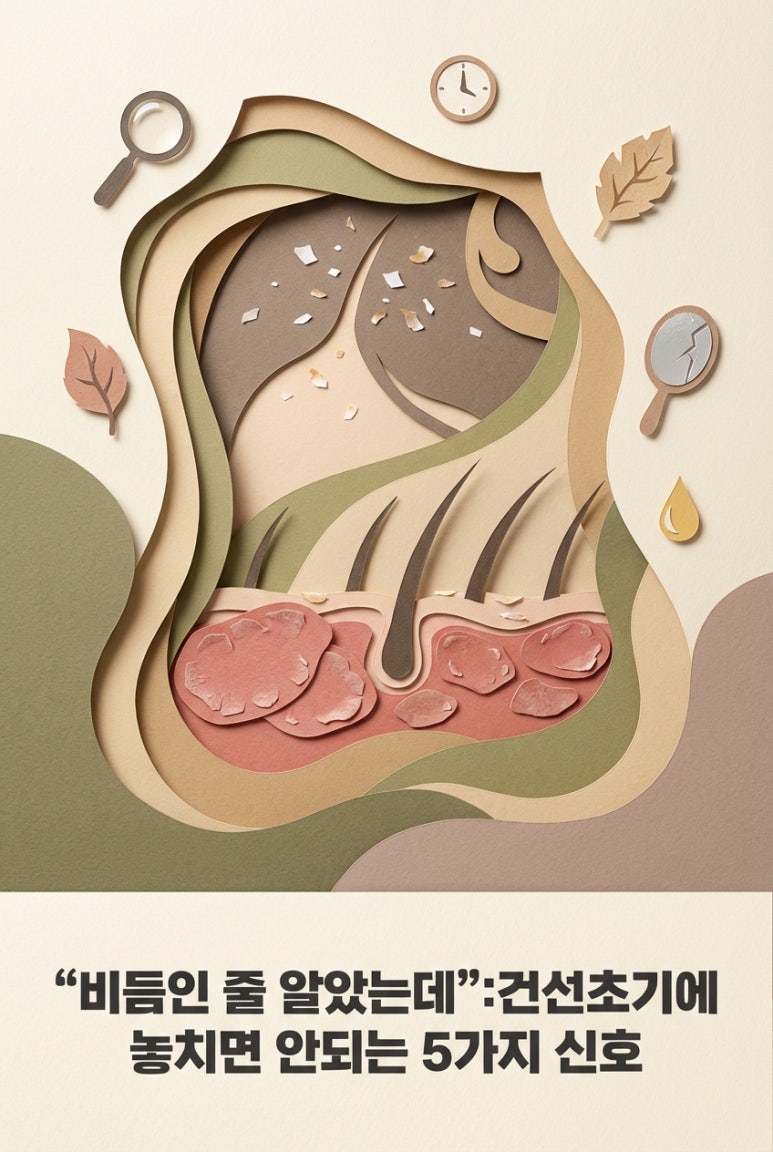
The greatest difference is silvery-white scales stacked in layers on a clearly demarcated red plaque[1].
The good news is that if caught early, a significant number of cases can maintain remission.
Please make sure to check the self-checklist I'm about to introduce and the 3 routines below.
 ✅ Action | Immediate Steps
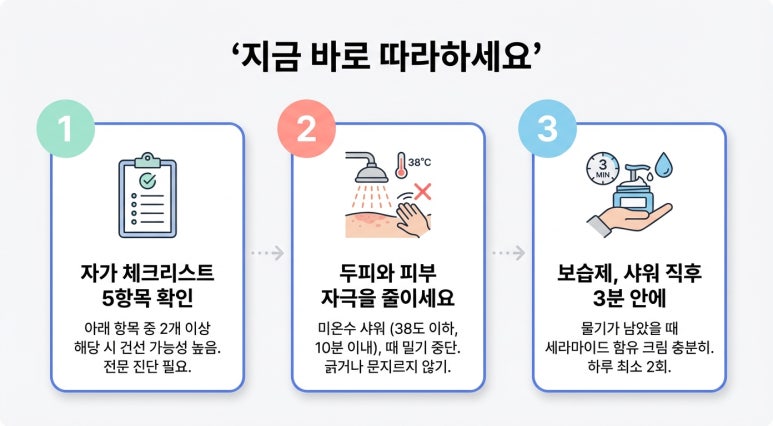
1️⃣ Check 5 Self-Assessment Checklist Items
If 2 or more of the following items apply, the possibility of psoriasis is high.
▷ The skin under the scales is clearly red.
▷ The scale borders are distinct like a coin.
▷ There is no change even after using dandruff shampoo for more than 4 weeks.
▷ It has spread to behind the ears or the hairline on the forehead.
▷ Small beads of blood appear when scales are forcibly removed.
If 2 or more apply, accurate diagnosis should come before self-management.
2️⃣ Reduce Scalp and Skin Irritation
Psoriatic skin is sensitive to external stimuli.
If you scratch or rub it, the Köbner phenomenon occurs, creating new lesions even on normal skin[2].
Keep shower water temperature at 38°C or below with lukewarm water, and limit the time to within 10 minutes.
You should stop exfoliating for the time being.
3️⃣ Apply Moisturizer Within 3 Minutes After Showering
Psoriatic skin loses moisture 2-3 times faster than normal skin.
Applying a ceramide-containing cream generously when water remains on the skin immediately after showering is most effective for recovering the skin barrier.
Apply at least 2 times a day, and add more when itchy or tight.
If there is no improvement even after trying on your own for 4 weeks or more, examining the root cause with a specialist is the fastest approach.
 🚨 Warning | Critical Warning Signs to Check
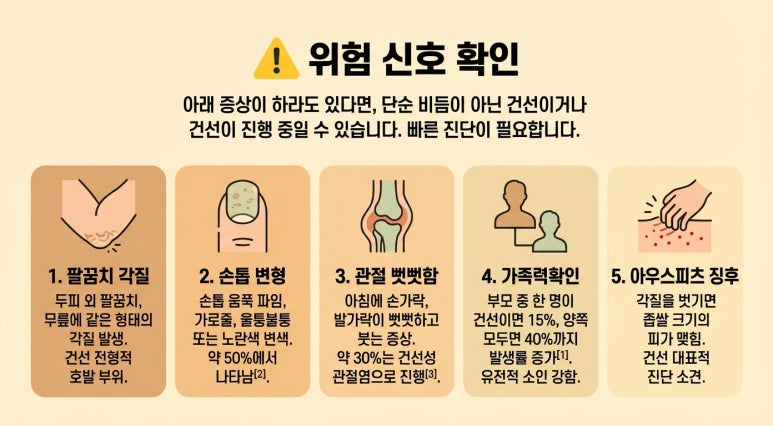
If you have any of the following symptoms, it may not be simple dandruff but psoriasis or psoriasis in progression.
Prompt diagnosis is necessary.
✔ The same form of scales appears on elbows and knees
If symptoms that were only on the scalp also appear on the outer elbows or knees, these are typical predilection sites for psoriasis.
✔ Indented dots or horizontal lines have appeared on the nails
Nail psoriasis appears in approximately 50% of all psoriasis patients[2].
If nails become bumpy or turn yellow, be sure to check with a specialist.
✔ Fingers or toes are stiff and swollen in the morning
Approximately 30% of psoriasis patients progress to psoriatic arthritis[3].
Early detection is important as the treatment direction changes when joint symptoms are involved.
✔ There is a family history of psoriasis
Psoriasis has a strong genetic predisposition.
If one parent has psoriasis, the risk in offspring is approximately 15%, and if both parents have it, it rises to about 40%[1].
✔ Small beads of blood appear when scales are removed
This is called the 'Auspitz sign.'
It is a representative diagnostic finding of psoriasis, and if this sign is present, the possibility of psoriasis is very high.
 🧠 The Why | Understanding the Cause
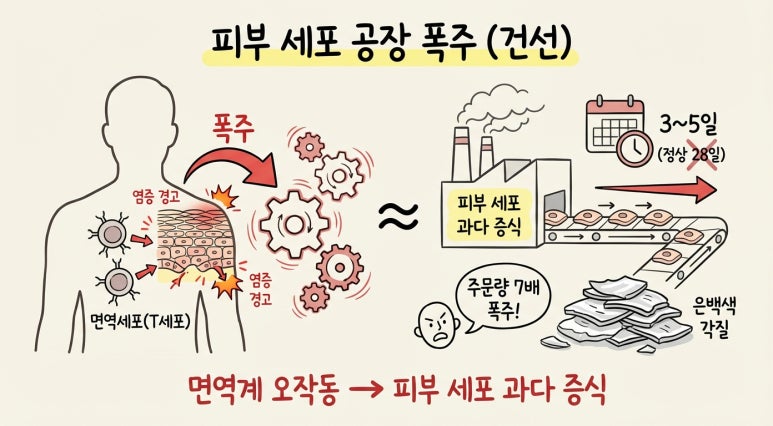
You can think of it as a skin cell factory running out of control.
Normal skin cells are created over approximately 28 days and naturally shed.
However, with psoriasis, this cycle is reduced to 3-5 days.
It's as if the factory is producing 7 times the ordered quantity.
Cells that cannot be properly processed accumulate in layers on the skin, forming those thick silvery-white scales.
Why does this happen?
Immune cells (T cells) mistakenly recognize their own skin as an 'enemy' and issue an attack command.
This attack causes inflammation in the skin, and skin cells grow abnormally rapidly.
In traditional Korean medicine, psoriasis is called 'Baekbi (白疕)' and is viewed in three stages: blood heat (血熱)·blood dryness (血燥)·blood stasis (血瘀)[4].
In the early stage, heat enters the blood, causing the skin to redden (blood heat), and over time, the blood dries, thickening the scales (blood dryness), and when it becomes chronic, blood stasis accumulates, making the skin thick and dark (blood stasis).
Since the treatment direction differs at each stage, identifying which stage you are currently in is key.
The biggest difference from dandruff is this:
Dandruff is caused by excessive sebaceous gland secretion and Malassezia fungus, so most cases improve with antifungal shampoo.
Psoriasis is an immune system problem, so shampoo alone cannot solve it.
📊 Proof | Cases and Evidence
The prevalence of psoriasis in Korea is approximately 1.5-2%, meaning 1-2 out of every 100 people have psoriasis[3].
The problem is that many people initially mistake it for dandruff or eczema and leave it untreated for an average of 6 months to 1 year before seeking treatment.
A male patient in his 30s whom I saw in my clinic had only been changing dandruff shampoos for over 2 years.
His scalp psoriasis had already spread to behind the ears, the hairline on the forehead, and elbows.
After starting herbal medicine and acupuncture treatment along with moisturizing and lifestyle management, the scale thickness noticeably decreased by the 3rd month, and by the 6th month, over 70% of the scalp lesions had improved.
Those who received accurate differentiation in the early stage and started treatment showed much higher remission rates[5].
The later treatment begins, the greater the risk of chronicity and systemic spread, so if you think "this is unusual for dandruff," the best course of action is to get it checked promptly.
 🔚 Closing | Summary and Encouragement
Scales that don't improve even after changing dandruff shampoo.
Clearly demarcated red plaques.
Changes spreading to elbows and nails.
If you see these signals, you should suspect psoriasis.
Psoriasis is much easier to manage when caught early.
When treatment tailored to your constitution and symptom stage is started, many people can live without discomfort in their daily lives.
Don't worry alone; feel free to reach out.
We will examine together what stage your current condition is in and what management is appropriate for you.
✍️ Reviewed by Choi Jang-hyuk, Director of Dongjedang Korean Medicine Clinic
❓ FAQ
Q. Is psoriasis contagious?
No, psoriasis is not contagious.
Psoriasis is an autoimmune disease caused by an immune system abnormality, not a bacterial or viral infection.
It does not spread even if you share towels or have skin-to-skin contact.
Many people experience stress due to misunderstandings from those around them, but you can rest assured on this point.
Q. What happens if I drink alcohol when I have psoriasis?
Alcohol is a representative aggravating factor of psoriasis.
When you drink, the liver's detoxification burden increases, strengthening the systemic inflammatory response, and skin blood vessels dilate, intensifying itching and redness[1].
If complete abstinence is difficult, at least avoid alcohol during flare-ups, and reduce consumption to no more than twice a week in general.
Q. Can I use steroid ointment for a long time?
Steroid ointment is effective at rapidly reducing acute inflammation, but prolonged use can thin the skin and expose blood vessels, causing side effects.
Special caution is needed in areas with thin skin, such as the face or armpits.
Always control the duration and intensity of use under professional guidance, and it is safer to combine herbal medicine, moisturizing, and light therapy for long-term management.
📚 References
[Western Medicine (WM)]
[1] NICE CKS (2024). "Psoriasis – Diagnosis and Management"
[2] AAD (2023). "Psoriasis: Signs and Symptoms"
[3] Korean Dermatological Association (2022). "Psoriasis Clinical Guidelines"
[Korean Medicine (KM)]
[4] Korean Association of Korean Medicine Dermatology and Surgery (2020). "Pattern Differentiation and Treatment of Psoriasis in Korean Medicine"
[5] NIKOM (2021). "Korean Medicine Approach to Chronic Skin Diseases"
Skin
Thought It Was Dandruff: 5 Critical Signs of Early Psoriasis You Cannot Miss
View Program