"After failing IVF three times I feel like my body is broken" | Constitutional recovery and re-challenge after repeated ART failure
 The Third Time Everything Fell Apart
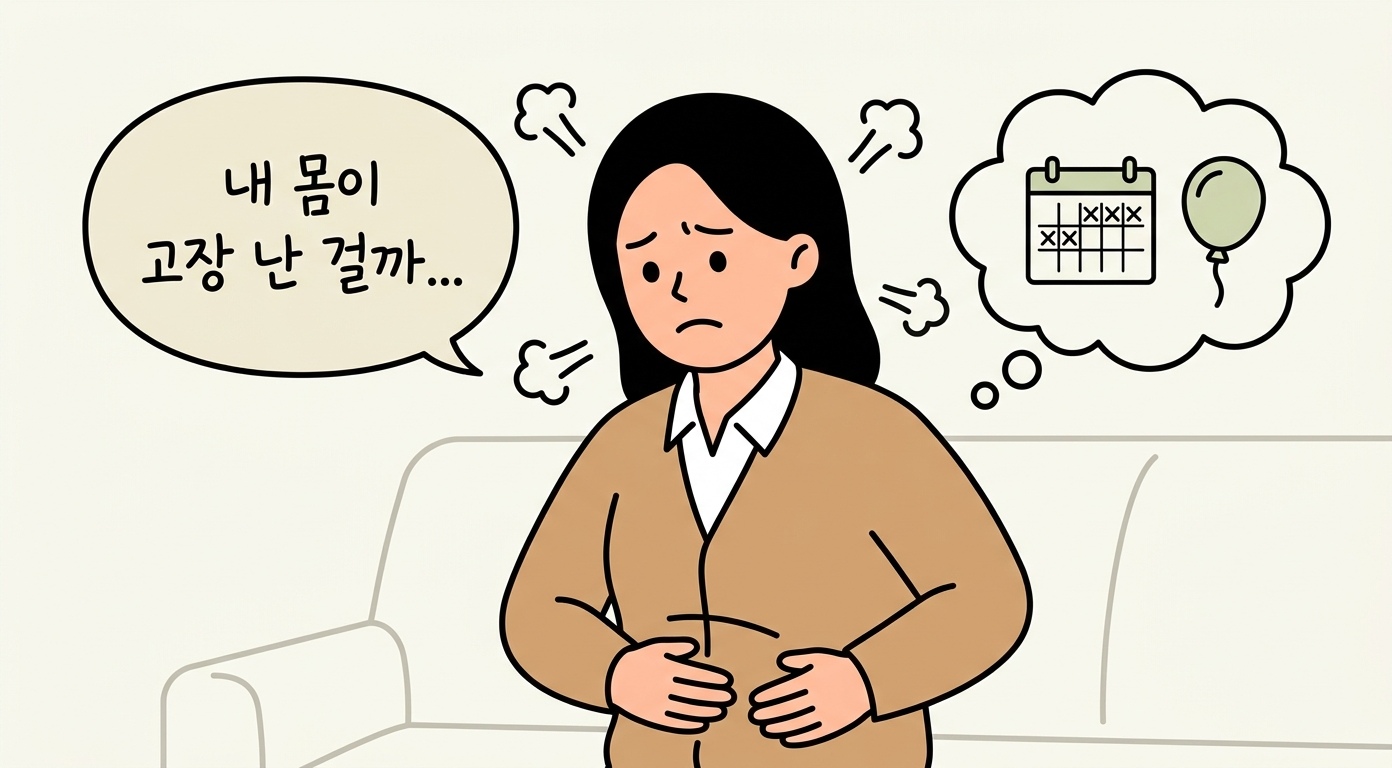
"After my third failed IVF cycle, I started to wonder if something was just broken in my body.
The ovarian stimulation shots left me bloated and swollen all over — I could handle it if the results were good.
But when they told me it didn't work again, I just wanted to give up."
These were the words of Soo-jin (pseudonym), a 36-year-old office worker, the first time she came to see me.
Soo-jin was a woman in her third year of marriage, working a desk job at a small company.
When natural conception didn't happen in her second year of marriage, she began testing at an OB-GYN. She was told her AMH levels were lower than average for her age, and she went straight into in vitro fertilization.
First attempt, second attempt, third attempt.
Each time, her doctor said "the embryo grade isn't bad," but implantation never occurred.
With each repeated cycle, Soo-jin's body grew more and more exhausted.
The side effects of ovarian stimulation shots led to severe abdominal bloating and swelling, and after egg retrieval she often struggled with daily activities for days at a time.
Sleep didn't come until well past 2 a.m., and meals were increasingly replaced with convenience foods.
Most of all, what wore her down was doubt about herself.
"I feel so sorry for my husband.
It feels like I'm the reason we can't have a child."
I didn't just look at Soo-jin's body.
I looked at how much her entire body had been depleted through three cycles, and how deep that exhaustion had accumulated.
Every time I hear stories like this, my heart grows heavy.
So then — if the tests show no particular abnormality, and the embryo grade is fine, why does implantation keep failing?
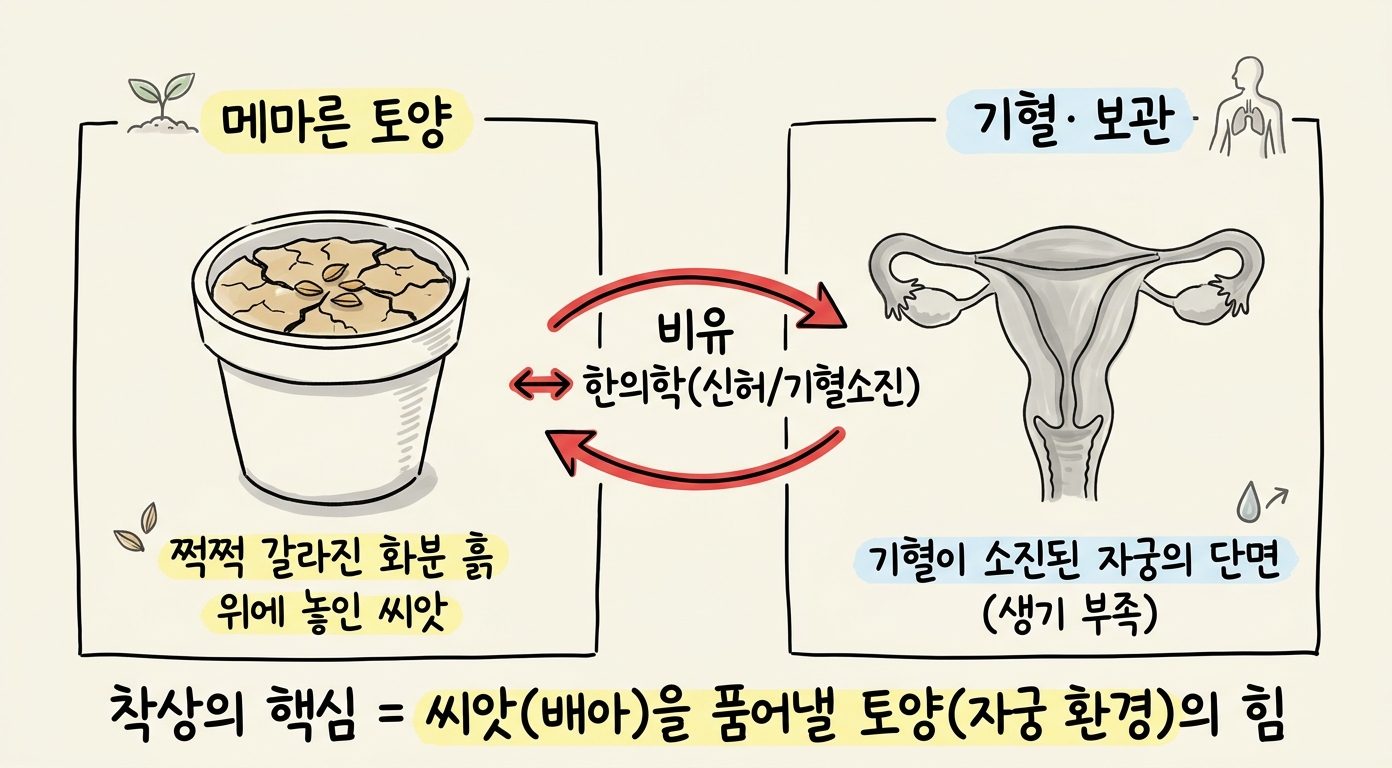 The Problem Is Not the Seed — It Is the Soil
In Korean medicine, this condition is understood through the concept of 신허(腎虛) — Kidney Deficiency.
신허(腎虛) doesn't simply mean the kidneys are weak.
It means the root of the body's reproductive energy has become depleted — the fundamental energy needed to create and sustain pregnancy has run out.
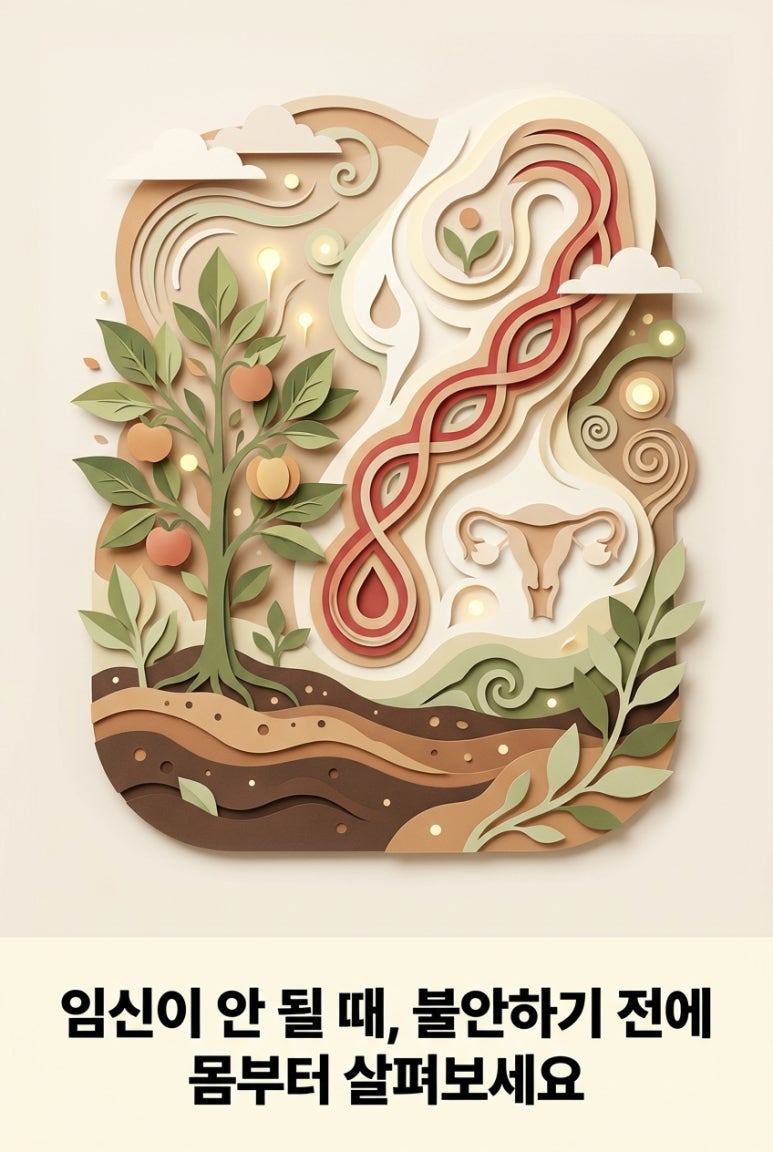
Imagine a dry flower pot.
No matter how good the seed, if the soil is parched and without moisture, roots cannot take hold.
A good embryo grade means the seed is healthy — but if the soil in which it must take root, the uterine environment, is not ready, implantation becomes difficult.
Modern medicine has also begun to focus on this issue through the concept of 자궁내막 수용성 (endometrial receptivity).
It is not just the thickness of the endometrium that matters — whether the endometrium is prepared to receive the embryo is at the heart of implantation.
Korean medicine adds one more layer to this.
The repeated processes of ovarian stimulation, egg retrieval, and embryo transfer place a considerable burden on the body.
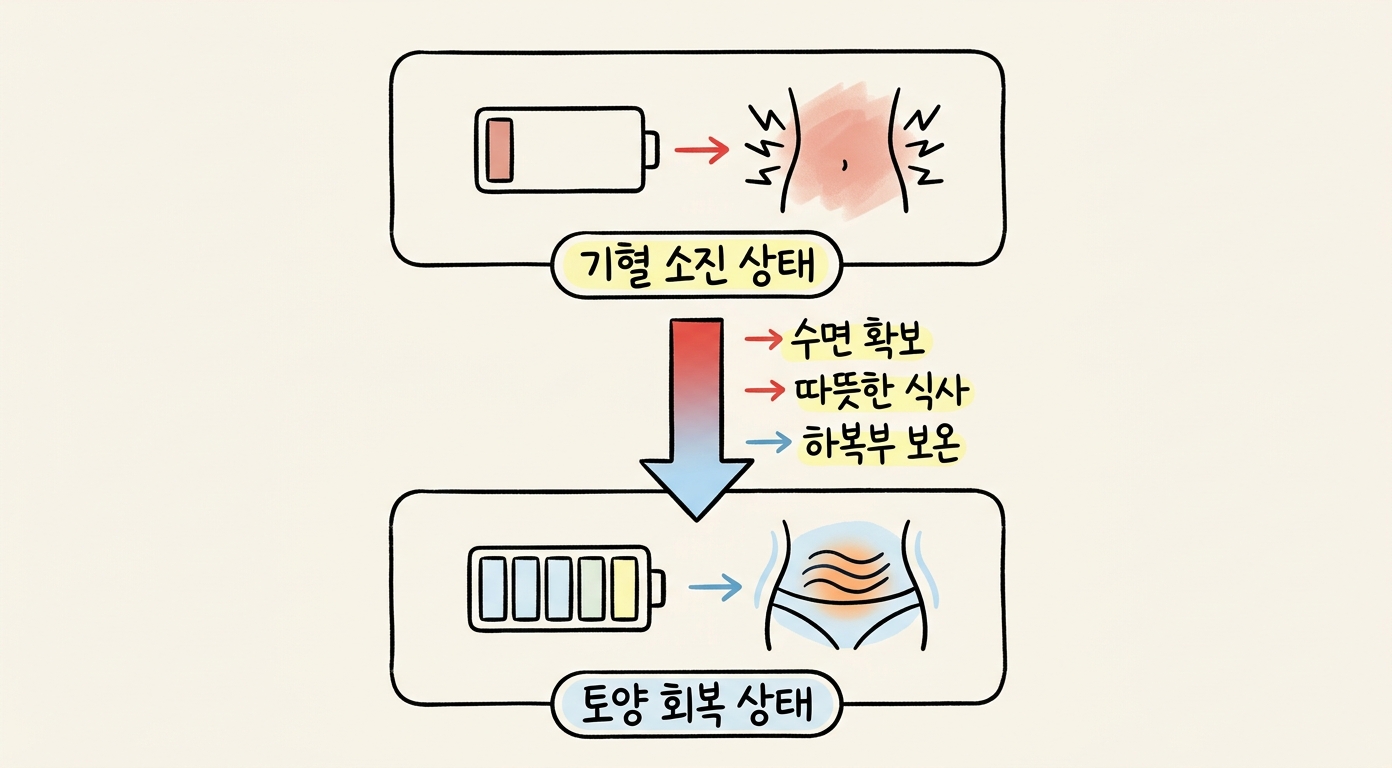
It is like a battery being run continuously without recharging.
Even a single IVF cycle requires the body to simultaneously handle the dramatic hormonal changes, the physical demands of the procedures, and the psychological tension of waiting for results.
When this is repeated, 기혈(氣血) — the body's vital energy and nourishment — becomes exhausted.
기혈(氣血) refers to the flow of energy and nutrients that move and restore the body.
Korean medicine particularly emphasizes that the 충임맥(衝任脈) — the energy pathways leading to the uterus — must flow freely for pregnancy to be possible.
When 기혈(氣血) is depleted, even these pathways lose their strength.
When another cycle is attempted in a body where 기혈(氣血) has been exhausted, it is as if seeds are being planted in already depleted soil.
Repeated procedures deplete 기혈(氣血), and depleted 기혈(氣血) worsens the implantation environment — a cycle.
Unless this cycle is broken, the number of procedures will simply keep increasing.
 If the Body Needs to Rest Before the Next Procedure
So how can one break free from this vicious cycle?
The most important thing is to allow the body the recovery time between cycles.
There is urgency to move on to the next procedure quickly, but if an exhausted body starts again without recovering, the same outcome is likely to repeat.
If sleep has broken down, the bed is the first thing to tend to.
Getting into bed before eleven at night and securing time for the body to rest — this alone helps the hormonal rhythm gradually find its way back.
For meals, reducing convenience foods and eating warm, gentle foods that ease the burden on the digestive system is beneficial.
This is because 비위(脾胃) — the digestive system — must be at ease for 기혈(氣血) to be produced.
Keeping the lower abdomen warm is also a method that Korean medicine's tradition has long emphasized.
The uterus is sensitive to cold environments.
When circulation in the lower abdomen flows well, the condition of the endometrium also improves.
Simple methods like a heating pad or a half-body bath — practiced consistently — can lead to a noticeable change in the body.
However, treatment schedules and medication adjustments must always be discussed with your infertility specialist.
Korean medicine's constitutional strengthening is not a replacement for IVF procedures — it is the process of cultivating the body's soil so that the procedures can succeed.
 The Courage to Stop in Order to Run Again
Four months later, on the eve of her fourth IVF cycle, Soo-jin said:
"I can feel that my body is different this time.
I'm sleeping well, I'm not bloated, and my mind feels more at ease."
I never told Soo-jin to stop the treatments.
I only asked her to pause her run and catch her breath for a while.
What was needed was not simply suppressing symptoms, but the process of changing the body's environment.
During that time, Soo-jin's body began to find its balance on its own.
Please listen to the signals your body is sending.
If you are exhausted right now, that is not your fault — it is a message that your body needs rest.
Your body has a remarkable capacity for recovery.
My role is simply to be a companion in finding the key to that recovery together.
Even if not with me — please find a practitioner who will look carefully at your whole body.
Stopping is not giving up.
It is preparation for running again.
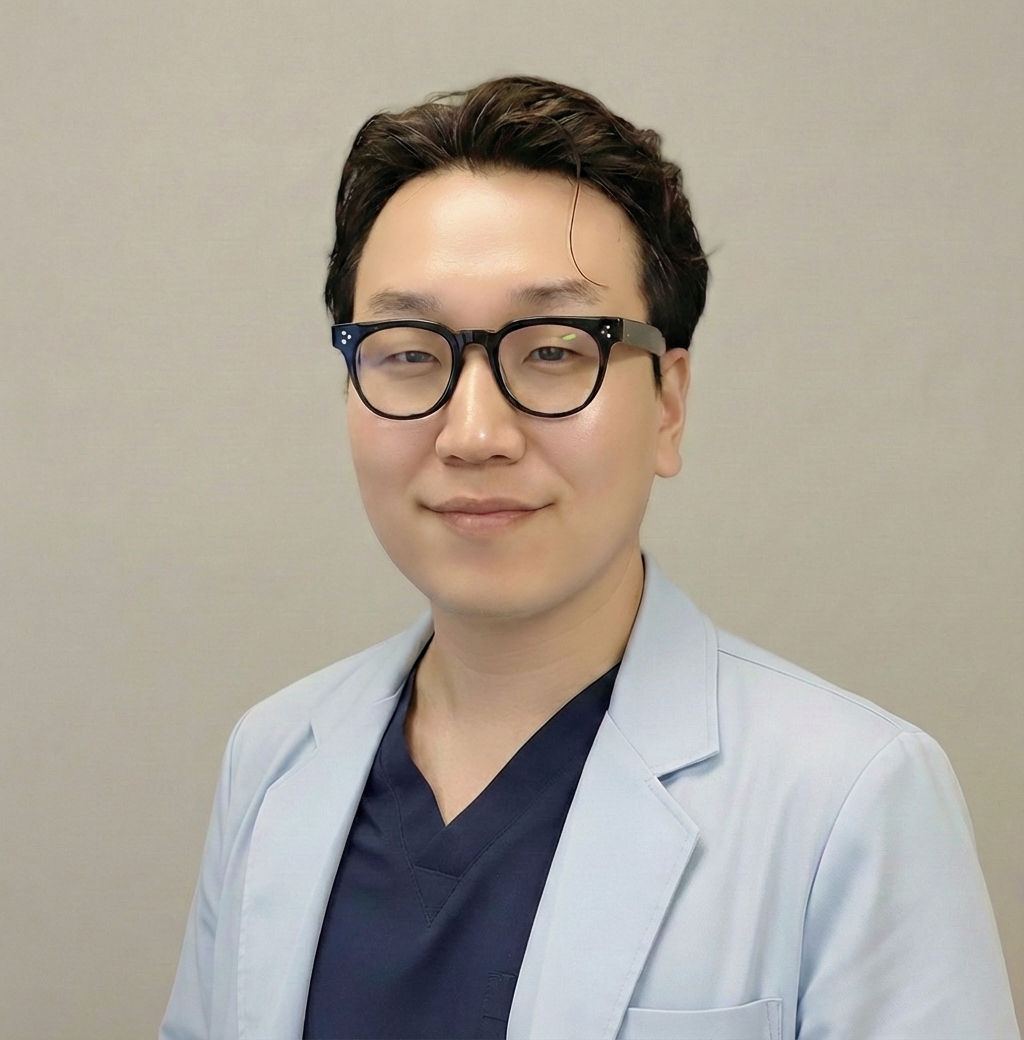
✍️ Reviewed by Dr. Choi Jang-Hyuk, Director of Dongjedang Korean Medicine Clinic
Women's Health
"After failing IVF three times I feel like my body is broken" | Constitutional recovery and re-challenge after repeated ART failure
View Program