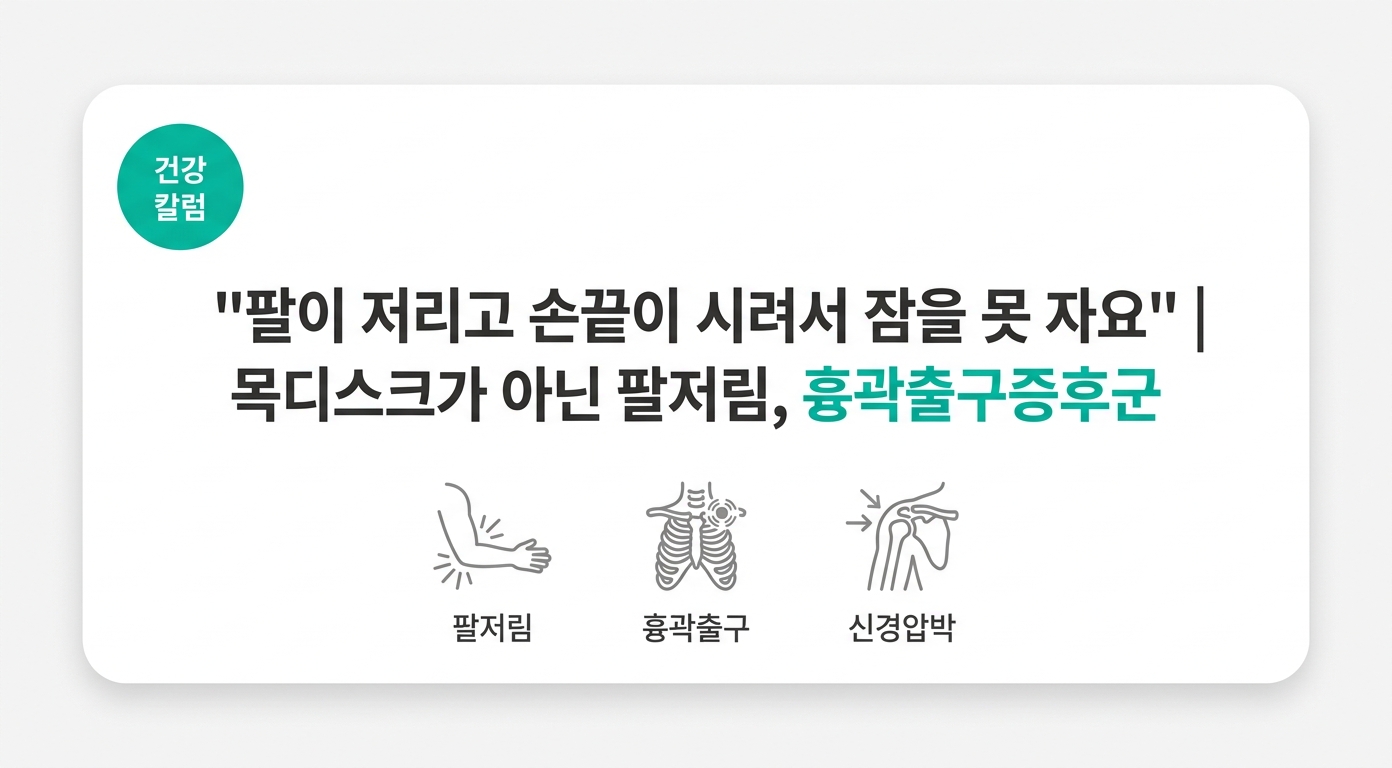
"My arm goes numb and my fingertips are cold so I can't sleep" | Arm numbness that is not a herniated disc: thoracic outlet syndrome

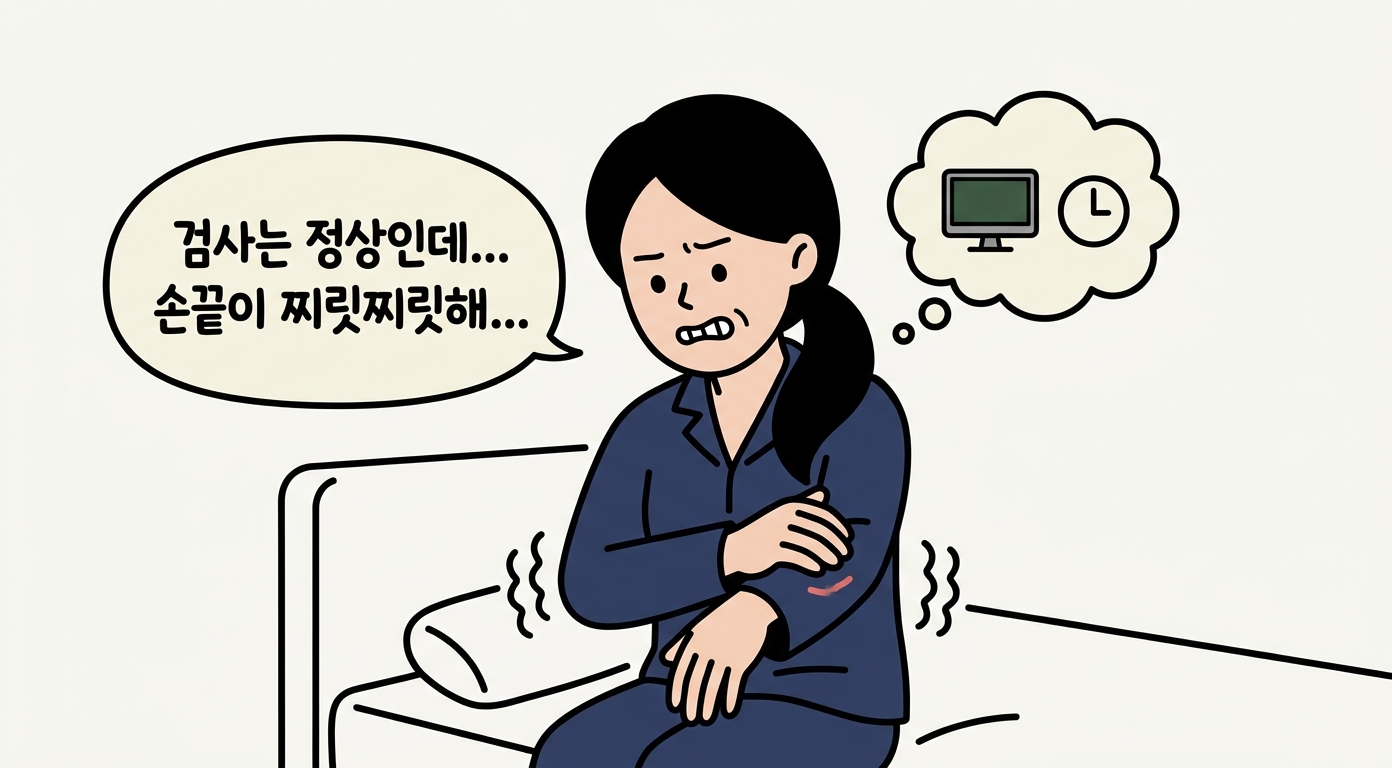 Tests Are Normal — So Why Is My Arm Numb?
"My arm goes numb and my fingertips feel cold, waking me up in the early hours.
When I hold a mouse, there's a tingling sensation on the pinky side, and in the morning my fingers feel stiff and swollen."
These were the words of Soo-jin (pseudonym), a 37-year-old IT freelancer, the first time she came to see me.
Soo-jin worked more than ten hours a day in front of a monitor.
Last autumn, as project deadlines piled up, numbness in her right arm began.
At first she thought it might be from sitting too long — but the numbness spread to her fingertips and started disrupting her sleep every night.
She had X-rays and MRIs taken at two orthopedic clinics, but there was no abnormality in the cervical spine.
At a neurosurgery clinic, she was told only that "there's nothing particularly wrong."
Painkillers from the pharmacy and wrist supports offered little help.
"They say the MRI is normal and the blood tests are fine.
So why does it hurt like this?"
Soo-jin's eyes held both frustration and anxiety.
There was even a shadow of self-doubt — wondering whether something serious was being missed, or whether she was simply overreacting.
I didn't see Soo-jin's symptoms as simply a cervical disc problem.
I paid attention to the state of tension between the neck and shoulders, particularly the muscles above and below the clavicle.
Discomfort that doesn't show up in tests is a lonelier kind of suffering.
Every time I hear stories like this, I find myself deeply relating to the patient's frustration.
So where was Soo-jin's arm numbness actually coming from?
 The Invisible Bottleneck of a Narrowed Passage
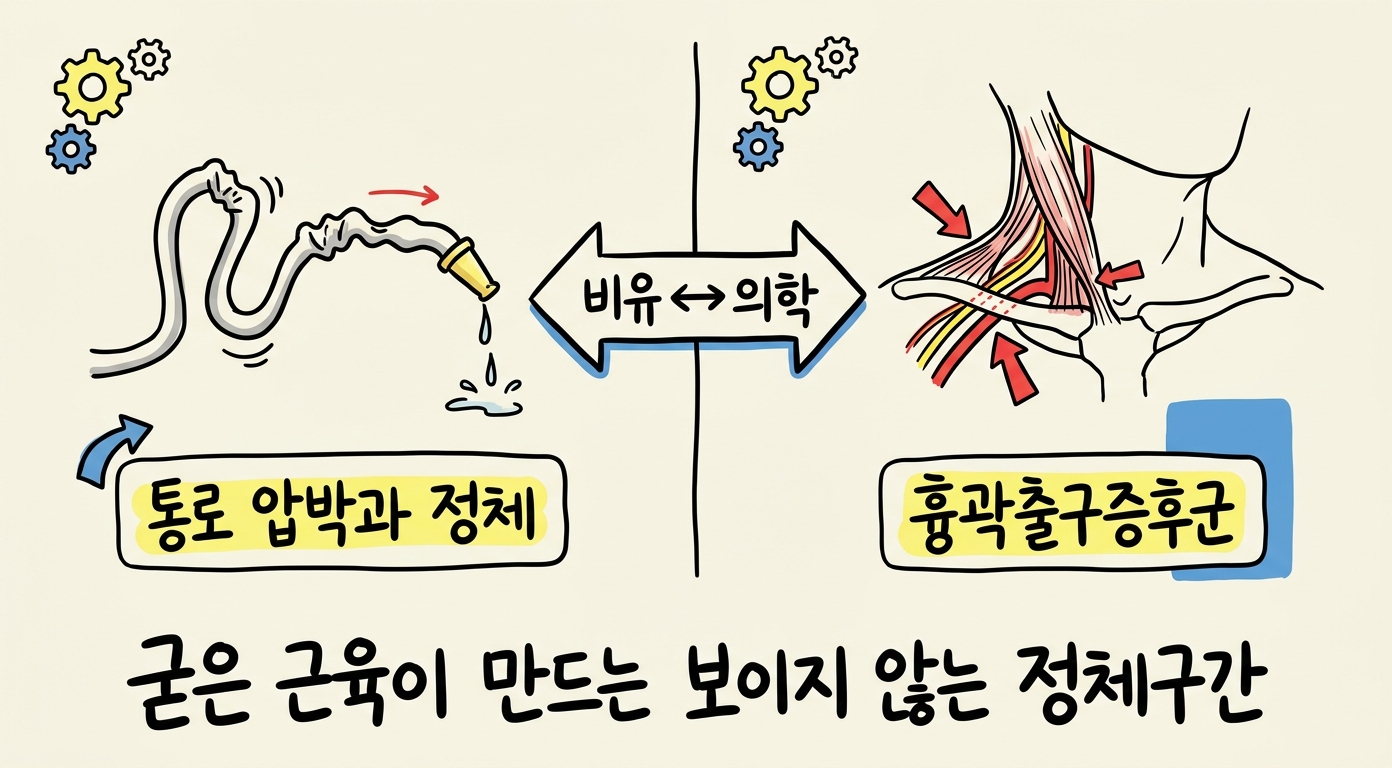
Between our neck and ribcage, there is a narrow passage through which nerves and blood vessels pass.
This space, called the thoracic outlet, is formed between the scalene muscles on the side of the neck, the clavicle, and the first rib.
The brachial plexus and subclavian artery passing through this space control sensation and blood flow throughout the arm and hand.
Imagine a bottleneck on a highway.
The road itself is perfectly fine — but when just one section narrows, cars pile up behind it.
When the thoracic outlet narrows, numbness, coldness, and heaviness appear all the way down to the arm and fingertips — for the same reason.
In Korean medicine, this is understood as an obstruction of 기혈(氣血) circulation.
When the pathways of the meridians through which 기(氣) and 혈(血) flow become blocked, numbness and cold sensations — known as 비증(痺症) — appear.
Simply put, when vital energy and blood cannot circulate properly, the arm and hand grow numb.
In particular, when the 경근(經筋) — the meridian sinews connecting the neck, shoulder, and arm — become rigid from prolonged tension, the flow of 기혈(氣Blood) within them is also blocked.
If you have ever bent a garden hose, you know the feeling.
There is nothing wrong with the hose itself — but because of the kink, water trickles or stops.
Something similar was happening in Soo-jin's body.
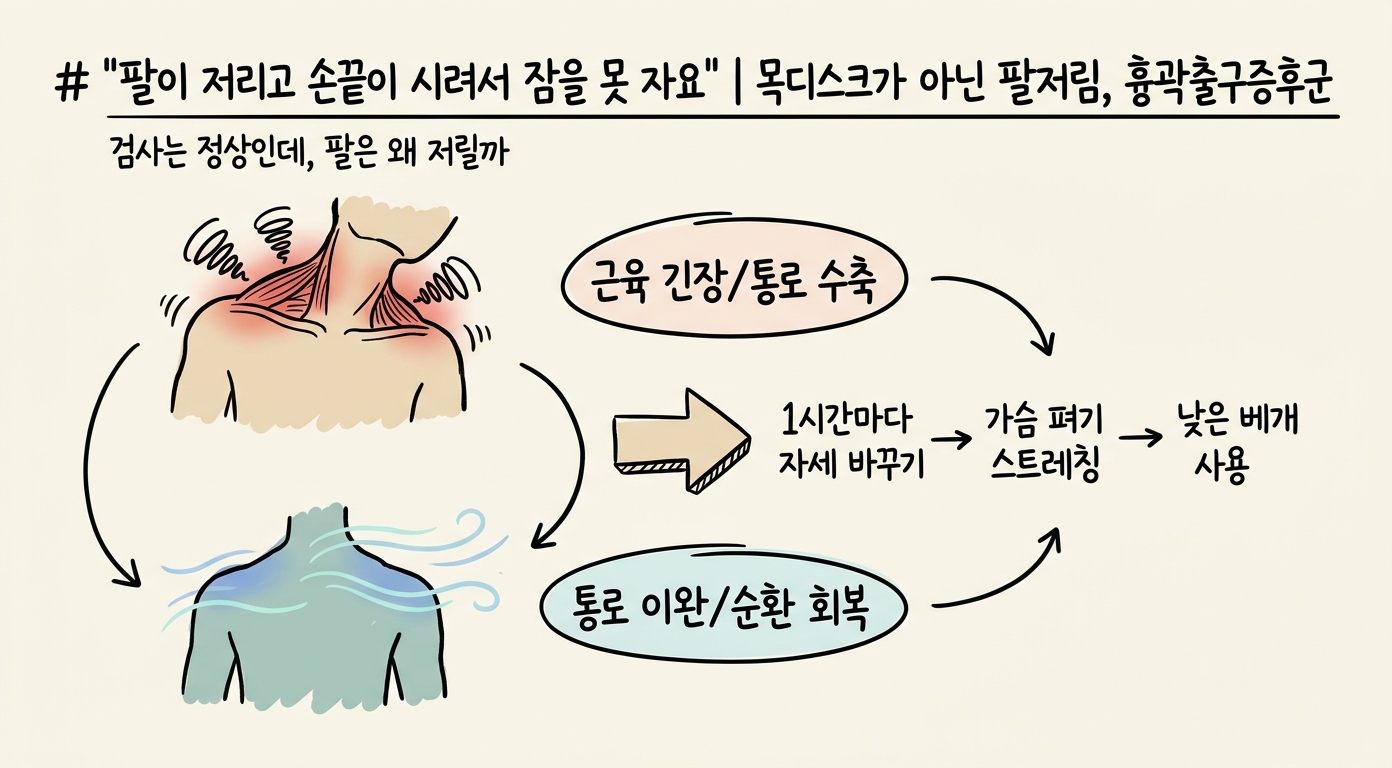
Working for long hours in a hunched posture had hardened the scalene muscles along the side of the neck and the pectoralis minor at the front of the chest, compressing the nerves and blood vessels passing between them.
In modern medicine, this condition is called Thoracic Outlet Syndrome (흉곽출구증후군).
It is characterized by being rarely visible on imaging tests such as MRI or X-ray.
A significant number of complaints about arm numbness despite normal test results are related precisely to this narrowed passage.
Compression creates numbness, numbness disrupts sleep, and sleep deprivation further tightens the muscles — a vicious cycle.
 So How Can One Break Free from This Frustrating Numbness?
As seen in Soo-jin's case, posture and lifestyle habits lie at the root of Thoracic Outlet Syndrome.
While sitting for long hours looking at a monitor, the shoulders roll forward, the neck protrudes, and the muscles at the front of the chest shorten.
When this continues for months and years, the thoracic outlet inevitably narrows little by little.
The most accessible thing to do in daily life is to change your sitting posture from time to time.
Once an hour, leaning the back against the chair and gently spreading both arms behind to open the chest can release tension in the pectoralis minor and scalene muscles.
Tilting the head slightly back to look at the ceiling at the same time also relaxes the muscles at the front of the neck.
For those who wake up at night with numb arms, try checking the pillow height.
A pillow that is too high creates more tension in the muscles along the side of the neck, narrowing the passage further.
In Korean medicine, the approach combines acupuncture to release the hardened 경근(經筋) with methods that support the flow of blocked 기혈(氣血).
The key is not just looking at the painful area alone, but examining the entire flow from neck to shoulder to arm.
However, if arm numbness is accompanied by a noticeable pallor in the hand or a sudden loss of strength in the arm, vascular compression may have worsened — seek medical attention immediately.
 Not Ignoring the Small Signals the Body Sends
Three months later, Soo-jin said with a smile that she was now able to sleep through the night without waking.
It was not simply a matter of suppressing symptoms — it required the process of widening the narrowed passage again and changing the body's environment.
Numbness in the arm and cold fingertips are small signals from the body.
Listening to those signals is the beginning of recovery.
Your body has a remarkable ability to find its own balance.
My role is to be a companion in finding the key to that recovery together.
Even if not with me — please find a healthcare provider who looks carefully not just at test results, but at the flow of the whole body.
✍️ Reviewed by Dr. Choi Jang-Hyuk, Director of Dongjedang Korean Medicine Clinic
Pain
"My arm goes numb and my fingertips are cold so I can't sleep" | Arm numbness that is not a herniated disc: thoracic outlet syndrome
View Program