"When I stop birth control my period stops again" | Polycystic ovary syndrome in a woman who wants to break free from birth control dependence
 The Body That Goes Silent When the Pills Stop
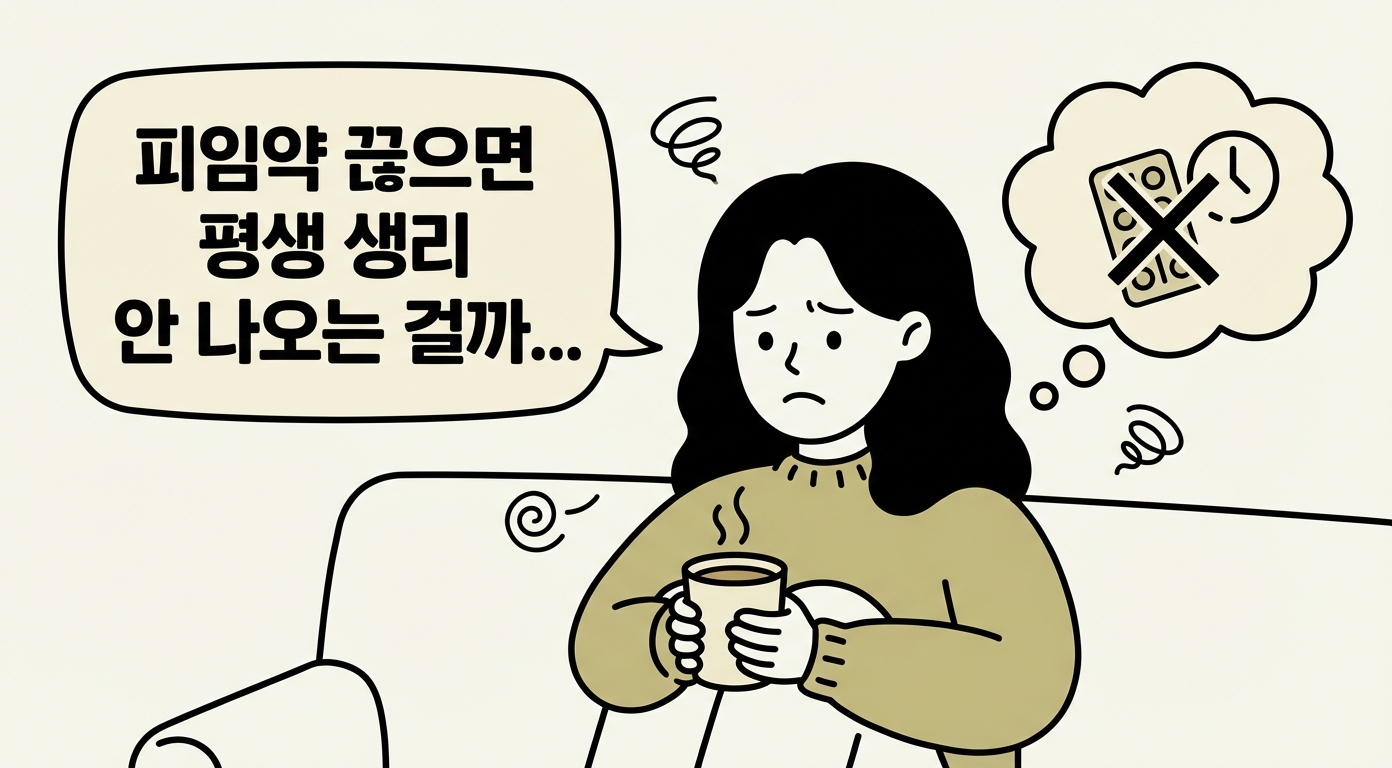
"When I take the contraceptive pill, I get my period. But when I stop, it doesn't come for three or four months.
The gynecologist just tells me to start taking the pill again.
I wonder if this is how I'll have to live for the rest of my life."
These were the words of Su-hyeon (pseudonym), a 29-year-old office worker, when she first came to see me.
Su-hyeon worked in marketing at a small-to-medium-sized company.
Her periods became irregular when she was 22, in her third year of university, and she was diagnosed with polycystic ovary syndrome (PCOS) at a gynecology clinic.
She was prescribed oral contraceptives from that point on, and for the following seven years had been cycling on and off the medication.
While taking the pills, her period came on a fixed date every month.
But when she stopped, her period stopped with it.
She had tried three different gynecology clinics, but the answer was always the same.
She had tried supplements she found online for half a year, and had attempted dieting, but only ended up in a cycle of yo-yo weight changes.
"I keep getting spots around my chin, I keep putting on weight — it feels like my body is broken."
There was a look of resentment and helplessness in Su-hyeon's eyes when she spoke about her own body.
Her blood test had shown hormone levels that were somewhat elevated, but she had only been told "it's nothing to worry about."
The numbers were apparently fine, yet her body kept sending strange signals.
I did not view Su-hyeon's symptoms as simply a matter of hormone levels.
Behind the artificial cycle the pill had created, I focused on the process by which Su-hyeon's body had lost its own rhythm.
Every time I hear a story like this, I feel profound empathy.
The frustration of having to entrust to medication what your body should be doing on its own.
The vague fear of wondering, "Will I be able to have a child someday?"
So why does the body fall silent again once the pill is stopped?
 A Bicycle That Falls Over When the Training Wheels Come Off
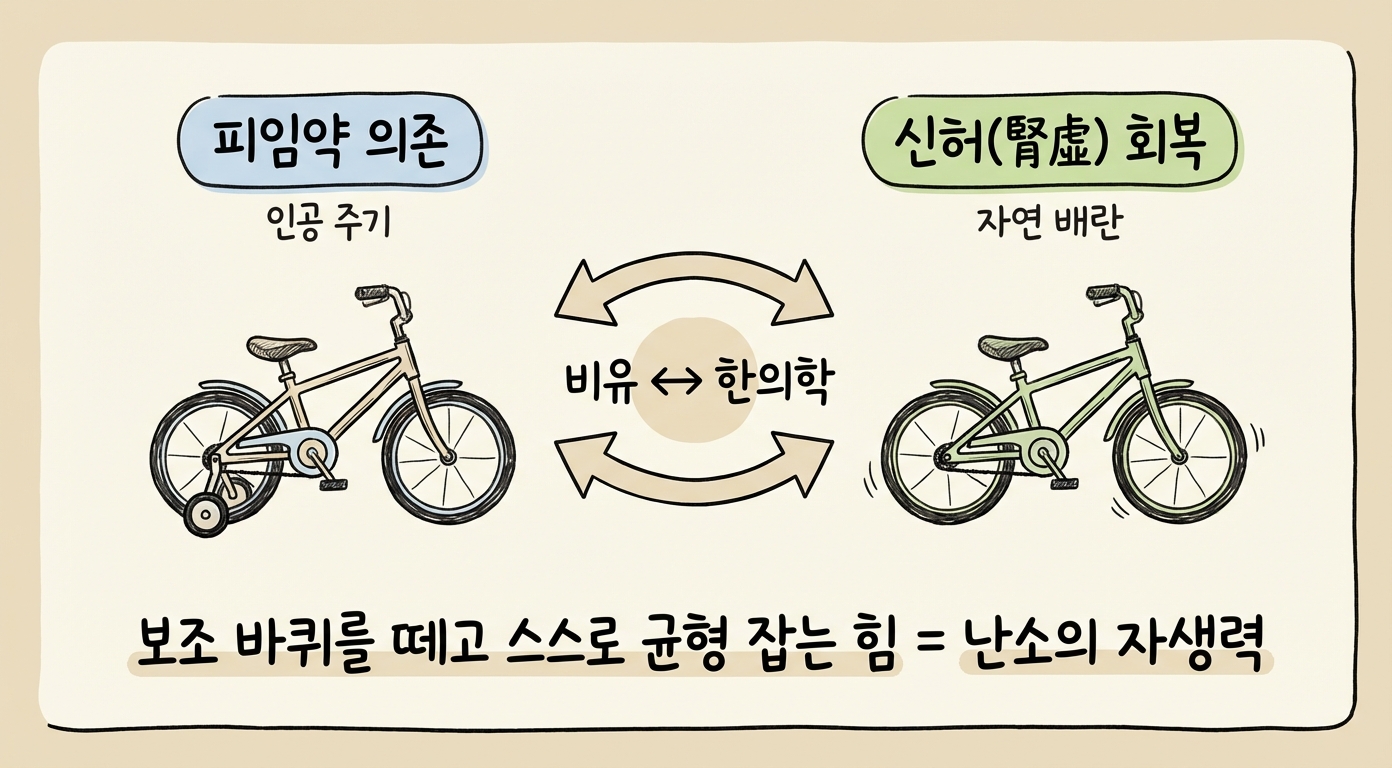
I often compare this situation to a bicycle with training wheels.
Oral contraceptives are a device that introduces hormones from outside to create an artificial menstrual cycle when the ovaries are unable to ovulate on their own.
It is like training wheels that prevent the bicycle from falling over.
But relying solely on the training wheels means you can never learn to balance on your own.
When menstruation stops again after the pills are discontinued, it is no different from the bicycle lurching the moment the training wheels are removed.
In Korean medicine, this state is understood through the concept of 신허(腎虛) — kidney deficiency.
Here, the term "kidney" (腎) does not refer simply to the organ.
It signifies the foundational energy that governs reproduction and growth.
The failure to ovulate in PCOS is a state in which this foundational energy has weakened and the ovaries can no longer fulfill their role.
To this is often added 비허습담(脾虛痰濕) — spleen deficiency with phlegm-dampness.
When the function of the spleen-stomach (脾胃), which governs digestion and metabolism, declines, waste and dampness accumulate within the body.
This corresponds in meaning to what modern medicine calls insulin resistance.
When insulin fails to function properly, blood sugar regulation becomes difficult, and this disrupts hormonal secretion from the ovaries.
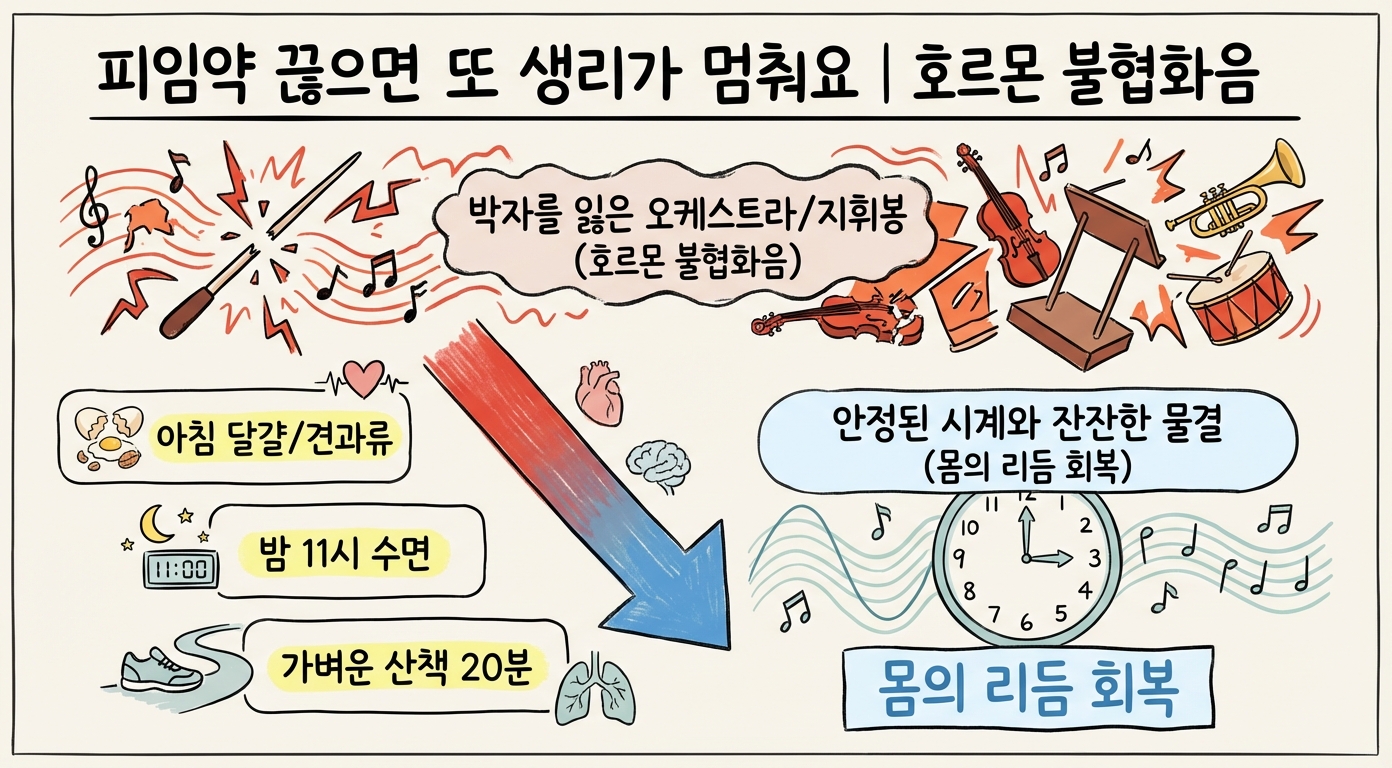
It is like an orchestra in which the conductor has lost the beat.
When the ovaries, adrenal glands, and pancreas each begin playing to a different tempo, the hormonal harmony of the entire body collapses.
Weight increases, acne appears on the chin, and hair falls out.
These are all manifestations of this disharmony surfacing.
Trying to address each symptom one by one leads nowhere.
It is only when the conductor returns to their place that the whole orchestra can find its sound again.
 Can My Body's Rhythm Be Restored?
For someone like Su-hyeon who has depended on oral contraceptives for a long time, the body needs time to remember its own rhythm.
But there are lifestyle changes that can support that process.
The first thing to look at is your diet.
The pattern of skipping breakfast and eating heavily at lunch and dinner causes blood sugar to spike and crash rapidly, fueling insulin resistance.
Having just one egg or a small handful of nuts in the morning can change the way blood sugar flows throughout the day.
Reducing sweet drinks and flour-based snacks is also a great help to the ovaries.
Sleep is also deeply connected to the rhythm of hormones.
In Korean medicine, the hours between 11 p.m. and 1 a.m. are the time when the liver (肝) recovers its energy.
Being awake during this time disrupts the circulation of qi and blood.
Simply going to bed and waking up at the same time each day gradually makes the body's internal clock more accurate.
Gentle, low-impact movement such as light walking or stretching is also helpful.
Vigorous exercise can actually raise stress hormones, so a 20~30 minute walk each day is sufficient.
However, if your period has been absent for six months or more, or if there is sudden bleeding, please visit a gynecology clinic for an examination first.
Confirming the condition of the uterine lining is the starting point for a safe recovery.
 For the Day You Pedal on Your Own
Polycystic ovary syndrome is not a condition where simply suppressing symptoms is enough.
It requires a process of changing the body's environment itself.
You cannot have the training wheels of oral contraceptives on forever.
In Korean medicine, we approach this by strengthening the energy of the kidney (腎), restoring the metabolic function of the spleen-stomach (脾胃), and clearing the phlegm-dampness that has stagnated within the body — creating an environment in which the body can ovulate on its own.
Because the approach is tailored to each person's constitution and condition, the treatment differs from person to person even with the same PCOS diagnosis.
Three months later, Su-hyeon got her period for the first time under her own power, without medication.
I still remember the relief and joy contained in those words: "My body did it."
Please listen to the signals your body is sending.
Your body possesses a remarkable power to rediscover its own rhythm.
My role is simply to serve as a helper who supports that power in working again.
Even if it is not with me, I hope you find a healthcare provider who looks carefully at the balance of your whole body, not just your hormone numbers.
✍️ Reviewed by Dr. Choi Jang-hyeok, Director of Dongjedang Korean Medicine Clinic