Do Oriental Medicine Clinics Perform Blood Tests?
 🧾 Answer First | Core Conclusion
"Do Oriental medicine clinics perform blood tests?"
This is one of the most frequently asked questions in consultation rooms.
Yes, we do.
According to the Ministry of Health and Welfare's official interpretation (1995, 2014, 2016 reconfirmation),
Oriental medicine doctors are permitted to perform blood draws and use automated blood test equipment.
Our clinic has been directly performing blood draws in-house and conducting tests with automated equipment since 2010.
And this testing greatly helps elevate the accuracy of Oriental medicine diagnosis to the next level.
 🧠 The Why | Why Do Oriental Medicine Doctors Need Blood Tests?
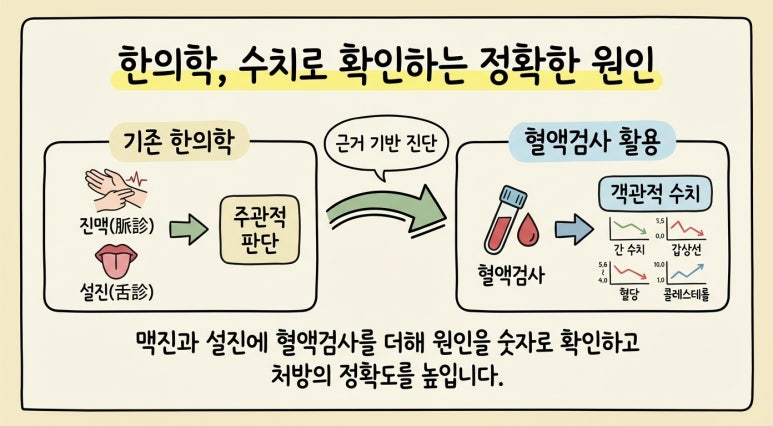
Many people associate Oriental medicine only with pulse diagnosis (脈診) and tongue diagnosis (舌診).
Of course, pulse and tongue diagnosis are the cornerstones of Oriental medicine diagnosis.
However, you cannot determine thyroid levels from pulse diagnosis.
It is also difficult to accurately identify blood sugar or cholesterol levels through pulse diagnosis alone.
By utilizing blood tests together, what has changed is
the ability to confirm "why these symptoms occurred" with concrete numbers.
We can now explain to patients with visible evidence: "These symptoms are appearing because your liver function is elevated."
The direction of treatment has also become more accurate.
Even with the same fatigue symptom, the treatment for iron deficiency fatigue and fatigue caused by thyroid issues is completely different.
📊 Proof | 19 Years of Clinical Experience
📌 Application in Herbal Medicine Prescription
There are situations where blood tests are particularly helpful.
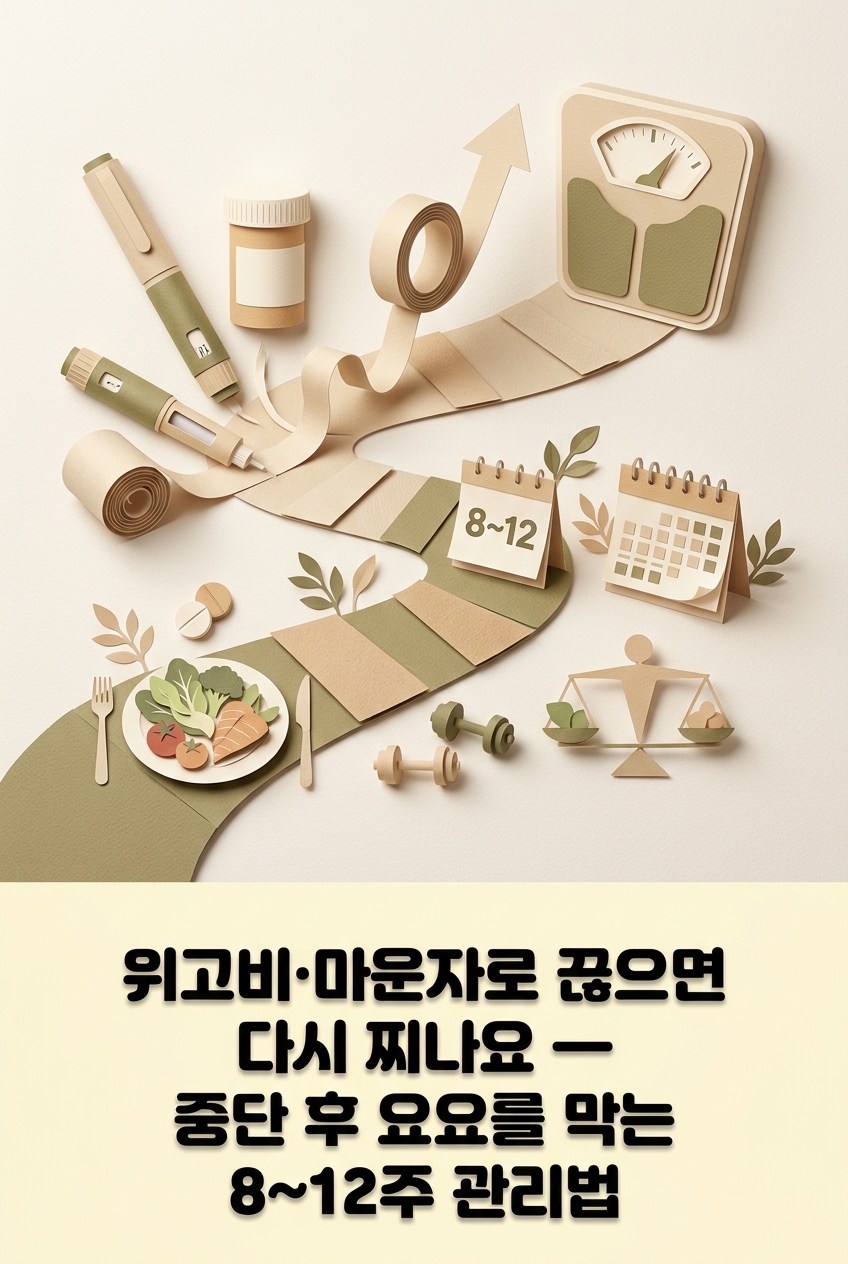
✔ Before prescribing weight-loss herbal medicine ✔ Before prescribing herbal medicine for chronic fatigue or lassitude ✔ Before prescribing herbal medicine for women's diseases (menstrual irregularities, menopause)
In these cases, prescribing based only on symptoms can miss the underlying cause.
When we first confirm the cause through blood tests and then prescribe accordingly, the results are much faster.
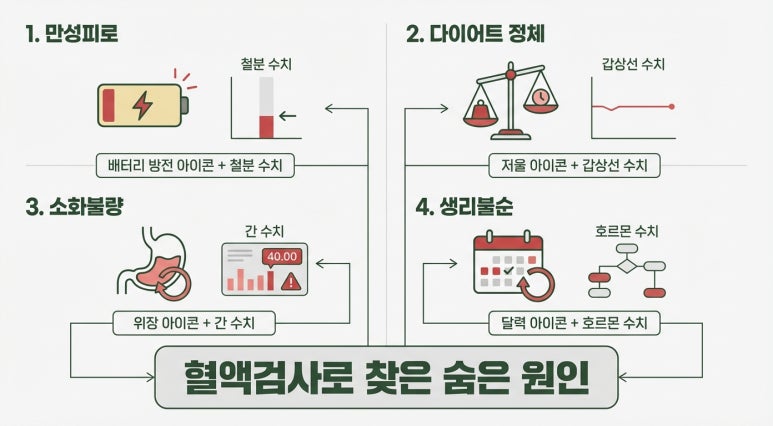 📌 Things Difficult to Find with Pulse Diagnosis Alone
Not everything can be discovered through Oriental medicine pulse diagnosis. There have been several instances where utilizing blood tests together changed the direction of treatment.
Case 1. A 30-year-old woman who is tired no matter how much she sleeps
A 30-year-old female patient presented with chronic fatigue. Clinical examination suggested qi deficiency (氣虛), but something seemed off. Blood tests revealed ferritin (storage iron) levels at rock bottom. Hemoglobin was within normal range, but she had "hidden anemia" with depleted iron stores. → We treated her by adding blood-tonifying (補血) direction to the qi-supplementing (補氣) prescription, and within a month, she reported "waking up in the morning feels different."
Case 2. Why weight doesn't come off — Thyroid
Among weight-loss patients, there are cases where weight doesn't decrease despite strict dietary control. Blood tests revealed elevated TSH levels. Thyroid dysfunction. → Instead of simple weight-loss prescription, we changed to a prescription prioritizing thyroid function recovery and proceeded accordingly.
Case 3. I thought it was indigestion — Abnormal liver function
A 40-year-old male patient with bloating and loss of appetite. Clinical and pulse examination showed spleen-stomach (脾胃) weakness. However, blood tests showed AST and ALT (liver enzymes) three times normal. Upon inquiry, he was taking multiple health supplements. → Instead of spleen-stomach prescription, we changed to liver function recovery treatment and after discontinuing unnecessary supplements, he improved.
Case 4. Menstrual irregularity and polycystic ovary syndrome
A 20-year-old female with irregular menstruation. Blood tests showed elevated male hormone (testosterone) and confirmed insulin resistance. It was PCOS. → Rather than simple menstrual irregularity treatment, we treated her with a prescription considering both hormonal balance and insulin resistance.
If we had judged based only on pulse and clinical examination, these patients might have received inappropriate treatment, which would have been difficult for both patient and doctor.
 🚨 Warning | Important Points to Understand
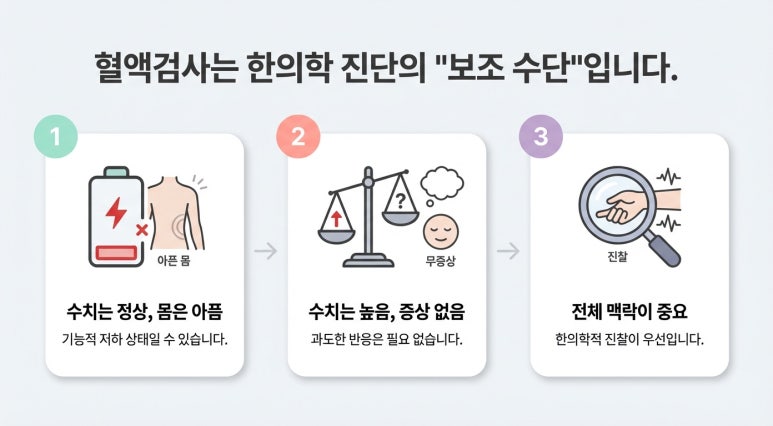
Blood tests are a "supplementary tool" to Oriental medicine diagnosis.
Like ultrasound, blood test values are not everything.
There are cases frequently seen in clinical practice.
✔ Cases where all test values are normal, but the body is clearly unwell. Even within normal test ranges, there can be functionally diminished states. In such cases, Oriental medicine examination often reveals the problem.
✔ Conversely, cases where values are slightly elevated but there are no symptoms at all. You don't need to react excessively to a single value. You must view the entire context together.
Therefore, the Oriental medicine doctor is the main diagnostician, and blood tests are the tool that aids that judgment.
Oriental medicine clinical examination—seeing, listening to, and physically examining the patient—comes first,
and blood tests play a role in confirming and supplementing that judgment.
No matter how clean the values are, the experience and judgment of the person interpreting the tool is key.
 "Do Oriental medicine clinics perform blood tests?"
Now we can answer this question with confidence.
Yes, we do.
The combination of traditional Oriental medicine diagnosis and modern testing tools.
This is the experience our clinic has built over 19 years since 2007.
Unexplained fatigue, weight that won't come off, recurring indigestion — you don't have to bear these alone.
If you would like a consultation where we can examine both your constitution and test results together, please feel free to contact us anytime.
✍️ Reviewed by Dr. Choi Jang-hyuk, Director of Dongjethang Oriental Medicine Clinic
❓ FAQ
Q. Is blood testing at an Oriental medicine clinic different from a hospital?
The test items and equipment are identical. Since our clinic directly conducts tests with in-house automated equipment, results come faster. However, the difference is that we interpret test results together with Oriental medicine diagnosis (pulse examination, clinical inquiry, and tongue examination). When necessary, we recommend advanced hospital testing.
Q. What test items do you examine?
It varies depending on symptoms and purpose, but we primarily check general blood tests (CBC), liver function, kidney function, thyroid function, blood sugar, cholesterol, iron levels, inflammation markers, and others. For women's diseases, we sometimes add hormone tests.
Q. If blood test results are normal, does that mean nothing is wrong?
No. Even if values are within normal range, there can be a functionally diminished state. For example, if ferritin (storage iron) is near the lower limit of normal, it is technically "normal," but the body may already be experiencing iron deficiency symptoms. That's why we make comprehensive judgments together with Oriental medicine examination.
Q. Why do blood tests when receiving herbal medicine treatment?
Even with the same symptom, the prescription differs completely if the underlying cause is different. Whether fatigue is from iron deficiency, thyroid problems, or liver dysfunction changes the treatment direction. We must know the accurate cause to provide accurate treatment.
Q. How long does it take to get blood test results?
Since we have automated testing equipment in-house, results come out within 1 hour of blood draw at the fastest, or by the next day at the latest. When results are ready, we explain them directly and discuss treatment direction together.
Q. Is it legal for Oriental medicine doctors to order blood tests?
The Ministry of Health and Welfare stated in its 1995 official interpretation that blood draws by Oriental medicine doctors are permissible, and in 2014, it added the interpretation that "Oriental medicine doctors can use blood test equipment where results are automatically quantified and extracted." It reconfirmed this position in 2016. Our clinic has been conducting blood tests with in-house automated equipment since 2010.
📚 Reference Materials
[Laws and Administration]
Medical Services Act Article 2 - Oriental medicine doctors engage in Oriental medicine services and Oriental medicine health guidance as their duty. https://www.law.go.kr/LSW/lsInfoP.do?lsiSeq=243547#0000
Ministry of Health and Welfare Official Interpretation (의정 65507-914, August 4, 1995) - Blood draws and clinical testing by Oriental medicine doctors are permissible. Ministry of Health and Welfare (March 19, 2014) - Interpretation that automated blood test equipment use by Oriental medicine doctors is permissible. Ministry of Health and Welfare (September 8, 2016) - Reconfirmed unchanged position from 1995 interpretation. https://www.medicaltimes.com/Mobile/News/NewsView.html?ID=1126555
[Medicine]
National Institute of Korean Medicine (NIKOM) - Development and Distribution Project of Korean Medicine Standard Clinical Practice Guidelines https://nikom.or.kr/nckm/html.do?menu_idx=43