
Blog July 29, 2026
Will Weight Return After Stopping Wegovy or Mounjaro? — 8-12 Week Management Strategy to Prevent Rebound After Discontinuation

Jang-Hyuk Choi, KMD
Head Doctor
Table of Contents
- 🧾 Answer First | Core Conclusion
- ✅ Action | Immediate Implementation — What to Prepare Before Stopping the Medication?Start from 4 weeks before discontinuation. If you've already stopped, you can begin now.
- 🚨 Warning | Critical Warning Signs to Check — What Type of Weight Regain Is Dangerous?
- 🧠 The Why | Root Cause Analysis — Why Does Appetite Return Fully When You Stop the Medication?
- 📊 Proof | Cases and Evidence — How Much Actually Returns?
- 🔚 Closing | Summary and Encouragement
- ❓ FAQ
- Q. Can I start herbal medicine right after stopping Wegovy?
- Q. How many weeks before stopping the diet injection should I start preparing?
- Q. I used Saxenda and stopped it, but is it too late to manage it now?
- Q. I've already experienced rebound. Is it too late now?
- Q. What does it mean to focus on body composition rather than weight?
- 📚 References
 🧾 Answer First | Core Conclusion
"Six kilograms came back just two months after stopping the injection."
These are patients who did well while receiving injections. But the moment you stop, the hunger returns.
I am Dr. Choi Jang-hyuk, director of Dongjjedang Korean Medicine Clinic.
Let me start with the conclusion. A substantial portion will return when you stop.
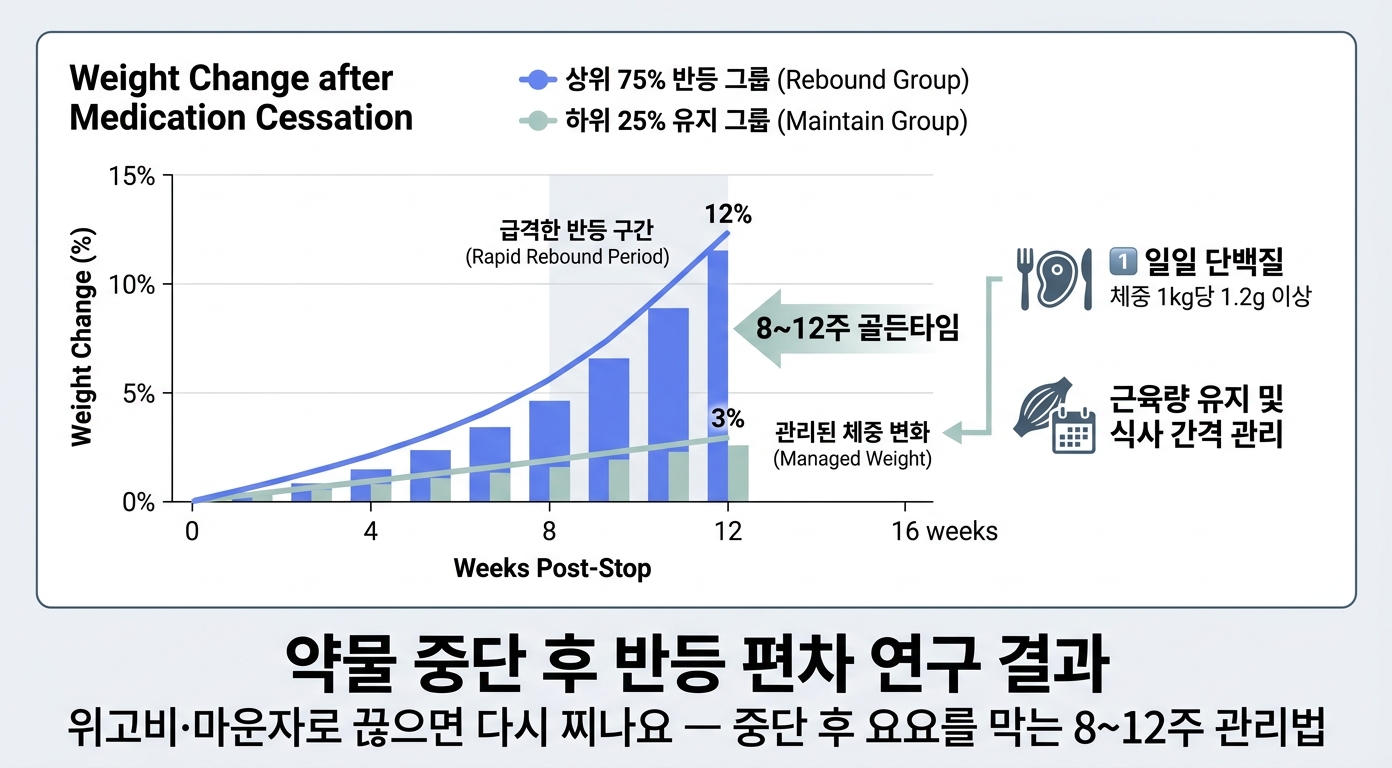
However, how much returns depends on the 8-12 weeks before and after discontinuation. If you secure adequate protein, muscle, and management intervals during this period, the extent of weight rebound changes.
When to stop the injection should be decided in consultation with your prescribing physician. This article covers what to prepare after deciding to stop.
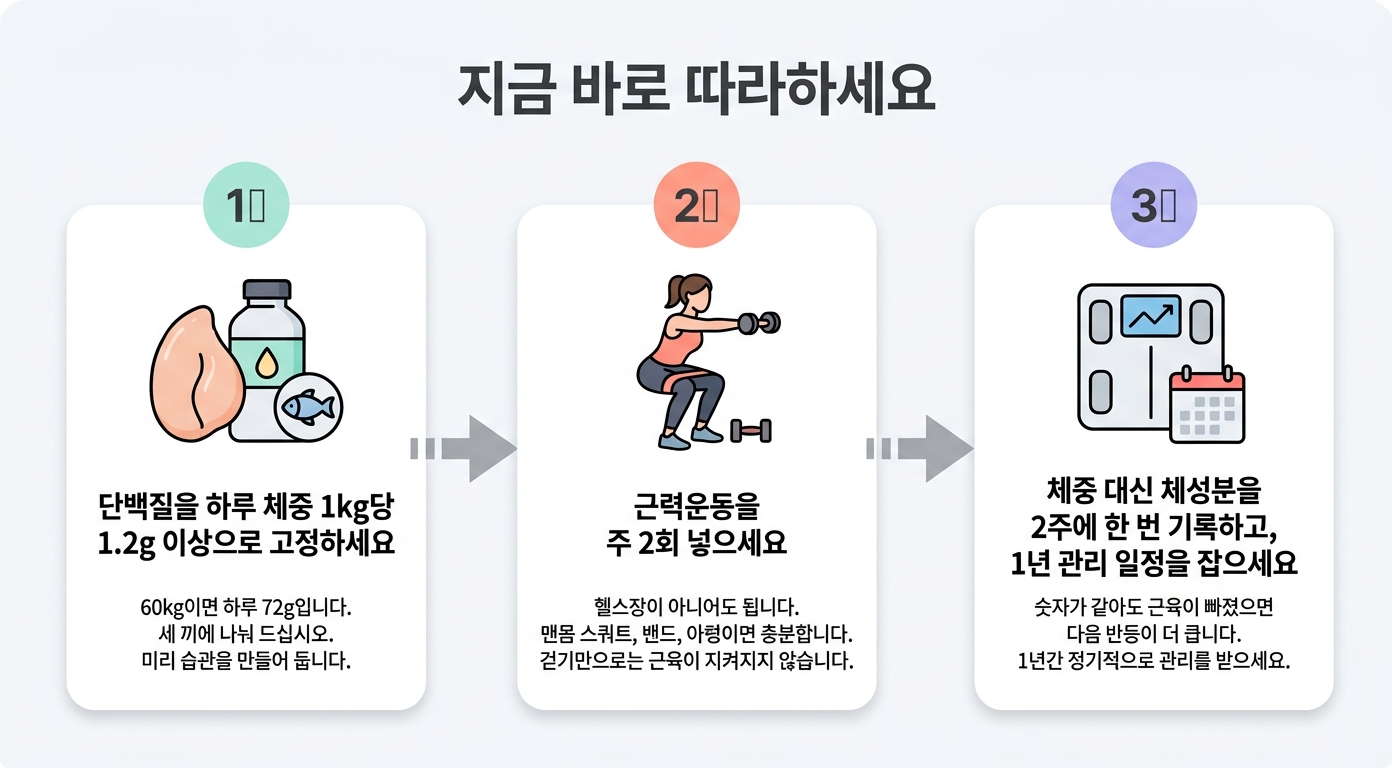 ✅ Action | Immediate Implementation — What to Prepare Before Stopping the Medication?Start from 4 weeks before discontinuation. If you've already stopped, you can begin now.
1️⃣ Fix protein intake at 1.2g or more per kilogram of body weight daily
If you weigh 60kg, that's 72g per day. Distribute it across three meals[4]. Consuming it all at once wastes absorption. While receiving injections, loss of appetite makes it difficult to meet this amount. Therefore, build the habit in advance.
2️⃣ Include resistance training twice per week
You don't need a gym. Bodyweight squats, bands, and dumbbells are sufficient[4]. Walking alone won't preserve muscle.
3️⃣ Record body composition instead of weight every two weeks, and schedule a 1-year management plan
Even with the same number on the scale, if muscle is lost, the next rebound will be larger. The Obesity Korean Medicine Standard Clinical Practice Guideline also recommends regular medical institution management for 1 year after weight loss[5].
If these three are overwhelming, start with number 1 first. If it's difficult to manage alone, you may want to first read an article explaining why a 12-week detox diet is not the end.
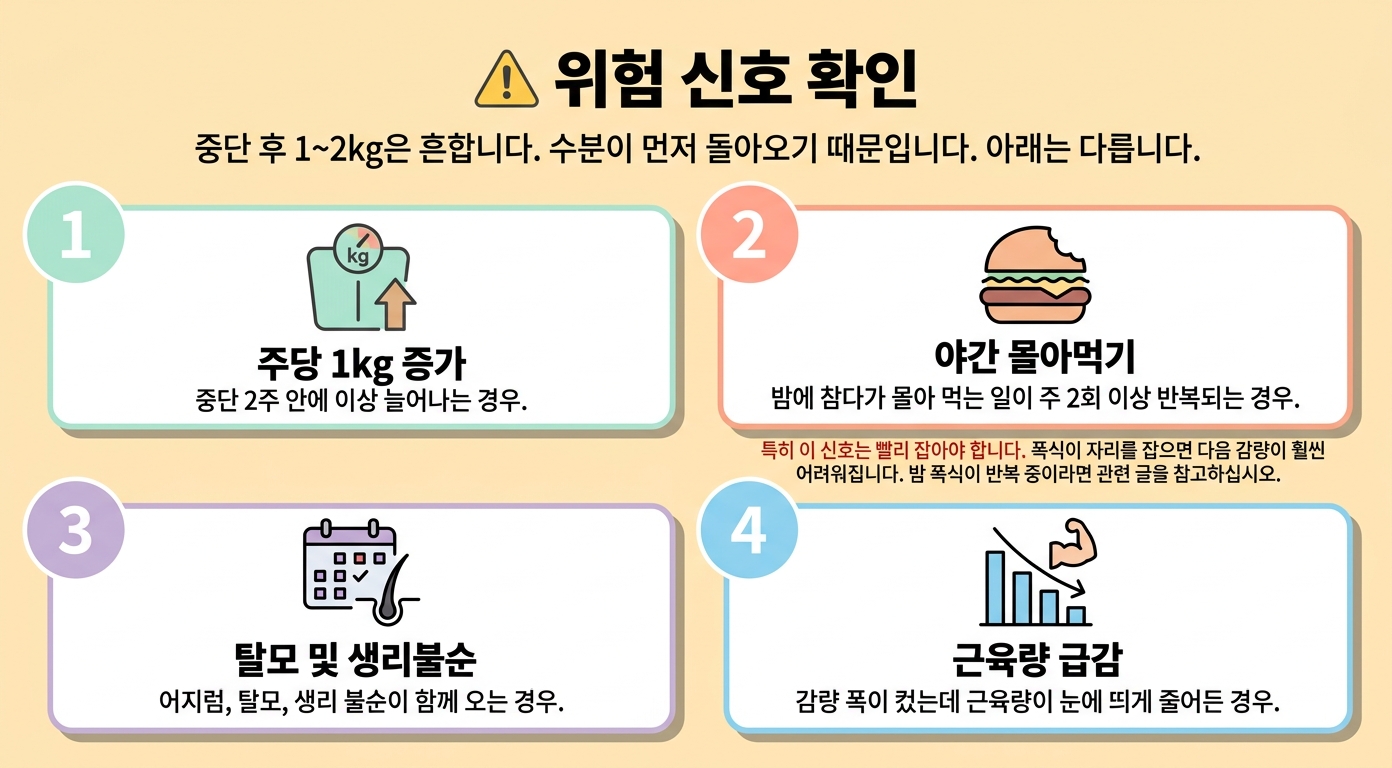 🚨 Warning | Critical Warning Signs to Check — What Type of Weight Regain Is Dangerous?
1-2kg weight gain after stopping is common. Water returns first. The following is different.
✔ If weight increases by 1kg or more per week within 2 weeks of stopping, it means fat is accumulating, not just water. If this pace continues for four months, most of the lost weight will disappear.
✔ If binge eating at night happens 2 or more times per week, once binge eating becomes established, the next weight loss becomes much more difficult. This is the signal to catch most quickly.
✔ If dizziness, hair loss, and irregular menstruation occur together, it's not just weight loss—nutrition and hormones are destabilized. Weight loss is not the right direction at this point.
✔ If muscle mass decreases noticeably despite significant weight loss, the next rebound will be larger even at the same weight. Without body composition records, you'll miss this signal.
If night binge eating is already repeating, refer to an article addressing the connection between stress and binge eating.
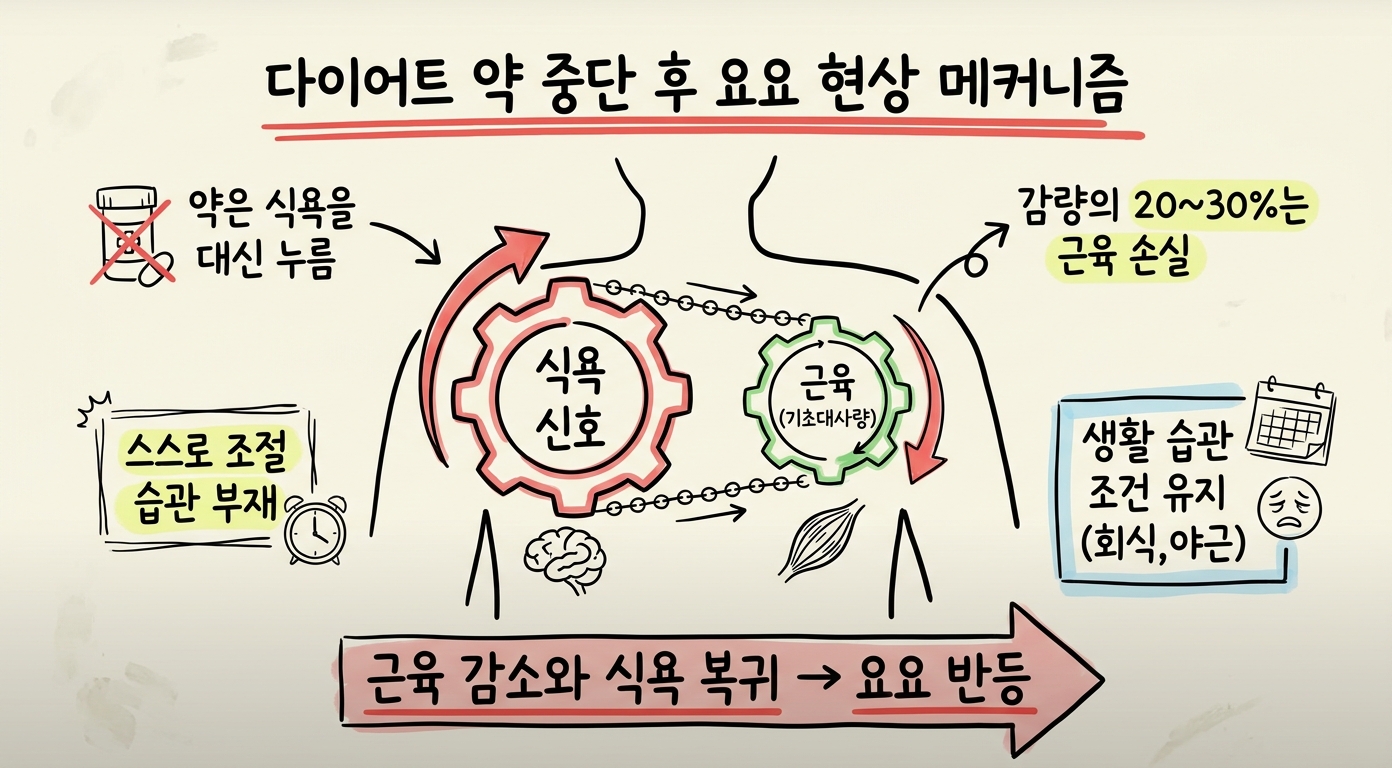 🧠 The Why | Root Cause Analysis — Why Does Appetite Return Fully When You Stop the Medication?
The medication suppressed appetite signals on your behalf. Your body has never learned to regulate itself. Therefore, when the medication stops, the signal returns to its original intensity.
Two additional factors overlap here.
One is muscle. The faster weight drops, the more it's not just fat. Reports show that 20-30% of weight loss comes from lean mass[3]. When muscle decreases, daily energy expenditure decreases. Original appetite with reduced consumption. This combination creates rebound.
The other is the condition that first led to receiving this injection.
Three business dinners per week, leaving work at 11 PM, shift work, personal time only after putting children to bed. In clinical practice, the stories are mostly similar. The medication was simply a lid covering these conditions. When you remove the lid, what was underneath rises back up.
That's why in discontinuation counseling, I ask about daily routine before asking about weight. Understanding how evening hours flow after stopping determines what needs to change. The cycle of trying to solve it through fasting but ending up eating more is explained in detail in a previous column. If you want to explore more deeply how emotions and appetite intertwine, the intersection of emotional eating and Sasang constitutional theory is recommended.
 📊 Proof | Cases and Evidence — How Much Actually Returns?
The numbers are clear. In tirzepatide (Mounjaro) clinical trials, patients who lost weight over 36 weeks and then stopped the medication regained an average of 14% in the following year[1]. Those who continued the injection lost an additional 6.7%.
Semaglutide (Wegovy) shows similar results.
Patients who lost an average of 17.3% over 68 weeks regained approximately two-thirds of their weight loss one year after stopping[2]. Blood pressure and blood sugar indicators also returned.
What's important here is not the average but the variation.
Among 308 placebo-group patients who had lost 10% or more, 82% regained at least one-quarter of their lost weight.
Yet within that group, 74 people regained 75% or more, while 54 regained less than 25%[1]. Same medication, same discontinuation, different results.
One more thing to add. In this study, people who stopped the medication continued to receive diet and exercise management. Yet the average still increased.
This means weight rebound doesn't disappear with management alone.
What I'm telling you is not a promise to eliminate rebound, but rather that which range you fall into hasn't been determined yet.
Korean medicine evidence is also established. The Obesity Korean Medicine Standard Clinical Practice Guideline presents herbal medicine treatment as **Recommendation Level A (High Evidence Level)**[5]. This is based on double-blind placebo studies that matched the herbal formulas' color, taste, and aroma. For individual prescriptions, Ui-Yi-In-Tang is Level A, and Tae-Eum-Jo-Ui-Tang, Bangpung-Tongseong-San, and Ephedra-modified formulas are Level B.
However, I'll add honestly. Studies combining herbal medicine and lifestyle management are Level C (Low). Blinding is difficult in this design, carrying high bias risk. In international meta-analyses, the BMI reduction from Bangpung-Tongseong-San was also not substantial[6]. This doesn't mean herbal medicine is a panacea—I'm speaking only to what's confirmed.
Let me share one clinic case. A woman in her late 30s, a working professional, came to me after stopping Wegovy after 6 months.
Five kilograms had returned within two months.
I asked about her evening routine before the scale number. Late nights ending at 10:30 PM after overtime—that was her only relaxation time.
Instead of tightening her diet, I moved evening protein earlier and combined body composition checks at 2-week intervals with constitution-matched herbal medicine.
After 12 weeks, her weight dropped about 2kg, but I found greater meaning in her maintained muscle mass.
She didn't become stricter. Her body simply responded differently when the conditions of her evening routine changed.
 🔚 Closing | Summary and Encouragement
Stopping the medication is not failure. It's time for your body to learn self-regulation.
To summarize, there are three things: meeting your protein needs, preserving muscle, and not going it alone.
Guidelines also recommend 1 year or longer of diet, exercise, and behavioral management combined after weight loss[5]. This is why 12 weeks is not the end.
If you'd like a consultation that can address both your constitution and current state together, please contact us anytime. You may also want to first check the overall flow at Dongjjedang Detox and Diet Program Information.
✍️ Reviewed by Dr. Choi Jang-hyuk, Director of Dongjjedang Korean Medicine Clinic · Obesity and detox treatment based on Sasang constitutional medicine Final review: 2026-07-29
❓ FAQ
Q. Can I start herbal medicine right after stopping Wegovy?
Yes, it's possible. However, you must receive a consultation first. The Obesity Korean Medicine Standard Clinical Practice Guideline separately addresses the safety of prescriptions containing ephedra when dosage is adjusted by a Korean medicine doctor[5]. This differs from taking commercial products on your own.
Q. How many weeks before stopping the diet injection should I start preparing?
4 weeks before discontinuation is recommended. During injections, loss of appetite makes it difficult to meet protein needs. Even if you've already stopped, it's not too late.
Q. I used Saxenda and stopped it, but is it too late to manage it now?
It's not too late. Saxenda prescriptions decreased significantly after Wegovy and Mounjaro became available, but many people still experience rebound after stopping. Regardless of which medication you used, the approach is the same. Instead of fasting again, start by looking at muscle mass and daily rhythm.
Q. I've already experienced rebound. Is it too late now?
No. More people come after rebound has already occurred. However, the approach differs. Instead of fasting again, we first confirm muscle mass and daily rhythm.
Q. What does it mean to focus on body composition rather than weight?
The same 60kg can have different composition. If muscle decreases and fat increases, the next rebound will be larger. That's why I recommend recording body composition every two weeks.
📚 References
[Western Medicine (WM)]
- [1] Aronne LJ, et al. Continued Treatment With Tirzepatide for Maintenance of Weight Reduction in Adults With Obesity: The SURMOUNT-4 Randomized Clinical Trial. JAMA. 2024;331(1):38-48 (PMID: 38078870) · Analysis by rebound range: Horn DB, et al. Cardiometabolic Parameter Change by Weight Regain on Tirzepatide Withdrawal. JAMA Intern Med
- [2] Wilding JPH, et al. Weight regain and cardiometabolic effects after withdrawal of semaglutide: The STEP 1 trial extension. Diabetes Obes Metab. 2022;24(8):1553-1564 (PMID: 35441470)
- [3] The Influence of GLP-1 Receptor Agonists and Other Incretin Hormone Agonists on Body Composition
- [4] Optimizing GLP-1 therapies for obesity and diabetes management — Recommendation for protein 1.2g/kg or more and concurrent resistance training
[Korean Medicine (KM)]
- [5] Korean Institute of Oriental Medicine. Obesity Korean Medicine Standard Clinical Practice Guideline (National Korean Medicine Clinical Information Portal NCKM)
- [6] Japanese traditional Kampo medicine bofutsushosan (防風通聖散, Bangpung-Tongseong-San) improves body mass index in participants with obesity: systematic review and meta-analysis. PLOS One. 2022
Related Program
Diet
Will Weight Return After Stopping Wegovy or Mounjaro? — 8-12 Week Management Strategy to Prevent Rebound After Discontinuation
View Program